St. Bernward of Hildesheim
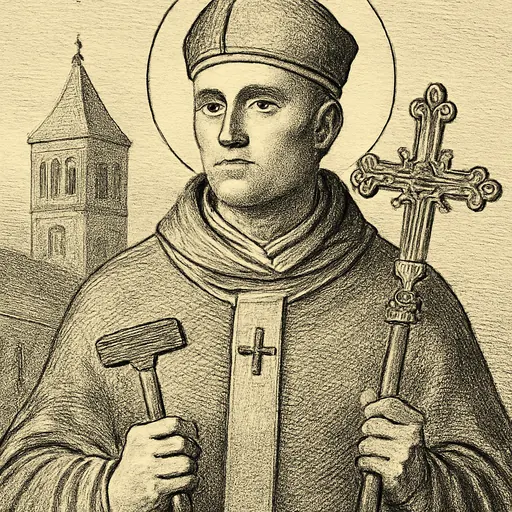
St. Bernward of Hildesheim (about 960–1022) was a Saxon noble, tutor to the young Emperor Otto III and bishop of Hildesheim from 993. A gifted artist, he commissioned the bronze Bernward Doors and Column and built St. Michael's Church, where he is buried. Pope Celestine III canonized him in 1193. We keep his feast on November 20.
Who was St. Bernward of Hildesheim?
St. Bernward of Hildesheim was a Saxon bishop of the Ottonian age who prayed, governed and worked with his own hands. He tutored the boy emperor Otto III, ruled the diocese of Hildesheim for nearly thirty years, and filled his cathedral city with bronze, gold and stone made for the glory of God. His bronze doors and bronze column are still among the great works of medieval art. We keep his feast on November 20.
The emperor's tutor
Bernward was born about 960 into a noble Saxon family. The 1907 Catholic Encyclopedia names his grandfather as Athelbero, Count Palatine of Saxony. He lost his parents young, and his uncle Volkmar, bishop of Utrecht, put him in the care of Thangmar, a learned priest who ran the cathedral school of Hildesheim and later wrote Bernward's life.
Under Thangmar he learned the liberal arts, mathematics, painting and architecture, and also the "mechanical arts," especially work in gold and silver. He finished his studies at Mainz, where Archbishop Willigis ordained him a priest. Rather than take a rich post, he stayed to care for his aged grandfather. After the old count died in 987, Bernward went to the imperial court as a chaplain, and the Empress-Regent Theophano made him tutor to her six-year-old son, Otto III. The Catholic Encyclopedia gives him much of the credit for Otto's learning and piety.

Bishop of Hildesheim
In 993 Bernward was elected bishop of Hildesheim. His biographer describes him going from the cathedral altar to the workshops of the cathedral school and working the metal himself. He built churches and fortified his city with walls and towers against Viking raids.
His long quarrel with Archbishop Willigis of Mainz over the convent of Gandersheim shows another side of him. Willigis claimed the abbey for his own diocese, and the nuns, led by Otto's sister Sophia, took the archbishop's part. Bernward set out for Rome in November 1000, crossed the Alps in winter, and arrived on January 4, 1001. Otto III came out to meet him and lodged him in his palace. Pope Sylvester II and a Roman synod upheld the rights of the bishop of Hildesheim. Our account of these years comes from Thangmar, who was Bernward's own priest and, as Baring-Gould says plainly, gives only his master's side.
Bronze for the glory of God
The works that bear Bernward's name are the reason most visitors know him.
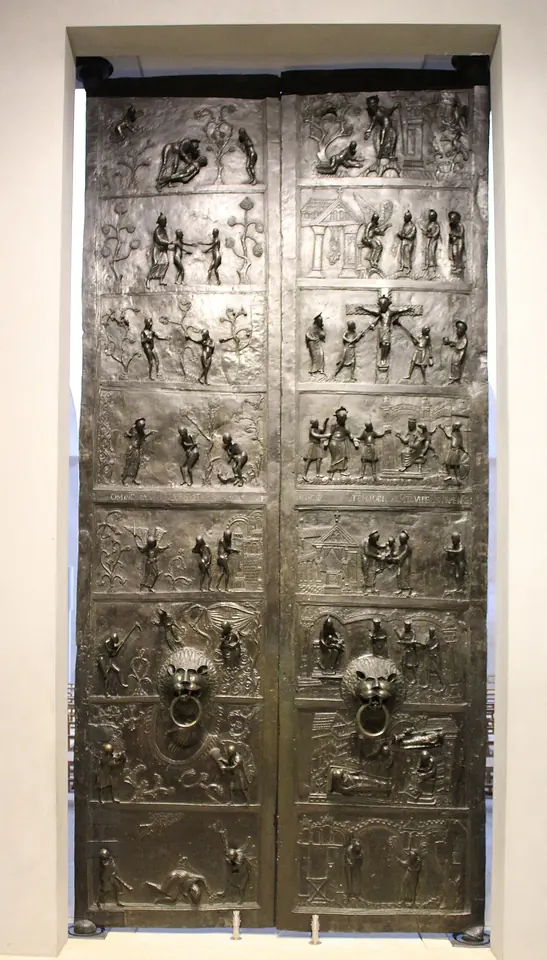
- The Bernward Doors (1015): two great bronze wings, about sixteen feet high by Baring-Gould's measure. On one side are scenes from Genesis, from Creation to the death of Abel; on the other, the life of Christ from the Annunciation to the Resurrection. Baring-Gould calls their subject "the First and Second Adam."
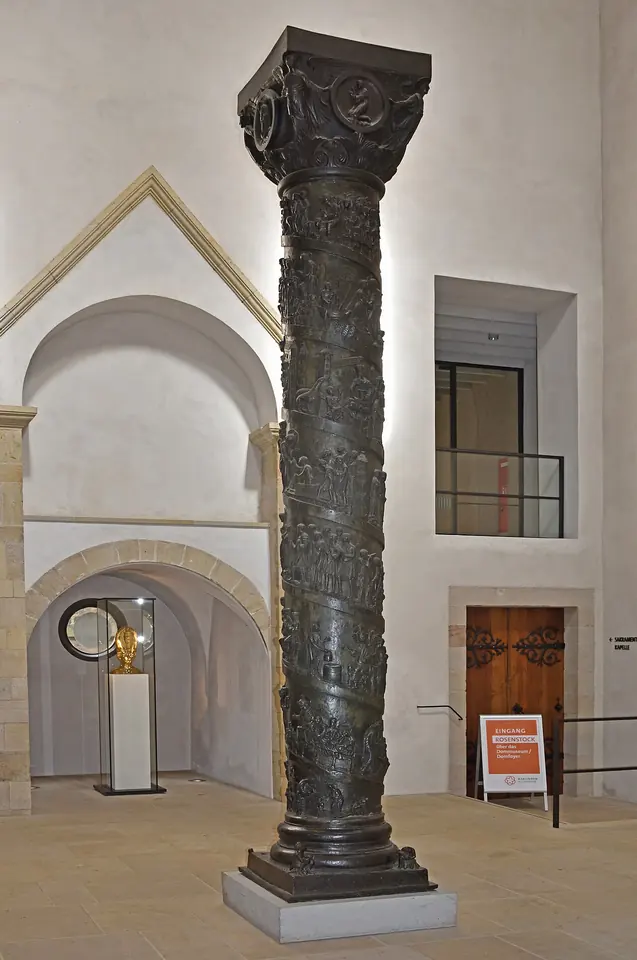
- The Bernward Column: a bronze column about fourteen feet high, with scenes of Our Lord's life winding up it like a scroll, after the manner of Trajan's Column in Rome.
- The Bernward Cross and candlesticks: a jeweled cross and a pair of silver candlesticks, the candlesticks found in his grave when his body was raised in 1194.
He also commissioned illuminated books. Baring-Gould quotes the dedication in one of his Gospel books, written in his own hand: "I Bernward had this codex written out, at my own cost, and gave it to the beloved saint of God, Michael."

St. Michael's Church and his death
His greatest building was the abbey church of St. Michael on a hill above Hildesheim, built between 1010 and 1020 on a symmetrical plan with two apses. UNESCO lists it, with the cathedral and its treasures, as a World Heritage Site. The church passed to the Protestants at the Reformation.
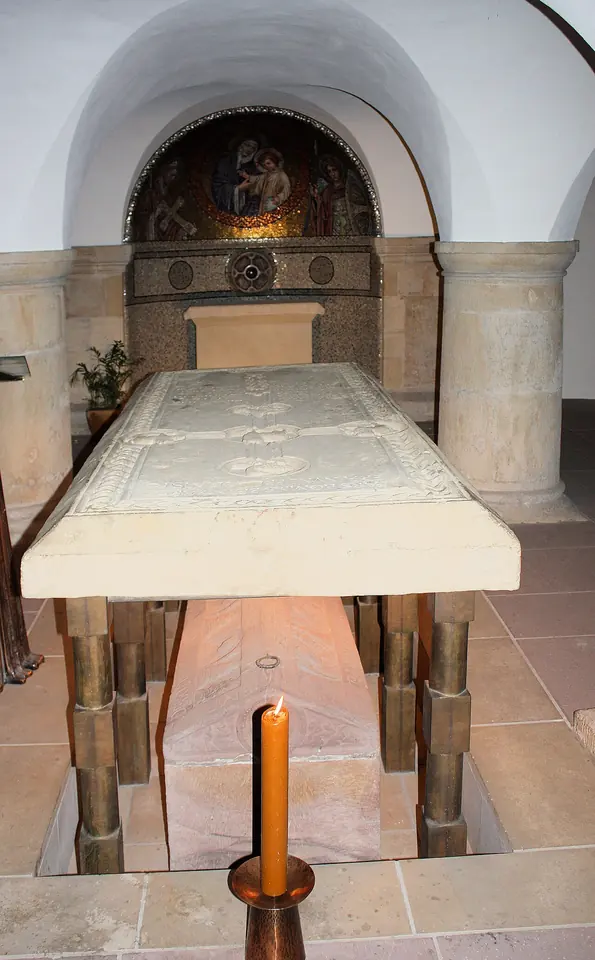
A man of prayer and penance, he asked to be clothed in the Benedictine habit shortly before he died. He died on November 20, 1022, and was laid to rest in the western crypt of St. Michael's. Pope Celestine III canonized him in 1193. The old lives record no particular miracles; his holiness was remembered in his care for his people and in his work.
Symbols of St. Bernward in art
Bernward is shown as a bishop, and German art usually gives him a sign of his craft. Look for:
- Bishop's vestments, miter and crozier: his office in Hildesheim.
- A hammer or goldsmith's tools: his skill in metalwork.
- A chalice or jeweled cross: the altar vessels he made, and the Bernward Cross.
- A model of St. Michael's Church: the church he founded and where he lies.
The Stammheim Missal page above, painted about 150 years after his death, shows him in his church receiving a cross from an angel.
Feast day and prayer
We keep the feast of St. Bernward of Hildesheim on November 20, the day he died. See the feast day calendar for the other saints of the day.
We know of no traditional prayer to St. Bernward in common English use. Let us ask him to pray for bishops and teachers, and for all who make beautiful things for the worship of God: St. Bernward of Hildesheim, pray for us.
Frequently asked questions
What is St. Bernward of Hildesheim known for?
For the art he made and commissioned as bishop of Hildesheim, above all the bronze doors with scenes from Genesis and the life of Christ, the bronze column with a spiral of Gospel scenes, the jeweled Bernward Cross and the church of St. Michael. The church and the cathedral treasures are a UNESCO World Heritage Site.
When is the feast of St. Bernward?
November 20, the day he died in 1022.
Who canonized St. Bernward?
Pope Celestine III, in 1193. His body was raised from the tomb the following year.
Was Bernward the teacher of Emperor Otto III?
Yes. The Empress Theophano made him tutor to her son Otto III when the boy was about six, and they stayed close friends; Otto welcomed him as a guest in his palace in Rome in 1001.
Keep exploring
Sources
- Catholic Encyclopedia (1907): St. Bernward. His family and education, tutor to Otto III, the bronze works, the Benedictine habit, canonization in 1193, feast and burial
- S. Baring-Gould, The Lives of the Saints, vol. 14 (November), 1914: S. Bernward, B. of Hildesheim. Thankmar as his teacher and biographer, the Gandersheim dispute, the journey to Rome of 1000–1001, the inscription in his Gospel book
- UNESCO World Heritage List: St Mary's Cathedral and St Michael's Church at Hildesheim