St. Felicitas of Rome, Martyr and Mother of Seven Sons
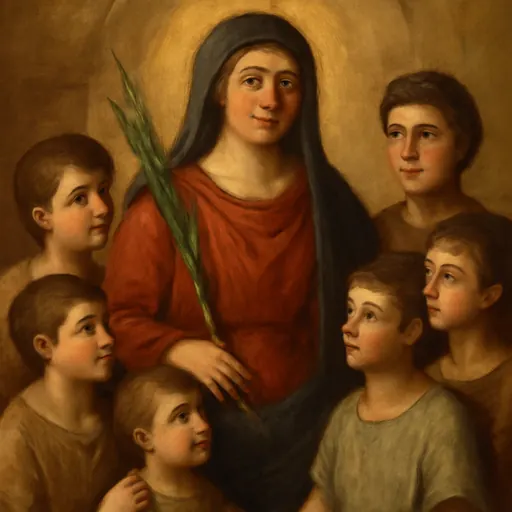
St. Felicitas of Rome was a Christian widow martyred in the second century and buried in the catacomb of Maximus. Ancient Roman tradition honors her as the mother of seven martyred sons, and St. Gregory the Great preached at her tomb. Her feast is November 23, and she is invoked by mothers and by parents who have lost a child.
Who was St. Felicitas of Rome?
St. Felicitas of Rome was a Christian widow who gave her life for Christ in Rome in the second century. Her tomb was in the catacomb of Maximus on the Via Salaria, and the Roman Church kept her feast there on November 23 from very early times. An old and beloved tradition says she was the mother of seven sons who were martyred before her eyes, and that she encouraged each of them to stay faithful before she died herself.
She is a different woman from St. Felicity of Carthage, the young mother who died with St. Perpetua in North Africa in 203. The two are often mixed up because they share a name and both are honored as martyrs and mothers.
What we know and what the legend tells
The history
The oldest Roman list of martyrs' feasts, the Depositio Martyrum from the middle of the fourth century, names seven martyrs honored on July 10: Felix and Philip, Martial, Vitalis and Alexander, Silanus and Januarius. They were buried in four different catacombs. One of them, Silanus, lay in the catacomb of Maximus, right beside Felicitas.
Felicitas herself is not in that fourth-century calendar. Her own feast first appears in the Martyrology of St. Jerome, on November 23. But her cult was strong. Pope St. Damasus (died 384), or a poet writing soon after him, praised her in a verse epitaph: "This woman feared not the sword, but perished with her sons." St. Peter Chrysologus preached about her in the fifth century. And on her feast day, St. Gregory the Great preached his third homily on the Gospels in the basilica built over her tomb.
The Catholic Encyclopedia concludes that it is historically certain Felicitas was a martyr and that ancient Roman tradition remembered her dying with her sons. Because the tomb of Januarius dates to the late second century, the martyrdoms probably happened under Marcus Aurelius.
The Acts of Felicitas and her seven sons
The story most people know comes from the Acts of the martyrs, which existed by the sixth century. Scholars now date them no earlier than that, and the Catholic Encyclopedia thinks they likely joined Felicitas to the seven martyrs of July 10 because Silanus was buried next to her. We tell it here as traditional.
The Acts say Felicitas was a noble Roman widow who spent her days in prayer and works of mercy. Her example drew so many to Christ that pagan priests complained to the emperor, and she and her sons were brought before Publius, the prefect of Rome. Butler's translation gives her answer:
Do not think to frighten me by threats, or to win me by fair speeches. The spirit of God within me will not suffer me to be overcome by Satan, and will make me victorious over all your assaults.

The next day, as the prefect urged her to pity her children, she turned to them and said: "My sons, look up to heaven where Jesus Christ with his saints expects you. Be faithful in his love, and fight courageously for your souls." Each son refused to sacrifice. The emperor divided them among four judges, which matches the four places where they were buried. Felicitas, the Acts say, was put to death last.
St. Gregory the Great on St. Felicitas
Gregory's homily, preached at her tomb, gave the Church its most quoted words about her. In Butler's English, he said she "was as much afraid of leaving them behind her on earth, as other mothers are of surviving theirs," and that she "was in some sort a martyr in each of them." Seeing her sons in torment, he said, she felt their pain as their mother "but rejoicing for them in her heart by hope."
Gregory turned the story on his listeners. If one sharp word can shake us, what do we learn from a mother whom death itself could not move?
Why St. Felicitas is the patron saint of mothers and grieving parents
Mothers have looked to Felicitas for centuries because her whole witness was a mother's witness. She raised her sons in the faith and stood beside them to the end. The church of Santa Susanna in Rome, which keeps her relics, names her patron of parents who have lost a child in death. A father or mother who has buried a child can bring that grief to her. She knows it.
Symbols of St. Felicitas of Rome in art
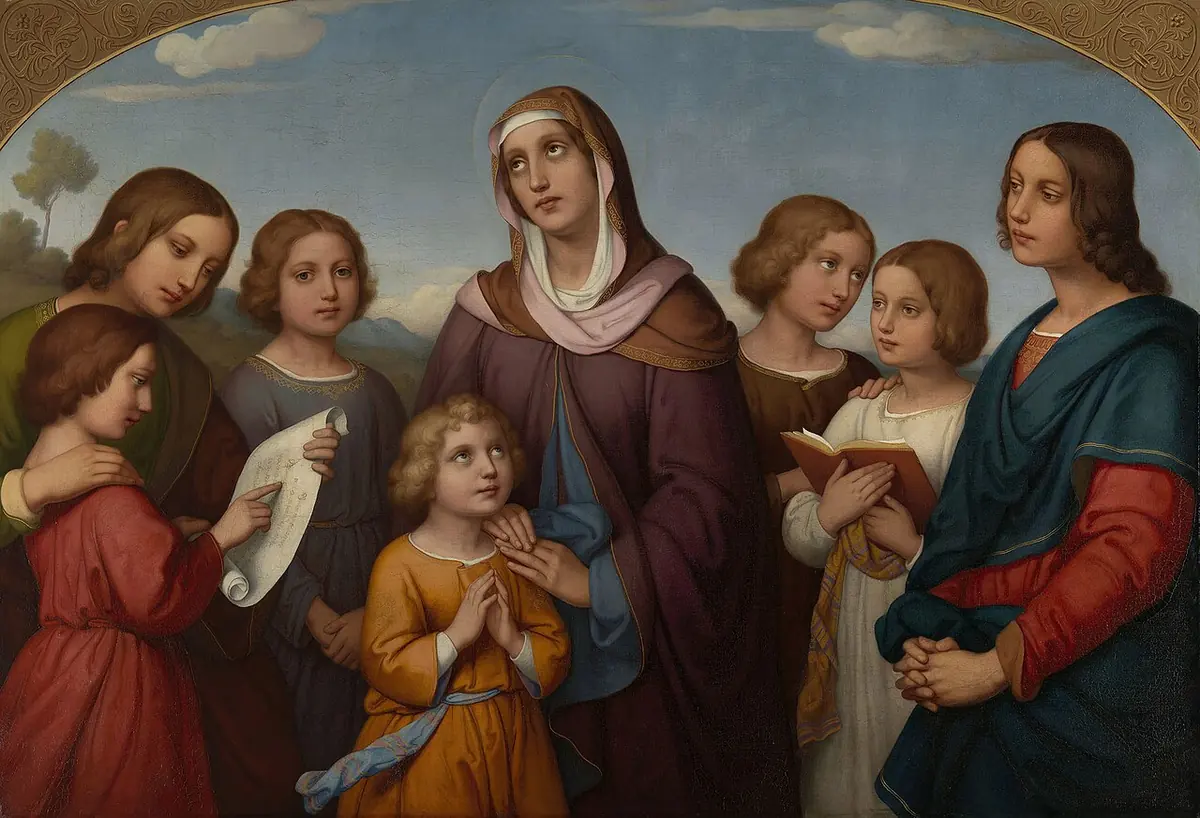
- Seven sons around her, the clearest sign. In Marie Ellenrieder's painting above they press close to her; in Neri di Bicci's altarpiece in Florence they stand in two rows beside her throne.
- A martyr's palm and sometimes a sword, the instrument of her death.
- A widow's veil and mantle.
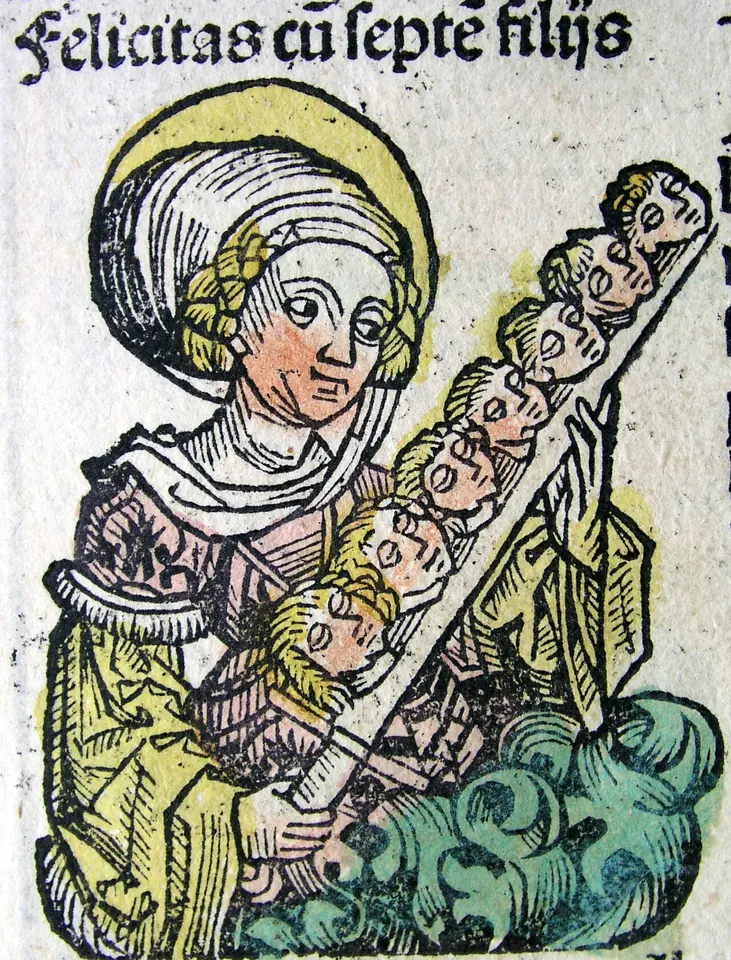
- Seven small heads on a sword or a platter, a blunt medieval way of showing her sons' martyrdom, as in the woodcut from the Nuremberg Chronicle on this page.
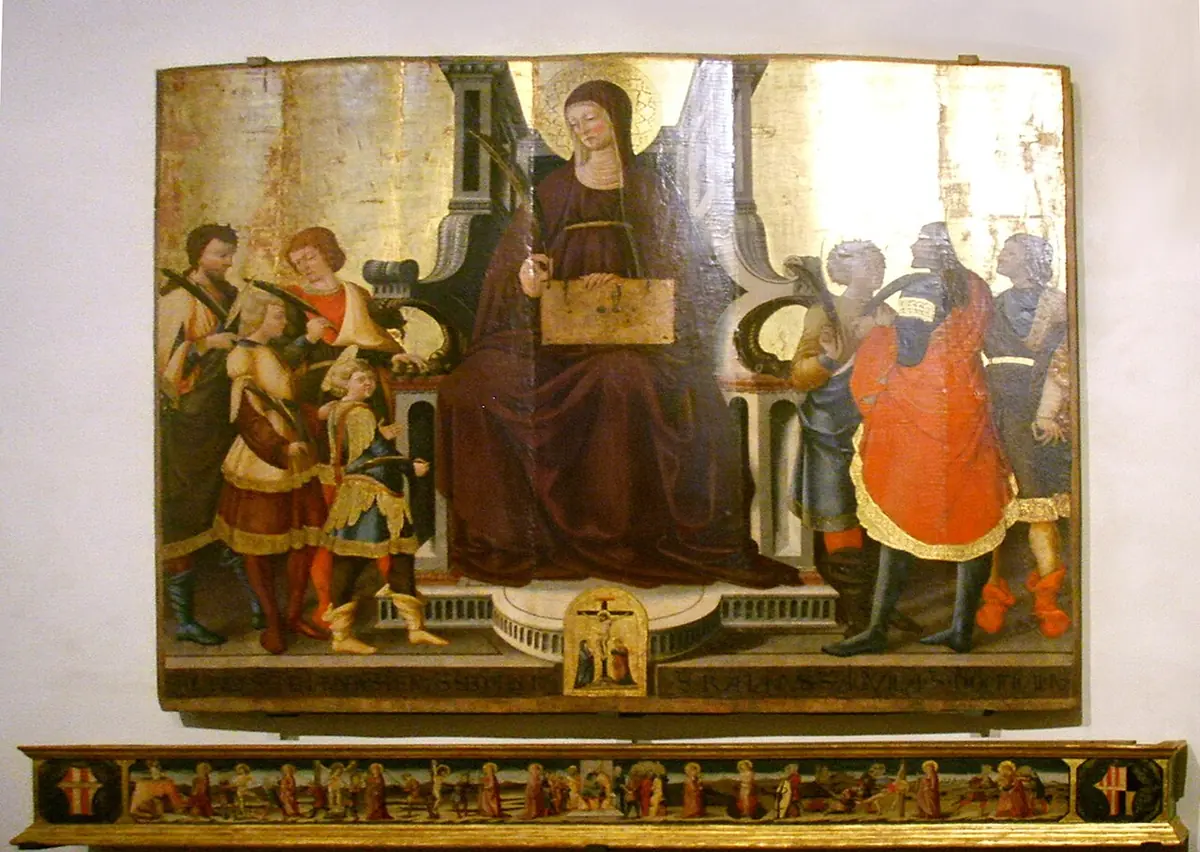
The Florentine church of Santa Felicita, one of the oldest in the city, is dedicated to her. Don't confuse her images with those of St. Felicity of Carthage, who is usually shown with St. Perpetua, sometimes with a child.
Where St. Felicitas of Rome is honored
Her crypt in the catacomb of Maximus was enlarged into an underground chapel, lost for centuries and found again in 1885. On its back wall a seventh-century fresco still shows Felicitas with her seven sons, with Christ above holding out the crown of glory. A faded painting of the same group survived in a medieval chapel near the Baths of Titus.

According to the history kept by the church of Santa Susanna, Pope St. Leo III, who had been its titular priest, brought her body there from the catacomb sometime after 800. Tradition holds she rests in its crypt with her son Vitalis.
See our feast days calendar for other saints of November, and our list of patron saints.
Prayer to St. Felicitas of Rome
We know of no traditional prayer to St. Felicitas in common use. Let us ask her, in our own words, for faithful hearts in our families, for courage for parents who suffer for their children, and for comfort for every mother and father who mourns a child. St. Felicitas, pray for us.
Frequently asked questions
When is the feast of St. Felicitas of Rome?
November 23 in the Roman Martyrology. The seven martyrs whom tradition calls her sons are honored on July 10, the date of the old feast of the Seven Holy Brothers.
Is St. Felicitas of Rome the same as St. Felicity with St. Perpetua?
No. St. Felicity of Carthage was a young slave woman martyred with St. Perpetua in North Africa in 203, and their feast is March 7. St. Felicitas of Rome was a Roman widow honored with seven sons, with her feast on November 23.
Were the seven brothers really her sons?
We can't be sure. The fourth-century Roman calendar lists the seven martyrs of July 10 without calling them brothers, and the Acts that name Felicitas as their mother date from the sixth century. The Catholic Encyclopedia judges it historically certain that she and the seven were martyrs, and that she died with sons, but the details of the Acts are legend.
What is St. Felicitas of Rome the patron saint of?
She is honored as a model for mothers and invoked by parents who have lost a child, the patronage named by the church of Santa Susanna in Rome, where her relics are kept.
Keep exploring
- Patron saint pages
- Mothers
- Feast-day calendar
- Saints remembered in NovemberSaint of the dayWhat saint is my birthday?
- Relics
- Where the relics are kept (map)
- More
- Saints A to ZPatron saints A to ZExplore every section
Sources
- Catholic Encyclopedia (1909): St. Felicitas. The Depositio Martyrum list, the dating of the Acts, the crypt rediscovered in 1885 and its seventh-century fresco, and the Damasus epitaph
- Alban Butler, Lives of the Saints, vol. VII (1866): The Seven Brothers, Martyrs, and St. Felicitas, Their Mother. The text of the Acts and St. Gregory the Great's homily
- Santa Susanna, Rome: Five Saints are buried at Santa Susanna (archived church website). The translation of her body by Pope Leo III and her patronage of bereaved parents