St. Sylvester Gozzolini, Founder of the Sylvestrine Benedictines
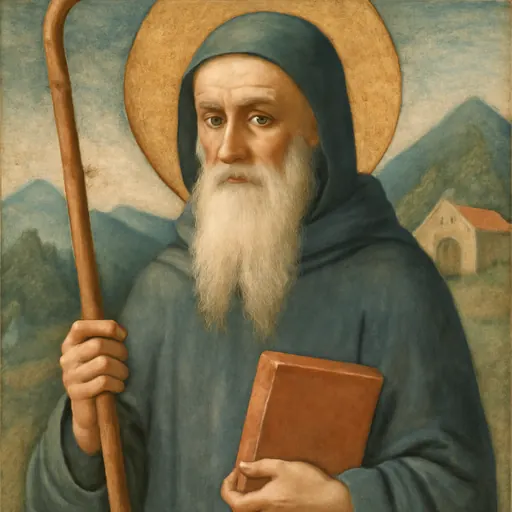
St. Sylvester Gozzolini (1177–1267) was a canon of Osimo, in central Italy, who left everything to become a hermit after gazing into the open grave of a man once famous for his good looks. His disciples became the Sylvestrine Benedictines, founded on Monte Fano near Fabriano in 1231. His feast is November 26.
Who was St. Sylvester Gozzolini?
St. Sylvester Gozzolini was an Italian priest who, at about fifty years of age, looked into an open grave and walked away from the world. Born at Osimo in the Marche in 1177, he became a canon of his home city's cathedral, then a hermit in the mountains, and finally the founder of the Sylvestrines, a congregation of Benedictine monks that still lives today. He died on Monte Fano, near Fabriano, on November 26, 1267, at the age of ninety.
He is one of those saints whose conversion story preaches by itself. Every Christian who has stood at a graveside and wondered what really matters is standing where Sylvester stood.
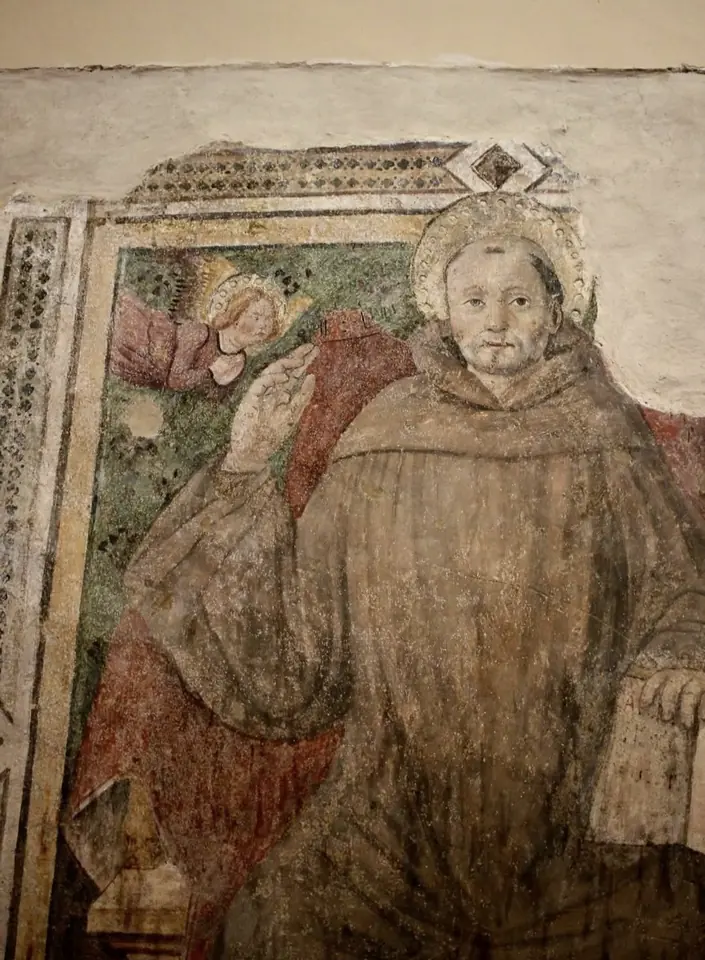
The life of St. Sylvester Gozzolini
Law, theology and a father's anger
Sylvester came from the noble Gozzolini family of Osimo. He was sent to study law at Bologna and Padua, but he felt called to the priesthood and turned instead to theology and Holy Scripture, spending long hours every day in prayer. The Catholic Encyclopedia relays the tradition that his father, angry at this change of plan, refused to speak to him for ten years.
He became a canon of Osimo and gave himself to pastoral work with great zeal. He was bold, too. When his bishop's irregular life caused scandal, Sylvester respectfully rebuked him, and the bishop threatened to take away his canonry.
The open grave
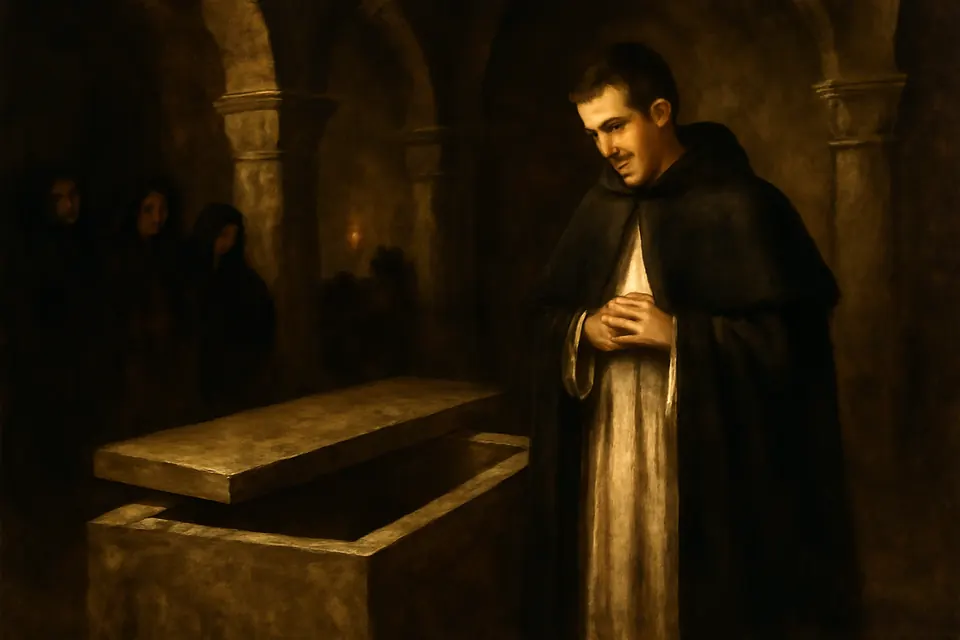
The turning point came at a funeral. Sylvester looked into the open tomb of a man who had been admired for his great beauty and saw what death had done to him. The sight decided him. In 1227 he left Osimo and went to live alone in a deserted place about thirty miles away.
The Church never forgot that moment. The old Collect for his Mass, prayed on his feast for centuries, begins with it.
Hermit and founder
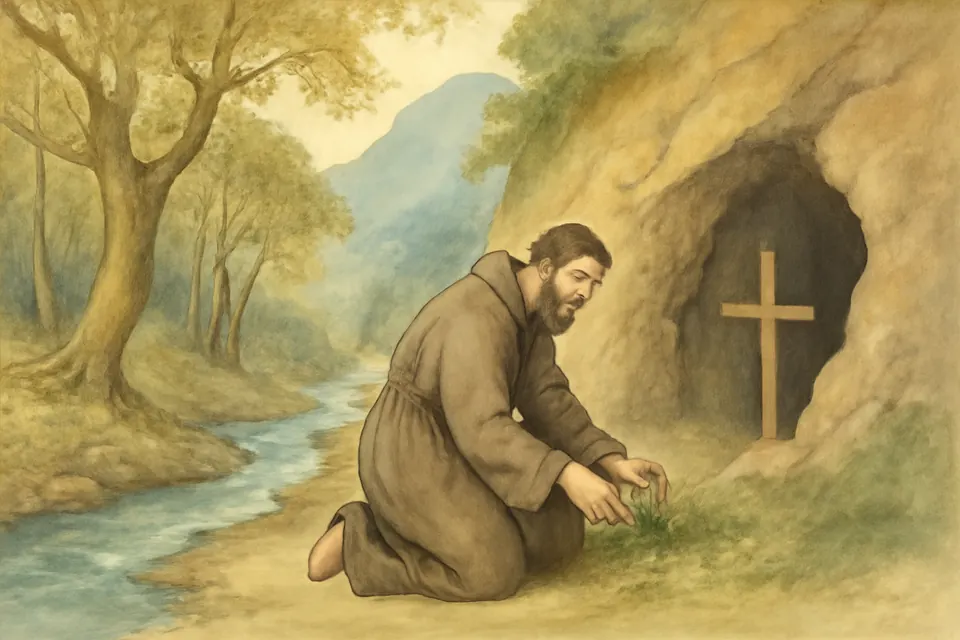
At first he lived in deep poverty on land belonging to a nobleman named Conrad, who recognized him and offered him a better site. The damp drove him on, and he settled at Grotta Fucile, a cave in a gorge, where he later built a monastery. There he lived on raw herbs and water and slept on the bare ground.
Disciples came looking for his guidance, and he needed a rule for them. A legend says that the founders of the great orders appeared to him in a vision, each asking him to take up his rule, and that he chose the Rule of St. Benedict. In 1231 he built his first monastery on Monte Fano, near Fabriano, where, like Benedict at Monte Cassino, he first had to clear away the remains of a pagan temple.
The Sylvestrines
Pope Innocent IV confirmed the new congregation at Lyons in 1247. The Sylvestrines kept the Rule of St. Benedict in its first strictness and went beyond it in poverty and fasting. When Sylvester died in 1267, eleven monasteries lived under his guidance. His monks wear a blue habit, which still sets them apart from other Benedictines.
The congregation stayed small and mostly Italian. Since 1568 it has had the church of Santo Stefano del Cacco in Rome, and in 1855 it began a mission in Ceylon, today Sri Lanka, centered on Kandy.
Miracles and veneration
Sylvester was venerated from the moment of his death. His body was placed in a shrine between 1275 and 1285 and is still honored in the church of Monte Fano. Pope Clement IV recognized the title of "Blessed" that the people already gave him, and in 1598 Pope Clement VIII had him entered in the Roman Martyrology as a saint. Leo XIII extended his Mass and Office to the whole Church.
The Catholic Encyclopedia points to Bolzonetti's book on Monte Fano (1906) for an account of his miracles but does not describe them, and we have not been able to check those accounts ourselves. The stories of healings at his tomb are reported in the tradition of his order; the vision of the founders is a traditional legend.
Symbols of St. Sylvester Gozzolini in art
You will mostly find St. Sylvester in churches of the Marche and in Sylvestrine houses.
- Blue or dark Benedictine habit: the habit of his congregation.
- Abbot's staff: the founder and father of Monte Fano.
- Book: the Rule of St. Benedict he chose.
- Open grave or skull: the sight that converted him.
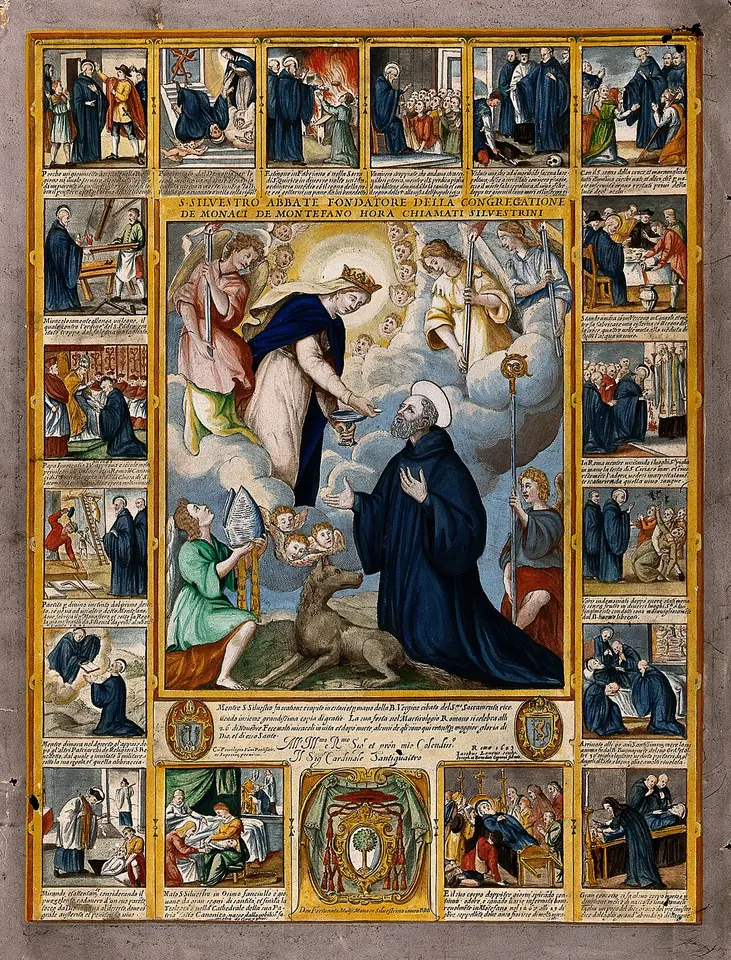
- Vision of the Virgin: Our Lady and angels appearing to him, as in the 1603 engraving below.
- Mountain or cave hermitage: Grotta Fucile and Monte Fano.
The 1603 print, published in Rome, surrounds his large central figure with small scenes of his life, a common way of telling a founder's story to his monks and their visitors.
Feast day and where he is honored
We keep the feast of St. Sylvester Gozzolini on November 26, the day he died. He is not to be confused with Pope St. Sylvester I, whose feast is December 31. His body rests at the hermitage of Monte Fano near Fabriano, still a Sylvestrine monastery. See more saints of the season on our feast days page.
Prayer to St. Sylvester Gozzolini
This is the Collect of his feast in the Roman Missal of 1962, in the English of the Divinum Officium edition:
Most merciful God, Who when the holy Abbot Sylvester was devoutly meditating upon the vanity of this world beside an open grave, graciously willed to call him into the desert and enrich him with unusual merits, we humbly pray that, following his example, despising the things of earth, we may thoroughly enjoy Your everlasting presence.
Let us ask St. Sylvester to pray for monks and hermits, for priests who must speak hard truths, and for everyone who stands at a grave and asks what life is for.
Frequently asked questions
Who was St. Sylvester Gozzolini?
An Italian priest of a noble Osimo family who studied law, became a canon of the cathedral, and at about fifty withdrew to live as a hermit. Disciples gathered, and he founded a strict congregation of Benedictine monks on Monte Fano, approved by Pope Innocent IV in 1247.
What is the story of St. Sylvester and the open grave?
At the funeral of a relative or acquaintance who had been known for great beauty, he looked into the open coffin and saw the decaying body. He asked himself what that man had been and what he himself would become, and he decided to leave the world. The old Collect of his Mass speaks of him 'meditating upon the vanity of this world beside an open grave.'
Who are the Sylvestrines?
A congregation of monks following the Rule of St. Benedict, founded by St. Sylvester in 1231. They wear a blue habit and have houses in Italy and, since 1855, in Sri Lanka.
When is St. Sylvester Gozzolini's feast day?
November 26, the day he died in 1267. Do not confuse him with Pope St. Sylvester I, whose feast is December 31.
Keep exploring
Sources
- Catholic Encyclopedia (1912): St. Sylvester Gozzolini. His studies, his father's ten years of silence, the rebuke to his bishop, the open grave, Grotta Fucile, the confirmation of 1247, his relics, his inscription in the Martyrology in 1598 and Leo XIII's extension of his feast
- Catholic Encyclopedia (1912): Sylvestrines. The founding on Monte Fano in 1231, the eleven monasteries at his death, the blue habit and the mission in Ceylon from 1855
- Roman Missal (1962), Collect for St. Sylvester, Abbot (November 26), Divinum Officium edition. Text of the Collect quoted on this page