Our Lady of Kibeho

Our Lady of Kibeho is the title under which the Church honors the Virgin Mary as she appeared at Kibeho, Rwanda, beginning on November 28, 1981, to three schoolgirls, Alphonsine Mumureke, Nathalie Mukamazimpaka and Marie Claire Mukangango. She called herself Nyina wa Jambo, Mother of the Word, called for repentance and prayer, and in August 1982 showed them a vision of bloodshed later read as a warning of the 1994 genocide. Bishop Augustin Misago approved the apparitions on June 29, 2001.
Who is Our Lady of Kibeho?
Our Lady of Kibeho is the title under which we honor the Blessed Virgin Mary as she appeared, beginning on November 28, 1981, to schoolgirls at Kibeho, a village on the green hills of southern Rwanda. She gave her name as Nyina wa Jambo, "Mother of the Word," which the visionaries understood to mean Mother of God. She asked for conversion and prayer, wept over a world that would not listen, and in August 1982 showed the girls a vision of slaughter that Rwandans would live through twelve years later.
After twenty years of study, the bishop of the diocese, Augustin Misago of Gikongoro, declared on June 29, 2001, that the Virgin Mary had truly appeared at Kibeho to three of the young people who claimed visions: Alphonsine Mumureke, Nathalie Mukamazimpaka and Marie Claire Mukangango. Few Marian apparitions of modern times have received a bishop's formal approval, and Kibeho is the best known of them in Africa.
The apparitions
Alphonsine: "I am the Mother of the Word"
Kibeho College was a Catholic boarding school for girls, far from any city. On November 28, 1981, Alphonsine Mumureke, sixteen, was in the school dining hall when, she said, she heard a voice "soft as air and sweeter than music." She saw a woman of great beauty, barefoot like the girls themselves, and asked who she was. The answer came: "I am the Mother of the Word."
Her friends ridiculed her, her teachers scolded her and her village shunned her. Alphonsine's apparitions went on for eight years. The last came on November 28, 1989, the anniversary of the first.

Nathalie and Marie Claire
On January 12, 1982, Nathalie Mukamazimpaka began to see the Virgin too, and on March 2, 1982, so did Marie Claire Mukangango. Marie Claire's visions lasted about six months and ended on September 15, 1982, the feast of Our Lady of Sorrows. Nathalie's continued until December 3, 1983.
Others came forward with visions in 1982 and 1983, including visions of Jesus. After study, Bishop Misago judged that "only the three initial testimonies merit being considered authentic." The others were left without approval.
What Our Lady asked
The messages were simple and searching. Our Lady asked for conversion and prayer from the heart, especially the Rosary. She spoke of humility and love of neighbor. "Repent, repent, repent! Convert while there is still time," she said to Marie Claire. The visionaries also said they were shown heaven, purgatory and hell.
The vision of August 15, 1982
The most solemn day came on August 15, 1982, the feast of the Assumption. Thousands had come expecting a joyful apparition. Instead, the visionaries wept and trembled. They described "a river of blood, people killing each other, abandoned corpses with no one to bury them." Bishop Misago recalled in 2007 how strange it had seemed that the vision came on a feast of joy. "Now we realise it was a vision of what was to happen in Rwanda," he said.

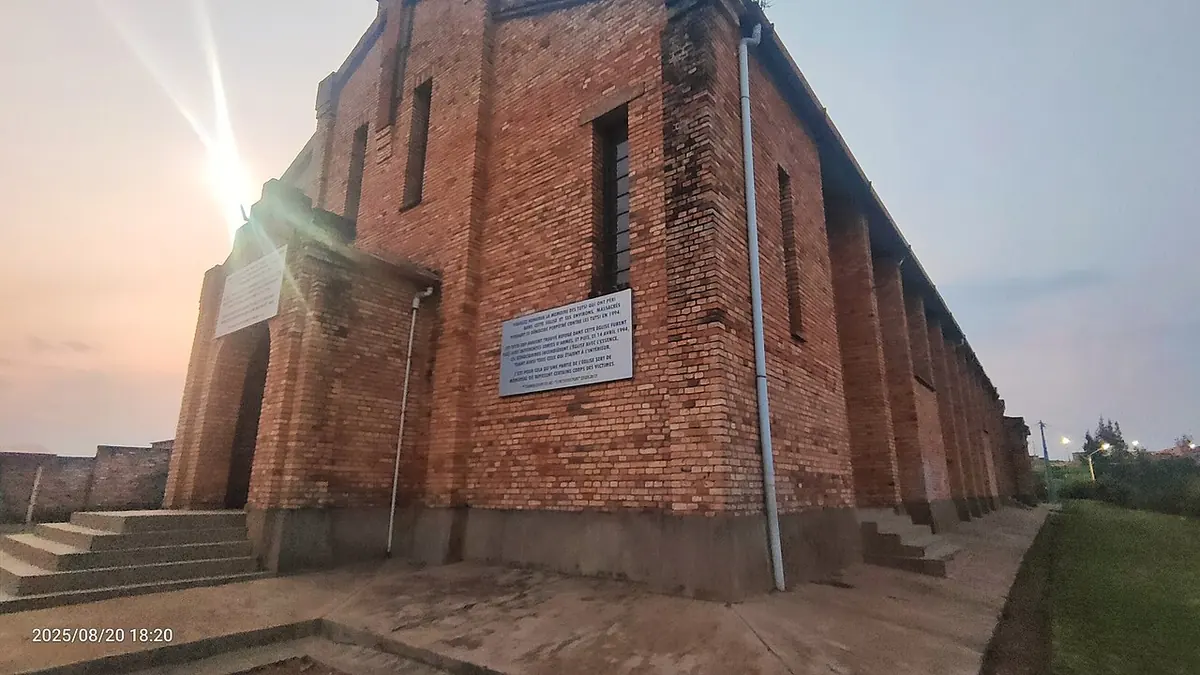
In 1994 genocide swept Rwanda, and Kibeho was not spared. Thousands of people who had taken refuge were killed in the parish church, and a year later more were killed on the esplanade where the apparitions had taken place. The church is now part of a genocide memorial. We label this vision reported: the Church approved the apparitions as a whole, and the reading of this vision as a prophecy of 1994 came afterward, from the bishop and the faithful who remembered it.
The Church's judgment
A medical commission and a theological commission studied the visionaries and their messages for years. Before their work was done, the Church took a first public step: on August 15, 1988, Bishop Jean-Baptiste Gahamanyi of Butare, then the bishop of the area, approved public devotion at the site. He deliberately left open the questions of whether the apparitions were real and which visionaries could be trusted. On November 28, 1992, the first stone was laid for a sanctuary at Kibeho, named the Shrine of Our Lady of Sorrows.
On June 29, 2001, the feast of Sts. Peter and Paul, at Mass in Gikongoro cathedral with the apostolic nuncio present, Bishop Misago read his declaration:
Yes, the Virgin Mary appeared at Kibeho on 28 November 1981 and in the months that followed.
He added, as the Church always does, that "the recognition of these apparitions should not be considered a requirement of faith." The Holy See Press Office published the declaration the same week.
The declaration, a summary of a 23-page report, explains why only three were accepted. For months, until about June 1982, Alphonsine, Nathalie and Marie Claire were the only witnesses; they made Kibeho known and drew the crowds. The commissions considered only apparitions that took place in public, before others. Nothing the three said or did was found contrary to faith or morals, and their message agreed with Scripture and Tradition. Later visions, including reported visions of Jesus from July 1982, were set aside, chiefly because of what the bishop called "disquieting personal situations" in the lives of those who reported them. The bishop also stressed that Kibeho brought no new revelation. Its message recalls the Church's ordinary teaching, long neglected, on prayer, conversion and the cross. He hoped the shrine would become a place of pilgrimage, prayer, conversion, reparation and reconciliation, "a fundamental centre that recalls the Gospel of the Cross." In 2006 and 2007 the Church in Rwanda kept a jubilee year for the twenty-fifth anniversary, closed at Kibeho on November 28, 2007, by Cardinal Ivan Dias, prefect of the Congregation for the Evangelization of Peoples, before some 35,000 pilgrims.

The Seven Sorrows rosary
The devotion most closely tied to Kibeho is the Seven Sorrows rosary, a chaplet of seven groups of seven Hail Marys, each group meditating on one of Mary's sorrows, from Simeon's prophecy to the burial of Jesus. It is far older than Kibeho; the Servite Order has prayed it for centuries. But at Kibeho it found new life. "Our Lady taught me to pray the Rosary of the Seven Sorrows, because she said a tragedy was about to happen in Rwanda," Nathalie told Fides in 2007.
In his guidance on the devotions of Kibeho, Bishop Misago noted that the chaplet "does not replace the Holy Rosary." Let us pray it as the visionaries did, keeping company with the Mother who stood beneath the cross.
Symbols of Our Lady of Kibeho in art
Images of Our Lady of Kibeho are recent, and most follow the statues at the shrine:
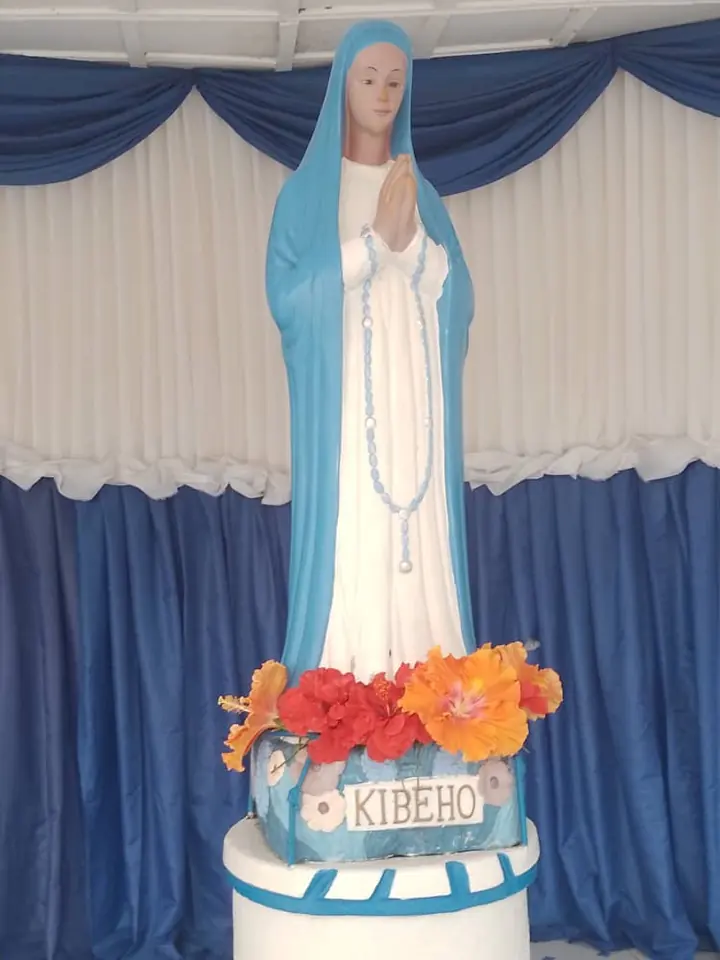
- White robe and blue mantle: Mary wears a long white robe, often with a white veil and a blue mantle over her head and shoulders.
- Hands joined in prayer: she prays with us and for us, the gesture of the Mother who intercedes.
- Rosary: a rosary hangs from her hands, recalling her call to prayer.
- Bare feet: Alphonsine said the Lady came barefoot, like the schoolgirls themselves.
- Tears: some images show tears, for the visions of 1982 and for Our Lady of Sorrows, the shrine's title.
- The pillar with a blue roof: at Kibeho her statue stands high on a white pillar under a small pointed blue canopy.
Feast day and the shrine
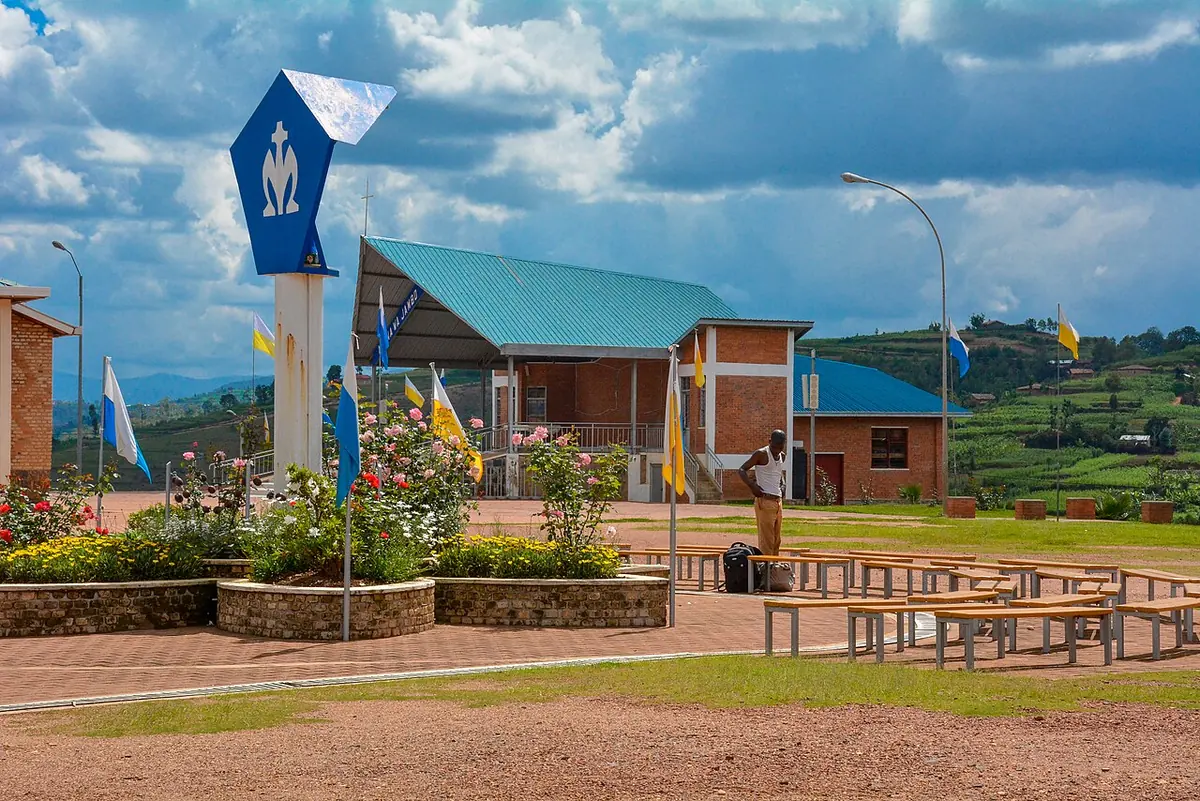
The feast of Our Lady of Kibeho is November 28, the anniversary of the first apparition, when pilgrims walk to Kibeho from across Rwanda and beyond. The shrine, on the grounds of the old college, keeps the places where the girls saw the Virgin, and the parish church and memorial stand nearby. See the feast day calendar.
Kibeho belongs to a region whose Christians have known both martyrdom and grace. In neighboring Uganda, St. Charles Lwanga and his companions died for Christ in 1886. At Kibeho Our Lady wept over what was coming, and she still calls her children to repentance and reconciliation.
Prayer to Our Lady of Kibeho
There is no single traditional prayer to Our Lady of Kibeho. The prayer she herself asked for is the Rosary, and at Kibeho above all the Seven Sorrows rosary. We can make our own the name she gave: Mother of the Word, Our Lady of Kibeho, pray for Rwanda, pray for us, and teach us to repent while there is still time.
Frequently asked questions
Is Our Lady of Kibeho approved by the Church?
Yes. On June 29, 2001, Bishop Augustin Misago of Gikongoro declared, "Yes, the Virgin Mary appeared at Kibeho on 28 November 1981 and in the months that followed." He accepted the testimony of three visionaries, Alphonsine, Nathalie and Marie Claire. The Holy See Press Office published his declaration. Public devotion had already been approved in 1988.
What did Our Lady of Kibeho say?
She introduced herself to Alphonsine with the words "I am the Mother of the Word." Her messages called for conversion, prayer from the heart, especially the Rosary, humility and love of neighbor. "Repent, repent, repent! Convert while there is still time," she told Marie Claire.
Did Our Lady of Kibeho predict the Rwandan genocide?
On August 15, 1982, the visionaries described seeing "a river of blood, people killing each other, abandoned corpses with no one to bury them." Twelve years later, in 1994, genocide swept Rwanda. Bishop Misago said, "Now we realise it was a vision of what was to happen in Rwanda."
What is the Seven Sorrows rosary of Kibeho?
It is a chaplet of seven groups of seven Hail Marys, each group meditating on one of the sorrows of Mary. The visionaries said Our Lady asked for it to be prayed, and it is the devotion most closely tied to Kibeho. Bishop Misago noted that it "does not replace the Holy Rosary."
When is the feast of Our Lady of Kibeho?
November 28, the anniversary of the first apparition in 1981, kept with a great pilgrimage at the shrine.
Sources
- Holy See Press Office: Dichiarazione del Vescovo di Gikongoro in merito alle apparizioni di Kibeho (Rwanda), June 29, 2001
- Bishop Augustin Misago, Judgement on the Apparitions of Kibeho (EWTN library)
- Agenzia Fides: Jubilee Year for the 25th anniversary of the apparitions in Kibeho, presided by Cardinal Ivan Dias (December 1, 2007)
- National Catholic Register: Our Lady of Kibeho, 'An Urgent Appeal to the Repentance and Conversion of Hearts' (November 24, 2021)
- The Guardian: The schoolgirls who warned of Rwanda's genocide (January 14, 2019)