St. Brendan of Birr

St. Brendan of Birr (died 573) was an Irish abbot of the sixth century, a pupil of St. Finnian of Clonard and one of the Twelve Apostles of Ireland. He founded the monastery of Birr, in today's County Offaly, and was honored in his day as a prophet. When a synod tried to excommunicate St. Columba, Brendan stood up for him. We keep his feast on November 29.
Who was St. Brendan of Birr?
St. Brendan of Birr was an Irish abbot of the sixth century who founded the monastery of Birr, in the Irish midlands, and was revered by the saints of his own day as a prophet. He studied under St. Finnian of Clonard and is counted among the Twelve Apostles of Ireland. He was a loyal friend to St. Columba, and he spoke up for him when the Irish clergy turned against him. He died in 573, and we keep his feast on November 29.
He is not St. Brendan the Navigator of Clonfert, the famous voyager, though the two lived at the same time and both were Columba's friends. To tell them apart, the old writers sometimes called the abbot of Birr Brendanus Senior, Brendan the Elder.
Son of Neman, pupil of Clonard
William Reeves, the great nineteenth-century editor of Adomnán's Life of Columba, gathered what the Irish records say about him. Brendan was the son of Neman and Mansenna. He studied at Finnian's monastic school at Clonard, and an old Latin life of Finnian calls him "Brendanus Biorra, qui Propheta in scholis illis," Brendan of Birr, who was held a prophet in those schools.
One of those prophecies survives in the Irish Life of Ciarán of Clonmacnoise in the Book of Lismore. When Finnian named the young Ciarán as the one who would lead the prayer after him, Brenainn of Birr foretold that the two of them would found monasteries "on two streams between chief cities." The story belongs to the traditional lives of the Irish saints, written down centuries later.
The monastery of Birr
Brendan founded his monastery beside a stream, and the place took its name from the water: Bir or Bior, Reeves explains, means "a stream." The year of the founding is not recorded. The monastery grew, and in time the town of Birr, in County Offaly, grew up around it.
Birr became a house of learning. About 250 years after Brendan's death, a scribe named Macregol, probably the abbot of Birr who died in 821 or 822, wrote and painted a book of the Gospels there. The Bodleian Library in Oxford still keeps it, known as the Macregol or Rushworth Gospels.

Defender of St. Columba at Teltown
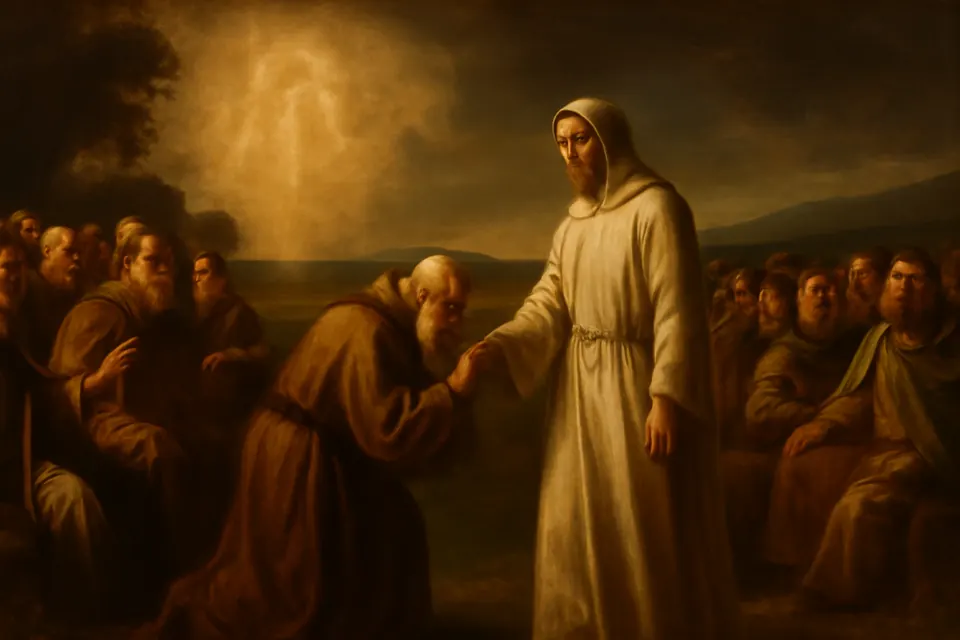
The best-known story of Brendan comes from Adomnán, abbot of Iona, who wrote his Life of Columba about a century after Columba's death. A synod meeting at Teltown in Meath had excommunicated Columba, "for some pardonable and very trifling reasons, and indeed unjustly," as Adomnán puts it. Columba came to the assembly anyway.
When Brendan saw him coming, he rose, bowed his head and kissed him. Some of the senior clergy rebuked him for honoring an excommunicated man. Brendan answered them, in Reeves's translation:
I have seen a most brilliant pillar wreathed with fiery tresses preceding this same man of God whom you treat with contempt; I have also seen holy angels accompanying him on his journey through the plain. Therefore I do not dare to slight him whom I see foreordained by God to be the leader of his people to life.
At those words the synod dropped the sentence and treated Columba with great respect. This vision is traditional: it rests on Adomnán's account and was never examined by any formal inquiry.
His death and Columba's vision
Brendan died in 573, by the date Reeves prefers from the Irish annals, in the eightieth year of his age. Adomnán tells how Columba, far away on Iona, called his attendant Diormit early one morning and ordered him to prepare the Eucharist, "for to-day is the birthday of blessed Brenden." Diormit objected that no messenger had come from Ireland. Columba replied that in the night he had seen the heavens open and choirs of angels come down to meet the holy Brendan's soul, with a brightness that lit the whole world.
Reeves adds that Columba instituted a festival on Iona in his memory. For the early Church, a saint's death was his birthday into heaven.

Symbols of St. Brendan of Birr in art
Very few old images of Brendan of Birr survive, and none is certain. In modern Irish churches look for:
- An Irish abbot with a staff and book: his office as founder of Birr, and the learning of his monastery.
- A pillar of fire or angels: his vision of Columba at Teltown.
- A prophet's raised hand: the gift for which his fellow students at Clonard remembered him.
His name lives on in Birr, where the ruined Old St. Brendan's Church and the town's churches carry it.

Feast day and prayer
We keep the feast of St. Brendan of Birr on November 29, the day Reeves gives for his death and the day of his memory in the Irish calendars. See the feast day calendar and our list of Irish saints for his companions.
We know of no traditional prayer to St. Brendan of Birr. Let us ask him to pray for all who are judged unfairly, for the courage to speak for them, and for the people of Birr and the midlands of Ireland: St. Brendan of Birr, pray for us.
Frequently asked questions
Who was St. Brendan of Birr?
A sixth-century Irish abbot, son of Neman, who founded the monastery of Birr and was counted among the Twelve Apostles of Ireland who studied under St. Finnian at Clonard. He died in 573 in the eightieth year of his age.
Is Brendan of Birr the same as St. Brendan the Navigator?
No. Brendan the Navigator, son of Finnlug, founded Clonfert and is remembered for his voyage, with his feast on May 16. Brendan of Birr was a different man of the same generation, sometimes called Brendan the Elder to tell them apart. Both were friends of St. Columba.
What did Brendan of Birr do for St. Columba?
When a synod at Teltown in Meath excommunicated Columba, Brendan rose to greet him and kissed him. He told the assembly he had seen a pillar of fire going before Columba and angels with him, and the synod gave up its sentence.
When is the feast of St. Brendan of Birr?
November 29.
Keep exploring
Sources
- Adamnan, Life of Saint Columba, ed. William Reeves (Edinburgh, 1874). Book III, chapters 4 and 12 (quoted), and Reeves's notes on Brendan's family, death date, the Clonard tradition and the name Birra
- Whitley Stokes, Lives of Saints from the Book of Lismore (Oxford, 1890). Life of Ciarán of Clonmacnoise, with Brenainn of Birr's prophecy at Clonard
- Bodleian Library MS. Auct. D. 2. 19 (the Macregol or Rushworth Gospels). Written at Birr in 801–825 by Macregol, probably the abbot of Birr