St. James of the Marches
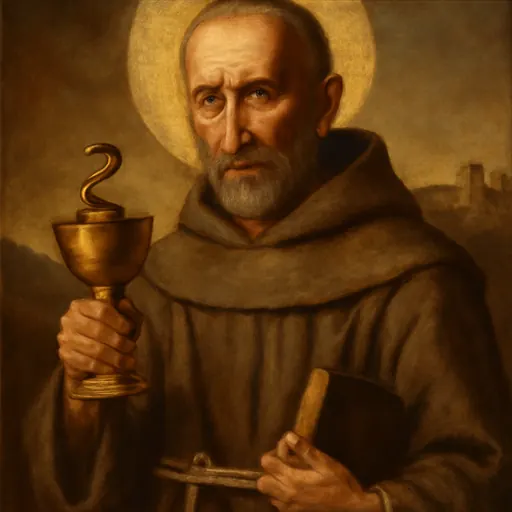
St. James of the Marches (Giacomo della Marca, about 1393-1476) was a Franciscan friar and one of the great preachers of fifteenth-century Italy, a disciple of St. Bernardine of Siena and companion of St. John of Capistrano. For fifty years he preached penance across Italy and Central Europe, served as papal legate, and founded charitable loan banks for the poor. We keep his feast on November 28; he is a patron of Naples, and his incorrupt body rests at Monteprandone, where he was born.
Who was St. James of the Marches?
St. James of the Marches, in Italian San Giacomo della Marca, was a Franciscan friar and one of the most tireless preachers the Church has known. Born in the hill town of Monteprandone in the March of Ancona, he preached for half a century, from the towns of Umbria and Tuscany to Bosnia, Hungary and Bohemia. He was a disciple of St. Bernardine of Siena and a brother in arms of St. John of Capistrano. He died in Naples in 1476.
We keep his feast on November 28.

From lawyer to friar
He was born to a poor family named Gangala, about 1393 (the Catholic Encyclopedia gives 1391). An uncle who was a priest started his schooling at Offida and sent him on to Ascoli. He went to the University of Perugia and took a doctorate in civil law, then worked in Florence as a tutor in a noble household and as a judge.
On July 26, 1416, he was received into the Order of Friars Minor in the little chapel of the Portiuncula at Assisi, where St. Francis had begun. He made his novitiate in the hermitage of the Carceri above Assisi and studied theology at Fiesole under St. Bernardine of Siena. He was ordained a priest on June 13, 1420.
Fifty years of preaching
From then on he hardly stopped. He preached penance in Tuscany, the Marches and Umbria, and the old accounts of his life are full of conversions and reported miracles. Like Bernardine, he spread devotion to the Holy Name of Jesus.
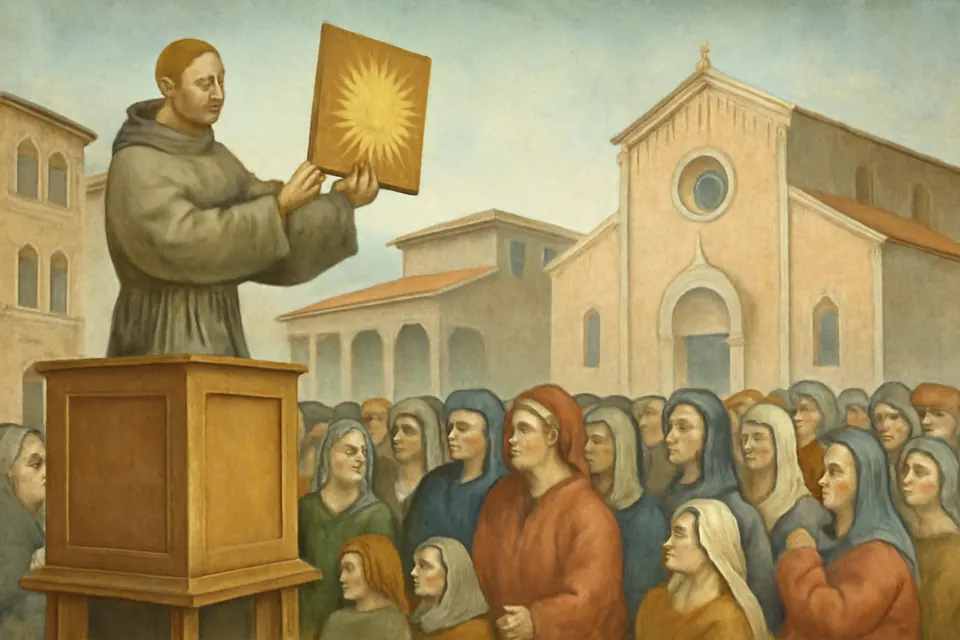
From 1427 he was sent on missions far from home, as preacher and papal legate, to Germany, Austria, Sweden, Denmark, Bohemia, Poland, Hungary and Bosnia, where he also served as commissary of the friars. He worked for the reconciliation of the moderate Hussites at the time of the Council of Basel, and for the union with the Greeks at the Council of Florence. When John of Capistrano died in 1456, James was sent to Hungary to take his place. In Italy he founded montes pietatis, charitable pawnshops that lent to the poor at little or no interest so that they would not fall into the hands of usurers. Milan offered him its bishopric in 1460. He declined.

The Precious Blood dispute
His life was not free of controversy. On Easter Monday, 1462, preaching at Brescia, he repeated the opinion of some theologians that the Precious Blood shed in the Passion was not united to the divinity of Christ during the three days in the tomb. The Dominican inquisitor of Brescia summoned him. James appealed to the Holy See, and the question was debated in Rome before Pope Pius II at Christmas 1462. No decision was given. He suffered also from the quarrels between the branches of his own order, and in 1455 Pope Callistus III appointed him one of the arbiters between them.
He spent his last three years in Naples and died there on November 28, 1476. Pope Urban VIII beatified him in 1624, and Pope Benedict XIII canonized him in 1726.
The miracles of St. James of the Marches
The best-loved story is kept at his shrine. It is a traditional account. In Brescia a boy named Corrado came to every sermon, and James taught him the Hail Mary. Corrado taught it to a friend, whose father hated the faith; when the man heard his son praying, he struck Corrado dead and walled the body up in the chimney. After three days Corrado's father came to the friar. James urged him to forgive, went to the house with two brothers, and told them where to break the wall. As they hammered, a voice called from inside, "Gently, you're hurting me!" and Corrado came out alive.
Because so many of his miracles concerned children, he is invoked as their protector. Every Sunday at Monteprandone children are blessed at his chapel, and mothers expecting a child, or hoping for one, come to ask his prayers.
His body is a further sign. The shrine records that it was examined during the canonization process in 1700, when 39 witnesses testified that it was still flexible and experts found no sign of embalming, and again in 1968, when it was found well preserved though no longer flexible. The Church has not declared the incorruption a miracle; we report it as the shrine does.

Symbols of St. James of the Marches in art
- A chalice with a serpent escaping from it: his special sign. The Catholic Encyclopedia links it to attempts by heretics to poison him, or less likely to the Precious Blood dispute.
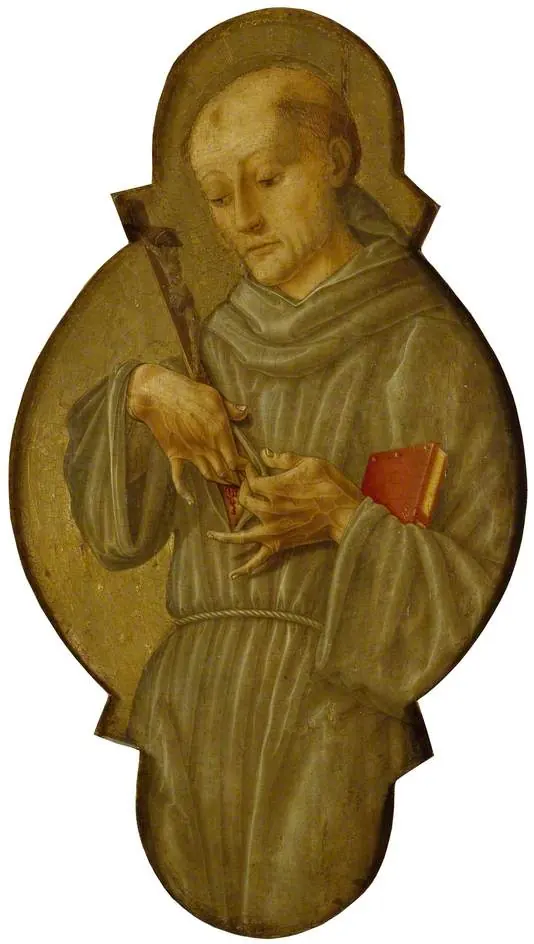
- The Franciscan habit and cord: he was a friar of the Observance.
- The monogram of the Holy Name: sometimes he holds the sunburst tablet of the Name of Jesus, like Bernardine.
- A book: for his learning and his preaching.
Crivelli's panel of 1477 is one of the earliest images of him; Zurbarán painted him in the next century with the chalice held high.
His shrine at Monteprandone
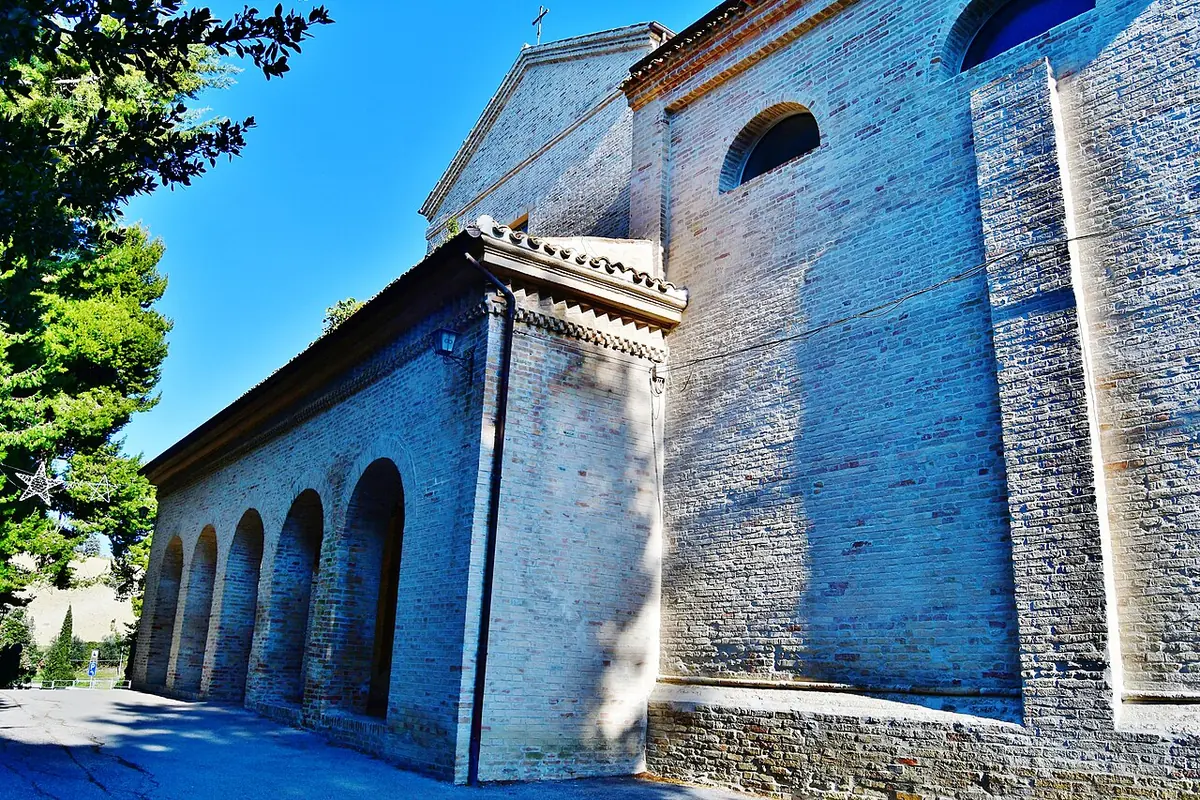
For more than five hundred years his body lay in the Franciscan church of Santa Maria la Nova in Naples, which venerates him as a patron. In 2001 it was carried home to Monteprandone and laid in the shrine of Santa Maria delle Grazie, the friary he himself founded in 1449. Part of his library and his handwritten books are also kept in Monteprandone.
Feast day and prayer
We keep his feast on November 28; see the feast day calendar and the patron saints index. His shrine at Monteprandone publishes a novena and a prayer for children in his honor. Let us ask St. James of the Marches to pray for preachers and confessors, for children and their parents, and for all who lend and borrow, that money may serve the poor and not crush them.
Frequently asked questions
Why is St. James of the Marches shown with a chalice and a snake?
The Catholic Encyclopedia explains that the snake escaping from the chalice recalls attempts by heretics to poison him, or less likely the dispute over the Precious Blood in which he was involved in 1462. In both readings the serpent flees and the saint is unharmed.
When is the feast of St. James of the Marches?
November 28, the day he died in Naples in 1476.
Where is the body of St. James of the Marches?
For more than five centuries it lay in the Franciscan church of Santa Maria la Nova in Naples. Since 2001 it has rested in the shrine of Santa Maria delle Grazie at Monteprandone, the friary he founded in his hometown in 1449.
Why is St. James of the Marches a protector of children?
His shrine at Monteprandone keeps an old tradition that many of his miracles concerned children, and every Sunday children are blessed and entrusted to him at his chapel.
Keep exploring
Sources
- Catholic Encyclopedia (1910): St. James of the Marches. His studies, profession at the Portiuncula, legations, the montes pietatis, the Precious Blood dispute of 1462, beatification in 1624 and canonization in 1726, and the meaning of the chalice and serpent
- Santuario San Giacomo della Marca, Monteprandone: Il corpo incorrotto. The examinations of his body in 1700, 1888 and 1968, and its transfer from Naples to Monteprandone in 2001
- Santuario San Giacomo della Marca, Monteprandone: Protettore dei bambini. The tradition of the boy Corrado at Brescia, and the blessing of children at his shrine