St. Severinus of Noricum, Apostle of the Danube

St. Severinus of Noricum (died 482) was a monk who came from the East to the Roman province of Noricum, in today's Austria, as the empire was falling apart. He fed the hungry towns along the Danube, ransomed captives and founded monasteries. We keep his feast on January 8, and he is honored as an apostle and patron of Austria.
Who was St. Severinus of Noricum?
St. Severinus of Noricum was a monk who appeared on the Danube frontier in the middle of the fifth century, just as Roman order there was collapsing, and spent the rest of his life holding its people together. He fed besieged towns, ransomed captives, warned of raids before they came, and spoke to barbarian kings as a father. He went barefoot through Austrian winters. Austrians honor him as the apostle of their land, and we keep his feast on January 8.
Most saints of his age are known only through legend. Severinus is different. His life was written about 511 by Eugippius, a monk who had lived in his community and helped carry his body to Italy. That makes it one of the most vivid eyewitness pictures we have of the end of the Roman Empire in the West.

A stranger from the East
Eugippius begins: "At the time of the death of Attila, king of the Huns, confusion reigned in the two Pannonias and the other borderlands of the Danube. Then Severinus, most holy servant of God, came from the parts of the East" to the small town of Asturis. That was about 453.
Where exactly he came from, no one knew. Eugippius confesses he had "no clear evidence." People around Severinus debated it, but no one dared ask him directly. Yet his speech, Eugippius says, "revealed a man of purest Latin stock," and he would sometimes hint, as if speaking of another, at cities of the East and a long and dangerous journey.
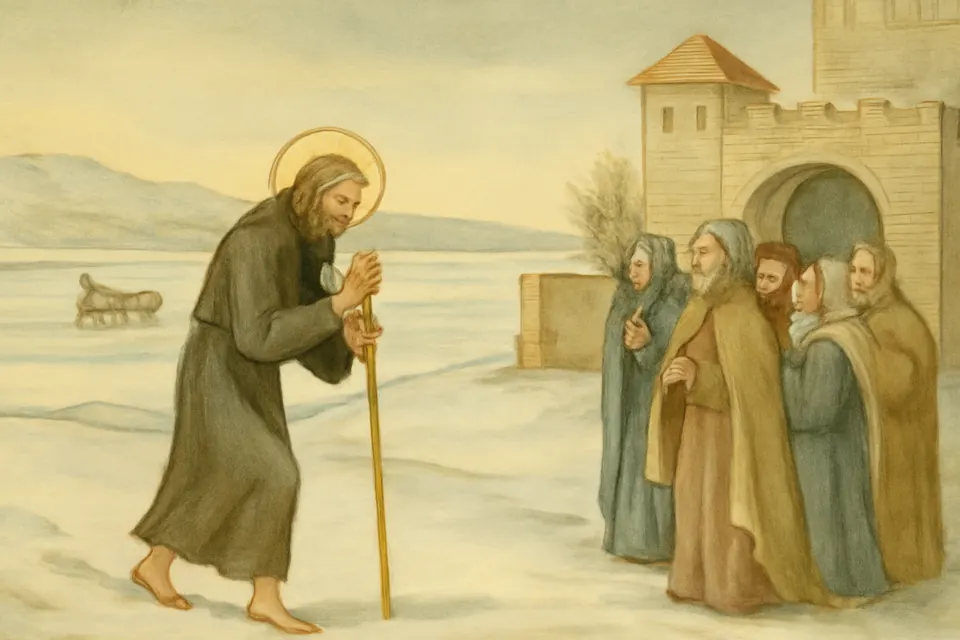
He lived as a monk among people who were frightened and poor. Eugippius describes his fasting and his bare feet: "He wore no shoes whatever. So at midwinter, which in those regions is a time of cruel, numbing cold, he gave a remarkable proof of endurance by being always willing to walk barefoot." The Danube froze so hard that carts drove across it. When people marveled, Severinus would answer:
Think not that what ye see is of my merit. It is rather an example for your salvation.
Holding the Danube towns together
Severinus founded a monastery at Favianis (today's Mautern in Lower Austria) and small cells for monks in other towns, among them Batavis (Passau). From there he did what a collapsing government no longer could. He organized the collection of tithes and clothing for the poor, arranged food for towns cut off by famine, and urged the citizens to fast and pray before every danger.
The barbarian kings around him listened to him. Gibuld, king of the Alamanni, "greatly honored and loved him," Eugippius says; at Severinus's word he released captives, and a deacon brought back about seventy of them. The kings of the Rugii, Flaccitheus and his son Feva, came to him for counsel. Feva's wife Giso tried to rebaptize Catholics, and Feva stopped her out of reverence for the saint.
One visitor became famous. A tall young barbarian named Odoacer, on his way to Italy, had to stoop in Severinus's low cell. As he left, the monk told him: "Go forth to Italy! Now clad in wretched hides, thou shalt soon distribute rich gifts to many." In 476 Odoacer deposed the last Western emperor and ruled Italy.

The miracles of St. Severinus
Eugippius records many wonders, and he wrote within a generation of the saint's death, often as a witness. None has been formally examined by the Church, so we call them reported miracles, kept by an early and careful source:
- The famine at Favianis. While the town starved, Severinus publicly rebuked a widow named Procula who had hidden away her grain, and she began to give it to the poor. Soon boats loaded with food arrived from Raetia, freed from the river ice, as the people believed, by the prayers of the man of God.
- The cross on the church posts. Where the Danube often flooded a church, he cut the sign of the cross into its wooden posts with an axe, and, Eugippius says, the water never rose above the cross again.
- The priest Silvinus. At the bier of a dead priest, Severinus called him by name. Silvinus opened his eyes and begged not to be kept from the rest he had tasted, and then fell asleep again in death.
- The leper Tejo, who came from far away and was cleansed through Severinus's prayer.
His death and the long journey of his body
On January 5, 482, Severinus felt a pain in his side. He called his monks, gave them his last counsel, and on January 8, Eugippius writes, he began the psalm himself while they wept: "Praise ye the Lord in his sanctuary; let everything that hath breath praise the Lord." Repeating that verse, "he fell asleep in the Lord."
He had foretold that the Romans would one day leave the Danube for Italy and asked his monks to take his body with them. In 488 Odoacer ordered exactly that. When the monks opened the grave, six years after the burial, "a fragrance of such sweetness surrounded us," Eugippius writes, and they found the body intact, "with beard and hair," though no one had embalmed it. The whole province went south with the coffin.
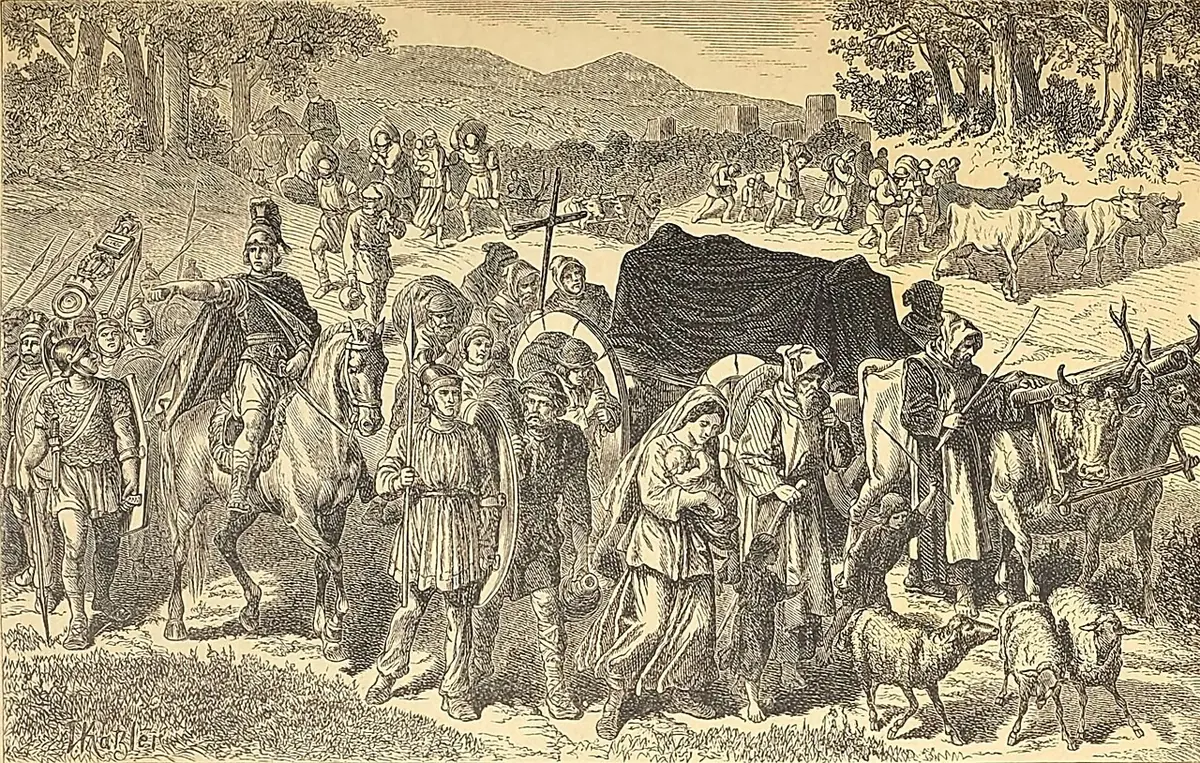
With the approval of Pope St. Gelasius, the body was laid in the Lucullan castle at Naples, in a mausoleum built by a noble lady named Barbaria. In 903, for fear of Saracen raids, it was carried to the Benedictine monastery of San Severino inside Naples. When the monasteries were suppressed under French rule, the relics were moved on May 30, 1807, to the church of San Sossio at Frattamaggiore, north of Naples, where they rest today.
Symbols of St. Severinus in art
There is no ancient portrait of Severinus, so artists have shown him in two ways:
- As a monk-abbot. In Italy, where his body lies, he appears as a Benedictine-style abbot in a dark habit with a crosier and a book, as on the fifteenth-century altarpiece from his church in Naples.
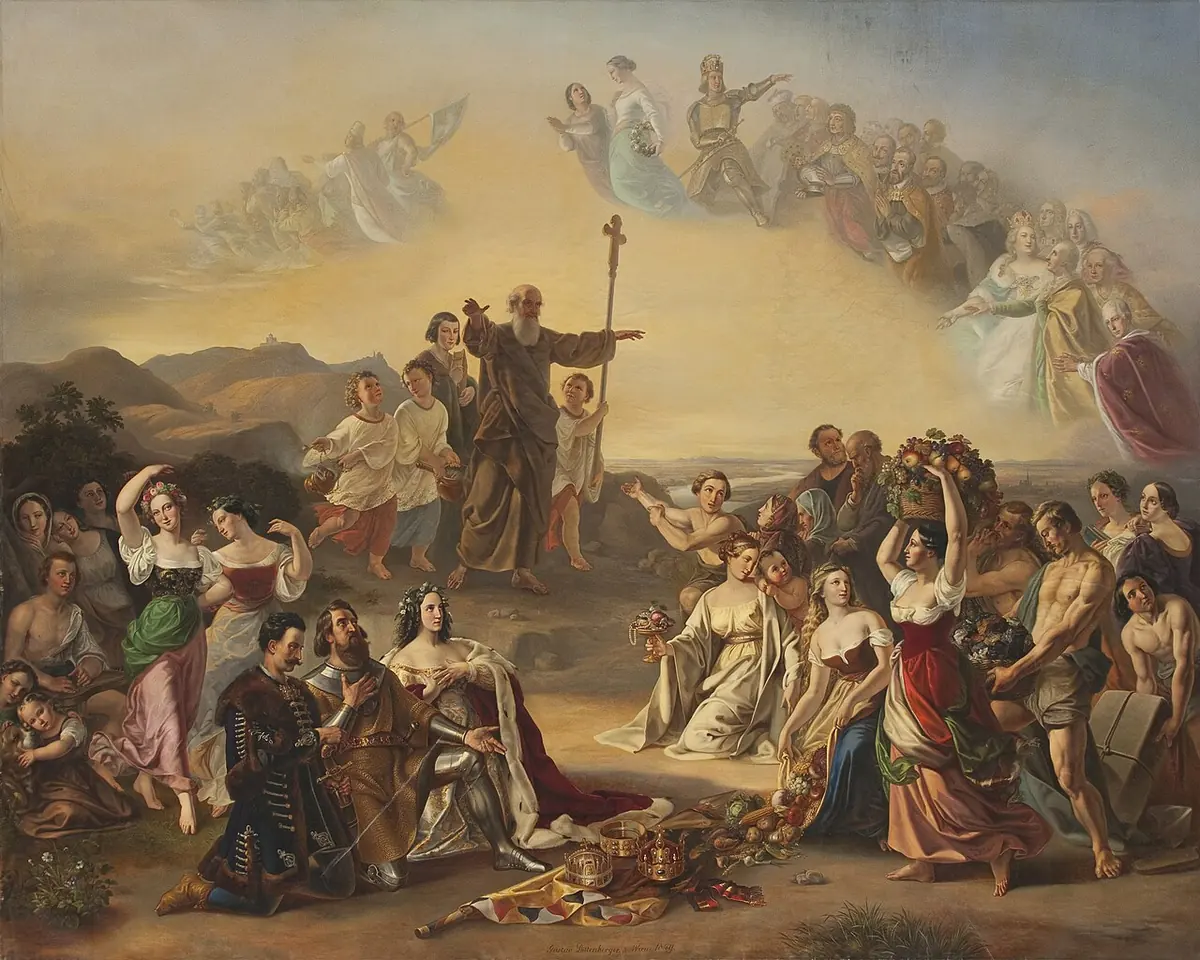
- As the bearded holy man of the frontier. Austrian and German artists of the nineteenth century painted him barefoot, in a rough robe, with a long beard and a staff, standing before kings or blessing the land.
- Bare feet recall Eugippius's description, and a cross raised over the countryside recalls his role as the apostle of Austria.

Patron of Austria and his feast day
Austria has long counted Severinus among its patrons, and churches, schools and parishes along the Danube, from Passau to Vienna, bear his name. In 1849 Gustav Dittenberger painted him blessing the land of Austria, a picture now in the Belvedere in Vienna.
We keep his feast on January 8. See the feast day calendar for the other saints of January.
Prayer to St. Severinus
We know of no widely used traditional prayer to St. Severinus in English, and we will not make one up in his name. But we can pray as he did at the end, with the last psalm on his lips: "Let everything that hath breath praise the Lord." Let us ask St. Severinus to pray for all who live through times when the old order is falling apart, for refugees and captives, and for everyone who must keep hope alive for others.
Frequently asked questions
Who was St. Severinus of Noricum?
A monk and holy man who worked along the Danube in Noricum Ripense (roughly today's Lower and Upper Austria and the Passau region of Bavaria) from about 453 until his death in 482. As Roman rule collapsed, he organized relief for the towns, ransomed captives and won the respect of barbarian kings. His disciple Eugippius wrote his life about 511.
When is the feast of St. Severinus of Noricum?
January 8, the day he died in 482.
Where are the relics of St. Severinus?
Near Naples. His monks carried his body to Italy in 488. It rested first in the Lucullan castle at Naples, then from 903 in the Benedictine monastery of San Severino in Naples, and since 1807 in the church of San Sossio at Frattamaggiore, north of the city.
Where did St. Severinus come from?
Nobody knows. Eugippius admits he had no clear evidence. Severinus never said, but his speech showed him to be of "purest Latin stock," and he hinted that he had first lived in a desert place of the East.
Keep exploring
Sources
- Eugippius, The Life of St. Severinus, translated by George W. Robinson (Harvard University Press, 1914), at tertullian.org. The primary source for his life, the quotations, the death on January 8, the incorrupt body in 488, and the translator's notes on the transfers of 903 and 1807