St. Helier of Jersey: Hermit, Martyr and Patron of the Island
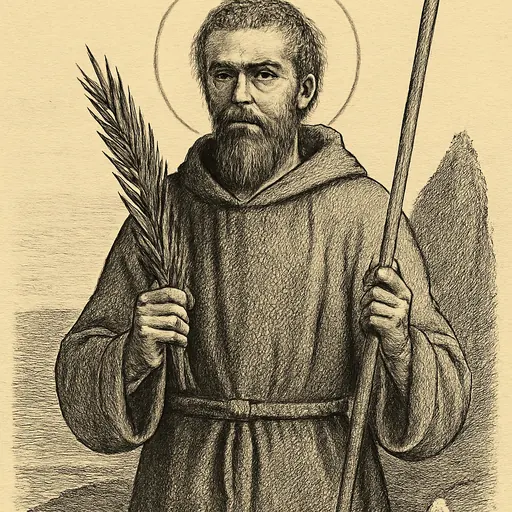
St. Helier was a 6th-century hermit, born in Tongeren in present-day Belgium, who lived for about fifteen years on a tidal rock off the island of Jersey and was killed there by raiders around 555. He is the patron saint of Jersey, and the island's capital, the town of St. Helier, is named for him. His feast day is July 16, when pilgrims walk out at low tide to his Hermitage beside Elizabeth Castle.
Who was St. Helier?
St. Helier was a hermit of the 6th century who left his home in what is now Belgium, came to the island of Jersey in the Channel Islands, and spent about fifteen years in prayer and fasting on a bare rock in the sea until raiders killed him, around the year 555. He is the patron saint of Jersey, and the island's capital, the town of St. Helier, is named after him. If you have searched for "St. Helier" and found ferry times and hotels, this is the man behind the name.
His name appears in many forms: Helerius in Latin, Hélier in French, Hélyi in Jèrriais, the old Norman language of Jersey, and sometimes Elier or Hellier in English.

Almost everything told about him comes from one medieval text, the Passio Sancti Helerii, the Passion of St. Helier. We should be honest about it, as Jersey's own historians have been. The Passion can't be older than the 11th century, because it uses the name Normandy for the region, which places it some five hundred years after the events. The Jersey historian G. R. Balleine called it a religious romance built from stories told of other saints, and the Bollandists, the Jesuit scholars who study the lives of the saints, classed it among the unreliable legends. Its dates contradict one another so badly that Balleine called its chronology absurd.
And yet the hermitage on the rock is real and very old. Medieval monks showed pilgrims the place where he lived and the stains on the stone they said were his blood. A. M. Bellows, writing for the Société Jersiaise, concluded that a hermit or a small community of hermits very probably did live there in the early Christian centuries, even if the story of Helier's life reached us dressed in legend. We honor a real man whose prayers, the island has always believed, first brought Christ to Jersey.
The life of St. Helier
What follows is the story as the Passion tells it. All of it is traditional. Where versions differ, we say so.
A child of prayer in Tongeren
Helier was born in Tongeren (Tongres in French), the old Roman city in present-day Belgium, probably between 510 and 520. His parents, a nobleman named Sigobard (or Sigebert) and his wife Lutsegard, were pagans and had no children. A Christian priest named Cunibert told them to pray to the true God, and they promised to give their firstborn to God's service if a child came. Helier was born, and when he was old enough, Sigobard handed him over to Cunibert, who raised him and taught him the faith.
The Passion gives the boy a string of small wonders. He spared the hares that were ruining a cabbage patch, healed a hunter, healed a woman suffering from a hemorrhage and drove an adder out of a boy's throat. These episodes are among the ones Balleine traced to the lives of other saints.
Flight and baptism
Sigobard came to regret his promise. His son's holiness drew attention, and the Passion says the father had Cunibert killed. Helier fled, first to Thérouanne in northern France and then west to Nanteuil in the Cotentin peninsula of Normandy, where the abbot St. Marculf (Marcouf) led a community of monks. Marculf baptized him there.
Sent to Jersey
Helier asked to live as a hermit. Marculf sent him to an island the Passion calls Gersuth, which later readers took to be Jersey, with a companion named Romard. They crossed from Genêts, on the bay of Mont-Saint-Michel, in a small boat. The island, the Passion says, had been nearly emptied by pirate raids, and only about thirty people of both sexes lived there, fishermen and their families on the dunes where the town of St. Helier would one day grow.
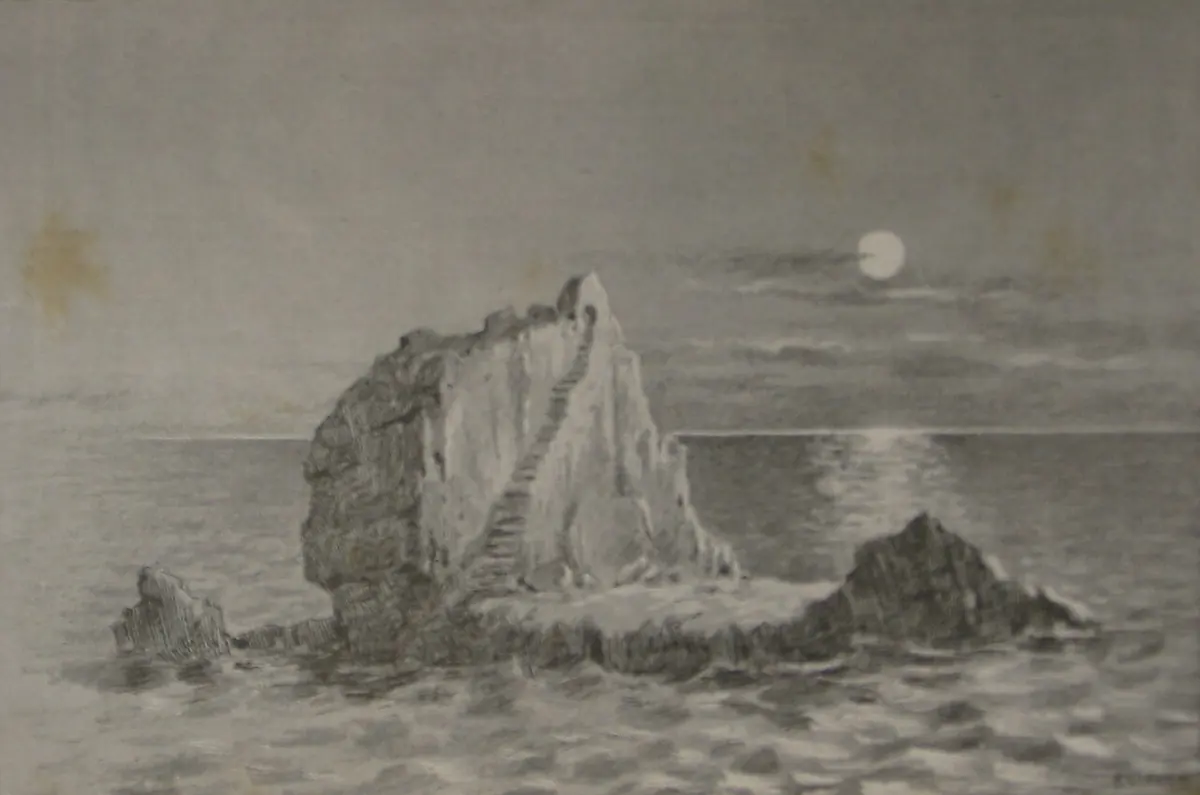
Helier's first act on the island was a healing. A paralyzed man named Anscretil was brought to him, and Helier prayed over him and blessed him, and he was cured. Then Helier climbed onto a tidal rock in the bay and made his home in a hollow of the granite, resting his head on a stone ledge. Romard went back and forth between the rock and the village.
The watchman on the rock
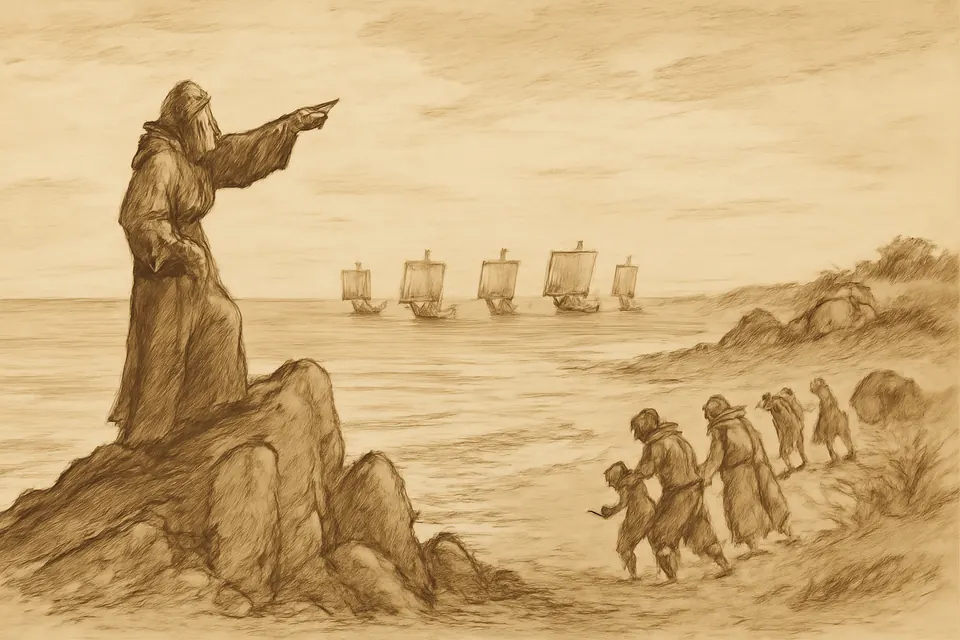
The Jersey tradition, built on the Passion, says Helier kept watch from his rock. When raiders' sails appeared on the horizon, he signaled to the people on shore, and they fled into the marshes until the danger passed. A hermit praying on a lookout rock, warning the poor when danger came, is a fitting picture of what a saint is for.
Marculf's visit and the storm
In the third year, Marculf came to visit. The Passion says Helier was so worn by fasting and vigils that his old abbot hardly knew him, and the two men wept and embraced. While Marculf was on the island, a fleet of about thirty ships came from the Orkneys. Marculf told Helier they would fight with God's weapons. The two prayed, and the raiders turned on one another, so that almost none were left to carry the news home. The older Lives of St. Marculf, which Balleine thought earlier than the 10th century, already speak of a hermit on the island whom Marculf visited. Some later retellings turn the deliverance into a sudden storm that wrecked the fleet.

Three days later Marculf and Romard left, and Helier never saw them again. He lived on with one attendant, eating once a week, so weak by the end that the Passion says he couldn't walk the distance of a thrown stone.
"Come to me, my beloved"
In the fifteenth year of his life on the rock, the Lord appeared to Helier and called him home. The Latin Passion gives the words:
Veni, dilecte mi, ad me; usque ad tertium diem ex hoc mundo laureatus sanguine migrabis.
In English: "Come to me, my beloved; within three days you will leave this world crowned with your blood." The old French version renders it "Venez vers moi, mon bien-aimé, dans trois jours vous quitterez cette terre avec la couronne des martyrs."
The martyrdom
Raiders the Passion calls Vandals landed with a large fleet and overran the island. Helier hid in his cave, the Passion says, out of weakness rather than fear, but the singing of birds gave him away. The raiders took the starving hermit for a madman, and one of them cut off his head. For centuries afterward the marks of his blood were pointed out on the rock.
Later Jersey tradition adds the most famous detail: that Helier picked up his head and walked. His companion found the body holding the head in its arms. The Passion gives no year; local tradition settled on 555, and some give 560.
Where St. Helier's body went
Here the traditions part ways, and none can be checked.
- The Passion's version: his attendant carried the body to the shore, laid it in a small boat and fell asleep. God's grace carried the boat across the sea to a place called Hereuarde, where the Meuse, the Rhine and the Waal meet, in the Low Countries. Bishop Willibrord had the body buried in a noble tomb "on the seventeenth day before the Kalends of August," which is July 16. Willibrord, the apostle of the Frisians, lived some 150 years after Helier, one of the contradictions that made Balleine doubt the whole account.
- The Norman version: the body came ashore at Bréville-sur-Mer, near Granville on the coast of Normandy. When the bearers set the heavy stone coffin down for the night, a spring rose where it rested, and a church was built nearby.
- The relics at Beaubec: the 17th-century writer Claude Chalmot recorded that Helier's relics were kept in the chapel of the Cistercian abbey of Beaubec, east of Rouen. Jersey's Dean Falle accepted this. The abbey was pillaged and demolished during the French Revolution, and the relics were lost.

The miracles of St. Helier
No miracle of St. Helier has been formally investigated by the Church. Sorted by this encyclopedia's labels:
- Childhood wonders (the hares, the hunter, the woman, the adder): traditional.
- The healing of Anscretil, the paralyzed man: traditional. A. M. Bellows pointed out that this healing is found only in Helier's Passion.
- The pirate fleet destroyed through prayer: traditional, told in the Lives of St. Marculf and in Helier's Passion.
- The vision announcing his death, and his walking with his head: traditional.
- Healings at his springs in Normandy and Brittany: reported. The Fontaine Saint-Hélier at Bréville-sur-Mer has been visited for centuries by people bathing their eyes and bringing sickly children, and the spring at Saint-Jouan-des-Guérets in Brittany was once credited with curing children's paralysis. None of these cures has been examined by the Church.
Why St. Helier is the patron saint of Jersey
Jersey remembers Helier as the man who brought Christianity to the island. Whether he was the first Christian there or not, his prayer on the rock and his blood shed on it made him the island's own saint. The parish around the old fishing settlement took his name, and the town that grew there, now Jersey's capital, took it from the parish.
In the 12th century a religious house was founded on L'Islet, the larger tidal island next to his rock. Balleine names William Fitzhamon as its founder. It was known as the Abbey (later the Priory) of St. Helier, and its monks kept the Hermitage and showed it to pilgrims. After the Reformation the Crown took over the monastic buildings, and the fortress of Elizabeth Castle was built on the islet in the late 1500s. The Hermitage still stands on its rock beside the castle.

In Normandy and Brittany he is remembered differently, as a healing saint. His springs drew people with sore and diseased eyes and parents with sick children, which is why we invoke him for eye ailments and for sick children as well as for the island. You can find other patrons on our patron saints page.
Symbols of St. Helier in art
Images of Helier are mostly local, in Jersey, Normandy, Brittany and his birthplace of Tongeren. Here is how to recognize him:
- A hermit's habit and beard: most images show a lean, bearded hermit in a plain brown or gray habit, often barefoot. The Tongeren window near the top of this page is a good example.
- The martyr's palm: the sign of his victory over death, as in the Tongeren window.
- An axe: the weapon of his martyrdom in Jersey tradition. Axes appear in the arms of the parish of St. Helier.
- A sword: some images use a sword for the same reason. A 20th-century window by François Décorchemont in the church of Saint-Hélier at Beuzeville in Normandy shows him with one.
- Carrying his own head: like St. Denis of Paris, Helier is a cephalophore, a "head-carrier." A mural of about 1270 in the church of St. John the Baptist at Omonville-la-Rogue in Normandy shows him twice holding his head, near an image of St. Thomas Becket.
- A rock in the sea, or a boat: his hermitage, or the boat that carried his body away. In Jersey's Parish Church of St. Helier, the chapel of the saint places a carved figure of the hermit in a small boat.
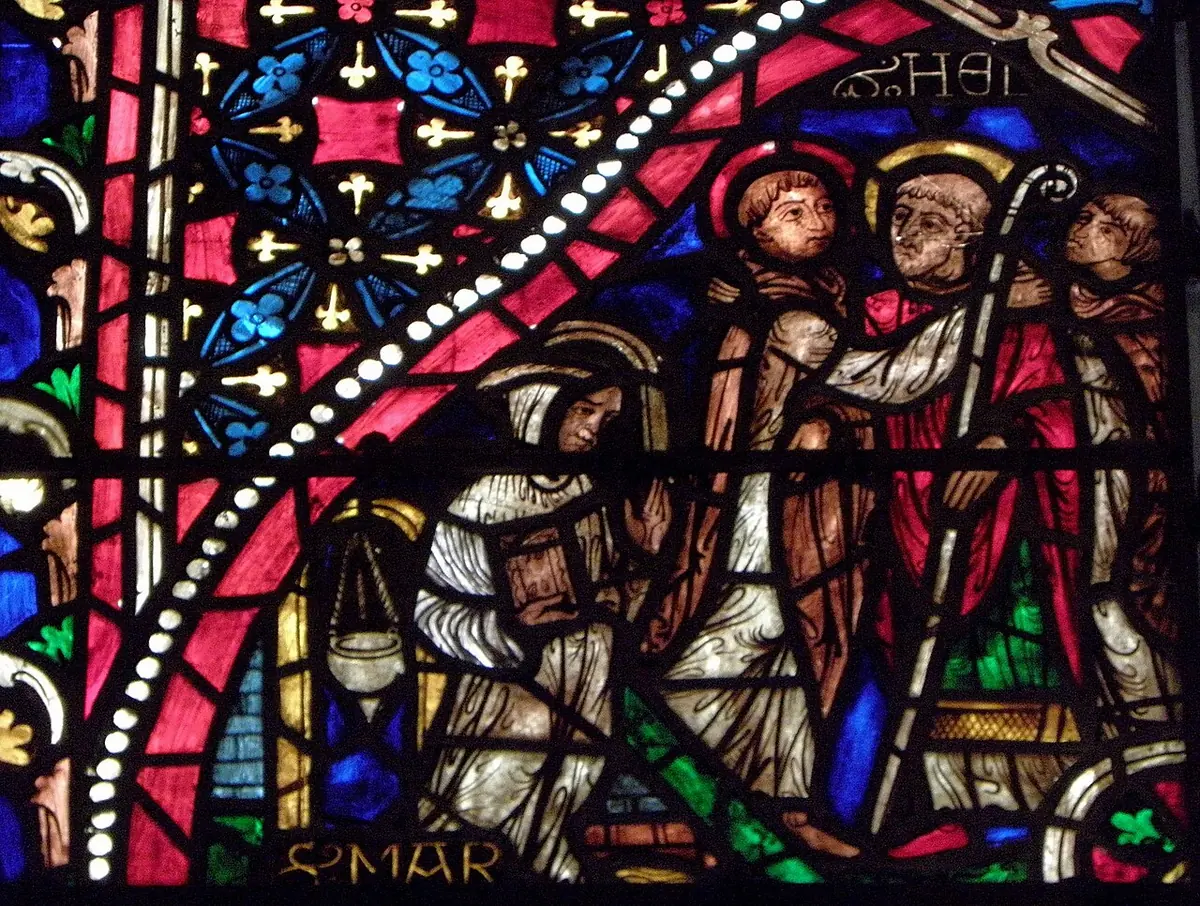
- With St. Marculf: in Normandy he often appears beside his abbot, as in the Coutances window.
A 15th-century painted stone statue in the chapel of Saint-Germain at Querqueville, in Normandy, is labeled "Helier" in Gothic lettering, a reminder that images of local saints were often identified by name rather than by emblem.
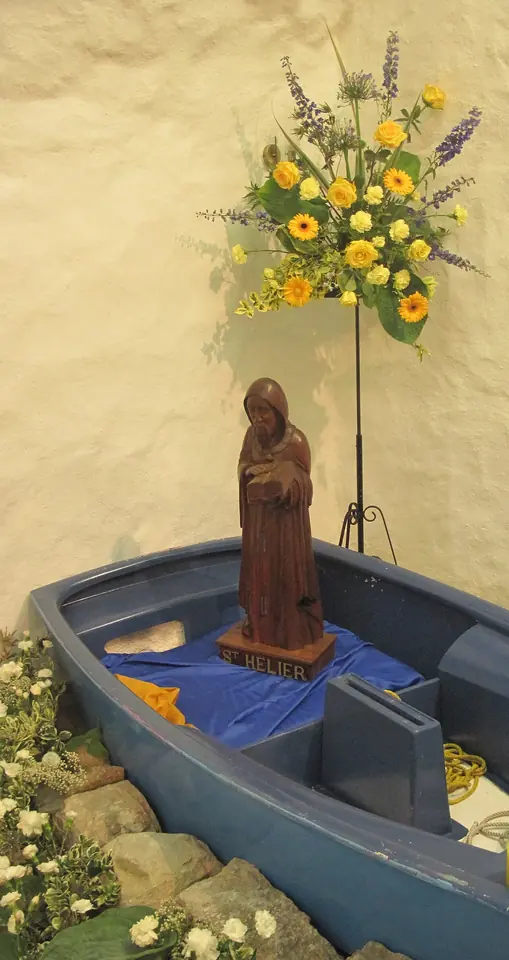
St. Helier's feast day and the pilgrimage
We keep St. Helier's feast on July 16, the date the Passion gives for his burial. The Diocese of Coutances in Normandy added him to its breviary in the late 1600s, and the Augustinian priory of Launceston in Cornwall had already put him in its calendar in the 15th century. He is not on the General Roman Calendar; his feast is a local one. The Orthodox Church honors him too, on July 16 (July 29 for churches on the old calendar), as one of the saints of the West from before the Great Schism. See the rest of the summer's saints on our feast days page.
Walking out to the Hermitage
Medieval pilgrims came to the Hermitage, but the custom faded after the Reformation. In 1921 Samuel Falle, Dean of Jersey and Rector of St. Helier, revived it, and on St. Helier's Day in 1922, which fell on a Sunday, he led his parishioners and the older schoolchildren out to the rock. By 1926 up to 900 people took part.
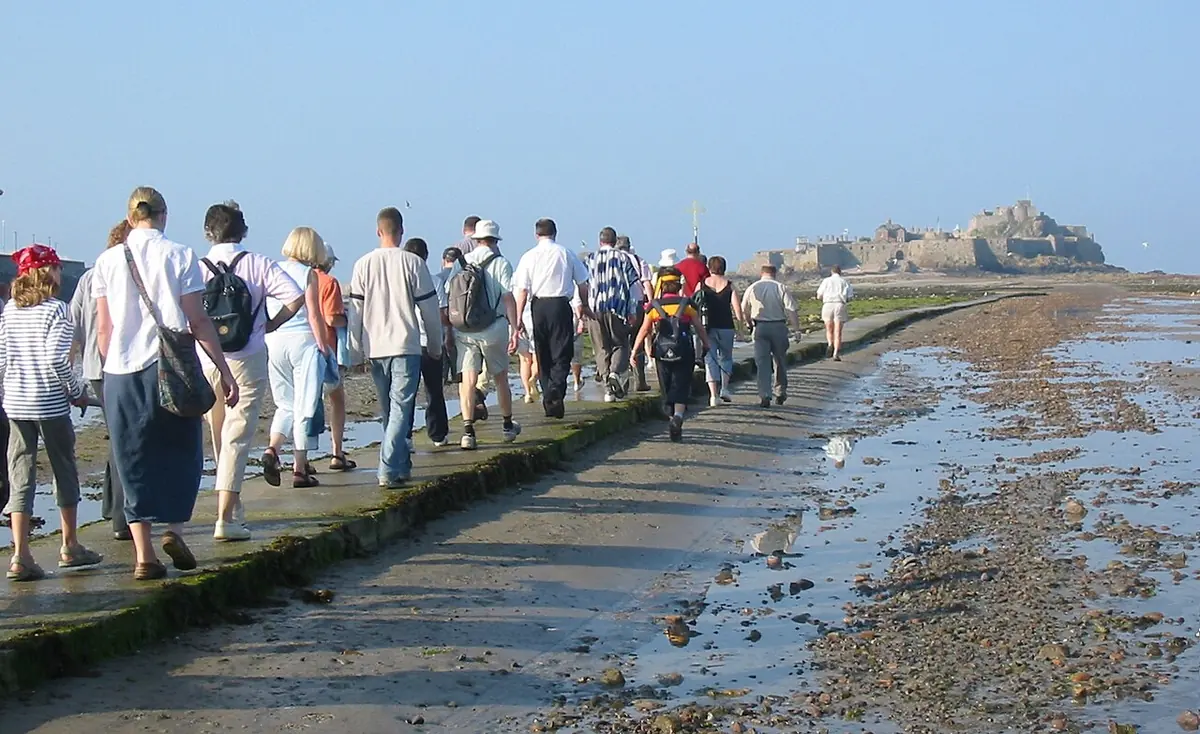
Today the Saint Helier Day pilgrimage, Lé Pèl'rinnage dé la Saint Hélyi, is held on the Sunday nearest July 16. Pilgrims walk across the sands and the causeway to Elizabeth Castle at low tide, climb the steps cut into the Hermitage Rock, and lay a wreath on St. Helier's Bed, the hollow in the granite where tradition says he slept. It is a civic and ecumenical occasion, open to everyone: Catholics, Anglicans and Orthodox walk it together. In 2023 the Dean of Jersey, the Bishop of Salisbury and the island's Lieutenant-Governor walked with the people behind a Scout band, and wreaths were laid at the Hermitage.
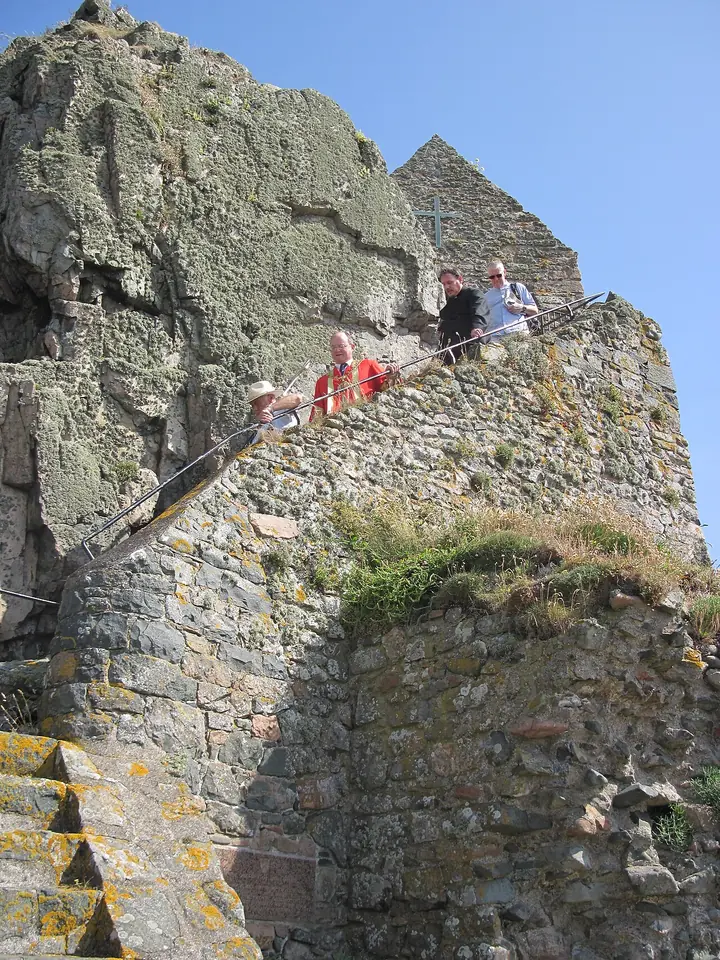
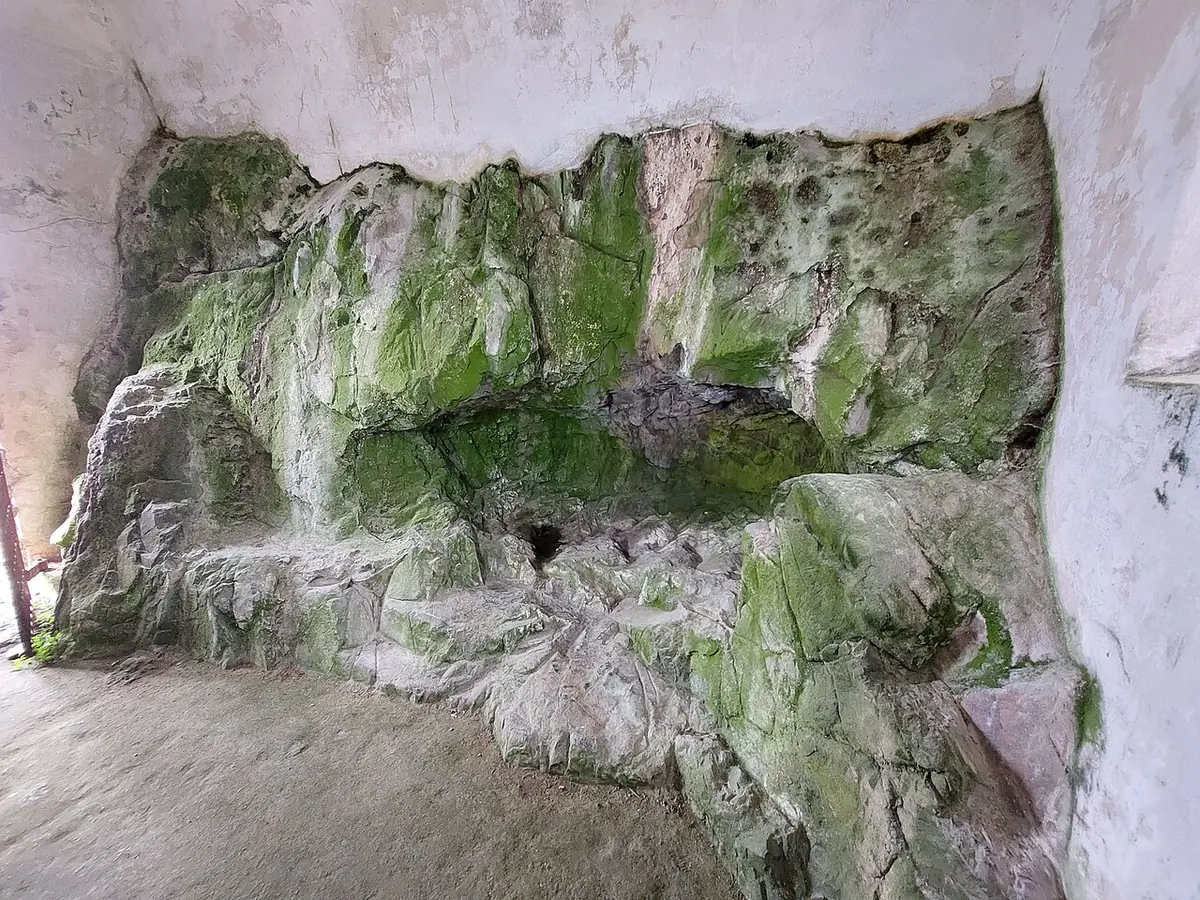
The Bed itself is very plain: a shallow, lichen-stained hollow in the rock, enclosed by the whitewashed walls of the little chapel built over it.
Where else St. Helier is honored
Helier's cult spread along the coasts of Normandy and Brittany. Churches and chapels bear his name at Rennes, where the 15th-century church of Saint-Hélier has a window of his martyrdom; at Beuzeville and Amécourt in the Eure; at Barentin in Seine-Maritime; and at Monhoudou in the Sarthe. Coutances Cathedral shows him meeting Marculf, and there is a chapel of St. Helier in the Catholic cathedral of Trenton, New Jersey.
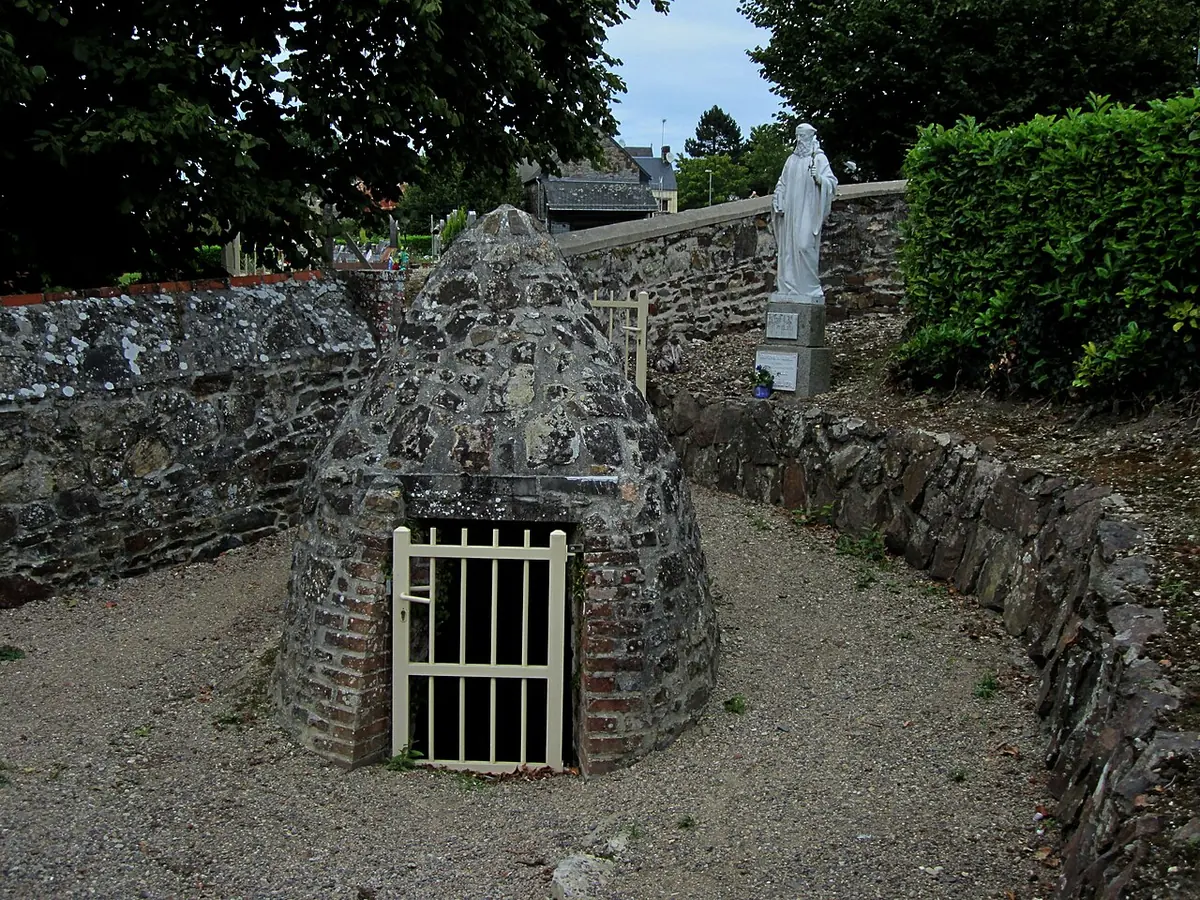
The spring at Bréville-sur-Mer, where tradition says his body came ashore, still has its little well house and a statue of the saint. The parish has long held a pilgrimage there each August, when the priest says Mass and blesses bread for the faithful.
Prayer to St. Helier
No prayer to St. Helier survives from the Middle Ages. Jersey's Parish Church of St. Helier keeps several prayers and hymns for his feast, published by the Société Jersiaise; the authors of the prayers aren't named. This short prayer of praise is one of them:
O glorious St Helier,
thou didst labour for Christ on the Isle of Jersey, in fasting, vigil and prayer.
Thou didst leave thy rock to convert pirates when they landed, and so obtain the crown of victory.
O valiant Martyr, we praise God Who has glorified thee.
A hymn written in the 1940s by the Rev. Kenneth Preston, curate of St. Helier, closes its prayer for faithfulness with the line "Saint Helier, for us sinners pray."
We can ask his help in our own words, too. Let us ask St. Helier to pray for the people of Jersey and of every island and coast, for those who keep watch and warn others of danger, for people with diseases of the eyes, and for sick children. And let us ask him, who prayed alone on a rock in the sea for fifteen years, to teach us to pray. St. Helier, pray for us.
Frequently asked questions
Who was St. Helier?
St. Helier (Helerius) was a hermit of the 6th century. His medieval Passion says he was born to pagan parents in Tongeren, raised by a Christian priest named Cunibert, baptized by St. Marculf in Normandy and sent to Jersey, where he lived on a rock in St. Aubin's Bay until raiders beheaded him around 555. The Passion is late and largely legendary, but the hermitage on the rock is very old.
Is the town of St. Helier named after a saint?
Yes. St. Helier, the capital of Jersey in the Channel Islands, takes its name from the parish of St. Helier, which is dedicated to the hermit. His Hermitage stands on a rock beside Elizabeth Castle, just off the town's seafront.
When is St. Helier's feast day?
July 16. In Jersey the Saint Helier Day pilgrimage to the Hermitage is held on the Sunday nearest that date. The Orthodox also commemorate him on July 16, which falls on July 29 for churches using the old Julian calendar.
What is St. Helier the patron saint of?
He is the patron saint of Jersey, and especially of the town and parish of St. Helier. In Normandy and Brittany he is known as a healing saint, and people bathed their eyes and brought sickly children to the springs that bear his name.
How did St. Helier die?
His Passion says raiders landed on Jersey, found him hiding in his cave on the rock and beheaded him. Later tradition adds that he picked up his head and walked, which is why he is sometimes shown carrying it. The story of his death is traditional, not documented history.
What is St. Helier's Bed?
It is a hollow in the granite of the Hermitage Rock where, tradition says, Helier slept and prayed. A small medieval chapel was built over it, and on the Saint Helier Day pilgrimage a wreath is laid on the Bed.
Where are St. Helier's relics?
No relics are known today. According to a 17th-century writer, Claude Chalmot, his relics were honored in the chapel of Beaubec Abbey near Rouen, which was destroyed during the French Revolution. His medieval Passion says his body was carried by boat to the Low Countries, and a Norman tradition says it came ashore at Bréville-sur-Mer.
Is there a prayer to St. Helier?
There is no ancient prayer to St. Helier. Jersey's parish has its own prayers and hymns for his feast, including "O glorious St Helier," which praises God for his labor, fasting and martyrdom. The text is on this page.
Sources
- G. R. Balleine, A Biographical Dictionary of Jersey: St. Helier (Société Jersiaise)
- Passio Sancti Helerii, Latin and French texts (Société Jersiaise)
- A. M. Bellows, St Helier: The Man and the Myth (Société Jersiaise)
- Saint Helier venerated outside Jersey (Société Jersiaise)
- Hymns and prayers to St. Helier (Société Jersiaise)
- Jersey Heritage: The Saint Helier Day Pilgrimage
- OrthoChristian: Two Saints of the Channel Islands, Helier and Branwalader
- Government House, Jersey: St Helier Pilgrimage to Elizabeth Castle (2023)