St. John the Merciful (St. John the Almsgiver)
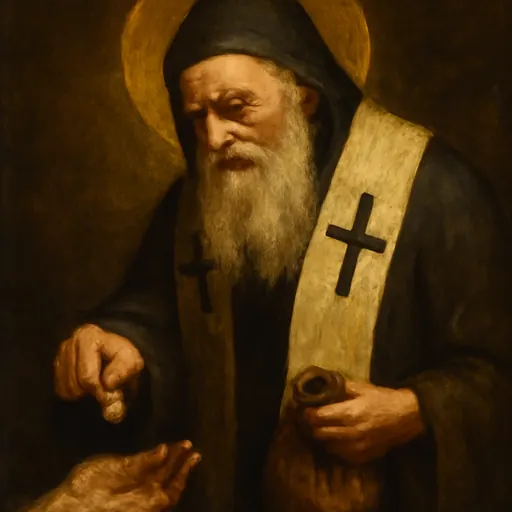
St. John the Merciful, also called St. John the Almsgiver, was a widowed layman from Cyprus who became Patriarch of Alexandria around 610 and gave away the whole wealth of his Church to the poor, whom he called his masters. He died in Cyprus around 619. The Roman Martyrology keeps his feast on January 23; the Orthodox Church honors him on November 12.
Who was St. John the Merciful?
St. John the Merciful, known in English as St. John the Almsgiver, was the Patriarch of Alexandria in Egypt in the early 600s. He was born in Amathus on the south coast of Cyprus, the son of Epiphanius, the island's governor. He married young at his father's wish, had children, and then lost his wife and all his children. Widowed, he gave himself to prayer and fasting as a monk.
Around 610 the new emperor Heraclius and his cousin Nicetas, who now governed Egypt, chose this layman for the vacant see of St. Mark. Over his protests, John went straight from monk to patriarch. He held the throne for about a decade, until the Persian armies took Alexandria, and he died back home in Amathus around 619.

We know him unusually well. His countryman Leontius, bishop of Neapolis in Cyprus, wrote his life after 641, in a plain style meant for ordinary people, and he had seen many of the scenes he describes. A fuller life by Sophronius and John Moschus, who both worked beside the patriarch, is lost, but parts of it survive in a later combined text. The translator Norman Baynes said Leontius wrote "with no hagiographic stencil," and the life is full of grain ships, ledgers, bath attendants and bickering clergy.
The life of St. John the Almsgiver
The vision of Compassion
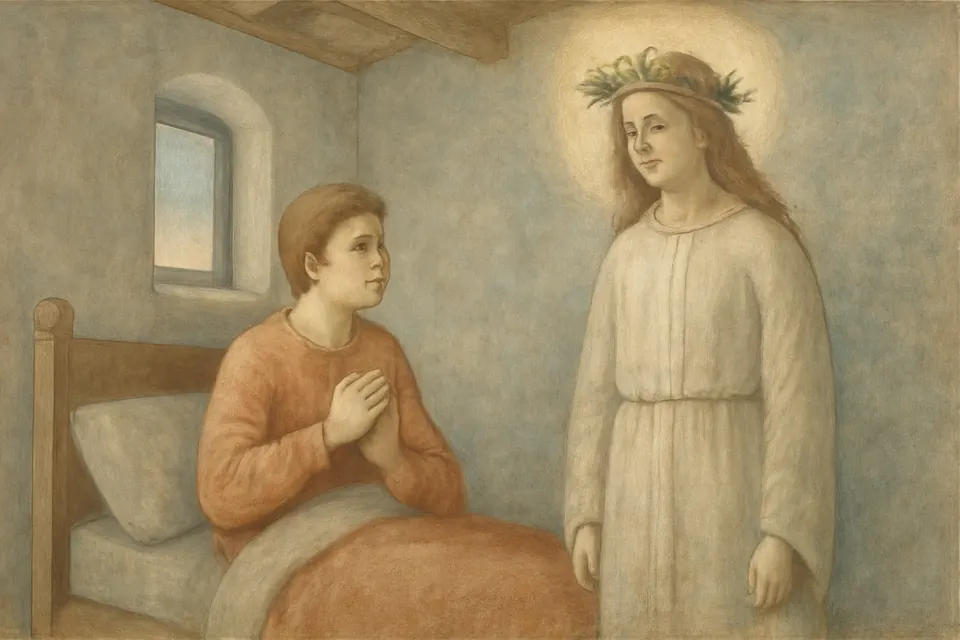
John told his friends that when he was about fifteen, still in Cyprus, he woke to find a radiant young woman beside his bed, crowned with olive leaves. "I am the first of the daughters of the King," she said, and promised to lead him into the King's presence, "for no one has as free access to Him as I have." He understood her to be Compassion, the mercy that moved God to become man.
That morning, on his way to church, he gave his goatskin cloak to a shivering beggar. Before he reached the church a man in white pressed a bag of a hundred gold coins into his hand and vanished. From then on, John said, he would give and then wait to see whether God would repay him, and God always did. This story comes from John himself through Leontius, so we class it as reported.
"My masters"
On his first day in Alexandria, before he was even enthroned, John sent his stewards through the city with an odd order: "make a list of all my masters down to the last." When they asked who could possibly be the patriarch's masters, he answered: "Those whom you call poor and beggars, these I proclaim my masters and helpers. For they, and they only, are really able to help us and bestow upon us the kingdom of heaven." The list came to more than 7,500 names, and each received a daily allowance from his own treasury.
He found about 8,000 pounds of gold in the patriarchal house. He spent it on refugees, hospitals, hostels for travelers and a hostel for monks, seven lying-in hospitals where poor mothers could rest for a week after giving birth, and on ransoming captives. When the Persians sacked Jerusalem in 614, he sent the priest Modestus a thousand workmen, a thousand sacks of grain and more for the rebuilding of the holy places, and paid to free about a thousand nuns taken captive.
The bench outside the church
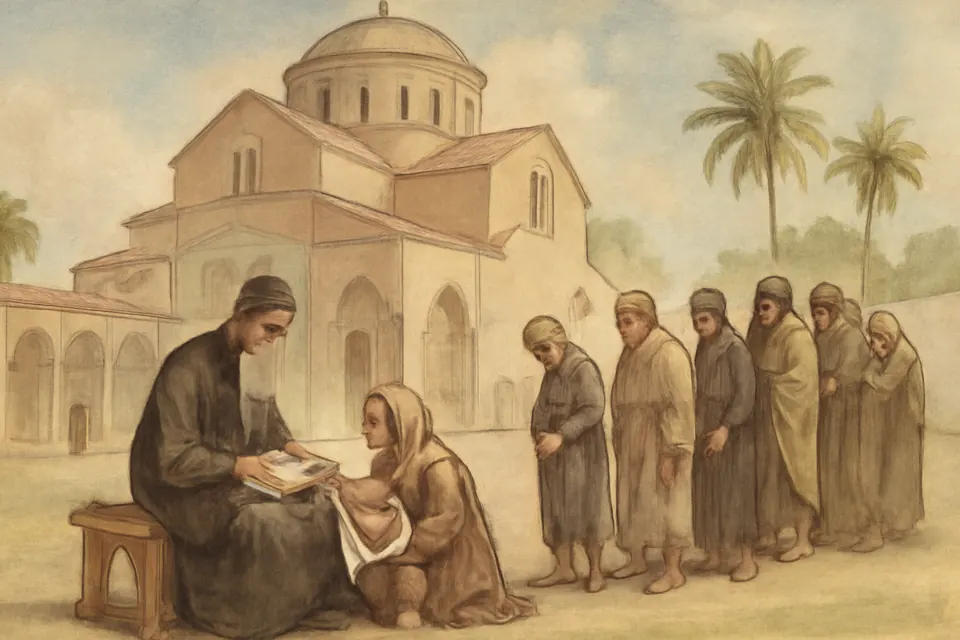
John learned that people with grievances were afraid to approach him past his ushers and officials. So every Wednesday and Friday he had a seat set up in the open in front of the church and sat there with a few companions and the Gospel book, keeping his retinue away so that anyone could walk up and speak. Leontius says that one day, when no one came at all, John went home downcast because he had done nothing for Christ that day, until Sophronius cheered him: it meant the city was at peace.
He also visited the hospitals three times a week, according to the Orthodox life, and fixed honest weights and measures so the poor would not be cheated in the market.
The coverlet and the beggar in disguise
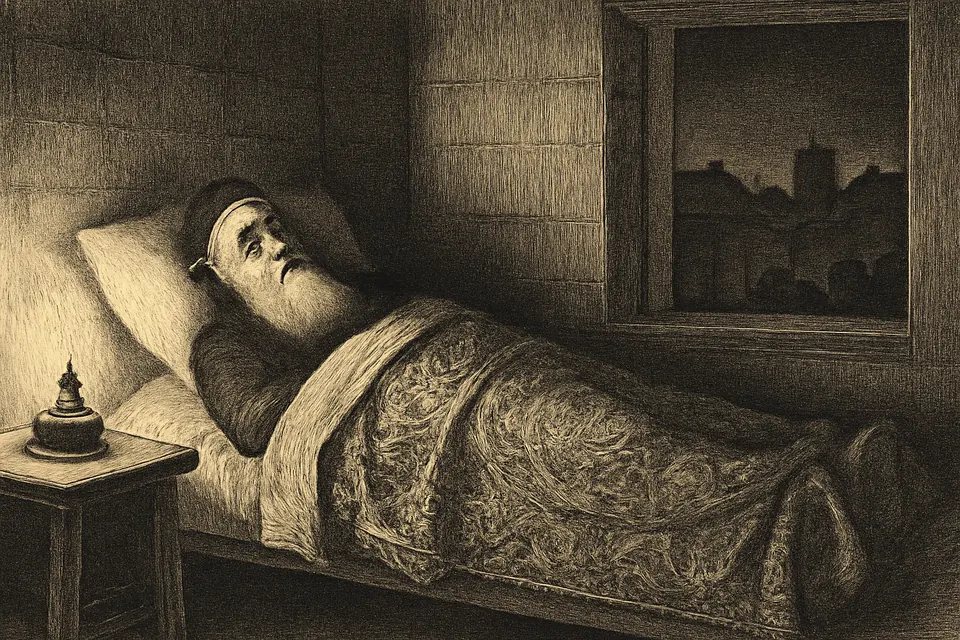
A wealthy citizen saw that the patriarch slept under a cheap blanket and gave him a coverlet worth 36 gold pieces. John slept under it one night and lay awake asking himself how many of "Christ's brethren" were shivering that night while "humble John," as he always called himself, lay under such a thing. In the morning he sold it and gave the money away. The donor bought it back and returned it. John sold it again. It went on like this, and the Catholic Encyclopedia reports John's dry remark: "We will see who tires first." It was not John.
The Orthodox life tells of a beggar who changed his clothes and came back for alms a second and a third time. When the servants wanted to chase him off, John doubled the gift: "Perhaps he is Christ putting me to the test."
The unfinished tomb
John knew that at a Byzantine emperor's coronation the tomb builders came in with samples of marble and asked which stone he wanted for his grave. He copied the custom. He had his own tomb begun and left unfinished, and on great feasts someone would come before him and say, "Your tomb, master, is still unfinished. Allow us, we pray, to finish it because you do not know at what hour the thief will come." He also liked to attend funerals and sit with the dying.
Peace before sunset
Once John and the governor Nicetas quarreled bitterly over a money matter, and both left angry. Late in the afternoon John sent a senior priest to Nicetas with a single sentence: "Master, the sun is nigh setting." Nicetas, "pricked to the soul," as Leontius puts it, burst into tears and came to the patriarch, and the two embraced.
Flight and death
When the Persian army reached Egypt around 617, John sailed with Nicetas for Constantinople. At Rhodes, Leontius says, he saw a radiant figure who told him, "Come, I beg you, the King of Kings is asking for you!" He turned for Cyprus instead and died in Amathus. His short will, dictated there, is the best summary of his life. He thanked God that he had been allowed to die owning only one small coin, a third of a gold piece, "and, as that, too, is God's, I direct that it, too, shall be given to those who are God's."
The miracles of St. John the Merciful
All of John's miracles come down to us through Leontius and the older life, written within a generation of his death. None was formally examined, since his cult long predates canonization.
- The vision of Compassion and the bag of gold: reported, from John's own telling.
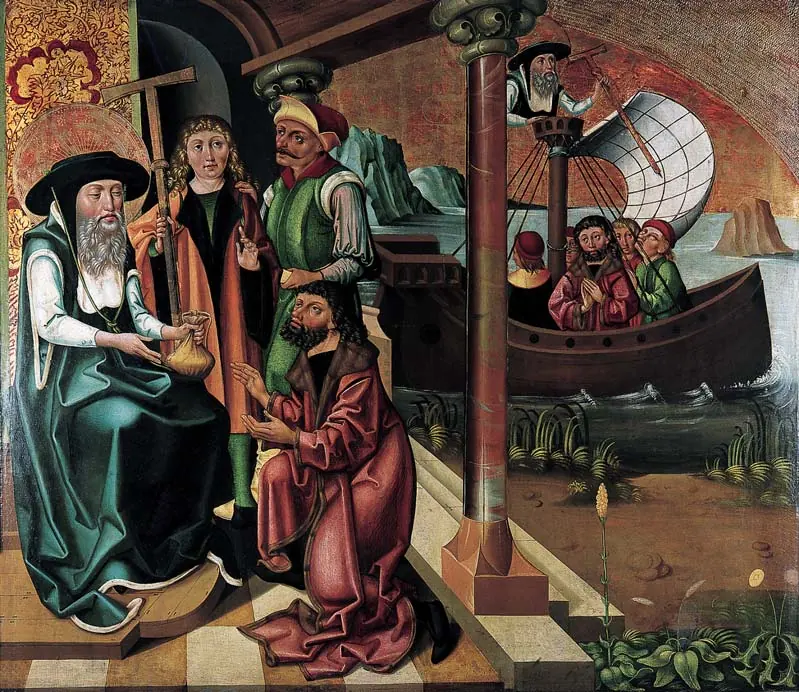
- The ship to Britain: traditional. A ruined shipowner, helped twice in vain, was given a Church ship full of grain. The captain said the patriarch stood by the steersman in a storm, that they reached Britain in a famine and took tin in payment, and that the tin turned to silver on the way home.
- The sealed confession: traditional. A woman too ashamed to speak her sin wrote it down and gave the sealed tablet to John, who died before reading it. After she prayed at his tomb, Leontius says, he appeared with the two bishops buried beside him and gave her back the tablet, with her writing blotted out and new words beneath it: "For the sake of My servant John your sin is blotted out."
- The bishops who made room: traditional. Leontius says that when John was laid in the tomb at Amathus, the bodies of two bishops already there moved apart to receive him.
Why St. John the Almsgiver is a patron of the poor and of the Hospitallers
John never set up an order or wrote a rule, but in the Christian East he became the model of a bishop who treats the goods of the Church as belonging to the poor. We ask his prayers for the poor, for refugees and for all who serve them.
In the West his fame came through the crusades. Merchants from Amalfi founded a hospice for pilgrims in Jerusalem in the 11th century, and the brotherhood that grew from it took him as its first patron. The Catholic Encyclopedia calls him "the original patron saint of the Hospitallers." When that brotherhood became the military Order of St. John, now the Sovereign Military Order of Malta, it adopted St. John the Baptist as its patron. In Malta a chapel in Cospicua still bears the Almsgiver's name. See our patron saints page for others who care for the poor, including St. Vincent de Paul and St. Elizabeth of Hungary.
Symbols of St. John the Merciful in art
John is almost always shown as an old, bearded bishop in the act of giving. Look for:
- A beggar at his feet, or a coin in his hand: the core of his story. Titian's altarpiece in Venice shows him leaning down from a high step to drop a coin to a half-naked beggar.
- A crowd of the poor: Russian icons like Kirill Ulanov's surround him with the sick, the crippled and the hungry.
- A purse: in Western panels he hands money bags to petitioners, as in Jan Goraj's Kraków altarpiece.
- Patriarchal vestments: in Eastern icons a white omophorion marked with crosses and a Gospel book; in Western art a cope and miter, as for any bishop.
In Venice, where many people meet him, the church of San Giovanni Elemosinario near the Rialto bridge still keeps Titian's painting on its high altar.

Feast day and relics of St. John the Merciful
The Roman Martyrology lists St. John the Almsgiver on January 23. The Orthodox Church keeps his memory on November 12, the day after his death on the feast of St. Menas. You can find both dates on our feast days page.
His body did not stay in Cyprus. According to the Catholic Encyclopedia, it was taken to Constantinople, then brought to Buda by King Matthias Corvinus of Hungary, moved in 1530 to a place near Pressburg during the Ottoman wars, and in 1632 placed in Pressburg cathedral, today St. Martin's Cathedral in Bratislava, Slovakia. The Baroque chapel where it lies was designed in the 18th century by the sculptor Georg Raphael Donner and paid for by Archbishop Emeric Esterházy.

Where the relics of St. John the Merciful are kept: see them on the relics map →
Prayer to St. John the Merciful
On his feast the Orthodox Church sings a troparion that praises him for his endurance, his unceasing prayer and his love for the poor, and a kontakion that says he gave away his wealth and gained a heavenly treasure in return, a true namesake of mercy. The OCA prints the full text on its website.
There is no long traditional novena to him in the Latin Church. We honor him best the way he would want: by giving something away. Let us ask St. John the Merciful to pray that we may see Christ in every person who asks us for help, and remember with him that the poor are our masters.
Frequently asked questions
Who was St. John the Merciful?
He was the Patriarch of Alexandria in Egypt from about 610 until the Persian invasion, a Cypriot nobleman who had been married and lost his wife and children before becoming a monk. As patriarch he fed more than 7,500 poor people every day, ransomed captives and refugees, and fought simony. He died in his hometown of Amathus, Cyprus, around 619.
Is St. John the Merciful the same as St. John the Almsgiver?
Yes. His Greek title, Eleemon, means "the merciful" or "the almsgiver," so he appears in English as John the Merciful, John the Almsgiver and John the Almoner. Don't confuse him with St. John Chrysostom, another Greek patriarch, or with the much later St. John the New Merciful.
When is the feast of St. John the Merciful?
January 23 in the Roman Martyrology. The Orthodox Church celebrates him on November 12. He died on November 11, the feast of St. Menas, according to his biographer Leontius.
Why is St. John the Almsgiver connected with the Knights Hospitaller?
The hospice for pilgrims in Jerusalem from which the Order of St. John grew was first placed under his patronage, and the Catholic Encyclopedia calls him the original patron of the Hospitallers. The order later took St. John the Baptist as its patron.
Where are the relics of St. John the Merciful?
His body was taken from Cyprus to Constantinople, given to King Matthias Corvinus of Hungary, and since 1632 has rested in St. Martin's Cathedral in Bratislava, Slovakia, where a Baroque chapel bears his name.
Keep exploring
Sources
- Leontius of Neapolis, Life of St. John the Almsgiver, trans. Elizabeth Dawes and Norman H. Baynes, Three Byzantine Saints (1948), Internet Medieval Sourcebook
- Catholic Encyclopedia (1910): St. John the Almsgiver (Wikisource)
- Orthodox Church in America: Saint John the Merciful, Patriarch of Alexandria
- Orthodox Church in America: Troparion and Kontakion of St. John the Merciful
- Roman Martyrology, January 23