Blessed Hermann of Reichenau, the Disabled Monk Linked to the Salve Regina

Blessed Hermann of Reichenau (1013–1054), called Hermann the Lame, was a German Benedictine monk of Reichenau Abbey who, though he could hardly move or speak, became one of the most learned men of his century. Tradition credits him with the Salve Regina (Hail Holy Queen). His feast is September 24, and he is invoked by people with disabilities.
Who was Blessed Hermann of Reichenau?
Blessed Hermann of Reichenau was a Benedictine monk of the 11th century who could barely move his body and yet taught half of Europe's scholars. Born on July 18, 1013, at Altshausen in Swabia, the son of Count Wolfrat II, he was so disabled that he could not stand, could not turn over in bed by himself, and spoke only with great effort. His name in Latin, Hermannus Contractus, means Hermann the Crippled, and in German he is still Hermann der Lahme, Hermann the Lame.
His parents placed him, at about seven, with Abbot Berno at the great abbey of Reichenau, an island in Lake Constance. He never left. There he became a monk, a priest, a teacher and one of the brightest minds of his age, and there, tradition holds, he wrote the prayer we still sing at the end of every rosary: the Hail Holy Queen.

The life of Blessed Hermann
A scholar in a carrying chair
The Catholic Encyclopedia says that he learned to read and write only with great effort, then went on to study theology, mathematics, astronomy and music, along with Latin, Greek and Arabic. Students came to him from many regions. He went everywhere in a carrying chair, unable to leave the monastery, and his mind did the rest.
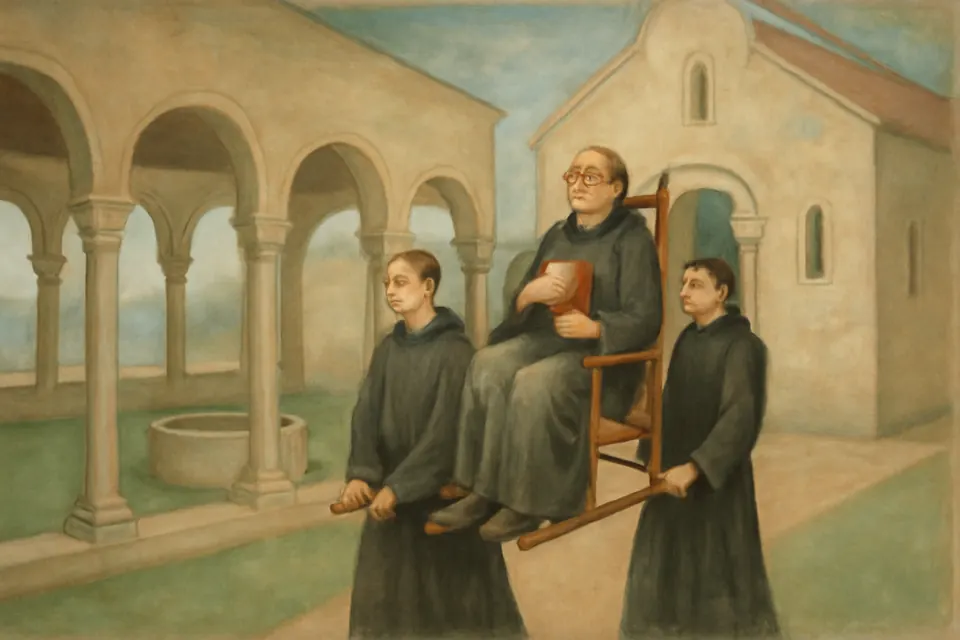
He took his monastic vows in 1043 and, according to the Ökumenisches Heiligenlexikon, was ordained a priest around the same time, although the law of the day normally barred men with his disabilities from the altar. Abbot Berno, a learned man himself, valued him and his holy life.
What he made
Hermann wrote a world chronicle running from the birth of Christ to 1054, the year of his death. The Catholic Encyclopedia calls it "the earliest of the medieval universal chronicles now extant." He wrote treatises on the calendar and on eclipses, described how to build astrolabes, sundials and other instruments, and devised a system of letters to fix the pitch of chant melodies. He wrote Latin hymns to St. George, St. Afra and St. Wolfgang, and a long poem on the eight principal vices, written for nuns.

His pupil Berthold, who wrote his life, remembered him as always cheerful and easy to be with, fond of a good argument, but fierce when he saw injustice.
His death
In September 1054 he fell gravely ill. He died after ten days, on September 24, with his brothers and family around him. He was probably buried in the family vault at Altshausen, where the monks of Reichenau soon founded a small priory beside his grave.
The Salve Regina and Alma Redemptoris Mater
For centuries Hermann was named as the author of two of the four great Marian antiphons of the Church: the Salve Regina, which we pray as the Hail Holy Queen, and the Advent antiphon Alma Redemptoris Mater. The Catholic Encyclopedia of 1912 says the authorship of the Salve "is now generally ascribed to Hermann Contractus" and that "the exquisite plainsong has been attributed to Hermann Contractus" as well. More recent writers, including the Ökumenisches Heiligenlexikon, note that his authorship of both is now doubted.
We can hold the tradition honestly. Whoever first wrote "poor banished children of Eve ... mourning and weeping in this valley of tears," the words fit a man who spent his whole life in a body that would not obey him and still called Mary "our life, our sweetness and our hope."

Miracles of Blessed Hermann
There are no miracles formally approved by the Church for Hermann, and he has never been canonized. A Baroque tradition, shown in the fresco at Ossiach and in other paintings, has the Virgin Mary appear to him at his work; this is a traditional image, not a recorded event from his life. The wonder that his contemporaries saw was his life itself.
Why he is the patron of people with disabilities and church music
Hermann is invoked by people with disabilities, since he lived his whole life severely disabled and served God fully within it, and by musicians, as a patron of church music for his chant, his music theory and the antiphons linked to his name. In 1762 Joseph Wannenmacher painted him beside St. Gregory the Great as patrons of church music in the abbey church of St. Gallen. See our patron saints page for more.
Symbols of Blessed Hermann in art
Hermann is recognized as a Benedictine monk in a black habit (sometimes painted brown) who sits in a chair or leans on a crutch. He often holds or points to a book open at the words Salve Regina, as on the Reichenau stove tile. Because of his science, he may hold an astrolabe or sit among globes and instruments, as in the library fresco at St. Gerold. Baroque painters show the Virgin and Child appearing to him. The oldest known image, from about 1320 in the church of St. Michael at Veringendorf, where he was baptized, already shows him before Mary and the Child.
The Nuremberg Chronicle of 1493 gives him an imagined woodcut portrait of a scholar with a book, like the other learned men in its pages.

Feast day, relics and Reichenau
We keep his feast on September 24, the day of his death. His grave at Altshausen was opened around 1630, when the family remains were reburied, and his relics were shared among several monasteries. A skull relic is displayed in the Schlosskirche of St. Michael in Altshausen, and a statue of him has stood in front of that church since 2013, the thousandth anniversary of his birth. At Reichenau, the island where he lived and taught, the old abbey church of St. Mary and St. Mark still stands. You can find other feasts on our feast days page.

Where the relics of Blessed Hermann of Reichenau are kept: see them on the relics map →
Prayer with Blessed Hermann
There is no traditional prayer addressed to Blessed Hermann. The best way to pray with him is to pray the antiphon that bears his name. This is the English text as printed in the 1878 Raccolta:
Hail, holy queen, mother of mercy, our life, our sweetness, and our hope; to thee do we cry, poor banished sons of Eve, to thee do we send up our sighs, mourning and weeping in this valley of tears. Turn then, most gracious advocate, thine eyes of mercy toward us, and after this, our exile, show unto us the blessed fruit of thy womb, Jesus. O clement, O loving, O sweet Virgin Mary!
Let us ask Blessed Hermann to pray for all who live with disability and pain, and for all who sing God's praise.
Blessed Hermann of Reichenau, pray for us.
Frequently asked questions
Did Blessed Hermann of Reichenau write the Salve Regina?
Possibly. The Catholic Encyclopedia of 1912 says the authorship "is now generally ascribed to Hermann Contractus" and credits him with the melody too. Recent scholars are less sure and treat it, like the Alma Redemptoris Mater, as a long tradition rather than a proven fact.
Why is he called Hermann the Lame?
Contractus means "contracted" or crippled. He was disabled, probably from birth, could not stand or turn over in bed without help, moved only in a carrying chair and spoke with difficulty.
When is the feast of Blessed Hermann of Reichenau?
September 24, the anniversary of his death in 1054. It is a local feast, kept especially in the dioceses around Lake Constance and Upper Swabia.
Is Hermann of Reichenau a saint?
He has been called blessed since his own lifetime and has a long local cult, but the Church never formally canonized him.
Keep exploring
Sources
- Catholic Encyclopedia (1910): Hermann Contractus. His learning, the chronicle as the earliest surviving medieval universal chronicle, and the hymns credited to him
- Catholic Encyclopedia (1912): Salve Regina. The attribution of the text and melody to Hermann, quoted
- Ökumenisches Heiligenlexikon: Hermann der Lahme. Birth date, priesthood about 1043, death after ten days of illness, burial at Altshausen, the relics, the 1745 to 1762 artworks and the doubts about the Marian antiphons
- The Raccolta, or Collection of Prayers and Good Works (1878 English edition). The English text of the Salve Regina, quoted