St. Andrew of Crete, Author of the Great Canon
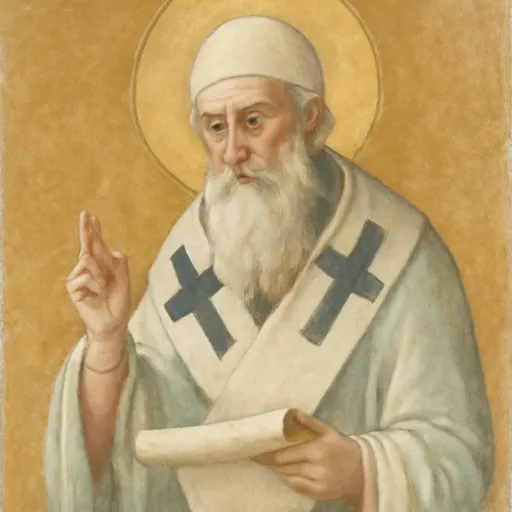
St. Andrew of Crete (about 660 to 740) was a monk of Jerusalem from Damascus who became archbishop of Gortyna in Crete and one of the Church's great hymn writers. He wrote the Great Canon of Repentance, 250 verses still sung in Byzantine churches every Lent. His feast day is July 4.
Who was St. Andrew of Crete?
St. Andrew of Crete was a monk, preacher and archbishop of the late 600s and early 700s, and he gave the Church one of its great prayers of repentance. Born in Damascus around 660, he served the Church of Jerusalem, worked in Constantinople and spent his last decades as archbishop of Gortyna, the old capital of Crete. He died on July 4, 740, on the island of Lesbos.
He is remembered above all for the Great Canon of Repentance, a hymn of 250 verses that Byzantine Christians still sing every Lent. The Catholic Encyclopedia credits him with inventing the canon itself, or at least bringing it into the Greek services, and it became the main form of hymn in the Eastern Church.
The life of St. Andrew of Crete
A boy from Damascus
Andrew grew up in a Christian family in Damascus, which had been under Muslim rule for a generation. The Orthodox Church in America's life of the saint says he could not speak until he was seven, and that he found his voice after receiving Holy Communion. This is traditional, and it is a fitting story for a man whose words would be sung for thirteen centuries.

Monk of Jerusalem
At about fifteen he went to Jerusalem and became a monk, the OCA says at the Lavra of St. Sabbas. He was enrolled among the clergy of Theodore, who governed the Church of Jerusalem, which is why older writers call him Andrew of Jerusalem. In 685, according to the Catholic Encyclopedia, Theodore sent him to Constantinople to congratulate Emperor Constantine IV on the Sixth Ecumenical Council, which had taught that Christ has two wills, divine and human.
Deacon in Constantinople
Andrew stayed in the capital and was ordained a deacon at Hagia Sophia. Nominis, the saints' calendar of the French bishops, adds that he ran the city's orphanage for a time. Then he was named archbishop of Gortyna in Crete, probably around 700.
Bishop of Crete, and a stumble
The Catholic Encyclopedia tells a part of the story that the hymns don't. In 712 Andrew attended a synod called under Emperor Philippicus that threw out the decrees of the Sixth Council. The next year he changed course and returned to the faith of the council. We tell this honestly because the Great Canon is a hymn of a man who knew his own weakness. Nominis mentions a tradition that the canon grew out of his sorrow over a personal failure in Constantinople.
He spent his remaining years preaching, writing hymns and caring for his people. Returning from a journey to Constantinople, he died at Eressos on Lesbos. The year is disputed: the Roman Martyrology gives 740, while the OCA notes that some historians prefer 712 or 726.
The Great Canon of St. Andrew
A canon is a set of nine odes, each built of short verses, sung at Matins and other services. Andrew's Great Canon is the longest ever written. The Catholic Encyclopedia says its length, 250 strophes, "has passed into a proverb with the Greeks."
It walks through Scripture from the fall of Adam to the coming of Christ. In each verse the singer speaks to his own soul and holds up a figure from the Bible, sometimes a sinner to avoid and sometimes a penitent to follow. Before every verse, the OCA explains, the faithful make the sign of the cross, bow, and sing:
Have mercy upon me, O God, have mercy upon me.
The canon is divided into four parts and sung at Great Compline on the first four evenings of Great Lent. On Thursday of the fifth week it is sung whole, together with the life of St. Mary of Egypt, the great penitent of the desert. Many Eastern Catholic parishes keep the same custom.
His other hymns and sermons
The Catholic Encyclopedia lists canons by Andrew on the raising of Lazarus, still sung before Palm Sunday, on the conception of the Mother of God by St. Anne, on the Maccabean martyrs and on St. Ignatius of Antioch. The Catholic Encyclopedia counts some forty sermons under his name, among them homilies on the Mother of God. The Roman Martyrology praises him for exalting the Virgin Mother of God, immaculate and taken up into heaven.
The miracles of St. Andrew of Crete
Few miracles are told of him. The one story the OCA records is the boy who could not speak until he received Communion, which is traditional. His real legacy is his hymns. The relics of the saint were carried to Constantinople, and a Russian pilgrim, Stephen of Novgorod, saw them there in 1350 in a monastery named for him. We don't know where they are today.
Why St. Andrew of Crete is honored by church singers
The Church never gave Andrew a formal patronage. On this site we list him with the patron saints of church singers, beside St. Romanos the Melodist, because cantors and choirs of the Byzantine rite sing his work every Lent and his troparion praises him for having "sung a new song in the assembly of the righteous."
Symbols of St. Andrew of Crete in art
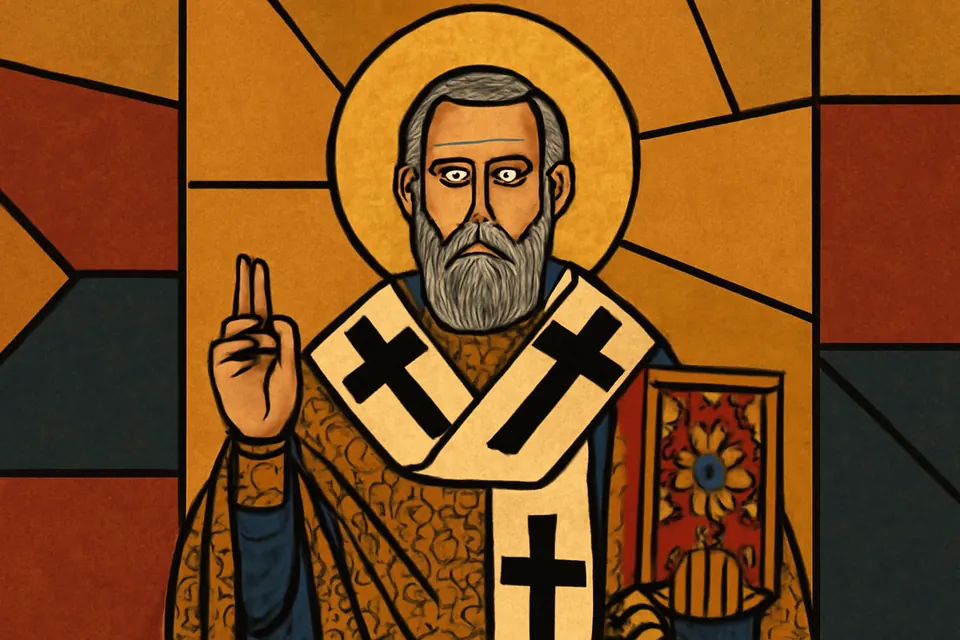
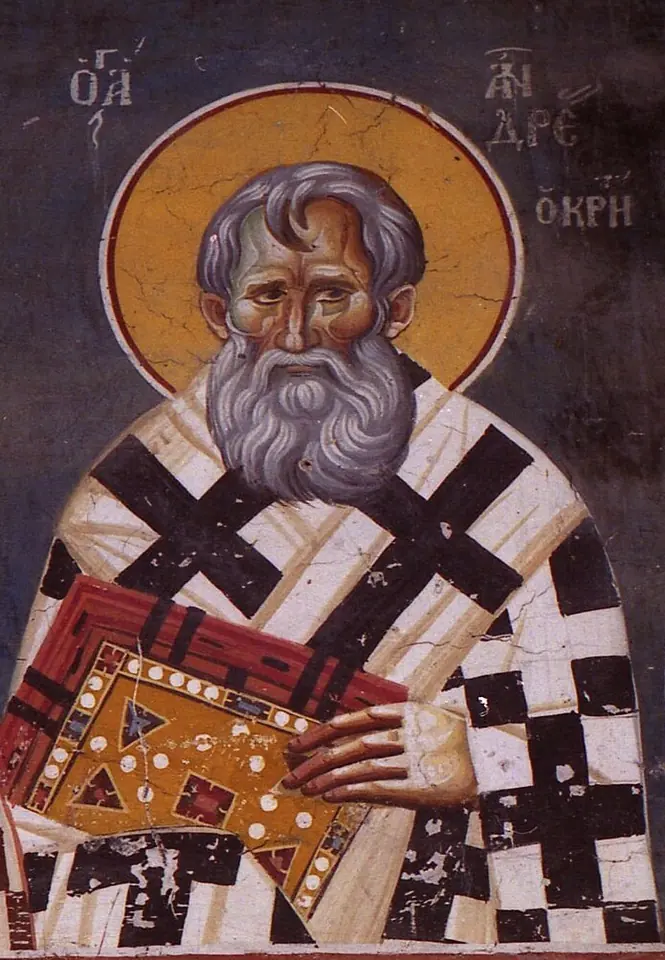
Andrew appears in Byzantine and Russian icons and frescoes as a bishop, and almost never in Western art. Look for:
- The omophorion with crosses: the white band of a bishop over a white robe, often checkered with black crosses in Athonite painting.
- A Gospel book: his office as bishop and preacher.
- A scroll: in later icons it carries words of his hymns.
- A long white or gray beard: the elder hierarch of the East.
The Greek inscription usually reads "Andreas of Crete." In the icon on this page he stands with St. Mary of Egypt, which tells you at once that you're looking at the author of the Great Canon and not at Andrew the Apostle, who is shown with an X-shaped cross.
St. Andrew of Crete's feast day
We keep his feast on July 4, the day he died, as the Roman Martyrology and the Eastern calendar both do. You can find his neighbors on our feast days page. His great day in the year, though, falls in Lent, wherever the Great Canon is sung.

Prayer to St. Andrew of Crete
The Orthodox Church in America gives these traditional hymns for his feast. The troparion, tone 5:
Emulating David / you sang a new song in the assembly of the righteous. / As an initiate of the Holy Spirit you guided us with hymns of grace / and the word of righteousness for our salvation, / O Andrew, glory of the Fathers.
The kontakion, tone 2:
Trumpeting forth divine melodies, / you were shown as a far-shining luminary for the world. / You shone forth with the radiant light of the Trinity, O Venerable Andrew. / Therefore we all cry to you: "Do not cease to intercede for us all."
Let us ask St. Andrew to pray for us when we can't find words for our own repentance, and borrow his: "Have mercy upon me, O God, have mercy upon me."
Frequently asked questions
What is the Great Canon of St. Andrew of Crete?
A long hymn of repentance, 250 verses in nine odes, that walks through the whole Bible from Adam to Christ and asks for mercy after each verse with the refrain "Have mercy upon me, O God, have mercy upon me." Byzantine churches sing it in four parts on the first four evenings of Lent and in full on Thursday of the fifth week of Lent.
When is the feast day of St. Andrew of Crete?
July 4, the day of his death in 740, in both the Roman Martyrology and the Eastern calendar.
Is St. Andrew of Crete the same as St. Andrew the Apostle?
No. St. Andrew the Apostle, Peter's brother, lived in the first century. Andrew of Crete was a bishop and hymn writer of the late 600s and early 700s. There is also a second St. Andrew of Crete, a monk martyred in 767 for defending icons, honored on October 17.
When is the Great Canon of St. Andrew prayed?
In the Byzantine rite, at Great Compline on Monday through Thursday of the first week of Great Lent, and in its entirety at Matins on Thursday of the fifth week, when the life of St. Mary of Egypt is also read.
Keep exploring
Sources
- Catholic Encyclopedia (1907): St. Andrew of Crete. Mission to Constantinople in 685; the synod of 712 and his change of course in 713; the 250 strophes of the Great Canon; his canons on Lazarus and the conception of St. Anne
- Orthodox Church in America: Saint Andrew, Archbishop of Crete. Mute until seven; the use of the Great Canon in Lent and its refrain; his relics in Constantinople, seen in 1350
- Orthodox Church in America: Saint Andrew, Archbishop of Crete, Troparion and Kontakion. Texts of the troparion and kontakion quoted
- Nominis (Conférence des évêques de France): Saint André de Crète. The orphanage in Constantinople; his death at Eressos; the Roman Martyrology entry for July 4