St. William of Maleval

St. William of Maleval (died 1157) was a penitent hermit of Tuscany, probably French, who after a wild youth as a soldier went on pilgrimage to Jerusalem and then lived in fierce penance in a lonely valley called Maleval. His disciples Albert and Raynald began the Hermits of St. William, the Williamites. We keep his feast on February 10.
Who was St. William of Maleval?
St. William of Maleval was a man who came out of nowhere to do penance and left behind a religious order. Nobody knows where he was born or who his family were. Butler says he "seems to have been a Frenchman" and is "thought to have passed his youth in the army," living the loose life too common among soldiers. Baring-Gould adds that he kept an "impenetrable secrecy" about his early years. What we know begins with his conversion.
He died on February 10, 1157, in a desolate valley in the Tuscan Maremma called Maleval, "the bad valley." There his first two disciples buried him in his little garden, and from his grave grew the Hermits of St. William, who spread across Europe.
We should be honest about the sources. His friend Albert, who lived with him in his last year, wrote down his death, but that life is lost. The Catholic Encyclopedia warns that the later life by Theodobald "is unreliable, having been interpolated with the lives of at least two other Williams." So the outline below keeps to what the older witnesses support.
The life of St. William of Maleval
The penitent pilgrim
The first picture we have of William is of a penitent on the road to Rome, praying at the tombs of the apostles. There he asked Pope Eugene III to give him a penance, and the pope sent him on pilgrimage to Jerusalem. The Catholic Encyclopedia says the visit and the pilgrimage are supported by fragments of the older life preserved in the antiphons and responsories of his feast. Butler dates the pilgrimage to 1145 and says it lasted eight years. The Catholic Encyclopedia thinks he stayed in Jerusalem only "one or two years."
Searching for solitude in Tuscany
About 1153 he came back to Italy and hid himself on the island of Lupocavio, in the territory of Pisa. Others gathered around him and asked him to lead them as a monastery, but their fervor soon cooled, and he could not bear their laxity. He moved to Monte Pruno and built a hut of boughs in the forest, only to be driven out by idlers who had come for alms rather than prayer. In the end, Butler says, he "was determined to pursue himself that rigorous plan of life which he had hitherto unsuccessfully proposed to others."
The bad valley
In September 1155 he entered the valley then called the Stable of Rhodes, later Maleval, near Castiglione della Pescaia in the diocese of Grosseto. At first he sheltered in a hole in the ground. For four months he ate only herbs and roots, with no company but the wild beasts, until the lord of Buriano took pity on him and built him a cell.
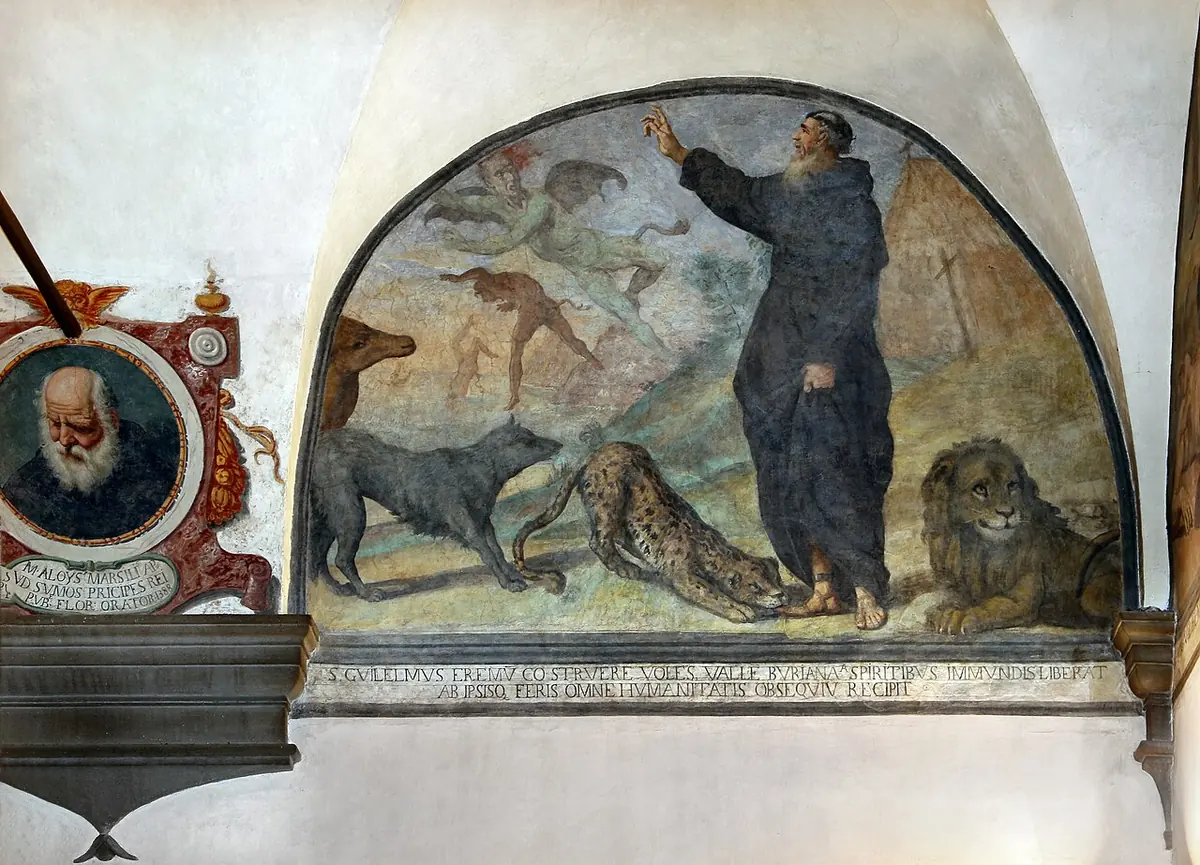
At the start of 1156 a young man named Albert came to stay with him. William lay on the bare ground and drank only water. Baring-Gould says that three days a week he took only a little bread and watered wine. He prayed, worked with his hands, and taught Albert as they worked. He spoke of himself, Butler says, as "the most infamous of criminals."

His death
Thirteen months later William was dying. He received the sacraments from a priest of Castiglione and died in Albert's arms on February 10, 1157. A physician named Raynald had arrived just in time to join them. Together the two men buried their master in his garden, built a small chapel over the grave, and tried to live by his teaching.

Miracles and legends
Butler says simply that William "had the gift of miracles, and that of prophecy." One story of prophecy comes from Albert's own account as Baring-Gould retells it, and it is traditional: when Albert grieved that he would be left alone, William told him God would soon send a companion. Albert went out and met Raynald on the path.
Many later wonders are traditional legends, some of them borrowed from other Williams: Poccetti's cycle in Florence shows him killing a dragon near Castiglione, being struck by a demon and healed by two heavenly maidens, and making a donkey carry overturned barrels without spilling them. The Church approved his cult in 1202, under Pope Innocent III.
Symbols of St. William of Maleval in art
St. William is one of the easiest hermits to spot, because he so often wears armor:
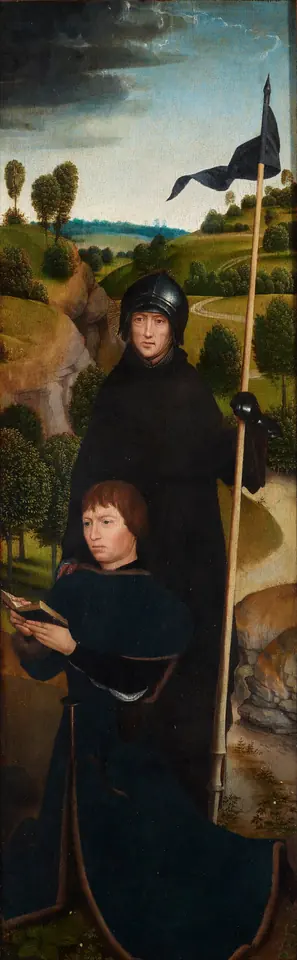
- Armor or a helmet with a hermit's habit. This shows the soldier turned penitent. Memling paints him in a steel helmet over his habit, holding a banner.
- St. Bernard and a fallen knight. Baroque painters such as Cornelis Schut show Bernard of Clairvaux converting an armored William. That scene really belongs to Duke William X of Aquitaine, a sign of how the stories were mixed.
- Wild beasts at his feet. Lions, wolves and leopards recall his months alone in the valley.
- A dragon. From the Tuscan legend that he freed the countryside of one.
- The black habit and pilgrim's staff of a hermit and pilgrim.

The Hermits of St. William
The community at his grave grew into the Williamites, or Hermits of St. William. The Catholic Encyclopedia says they "quickly spread over Italy, Germany, France, Flanders, and Hungary." At first they went barefoot and fasted almost without end. Pope Gregory IX eased their rule in 1229 and gave many houses the Rule of St. Benedict. When Pope Alexander IV gathered the hermit groups into the Hermits of St. Augustine in 1256, many Williamites joined; others stayed apart. Their chief German house at Grevenbroich passed to the Cistercians in 1628, and the last German house closed in 1785.

Feast day and where he is honored
We keep St. William's feast on February 10. Butler notes that he was honored in the Paris Missal and Breviary, and that his feast was kept at the abbey of the Blancs-Manteaux in Paris. The hermitage of Malavalle, in the woods between Castiglione della Pescaia and Tirli, still stands in ruins. You can find other saints of early February on our feast days page.
Praying with St. William of Maleval
No traditional prayer to St. William of Maleval is in common use today. We ask his help simply: "St. William, pray for us." He is a natural patron for anyone turning back to God after years far from Him, for soldiers and veterans who want peace of heart, and for all who seek silence.
Let us ask St. William to teach us the courage of real repentance, and to keep us faithful when the people around us grow lukewarm.
Frequently asked questions
Who was St. William of Maleval?
A twelfth-century hermit, probably French, who is thought to have spent his youth in the army. After a pilgrimage to Rome and Jerusalem he settled in Tuscany, and from 1155 lived in the desolate valley of Maleval near Castiglione della Pescaia, where he died on February 10, 1157.
When is the feast of St. William of Maleval?
February 10, the day of his death, as in the Roman Martyrology.
Why is St. William of Maleval shown in armor?
Painters show him as a soldier-turned-hermit, with armor or a helmet under or beside his habit. Part of this reflects his reported military youth, and part comes from a later life that mixed him up with St. William of Gellone and with Duke William of Aquitaine, both warriors.
What are the Williamites?
The Hermits of St. William, founded by his disciples Albert and Raynald at his grave. They spread through Italy, France, Flanders, Germany and Hungary; many of their houses joined the Augustinian friars in 1256, and the last German house closed in 1785.
Keep exploring
Sources
- St. William of Maleval, Catholic Encyclopedia (1912), New Advent. The lost life by Albert, the unreliable life by Theodobald, the visit to Eugene III, a stay of one or two years in Jerusalem, and the 1202 approval
- Williamites, Catholic Encyclopedia (1912), New Advent. The founding by Albert and Renaldus, the mitigation by Gregory IX in 1229, the 1256 union, and the end of the order
- Alban Butler, The Lives of the Fathers, Martyrs, and Other Principal Saints, vol. 2 (London: J. Murphy, 1812), February 10, Internet Archive. His probable French birth, his youth in the army, Lupocavio and Monte Pruno, the lord of Buriano's cell, his burial in his garden, quoted on this page
- Sabine Baring-Gould, The Lives of the Saints, vol. 2: February (Edinburgh: John Grant, 1914), February 10, Internet Archive. His penances, the prophecy of Raynald's coming, and his death in Albert's arms