St. Victoria of Albitina (Abitina)

St. Victoria of Albitina (Abitina) was a woman of Roman Africa, one of the 49 martyrs of Abitina arrested at Sunday Mass in 304. When her brother tried to free her by blaming others, she told the proconsul she had come of her own will, because she was a Christian. Her feast, with her companions, is February 12.
Who was St. Victoria of Albitina?
St. Victoria of Albitina was a young Christian woman from Abitina, a small town in the Roman province of Africa, in present-day Tunisia. One Sunday in 304, during the persecution of Diocletian, she and her fellow Christians were arrested while celebrating the Eucharist, which the emperor had forbidden. At Carthage, before the proconsul Anulinus, she refused every chance to go free. We honor her with the martyrs of Abitina on February 12. The name of her town is also spelled Abitinae, Abitene or Albitina.
The martyrs of Abitina
Diocletian's edicts of 303 ordered Christians to hand over the Scriptures, tore down their churches and banned their assemblies. At Abitina, a group of believers kept meeting anyway, led by the priest Saturninus, who came with four of his children. Pope Benedict XVI told their story at the Eucharistic Congress in Bari in 2005:
In Abitene, a small village in present-day Tunisia, 49 Christians were taken by surprise one Sunday while they were celebrating the Eucharist, gathered in the house of Octavius Felix, thereby defying the imperial prohibitions.
They were chained and taken to Carthage. According to St. Augustine, their trial before Anulinus took place on February 12, 304.

When the proconsul asked the lector Emeritus why they had disobeyed the emperor, he answered in words the Church has never forgotten: "Sine dominico non possumus." Benedict XVI explained them: "we cannot live without joining together on Sunday to celebrate the Eucharist."
Victoria before the proconsul
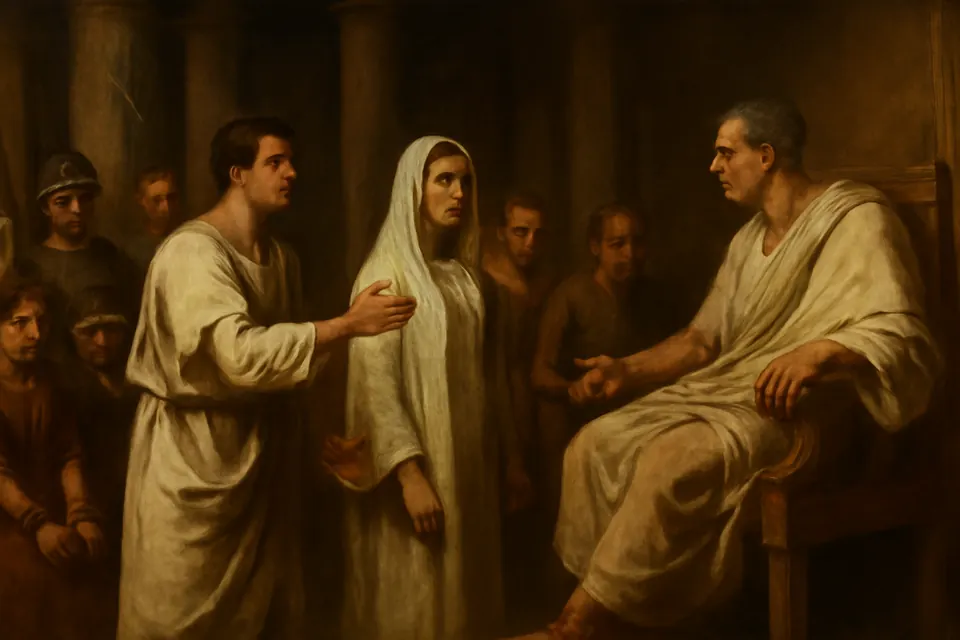
Victoria's moment came in the middle of the trial. The Martyrdom names, among the prisoners, a senator called Dativus. Victoria's brother, who was not a Christian, came forward and accused Dativus of having lured his sister into the faith. It was a way to save her: if she had been led astray, she could be sent home. Victoria would not take it. She answered that she had become a Christian, and had come to the assembly, on her own initiative.
Later that day Anulinus tried again. He asked whether she wanted to go free with her brother. She declined and declared that she was a Christian. The proconsul sent her to prison with the others.
Her vow of virginity
The Martyrdom stops to praise her. From childhood, it says, "a most chaste firmness of mind" was visible in her. When she came of age, her parents forced a marriage on her against her will, and she fled on the wedding day by throwing herself from a height. The account says she was "supported by compliant breezes" and set down unharmed on the earth. She remained a consecrated virgin in the Church.
The miracles of St. Victoria
- Traditional: her escape from the forced marriage, when, the Martyrdom says, the air bore her safely to the ground. It is the only wonder the text tells of her. We read it as the author's way of saying that God protected her consecration, not as an example to follow.
How do we know her story?
We should be honest about the source. The Martyrdom of Saturninus, Dativus and companions survives in a form shaped by the Donatist party of North Africa, which broke from the Church after the persecution. The Oxford Cult of Saints database, edited by Stanisław Adamiak, notes that most scholars date the text as we have it to the 5th century, written over an earlier and more faithful record of the trial. Its closing chapters attack the bishop of Carthage, Mensurius, and are clearly polemic.
The trial scenes are another matter. Augustine knew of the trial and its date, the martyrs' names are listed in the Roman Martyrology, and the Church has honored them as her own. Benedict XVI chose their words as the theme of the Italian Eucharistic Congress of 2005.
The account does not say how Victoria died. It says only that the martyrs "in diverse places and at various times... poured out their most blessed blood." Some were flogged to death on the day of the trial; others, it seems, died in prison.
Symbols of St. Victoria in art
No ancient image of Victoria survives, and she is rarely painted on her own. Where she appears, look for:
- A martyr's palm: her confession before Anulinus and her death for Christ.
- A lily: the virginity she protected when she fled the forced marriage.
- A veil: her life as a consecrated virgin.
- Chains: the chains in which the Christians of Abitina were taken to Carthage.
Feast day and prayer
We keep the feast of Victoria and the martyrs of Abitina on February 12. Her companions included the priest Saturninus and his children, the senator Dativus, the lector Emeritus and nineteen women. See the feast day calendar for the other saints of February.
There is no traditional prayer to St. Victoria alone. Her witness belongs to every Sunday: the Mass she would not give up. Before Mass, let us ask her and her companions to pray that we never take the Lord's day for granted (prayer before Mass). St. Victoria and all the martyrs of Abitina, pray for us.
Frequently asked questions
Who was St. Victoria of Albitina?
A young woman of Abitina, a town in Roman Africa in present-day Tunisia, who was arrested with her fellow Christians while celebrating the Eucharist on a Sunday in 304. At Carthage she confessed her faith before the proconsul Anulinus and refused to be released into her brother's care.
Who were the martyrs of Abitina?
Forty-nine Christians, men, women and children, led by the priest Saturninus, who kept gathering for Sunday Mass despite Diocletian's ban. Pope Benedict XVI recalled their words "Sine dominico non possumus," "without Sunday we cannot live."
How did St. Victoria die?
We do not know. The account of the trial ends with Victoria sent back to prison, and says only that the martyrs shed their blood "in diverse places and at various times." Some died under torture and some, it seems, in prison.
When is the feast of St. Victoria of Albitina?
February 12, the day the Roman Martyrology commemorates the martyrs of Abitina, which is also the date of their trial.
Keep exploring
Sources
- Cult of Saints in Late Antiquity (University of Oxford), E07672: The Latin Martyrdom of the Martyrs of Abitina. The text and its dating, Victoria's brother and Dativus, her answer, the forced marriage and the leap (quoted), the Donatist shaping of the text, Usuard's martyrology
- Benedict XVI, homily at the closing of the Eucharistic Congress, Bari, May 29, 2005. The 49 Christians, the house of Octavius Felix, Emeritus and "Sine dominico non possumus" (quoted)
- Santi e Beati: Santi Martiri di Abitene. The Roman Martyrology entry, Augustine's date of February 12, 304, and the list of names