St. Bibiana, Virgin and Martyr of Rome
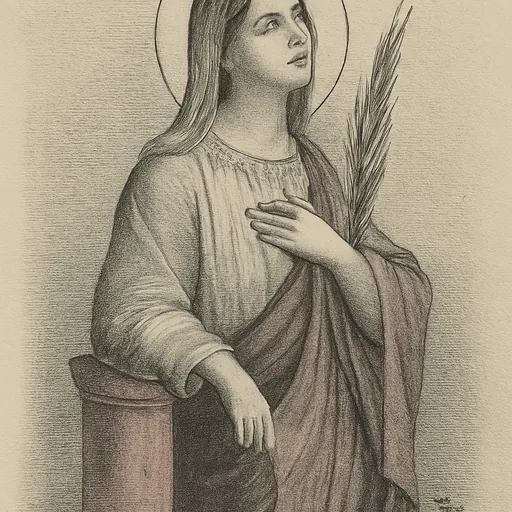
St. Bibiana (also called Viviana or Vivian) was a young Christian woman of Rome, honored as a virgin martyr since at least the 5th century, when Pope Simplicius consecrated a church over her body on the Esquiline Hill. Her legend says she was scourged to death at a pillar under the emperor Julian the Apostate about 363. Her feast day is December 2, and she is invoked against epilepsy, headaches and mental illness.
Who was St. Bibiana?
St. Bibiana was a young Christian woman of Rome who died for her faith in the 4th century and has been honored as a virgin and martyr ever since. Her name also appears as Viviana, Vivian and Bibiane. Her church still stands on the Esquiline Hill, a few steps from Rome's main railway station, and her relics lie under its high altar beneath one of the first statues the young Gian Lorenzo Bernini made for a church.
What history can say about her is brief. The Liber Pontificalis, the ancient book of the popes, records that Pope Simplicius (468–483) "consecrated a basilica of the holy martyr Bibiana, which contained her body, near the 'palatium Licinianum'," the old imperial gardens of Licinius. So by the late 5th century the Roman Church honored her as a martyr and kept her body inside the city walls, which was unusual. The Catholic Encyclopedia, written by the historian Johann Peter Kirsch, adds plainly: "We have no further historical particulars concerning the martyr or the circumstances of her death."

Everything else comes from her Acts, a legend written later and woven into the story of the Roman martyrs John and Paul. The Church read that legend for centuries in the Roman Breviary on her feast, and painters and sculptors drew from it. We tell it below as legend, and then come back to what the old stones and documents say.
The legend of St. Bibiana
The Acts of St. Bibiana set her story in the reign of Julian the Apostate (361–363), the emperor who was raised a Christian and tried to restore the worship of the old gods. Alban Butler, in the 18th century, retold the story from these Acts while warning that they were "disfigured by interpolations." The Roman Breviary used the same story for the lessons of her feast.
A Christian family
Bibiana was born in Rome to a noble family. Her father, Flavian, had been prefect of the city, and her mother, Dafrosa, was a Christian like him. They had two daughters, Bibiana and Demetria.
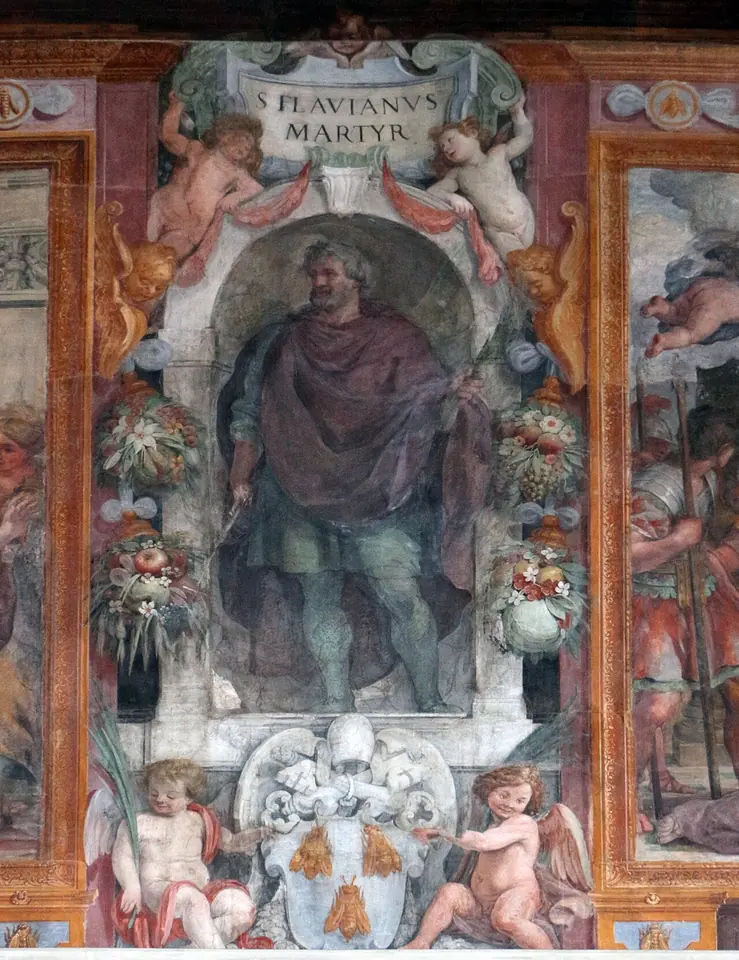
Under Julian, the legend says, Flavian was stripped of his rank, branded on the face like a slave and sent into exile at Aquae Taurinae, near today's Acquapendente north of Rome, where he soon died of his wounds. The Church remembers him as St. Flavian. Dafrosa was shut up in her house with her daughters, so that hunger would break them, and later taken outside the city and beheaded.
Two sisters alone
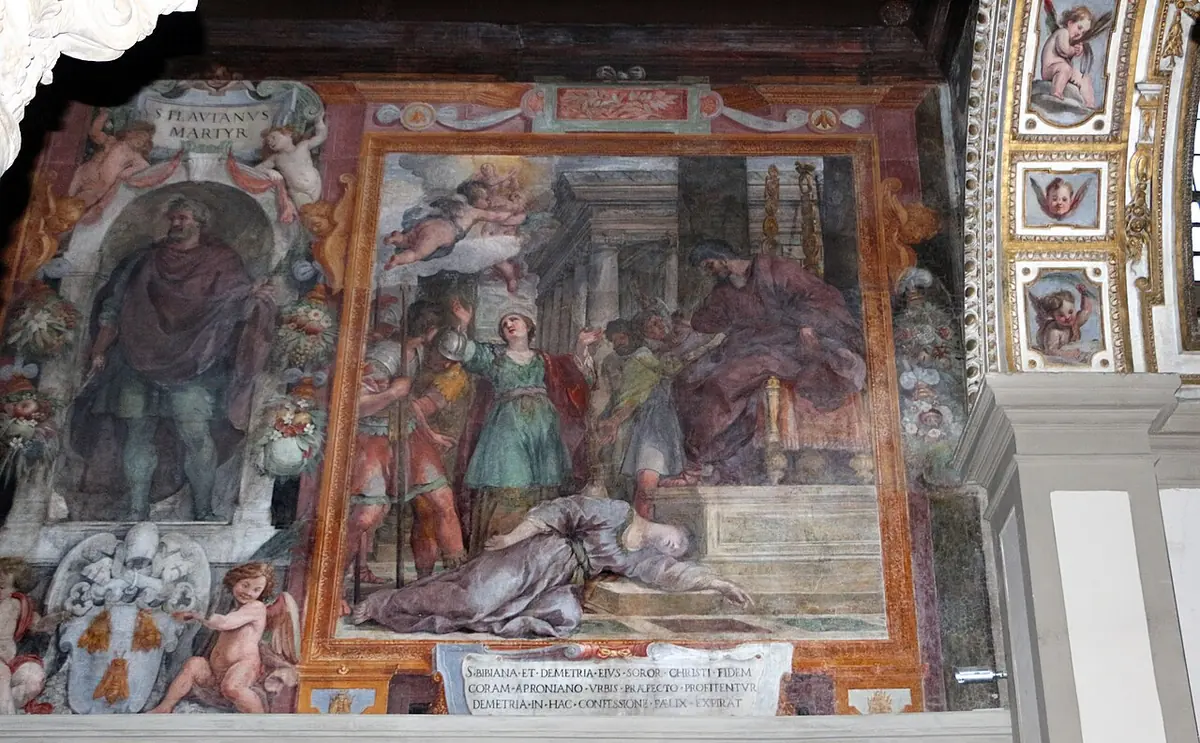
With their parents dead, Bibiana and Demetria were stripped of everything they owned. The new prefect of Rome, Apronianus, wanted their property. For five months the sisters lived in their empty house, fasting and praying. The Breviary says that God, "Who giveth bread to the hungry, fed them," so that when Apronianus called them in, he was amazed to find them stronger and healthier than before.

Apronianus tried promises first: their property returned, the emperor's favor, rich marriages, if they would honor the gods. If not, prison, the rods and the axe. The sisters refused. Then, in the words of the Breviary, Demetria "fell down suddenly, and died in the Lord, before the eyes of her sister Bibiana."
Rufina
Apronianus handed Bibiana over to a woman named Rufina, whom the Breviary calls "an artful woman," to corrupt her and turn her from her faith. Rufina tried flattery and argument and then beat her daily. Bibiana held firm. The legend makes a point that the old Roman martyr stories often made: a young woman who seemed to have no defenses at all proved stronger than the people who held power over her.

The pillar and the priest John
At last the prefect, furious that all his efforts had failed, had her stripped, tied by the hands to a pillar and beaten with scourges weighted with lead until she died. Her body was thrown out for the dogs in the Forum Tauri, an open square on the Esquiline. It lay there two days, and the dogs would not touch it. Then a priest named John came by night and buried her beside her mother and sister, near the palace of Licinius. The legend says the house later became a church, built by a Christian woman named Olympina.

History and legend: what can be trusted
The legend is beautiful, but it does not hold together as history, and the Church's own historians have said so for a long time. The Catholic Encyclopedia judges that the Acts have "no historical claim to belief" and that the story was written to explain why a church stood on that spot and held the bodies of three women. Sabine Baring-Gould, in 1914, put it more sharply: Julian did not carry out a general persecution, and "it is most improbable that any virgin suffered for her faith in the reign of Julian." He thought it more likely that Bibiana was a real martyr of an earlier persecution whose story was later reset under Julian.
What is solid is this. Bibiana was honored as a martyr in Rome by the 5th century. Her body lay in a church in the city, which Pope Simplicius consecrated. Her name, sometimes spelled Viviana, appears in the ancient lists of Roman churches, and the martyrologies of the 9th century took her story from the Acts.
One detail in the legend does touch real history. Apronianus was a real prefect of Rome. The pagan historian Ammianus Marcellinus, who served under Julian, records that Julian appointed him prefect, and that on the way to Rome "he had lost one eye," which he blamed on sorcery. As prefect he hunted down sorcerers and had several put to death. Ammianus, who thought well of him, calls him "a just and strict official," and he tells of a charioteer accused of sorcery who fled into "a chapel of the Christian sect" and was dragged out and beheaded. Ammianus says nothing of Bibiana. But a Roman prefect with a grudge against anyone he suspected of secret arts was a believable villain for a story told by Rome's Christians.
The church of Santa Bibiana
Bibiana's church is one of the oldest martyr churches inside the walls of Rome, and much of her later fame grew from it.
From Simplicius to Urban VIII
Pope Simplicius dedicated it in the second half of the 5th century. Around 682, Pope Leo II brought to it the bodies of the martyrs Simplicius, Faustinus and Beatrix from a catacomb on the road to Porto. Mariano Armellini, the 19th-century historian of Rome's churches, records that the street around it was called Ursus pileatus, "the bear in a cap," probably after a shop sign with a bear wearing a hat. Pope Honorius III restored the church and built a convent of nuns beside it around 1220; the nuns stayed until the 15th century, and some of their abbesses' tombstones are still set in the walls.
An old inscription, which Urban VIII had set into the porch, claims that the bodies of 4,257 saints rested in the cemetery there, "not counting the little ones and the women." Armellini, writing in 1891, called that old cemetery legend unacceptable. At most, he thought, there was a hiding place where the relics of some martyrs had been laid.
By the early 1600s the church was close to collapse. Pope Urban VIII ordered it rebuilt for the Holy Year of 1625, and the work turned up the relics of the three women. The parish records that under the old altar the workmen found a box with Bibiana's relics, a marble coffin with Demetria's body and, deeper still, an ancient tub of oriental alabaster from the Constantinian era, probably from the baths of a rich house nearby. The relics of Bibiana, Demetria and Dafrosa were placed in that tub, which stands on lion's feet under the high altar to this day.
Bernini's first church
Urban VIII gave the work to Gian Lorenzo Bernini, then in his mid-twenties. The parish calls it Bernini's first work of architecture. He gave the church a new facade, a porch of three arches below and a row of windows above, more like a Roman palace than a church. He closed the high windows of the nave so that the walls could be painted, built the chapel of the high altar and carved the statue of St. Bibiana that stands in it.

The two side walls of the nave carry the story of her life in fresco, both finished around 1624 to 1626. Agostino Ciampelli painted the right wall: her body abandoned in the Forum Tauri, her burial by the priest John and the building of the church by Olympina. The young Pietro da Cortona painted the left wall: the death of Demetria before Apronianus, Rufina tempting Bibiana and her scourging at the pillar, with figures of St. Flavian and St. Demetria between the scenes. It was one of Cortona's first great public commissions, and the parish notes that the two painters, who did not get along, still worked together on the whole cycle.
The column
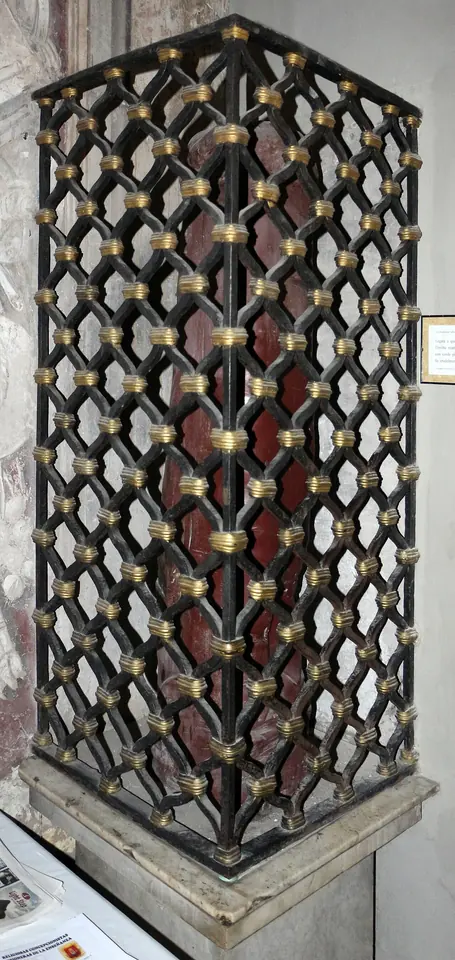
Just inside the door stands a short column of red marble that tradition holds is the one to which Bibiana was tied. Bernini designed the gilded bronze grille that protects it. No one can prove the tradition, but for four centuries pilgrims have touched the grille and prayed there.
A church by the railroad
When Rome built its central station in the 1860s and 1870s, the tracks came right up against the little church, and an underpass called the Arch of Santa Bibiana was cut beside it. The parish records that in May 1982 part of the ceiling plaster fell, shaken loose by the constant vibration of passing trains, and the church was closed for three years for repairs. It reopened in 1987. Since 1920 it has been cared for by the Sons of the Holy Family, the congregation founded by St. Joseph Manyanet.
The miracles of St. Bibiana
St. Bibiana lived long before the Church began formally investigating miracles, so no miracle of hers has been approved in the modern sense. The stories are of two kinds.
- Traditional: God fed the two sisters through five months of hunger, so that they grew stronger instead of weaker.
- Traditional: her body lay two days in the Forum Tauri, and the dogs would not touch it.
- Traditional: healings linked to the "herb of St. Bibiana" that grew near her church, which made her the saint of epilepsy and headaches. These stories were handed down in Roman popular devotion and were never investigated.
Why St. Bibiana is the patron saint of epilepsy and headaches
The reason lies in a plant. The parish of Santa Bibiana explains that the tuft of grass Bernini carved at the feet of his statue stands for the "herb of St. Bibiana," Eupatorium cannabinum, the plant English speakers call hemp agrimony. The same herb had appeared in the older altarpiece that Bernini's statue replaced. Popular tradition in Rome held that this herb, growing near her church, healed people who came to her for help. Over time she became the saint people asked for help with epilepsy, with headaches and with disorders of the mind. We have not found an early written source for the healings themselves, so they belong among the traditions, not the records.
Many modern lists of patron saints also call her the patron of hangovers, likely because of the same herb and the headaches it was said to cure. That title is a modern popular attribution, and we have found no old source for it. Let us ask her help for real suffering: for those who live with seizures, migraines and mental illness, and for those who care for them. She is not alone in this. St. Vitus is the older patron of epilepsy, and St. Dymphna the best known patron of mental illness. See all the patron saints by cause.
Symbols of St. Bibiana in art
St. Bibiana is not often painted outside Rome and Spain, so it helps to know her signs.
- A column: the pillar where she was scourged to death. It is her clearest attribute. Bernini's statue leans on it like a friend.
- A scourge weighted with lead: the instrument of her martyrdom, the plumbatae of the Breviary. In the stucco around her altar, little angels hold the palm, the leaded scourges and the crown.
- A palm branch: the sign of every martyr's victory.
- A crown or lily: the virginity she kept. The Collect of her feast speaks of "the lily of pure maidenhood" joined to "the palm of a glorious martyrdom."
- Herbs at her feet: the "herb of St. Bibiana," seen in Bernini's statue.
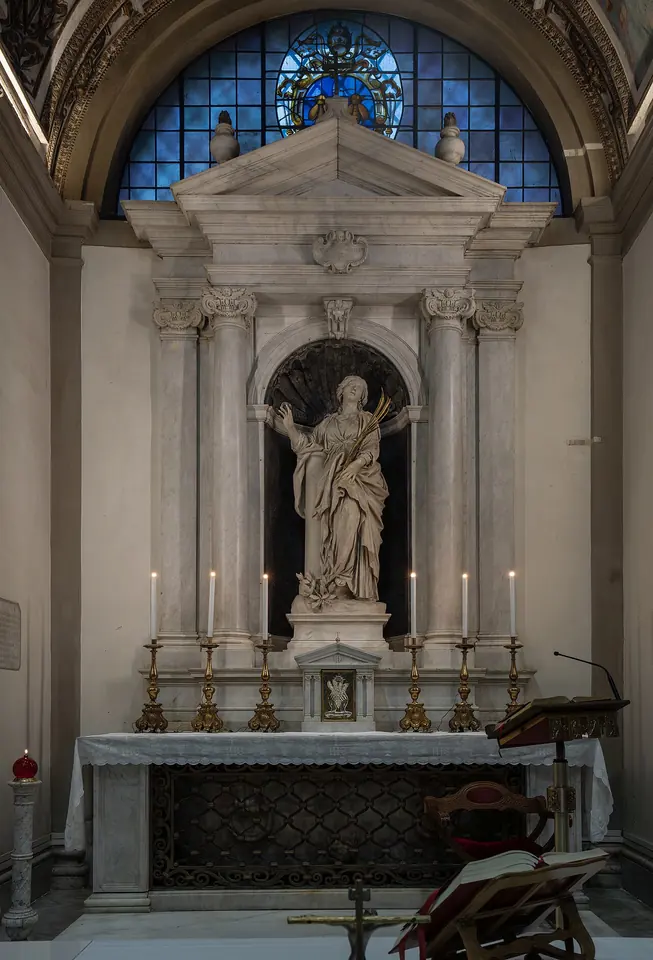
Be careful not to confuse her with St. Sebastian, who is also shown tied to a column, though he is pierced with arrows, or with other virgin martyrs of Rome such as St. Agnes, who has a lamb, and St. Cecilia, who has an organ or flowers. If a young woman in Roman dress stands next to a column with a palm, she is almost certainly Bibiana.
Bernini's statue is the image most people know. He shows her not suffering but at the moment of vision, one hand raised, her eyes lifted, her weight resting easily on the column of her pain. The parish notes that terracotta versions of it are kept in the Louvre and the Hermitage, and that Bernini designed a St. Barbara for the cathedral of Rieti in 1657 on the same pattern.

Feast day and where St. Bibiana is honored
St. Bibiana's feast day is December 2. In the old Roman calendar it was a semi-double feast, and the Breviary read the story of her martyrdom in the lessons of Matins. The 1969 reform of the calendar removed her from the universal calendar, as it did many saints whose lives rest mostly on legend, but she remains in the Roman Martyrology on December 2. Her church in Rome keeps the day with a solemn Mass. See the feast day calendar.
Her mother, St. Dafrosa, and her father, St. Flavian, have their own days in the old martyrologies. Baring-Gould gives January 4 for Dafrosa and December 22 for Flavian. The town of Montefiascone, north of Rome, honors Flavian in its ancient church of San Flaviano.
The name Bibiana is also common in Spain and Latin America, where many churches and many girls carry her name.
St. Bibiana and St. Vibiana of Los Angeles
Many people who search for St. Bibiana are really thinking of St. Vibiana, the patroness of the Archdiocese of Los Angeles. They are two different martyrs, and the similar names cause endless confusion. Old Latin often wrote B and V alike, and Bibiana's own church was once called Sancta Viviana.
St. Vibiana's story begins in 1853. According to Angelus News, the archdiocese's own publication, her remains were found on December 9, 1853, in an ancient catacomb near the Appian Way. A marble tablet on the tomb read "to the soul of the innocent and pure Vibiana," with a laurel wreath, which early Christians used as a sign of martyrdom. Pope Pius IX gave the relics to Thaddeus Amat, the new bishop of California's Monterey diocese, who later moved his see to Los Angeles and built a cathedral there for her. St. Vibiana's Cathedral was dedicated in 1876 at Second and Main Streets.
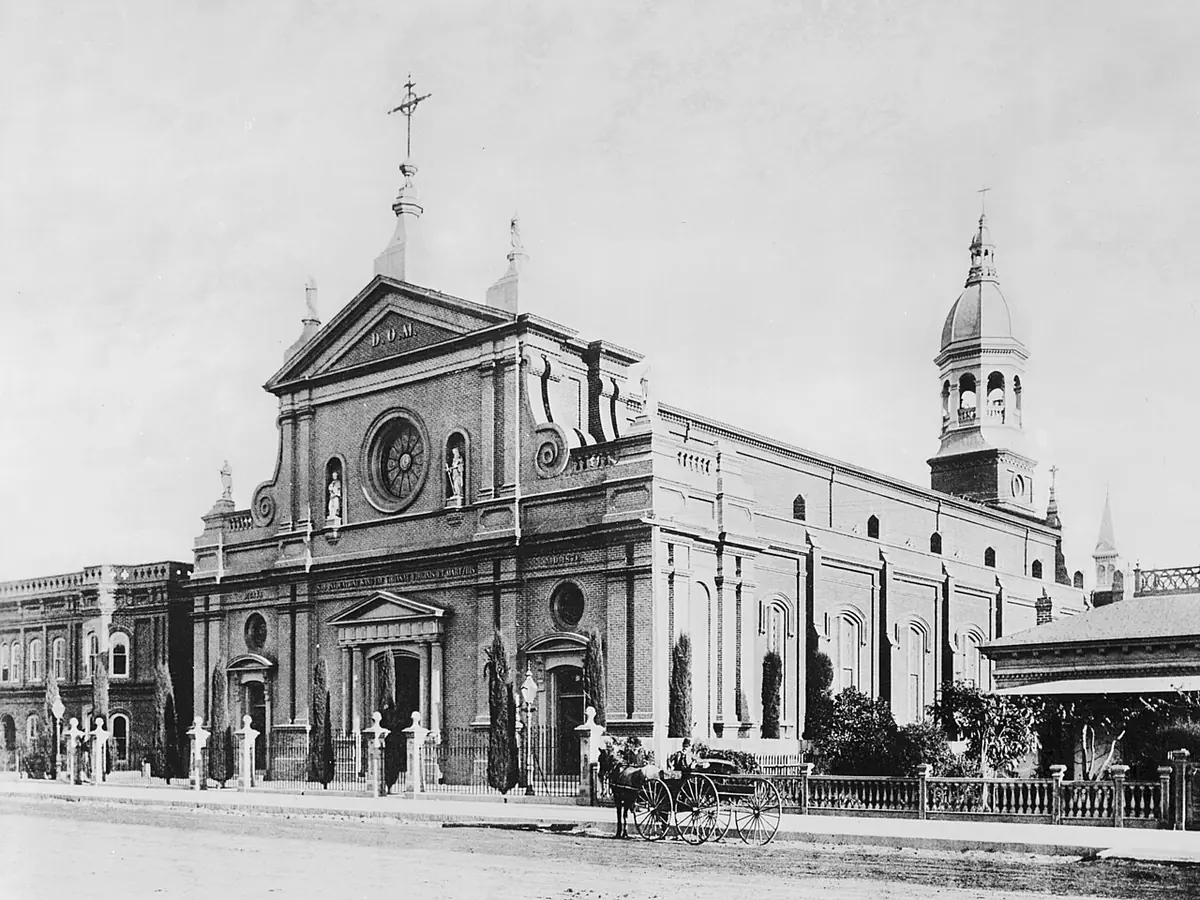
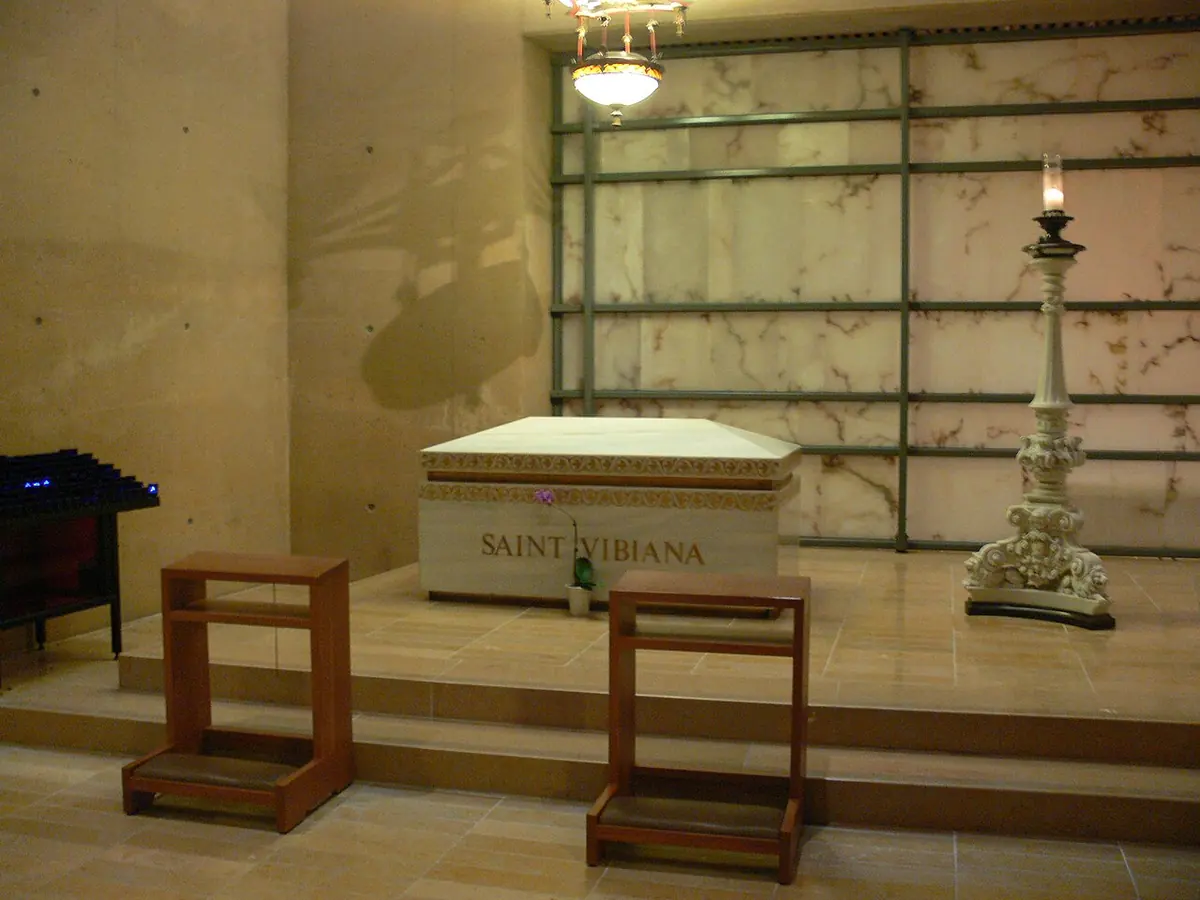
The old cathedral was badly damaged in the 1994 Northridge earthquake. Since 2002 St. Vibiana's relics have rested in the mausoleum of the new Cathedral of Our Lady of the Angels. She is honored as a 3rd-century virgin martyr; nothing is known of her life beyond what her tomb told. Her story is close to that of St. Philomena, another young martyr known only from a catacomb tomb.
Prayer to St. Bibiana
We ask St. Bibiana to pray for us when the body or the mind is in pain, and for the courage to stay faithful when we are pressured to let go of what we believe. Here is the Church's own prayer from her feast.
The Collect of St. Bibiana
This is the Collect of December 2 in the Roman Missal and Breviary used before 1969, still prayed in the traditional Latin liturgy:
Deus, ómnium largítor bonórum, qui in fámula tua Bibiána cum virginitátis flore martýrii palmam conjunxísti: mentes nostras ejus intercessióne tibi caritáte conjúnge; ut, amótis perículis, prǽmia consequámur ætérna. Per Dominum.
The English translation in the Divinum Officium edition of the Breviary reads:
O God, the Giver of all good gifts, Who unto the lily of pure maidenhood in the hand of thy servant Bibiana, didst join the palm of a glorious martyrdom, grant us, we beseech thee, at her pleading, that our hearts and minds being joined to thee by thy love, we may escape all dangers which do presently beset us, and finally attain unto thine everlasting joy.
Asking St. Bibiana's help
There is no long traditional novena to St. Bibiana that we could trace to an approved source. Many people pray the Collect above each day for nine days before December 2, adding an Our Father, a Hail Mary and a Glory Be, for someone with epilepsy, migraines or mental illness. A short prayer is enough too: "St. Bibiana, pray for us." Let us ask her, who stood firm when everything was taken from her, to stand with all who suffer in body and mind.
Frequently asked questions
Who was St. Bibiana?
A virgin martyr of Rome. The oldest record, the Liber Pontificalis, says only that Pope Simplicius (468–483) consecrated a basilica "of the holy martyr Bibiana, which contained her body." Her later legend makes her the daughter of Flavian and Dafrosa, persecuted under Julian the Apostate and scourged to death at a pillar.
When is St. Bibiana's feast day?
December 2. It was on the General Roman Calendar until 1969 and is still in the Roman Martyrology. Her church in Rome celebrates it with special solemnity.
What is St. Bibiana the patron saint of?
She is invoked against epilepsy, headaches and mental illness. Roman tradition linked her to a healing herb, the "herb of St. Bibiana," which Bernini carved at the feet of her statue. Modern patron-saint lists also make her the patron of hangovers; we have found no early source for that.
Is St. Bibiana the same as St. Vibiana of Los Angeles?
No. St. Vibiana, patroness of the Archdiocese of Los Angeles, is a 3rd-century martyr whose tomb was found in a Roman catacomb in 1853 and whose relics Pius IX sent to California. St. Bibiana is the 4th-century martyr of the church on the Esquiline. The two names are spelled alike in old Latin, which is why they are often confused.
Where is St. Bibiana buried?
In the church of Santa Bibiana in Rome, near Termini station. Her relics, with those of her sister Demetria and mother Dafrosa, rest in an ancient alabaster tub under the high altar, below Bernini's statue of her.
What does St. Bibiana hold in art?
A martyr's palm, and she stands beside or leans on the column at which she was scourged. Some images add the leaded scourge, and Bernini's statue has a tuft of herbs at her feet.
Is there a prayer to St. Bibiana?
Yes. The Collect of her feast from the Roman Missal and Breviary asks God, who joined in her the flower of virginity with the palm of martyrdom, to unite our hearts to him in charity. The Latin and an old English translation are given below.
Keep exploring
- Patron saint pages
- Anxiety
- Appears in
- Female saintsSaint names for girls
- Feast-day calendar
- Saints remembered in DecemberSaint of the day
- More
- Saints A to ZPatron saints A to ZExplore every section
Sources
- Catholic Encyclopedia (1907): St. Bibiana
- Ammianus Marcellinus, Roman History, Book XXVI, chapter 3 (the prefecture of Apronianus)
- Mariano Armellini, Le chiese di Roma dal secolo IV al XIX (1891): S. Bibiana
- Chiesa Santa Bibiana, Rome: Altare Maggiore (Bernini's statue, the herb and the alabaster urn)
- Chiesa Santa Bibiana, Rome: Trasformazioni (restorations, the trains and the 1982 closure)
- Chiesa Santa Bibiana, Rome: Navata Centrale (the fresco cycles)
- Roman Breviary, December 2, St. Bibiana: Collect and lessons (Divinum Officium, English)
- Sabine Baring-Gould, The Lives of the Saints, vol. 15 (December), 1914: S. Bibiana
- Angelus News: Saint of the day, Vibiana
- LAist: Meet the patron saint of LA you've never heard of (Bishop Amat and the 1994 earthquake)