St. Cyril of White Lake, Founder of the Kirillo-Belozersky Monastery
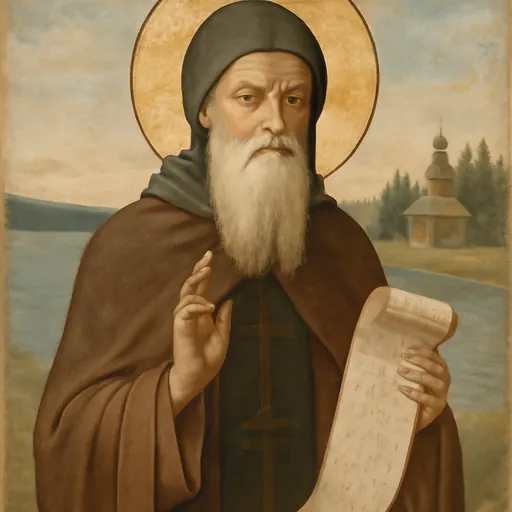
St. Cyril of White Lake (about 1337–1427) was a Moscow monk and friend of St. Sergius of Radonezh who at about sixty founded the Kirillo-Belozersky Monastery at White Lake, one of Russia's largest. He left his monks the words "Preserve love among yourselves." The Orthodox Church keeps his feast on June 9.
Who was St. Cyril of White Lake?
St. Cyril of White Lake was a Russian monk who left Moscow in old age to pray in the northern forests and, without meaning to, founded one of the greatest monasteries of Russia. The Orthodox Church calls him "venerable" (prepodobny), its title for holy monks, and keeps his feast on June 9. In Russian he is Kirill Belozersky, "Cyril of Beloozero," White Lake being the large lake near his monastery.
His Life was written about 1462 by the Athonite monk Pachomius, who lived at Cyril's monastery and spoke with men who had known him, above all his disciple Martinian. That makes it an unusually close source for a medieval saint, though it is still a work of praise, and we tell its wonders as tradition.
The life of St. Cyril
Cosmas of Moscow
He was born in Moscow about 1337 and baptized Cosmas. Orphaned young, he grew up in the house of a kinsman, the boyar Timothy Velyaminov, at the court of Grand Prince Dmitry Donskoy. Court life bored him. Knowing Timothy would never allow him to become a monk, the abbot St. Stephen of Makhra clothed him in the monk's robe on his own authority and named him Cyril. Timothy was furious at first, then repented, and let the young man go.
Baker and cook at Simonov
Cyril was tonsured at the Simonov Monastery in Moscow. He carried water, chopped wood and baked bread. St. Sergius of Radonezh, whose nephew Theodore was the abbot, used to look for Cyril in the bakery before he greeted anyone else. Then Cyril spent nine years in the kitchen. Looking into the fire, he would tell himself, "Have patience, Cyril, so that by this fire you might save yourself from the eternal fire."

To escape praise he began to act the fool for Christ, and his superior put him on bread and water for forty days, which he accepted with joy. In 1388, against his will, the brethren made him archimandrite of the monastery. He soon resigned and went back to his cell.
"Go to White Lake"
One night, reading the Akathist hymn before an icon of the Mother of God, he reached the words "Seeing the strange Nativity, let us become strangers to the world," and heard a voice: "Go to White Lake, where I have prepared a place for you." With his friend St. Therapon he walked north, set up a cross by Lake Siverskoye, and dug a cell in the earth. Therapon soon moved on to found his own monastery. Cyril stayed.
The monastery and its rule
Disciples came, and in 1397 Cyril built a church of the Dormition. He gave his monks a strict common life: silence in church and at table, no private property, no letters or gifts without the abbot's blessing, cells left unlocked with nothing in them but icons and books. When a boyar named Roman sent him the deed to a village, Cyril refused it, fearing that land would draw his monks into worldly cares.
He loved books. By 1635 the monastery library held more than two thousand, sixteen of them said to have been Cyril's own. Three of his letters to Russian princes survive.
He served his last Liturgy on Pentecost and died on June 9, 1427, the feast of his patron St. Cyril of Alexandria, in his ninetieth year. His last counsel to the brethren was to keep love among themselves.
The miracles of St. Cyril
All of these come from his Life and are traditional:
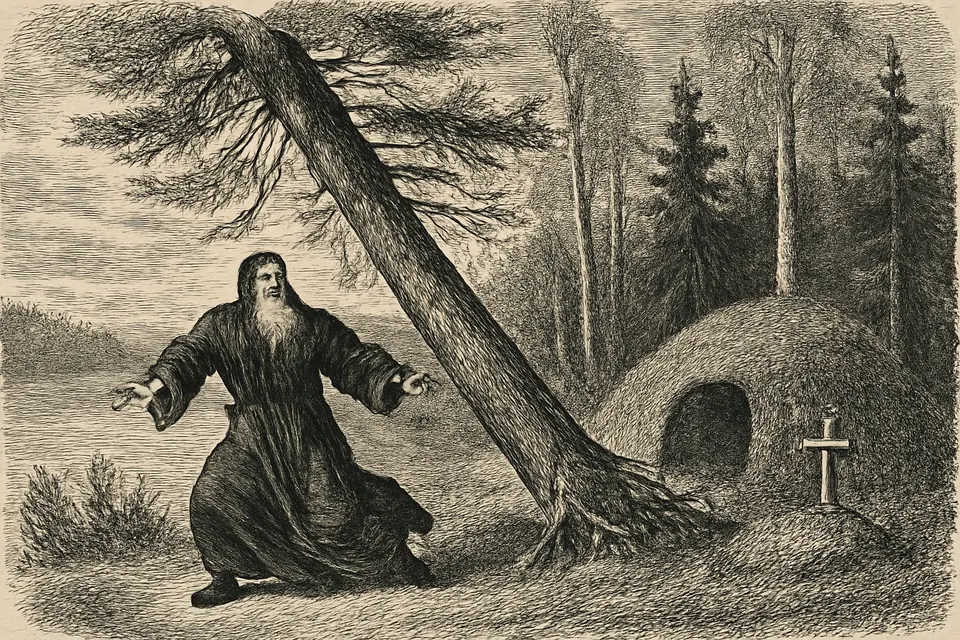
- Resting under a pine, he heard a voice cry "Run, Cyril!" and leapt away as the tree fell. He made a cross from its wood.
- When there was no wine for the Liturgy, an empty vessel was found full.
- In a famine he gave bread to everyone in need, and the monastery's stores did not run out.
- He calmed a storm on the lake that threatened fishermen.
- He foretold that none of the brethren would die of plague before him; within a year of his death, more than thirty of the fifty-three monks had died.
Symbols of St. Cyril of White Lake in art
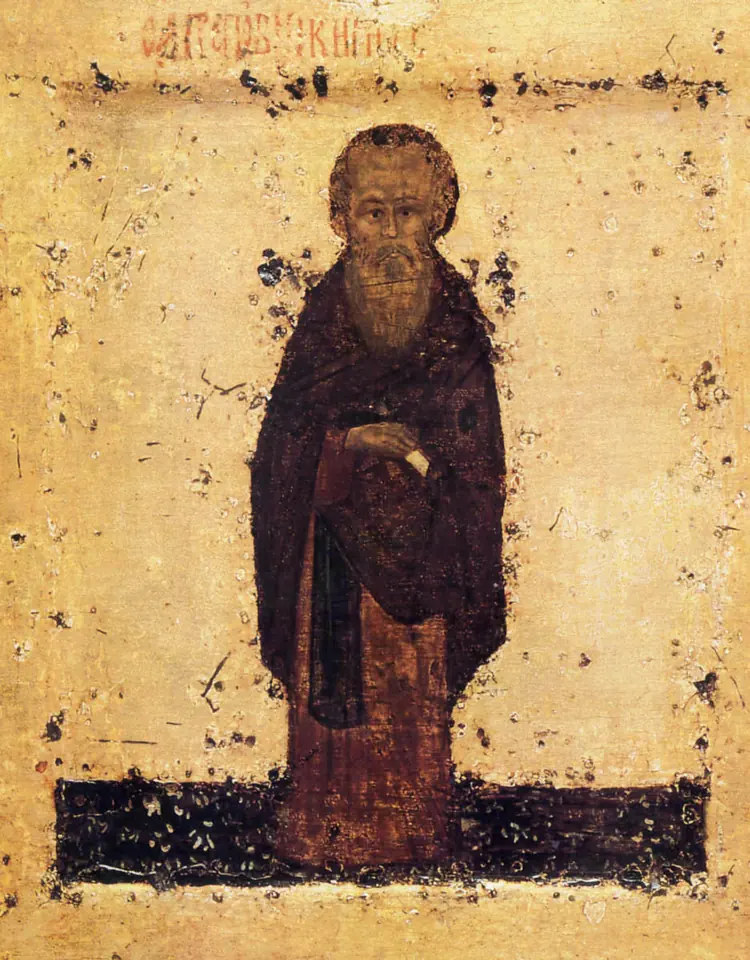
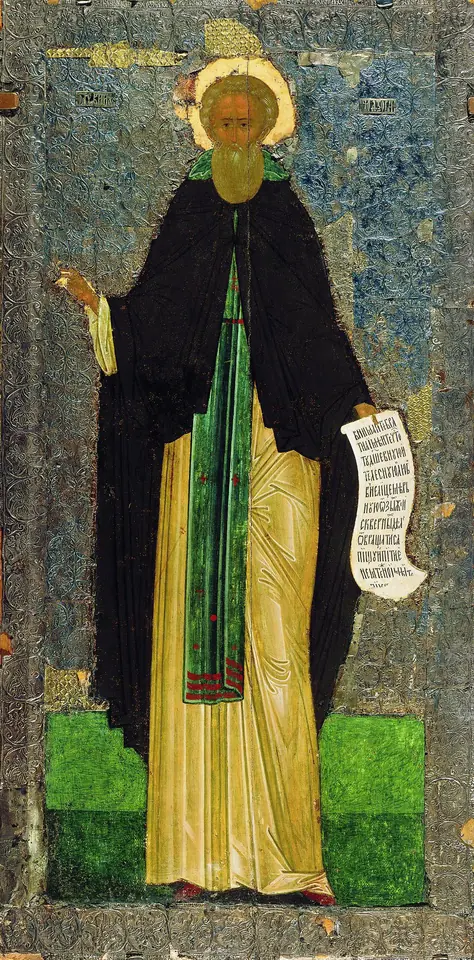
Russian icons show him as a very old monk with a long, thin beard, in a dark mantle and the monastic schema. His sign is the scroll in his hand, which on many icons carries his last words: "Preserve love among yourselves." Large icons of the school of the master painter Dionisius surround his figure with scenes from his life.
Where St. Cyril is honored
The Kirillo-Belozersky Monastery grew into a vast walled complex and became a museum in 1924. Its collections still keep vestments and books that belonged to the saint, and a canopy stands over the cross that marks his first cell. In 1909 the photographer Sergei Prokudin-Gorskii made color pictures of his shrine and of the embroidered cover laid over it.
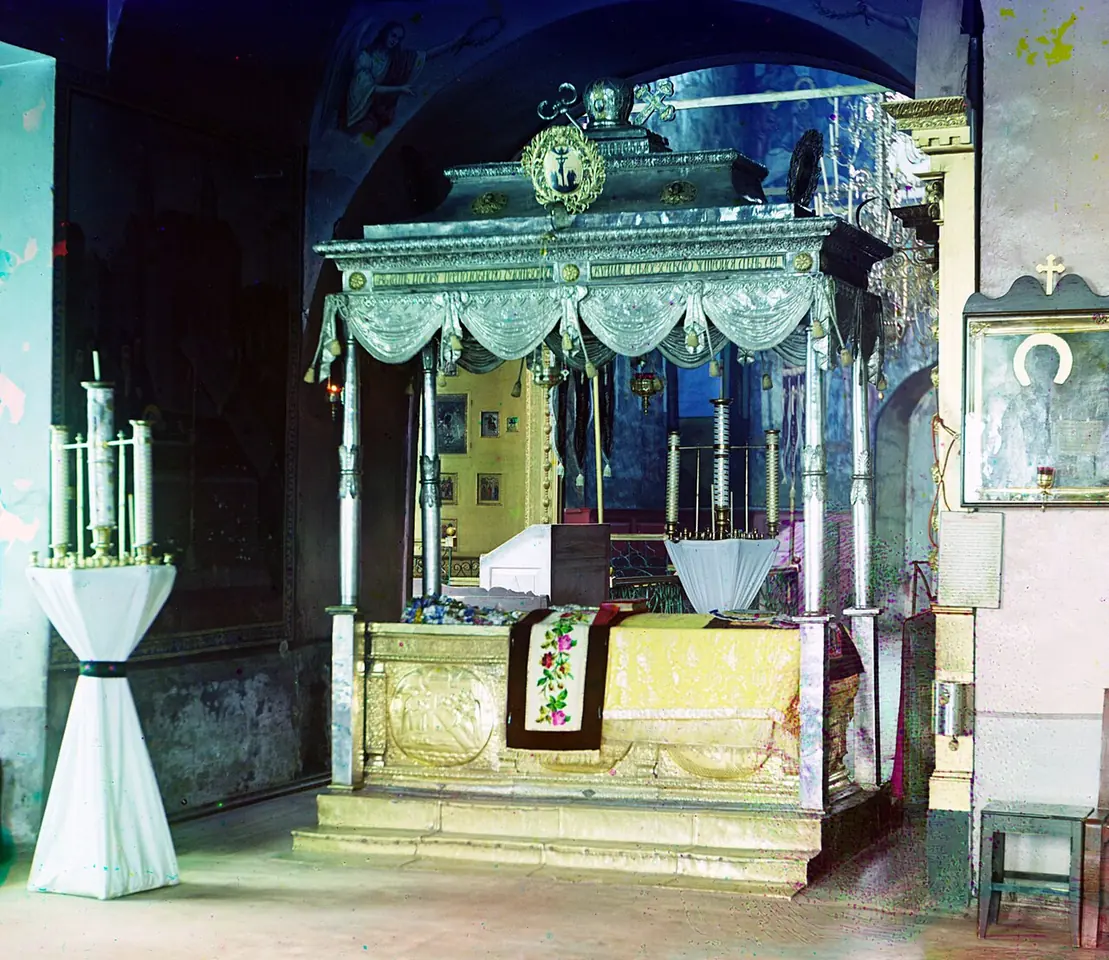
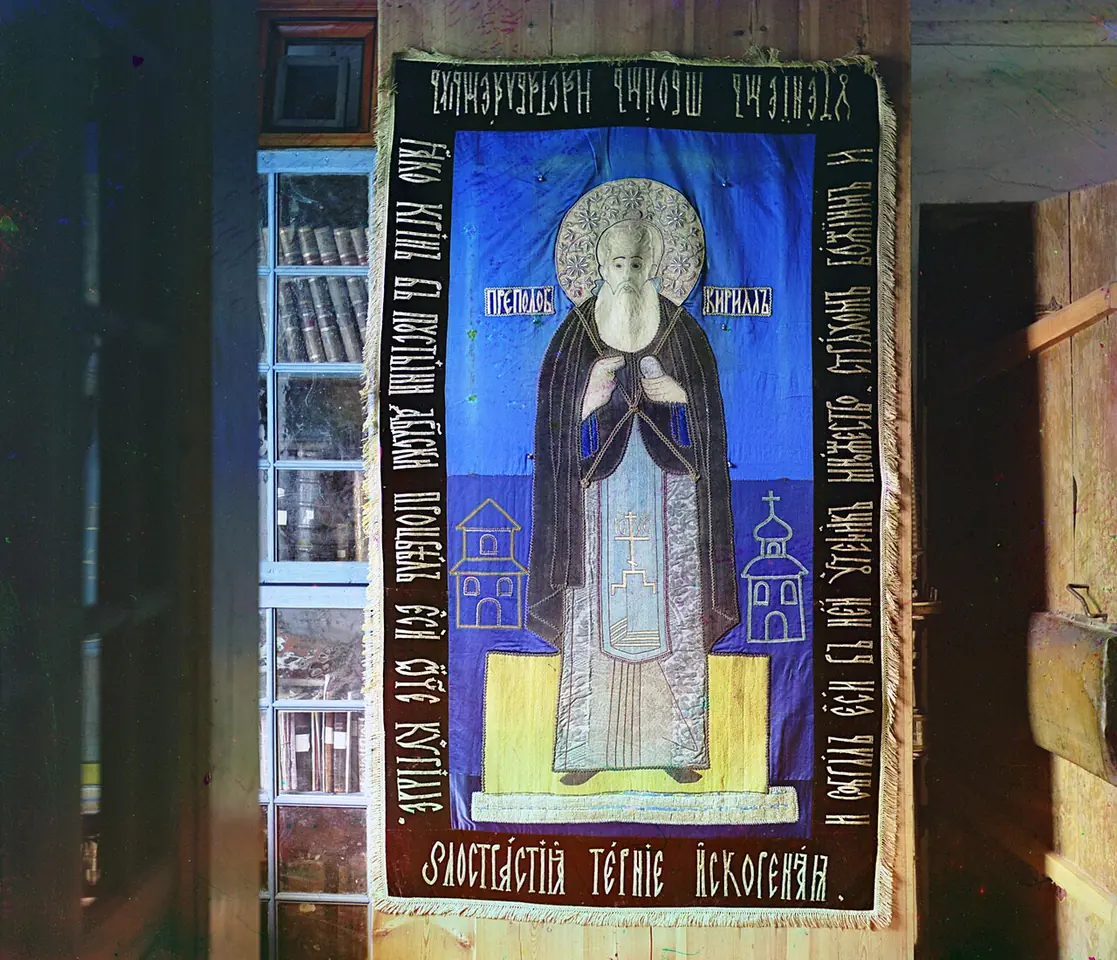
His feast is June 9. Later monks of his monastery include St. Nilus of Sora, who learned the monastic life there.
Prayer to St. Cyril of White Lake
The Orthodox Church sings a troparion and kontakion for his feast in the Menaion. We have not found an English text we could check against a published source, so we do not print one.
Let us ask St. Cyril to pray for monks and nuns, for all who live in community, for cooks and bakers who serve others quietly, and for every family and parish that needs to keep love among themselves.
Holy Father Cyril, pray to God for us.
Frequently asked questions
Who was St. Cyril of White Lake?
A Russian monk born in Moscow about 1337 and baptized Cosmas. He was tonsured at the Simonov Monastery, served there as baker, cook and briefly as archimandrite, then in the 1390s founded a monastery in the forests near White Lake that became the Kirillo-Belozersky Monastery. He died there on June 9, 1427.
When is the feast of St. Cyril of White Lake?
June 9, the day of his death, in the Orthodox Church (June 22 on the civil calendar for churches that keep the Julian calendar).
What miracles are told of St. Cyril of White Lake?
His Life, written about 1462, says he filled an empty wine vessel for the Liturgy, multiplied bread during a famine, calmed a storm on the lake, and escaped a falling pine. These are traditional accounts from his Life, not formally examined miracles.
Where is the Kirillo-Belozersky Monastery?
In the town of Kirillov, in the Vologda region of northern Russia, on the shore of Lake Siverskoye. It has been a museum since 1924, and its collections include the oldest belongings and books of St. Cyril.
Keep exploring
Sources
- Venerable Cyril, Igumen of White Lake, Orthodox Church in America. His Life by Pachomius, the voice at the Akathist, his rule, his refusal of the village, his last words, and the monastery library of 1635
- Ensemble of the Kirillo-Belozersky Monastery, Kirillo-Belozersky Museum-Reserve (official site, in Russian). The museum founded in 1924; the saint's own vestments and books; the canopy over the cross on his first cell
- Sepulchre of the Venerable Kirill, Kirillo-Belozerskii Monastery (photograph by S. M. Prokudin-Gorskii, 1909), Library of Congress