St. Joseph of Anchieta (José de Anchieta)

St. Joseph of Anchieta (José de Anchieta, 1534 to 1597) was a Jesuit from the Canary Islands who spent forty-four years in Brazil, helped found São Paulo, wrote the first grammar of the Tupi language and, as a hostage at Iperoig, composed a long Latin poem to the Virgin Mary. The Church calls him the Apostle of Brazil. His feast is June 9, and he is a model for catechists and missionaries.
Who was St. Joseph of Anchieta?
St. Joseph of Anchieta, better known by his Spanish name José de Anchieta, was a Jesuit from the Canary Islands who gave his whole adult life to Brazil. He arrived there as a sickly teenager in 1553 and never went home. He taught, preached, wrote plays and hymns in the native Tupi language, made peace between warring peoples, and helped found the city of São Paulo. The Church calls him the Apostle of Brazil.
When Pope Francis gave thanks for his canonization in 2014, he spoke of a boy who "had so much joy, so much joy that he founded a nation." Then he added: "He did not fear the joy."

The life of St. Joseph of Anchieta
From Tenerife to Coimbra
José de Anchieta was born in 1534 at San Cristóbal de La Laguna, on the island of Tenerife. He was sent to study at Coimbra in Portugal, and there, as a teenager, he entered the Society of Jesus. The Catholic Encyclopedia records that as a novice he nearly ruined his health with excessive penances, injuring his spine so badly that he was left almost hunchbacked. His superiors sent him to Brazil partly in the hope that the climate would restore him.
A school on the plateau
He reached Brazil in 1553. Pope Francis called him "a 19-year-old boy" who "hadn't studied theology, he hadn't studied philosophy." His first work was teaching Latin to young Jesuits and other students, very likely the first classical school in the Americas. In January 1554 he was among the Jesuits who opened a small college on the plateau of Piratininga. The settlement that grew around it became São Paulo.
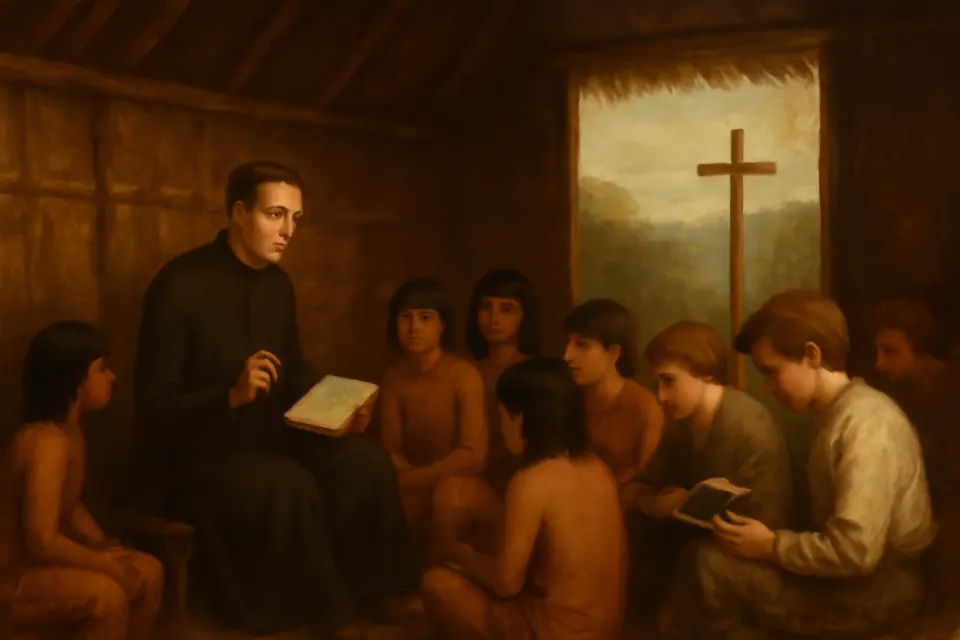
He learned Tupi quickly and wrote a grammar of it, along with books of religious instruction for missionaries. He wrote hymns that both the native people and the Portuguese sang, and religious plays performed in the open air, with interludes in Tupi so that everyone could follow. These were among the first plays staged in the New World.
Hostage at Iperoig
In 1563 the Tamoio peoples on the coast were at war with the Portuguese settlers. Anchieta, still not a priest, went with Fr. Manuel da Nóbrega to make peace and stayed behind among the Tamoio at Iperoig as a willing hostage. The Catholic Encyclopedia says he was twice close to being killed.
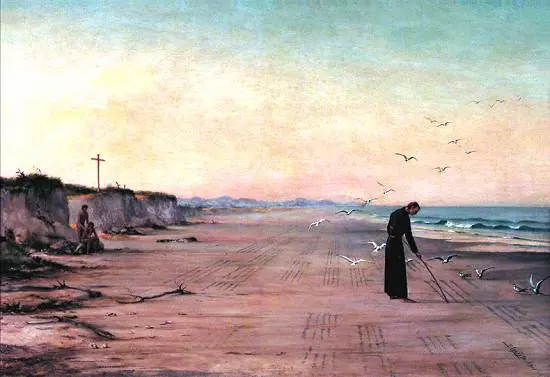
During those months he composed a long Latin poem to the Virgin Mary, De Beata Virgine Dei Matre Maria. With no paper, he committed it to memory and wrote it out after his release. Tradition holds that he traced the verses in the sand of the beach as he composed them. Pope Francis recalled "a beautiful hymn to the Virgin Mary" that compared her to the herald of Isaiah who proclaims peace.
Priest, provincial, pilgrim
After the war, Anchieta was ordained a priest by Pedro Leitão, bishop of Brazil. He was later rector of the college of São Vicente and, from 1577, provincial superior of all the Jesuits in Brazil. He walked barefoot on his journeys and owned almost nothing. He knew some medicine and used it for his people. Worn out, he laid down his office in 1591 and spent his last years at the mission of Reritiba, on the coast of Espírito Santo. He died there on June 9, 1597. The town is now called Anchieta.

The miracles of St. Joseph of Anchieta
His first biographers called him the wonder-worker of the New World. Simão de Vasconcelos's life of 1672 put that title on its title page. The stories the Catholic Encyclopedia gathered from these early lives are traditional: forest birds came to his hand, the sea stood like a wall around him while he prayed, the sick were healed by touching his clothing, he saw events far away as they happened, and he was sometimes seen surrounded by light while praying without knowing it.
His cause went slowly. He was declared Venerable, beatified by Pope John Paul II on June 22, 1980, and declared a saint by Pope Francis on April 3, 2014. That last step was an equivalent canonization: the Pope extended to the whole Church a cult already long kept, without the usual rite or a new approved miracle.
Why St. Joseph of Anchieta is a patron of catechists
Anchieta's life was teaching. He taught Latin to students, the catechism in Tupi to children, and the faith to whole villages through song and drama. He wrote in four languages, Tupi, Portuguese, Spanish and Latin, and used each where it would reach people best. That is why catechists and missionaries take him as their model.
Symbols of St. Joseph of Anchieta in art
- The black Jesuit cassock: Brazilian painters show him in the plain habit of the Society, often thin and slightly stooped, recalling his injured spine.
- A staff: the walking stick of a missionary who traveled on foot, as in Calixto's portrait.
- A book: his breviary, or his own writings, grammar and poems.
- Writing on the sand: the scene of the poem to the Virgin at Iperoig, painted by Calixto and others.
- Birds: a nod to the old stories of forest birds that came to him.
- The Virgin and Child in the clouds: as in the old engraving below, linking him to his Marian poem.

You will find him in the Museu Paulista and the churches of São Paulo, at the national shrine in the town of Anchieta, and in his birthplace of La Laguna on Tenerife.
Feast day and prayer
We keep the feast of St. Joseph of Anchieta on June 9, the day he died. Jesuits, the Church in Brazil and the Canary Islands celebrate him most of all.
There is no traditional prayer to him in the standard prayer books. The best prayer connected with him is his own poem to Mary, which Catholics in Brazil still read. Let us ask him, in our own words, to pray for catechists, teachers and missionaries, and for the joy that Pope Francis saw in him.
St. Joseph of Anchieta, pray for us.
Frequently asked questions
Who was St. Joseph of Anchieta?
A Jesuit missionary born in 1534 on Tenerife in the Canary Islands. He studied at Coimbra, joined the Society of Jesus, and in 1553 was sent to Brazil, where he taught, preached in the Tupi language, helped found the college that became São Paulo, served as a peacemaker and later as Jesuit provincial. He died at Reritiba on June 9, 1597.
When was José de Anchieta canonized?
Pope John Paul II beatified him on June 22, 1980. Pope Francis declared him a saint by equivalent canonization on April 3, 2014, extending his cult to the whole Church, and offered a Mass of thanksgiving for him at the church of St. Ignatius in Rome on April 24, 2014.
Did St. Joseph of Anchieta write a poem in the sand?
Tradition holds that while he was a hostage among the Tamoio at Iperoig in 1563, with no paper, he composed his Latin poem to the Virgin Mary and wrote its verses in the sand of the beach to fix them in memory, writing it out after his release. The Catholic Encyclopedia says only that he memorized the poem, of nearly five thousand verses, and wrote it out later.
When is the feast day of St. Joseph of Anchieta?
June 9, the day he died in 1597.
Keep exploring
Sources
- Thomas Campbell, "Joseph Anchieta," Catholic Encyclopedia (1907). His teaching, plays and canticles, the hostage episode and the poem of nearly five thousand verses, his ordination, and the wonders told of him (its birth and death years are wrong)
- Pope Francis, Homily at the Mass of thanksgiving for the canonization of St. José de Anchieta, April 24, 2014 (vatican.va). Quotations from the homily
- Simão de Vasconcelos, Vida do venerável padre Joseph de Anchieta (Lisbon, 1672), archive.org. The oldest full life, which calls him the wonder-worker of the New World