St. Petronilla: Early Roman Martyr and Legendary Daughter of St. Peter
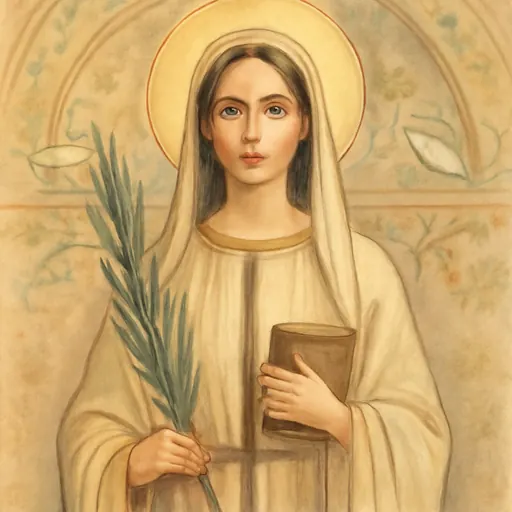
St. Petronilla was an early Christian virgin, probably a martyr, buried in the Catacomb of Domitilla in Rome at the end of the first century or in the second. A 4th-century fresco there names her "Petronilla Mart." Later legend made her the daughter of St. Peter. Her feast is May 31, and her relics rest at her own altar in St. Peter's Basilica. The kings of France took her as a patroness.
Who was St. Petronilla?
St. Petronilla was a young Christian woman of Rome, buried in the Catacomb of Domitilla on the Via Ardeatina, probably at the end of the first century. The Church honors her as a virgin and martyr, and she has one of the oldest witnesses to her cult of any Roman saint: her own picture, with her name, painted on a tomb a few steps from her grave.
Most people know her from a beautiful legend that makes her the daughter of St. Peter. History can't confirm that, but it can tell us something almost as moving. She belonged to the first generations of Roman Christians, the Church that Peter and Paul had just watered with their blood.
What history tells us
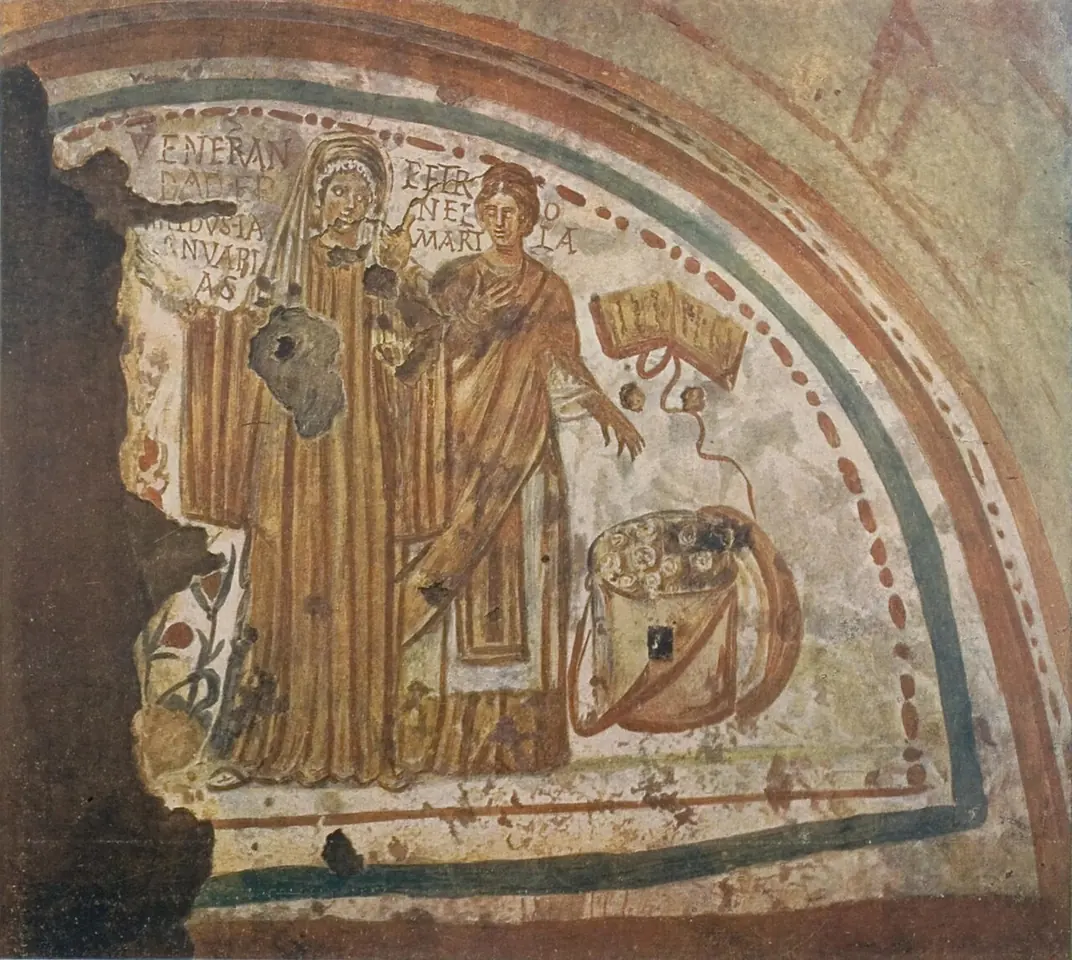
The early lists of Roman martyrs' tombs, from the 6th and 7th centuries, almost all place Petronilla's grave on the Via Ardeatina, near the martyrs Nereus and Achilleus. Excavations in the Catacomb of Domitilla in the 1870s confirmed it. Archaeologists found the underground basilica built over the three graves, and behind its apse a painting on the stone that closed a tomb. It shows a woman named Veneranda being led into heaven by a saint labeled Petronilla Mart. An inscription in the same tomb dates the painting to shortly after 356.
So by the middle of the fourth century the Christians of Rome were already asking Petronilla to receive their dead. That is the firm ground under her story.
Her sarcophagus, which no longer survives, carried the inscription Aur. Petronillae filiae dulcissimae, "to Aurelia Petronilla, sweetest daughter." The Catholic Encyclopedia's J. P. Kirsch pointed out that "Petronilla" comes from the Roman name Petronius, which ran in the family of the Christian consul Flavius Clemens. She may have been a relative of the Christian Flavians, which would explain why she lies in the catacomb of Flavia Domitilla. She may have died under Domitian, or somewhat later.
The legend of St. Peter's daughter
By the end of the 500s, Romans were calling Petronilla the daughter of St. Peter. The idea came from a second-century apocryphal Acts of Peter that mentions an unnamed daughter. Her name, so close to Peter's, and the great age of her tomb made the connection easy. The legend was then written into the Acts of Sts. Nereus and Achilleus, and from there into the medieval martyrologies (traditional).
The Golden Legend tells it this way. Petronilla was beautiful and lay sick with fever. When a disciple asked why Peter healed everyone except his own daughter, Peter told her, "Arise, Pernelle, hastily, and serve us," and she rose and waited on them. Then he sent her back to bed, and she was fully healed only later, "whereas she began to be perfect in the love of God."
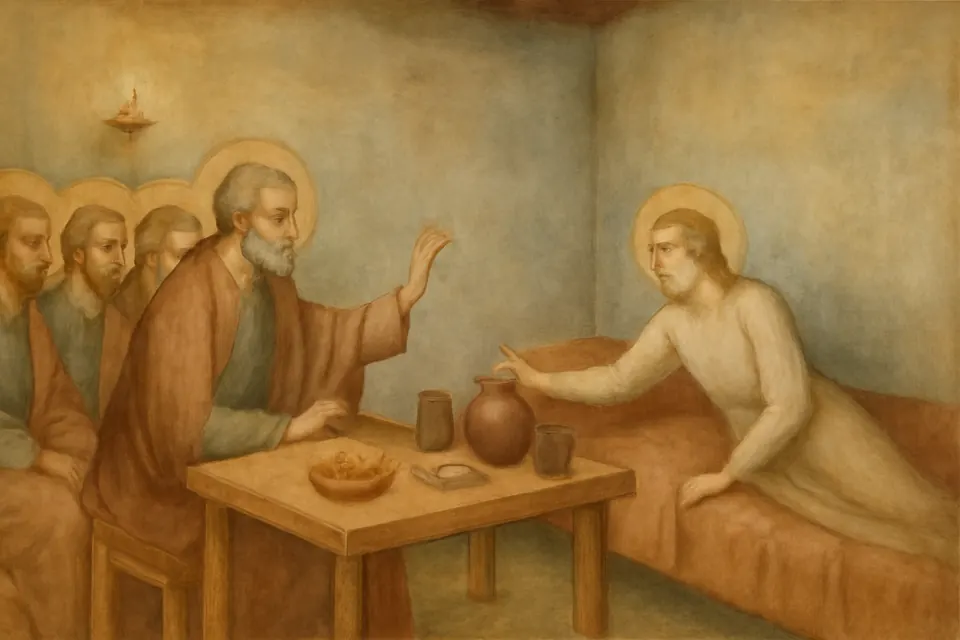
The legend goes on. A nobleman named Flaccus wanted to marry her. Petronilla asked him to send maidens to escort her, and while he made ready she gave herself to fasting and prayer, received Holy Communion, lay down, and died on the third day. In this telling she is a virgin who escapes marriage, not a martyr who sheds her blood. The fresco in the catacomb is older and calls her a martyr, so we keep both titles, as the Roman Martyrology does.
Her relics and her altar in St. Peter's
In 757 Pope Paul I moved her sarcophagus from the catacomb to an old round imperial mausoleum beside St. Peter's, which became the Chapel of St. Petronilla. The Frankish kings had just made their alliance with the papacy, and the chapel became tied to them. The Catholic Encyclopedia notes that Petronilla "subsequently appears as the special patroness of the treaties concluded between the popes and the Frankish emperors." This is the root of her old title as a patroness of France.
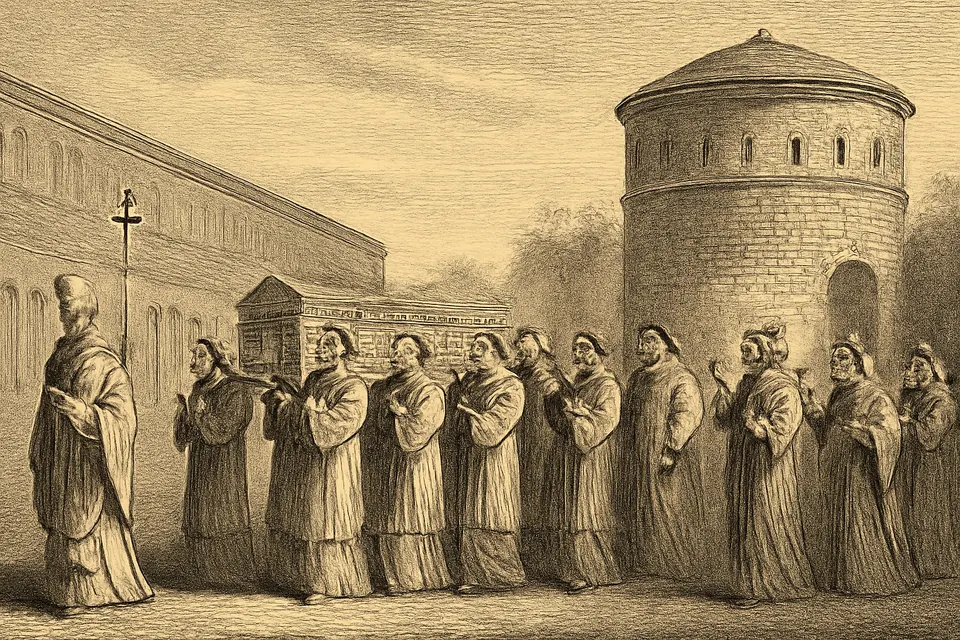
When St. Peter's was rebuilt in the 1500s, her remains were placed at an altar still dedicated to her, on the right side near the dome. So the "daughter of Peter" rests in Peter's own basilica.
Why St. Petronilla is a patron
- France: her chapel at St. Peter's was linked to the Frankish kings from the 8th century, and French devotion to her continued for centuries.
- Against fever: from the Golden Legend story of her fever, healed by St. Peter.
Symbols of St. Petronilla in art
Petronilla is shown as a young woman, often richly dressed or veiled. Look for:
- A palm: the sign of a martyr, as in the catacomb fresco's "Mart."
- A book: the Gospel she lived by. The Domitilla fresco already shows an open book and a box of scrolls beside her.
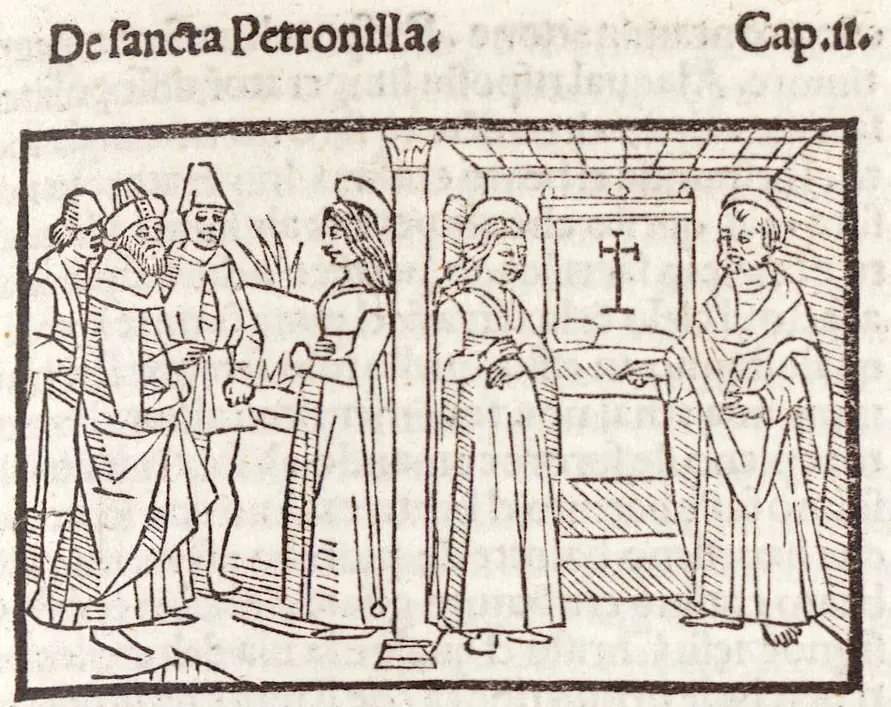
- A sickbed: scenes from her legend show her rising to serve Peter's guests, as in the 1497 woodcut above.
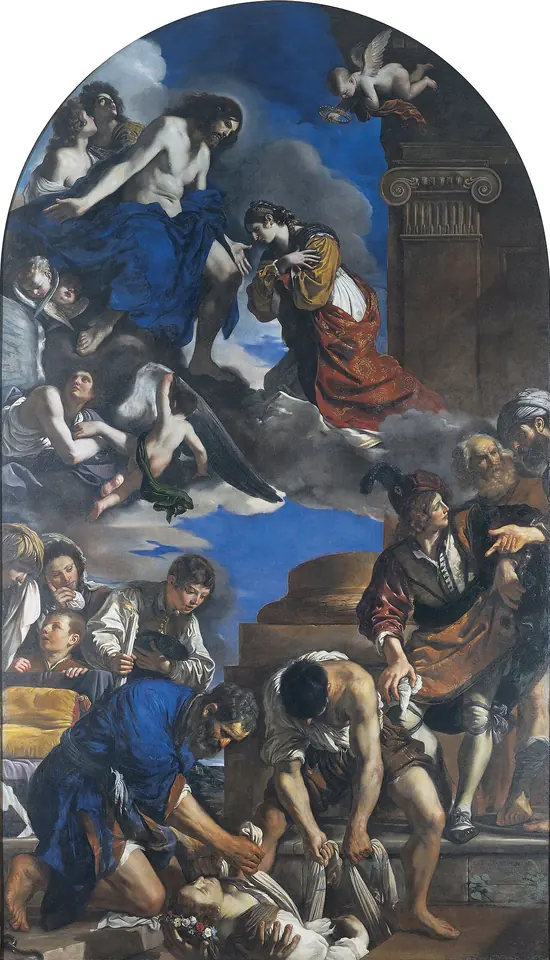
- Her burial: Guercino's great altarpiece shows her body lowered into the tomb while she is received by Christ above.
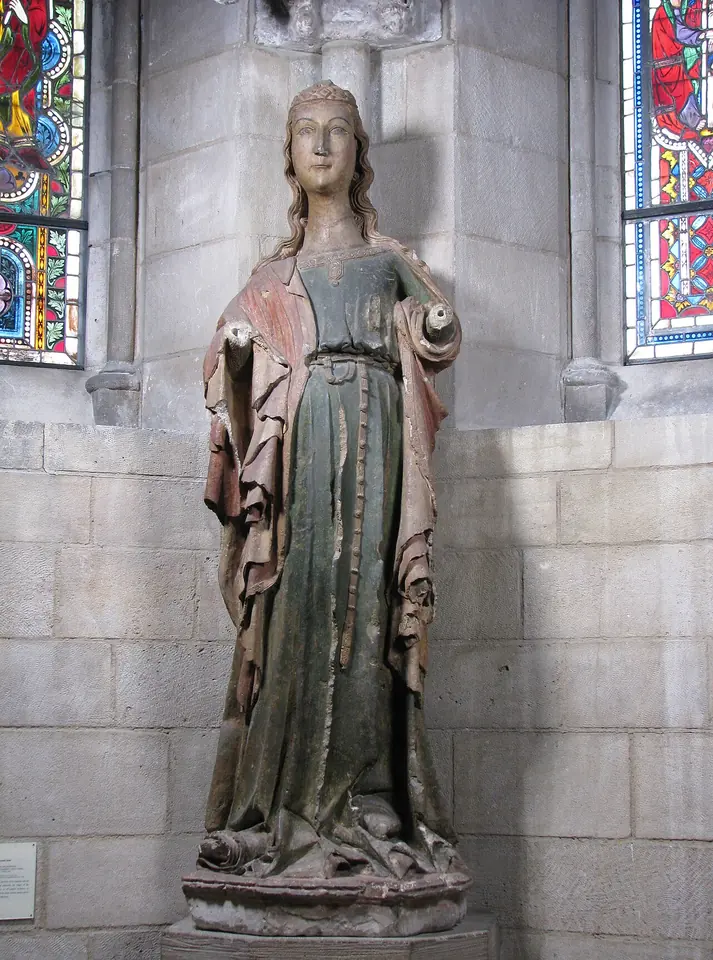
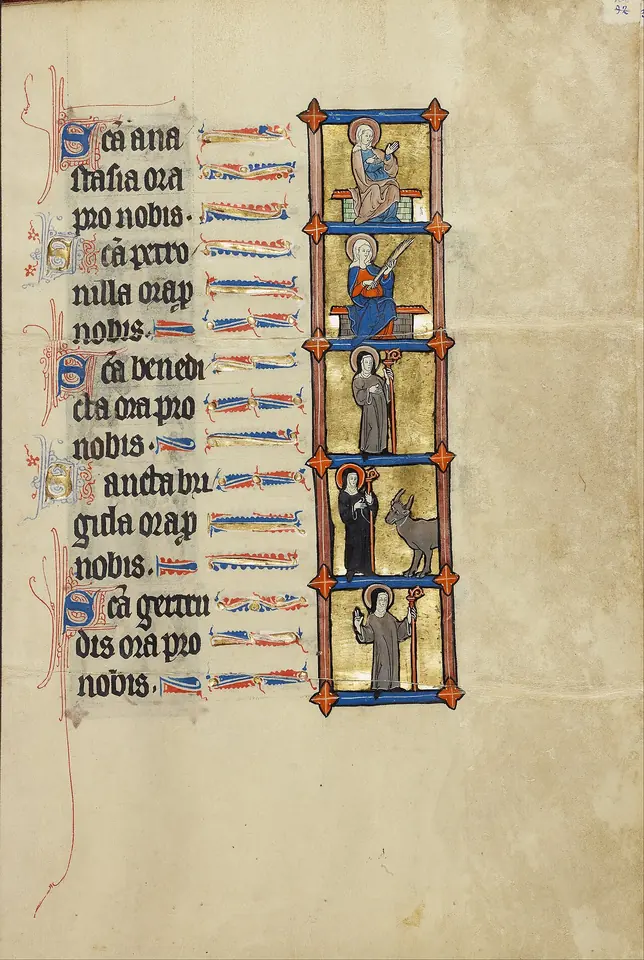
Medieval sculptors in Catalonia and France carved her as a gracious young woman with long hair, like the 14th-century statue now at the Metropolitan Museum. In medieval litanies she appears among the holy virgins, between Anastasia and the great abbesses.
Feast day and prayer
We keep St. Petronilla's feast on May 31, the last day of Mary's month, when the Roman Martyrology names her among the saints of the day. You can find the saints honored around her on our feast days page.
There is no traditional prayer to St. Petronilla with a known origin. Medieval litanies, like the one pictured below, simply asked, Sancta Petronilla, ora pro nobis: "St. Petronilla, pray for us." Let us ask her, who served at the apostle's table, to pray for the sick and feverish, and to help us serve gladly the guests the Lord sends us.
Frequently asked questions
Was St. Petronilla really St. Peter's daughter?
Probably not by blood. Her real name seems to have been Aurelia Petronilla, and the "Petronilla" likely comes from a Roman family name, Petronius, not from Peter. A 2nd-century apocryphal story about Peter's unnamed daughter was attached to her by the 6th century. We can rightly call her his spiritual daughter: she was a Roman Christian of the apostolic age, buried among the first martyrs.
When is the feast day of St. Petronilla?
May 31. The Roman Martyrology lists her that day as virgin and martyr, buried in the cemetery of Domitilla on the Via Ardeatina.
What is St. Petronilla the patron saint of?
She is honored as a patroness of France, whose kings were tied to her chapel at St. Peter's from the 8th century. Because of the legend of her fever, she is also invoked against fever.
Where are the relics of St. Petronilla?
In St. Peter's Basilica, under the altar dedicated to her near the great dome, on the right side. They were moved there from the catacomb in 757 and placed at the present altar during the rebuilding of the basilica.