St. Ronan of Locronan, Irish Hermit of Brittany
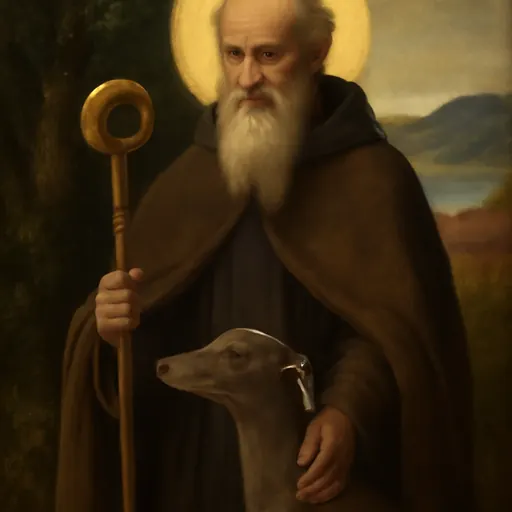
St. Ronan of Locronan was an Irish monk and hermit of the early 500s who preached to the pagans of the forest of Nevet in Brittany and gave his name to the town of Locronan, "Ronan's holy place." We keep his feast on June 1, and Locronan honors him every July with the Troménie procession.
Who was St. Ronan of Locronan?
St. Ronan of Locronan was an Irish monk and hermit who settled in western Brittany in the early sixth century. He made his cell on the slope of a hill above the Bay of Douarnenez, in a great forest the old texts call Nemet or Nevet, and preached the Gospel to the pagan country people around it. The town that grew up at his tomb is still called Locronan, from the Breton lok, a holy place, and Ronan.
What we know of him comes from a Latin Life copied in the thirteenth century (it survives in Paris, Bibliothèque nationale, MS lat. 5275) and probably written in the eleventh. Albert le Grand retold it in his Lives of the Saints of Brittany in 1636. Sabine Baring-Gould, who studied it closely, treated its outline as history and its wonders as legend, and we will do the same here.
From Ireland to Brittany
According to the Life, Ronan was born in Ireland to parents who had been converted by St. Patrick. He left home young, was trained for the religious life in Britain and was ordained a priest. Baring-Gould thought it likely that he then joined the company of St. Senan of Scattery Island, passed through Cornwall, and crossed with him to Léon, the northwest corner of Brittany, around 500. The town of Saint-Renan near Brest keeps his name from that first foundation.
For a reason the Life does not give, Ronan moved south to Cornouaille and built a cell in the forest of Nevet. There he lived as a hermit and preached to the people, who still kept the old pagan ways.
The werewolf slander
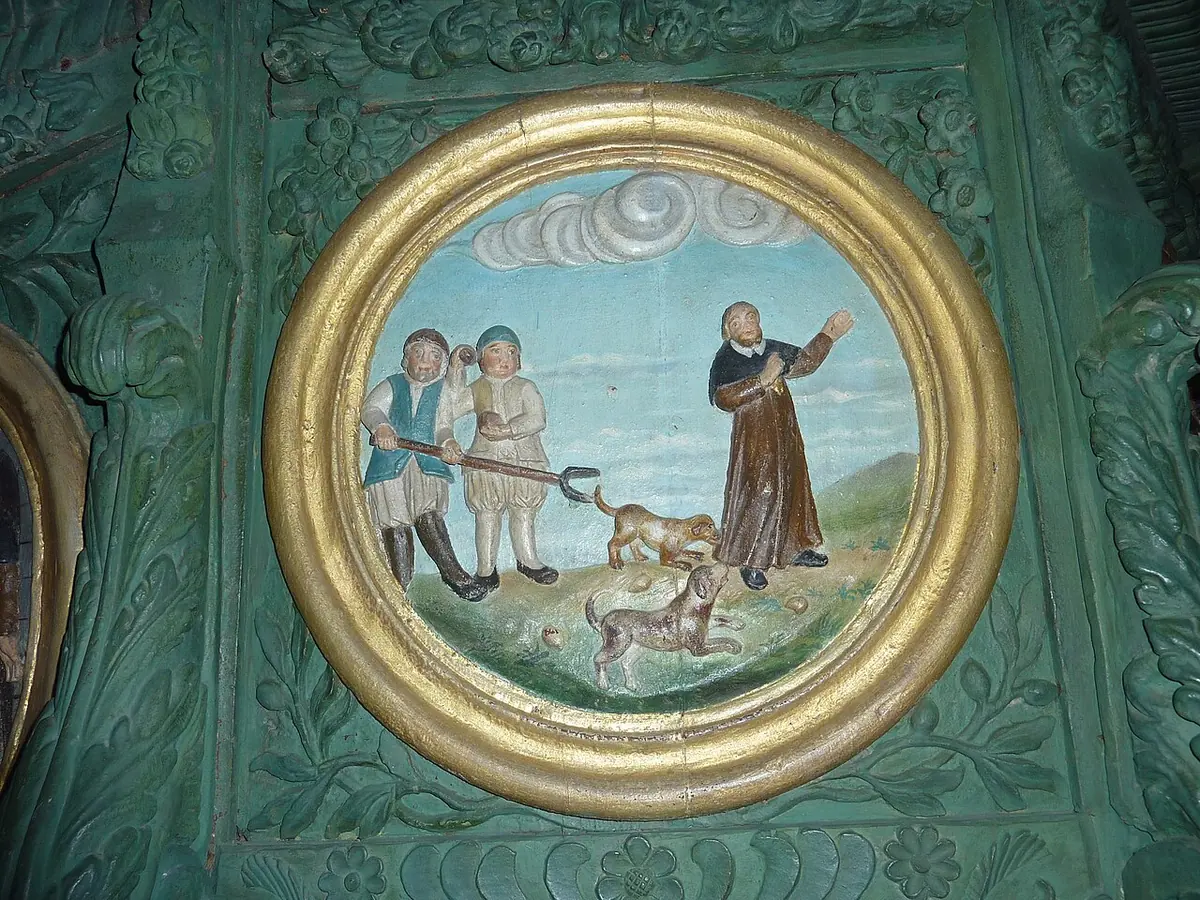
The best-known story about St. Ronan is a traditional one, and it has a homely beginning. A farmer came so often to hear the hermit that his wife, Keban, feared he would abandon her and become a monk. She hid her little daughter in a chest, went to King Gradlon at Quimper, and accused Ronan of being a werewolf who prowled the sheepfolds at night and had devoured her child.
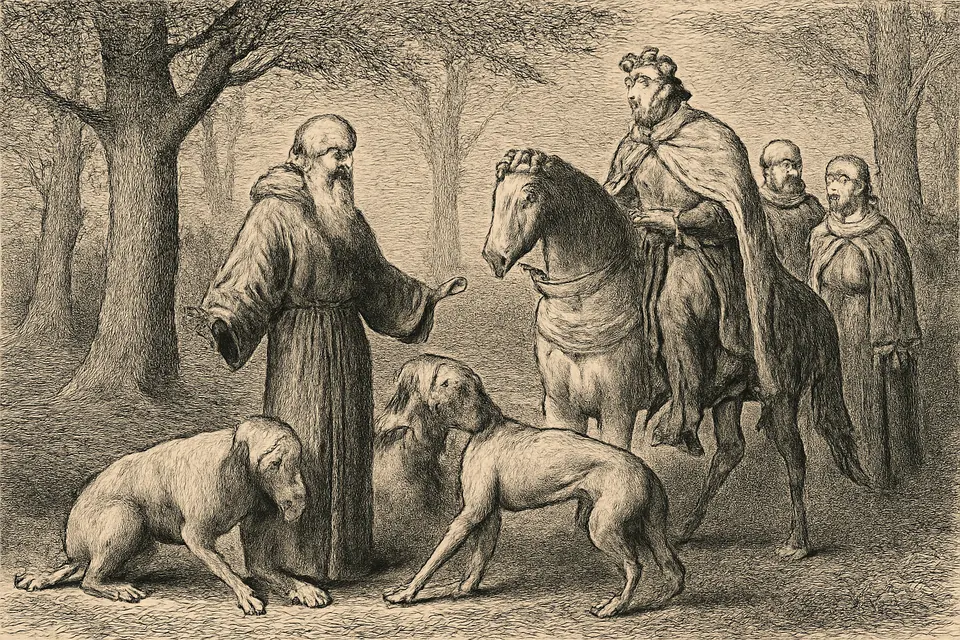
The king had Ronan seized and set his hunting hounds on him, saying they would tear him to pieces if they caught any scent of the wolf. Instead the dogs lay down and fawned on the old man. The crowd changed its mind on the spot and proclaimed him a saint, and when the woman's house was searched, the child was found alive in the chest.
Baring-Gould, writing as a historian, suggested a plainer version: the Christian king kept Ronan near him for some days and let him feed the hounds, so that on the day of the trial they knew him as a friend. Either way, the story is the heart of Locronan's memory of its saint.
His death and the ox-cart
Keban kept up her hostility, and the Life says Ronan finally left Cornouaille for the north coast, near Hillion on the Bay of Saint-Brieuc. One morning he was found dead in his cell, kneeling in prayer. Baring-Gould placed his death, only by conjecture, around 540.
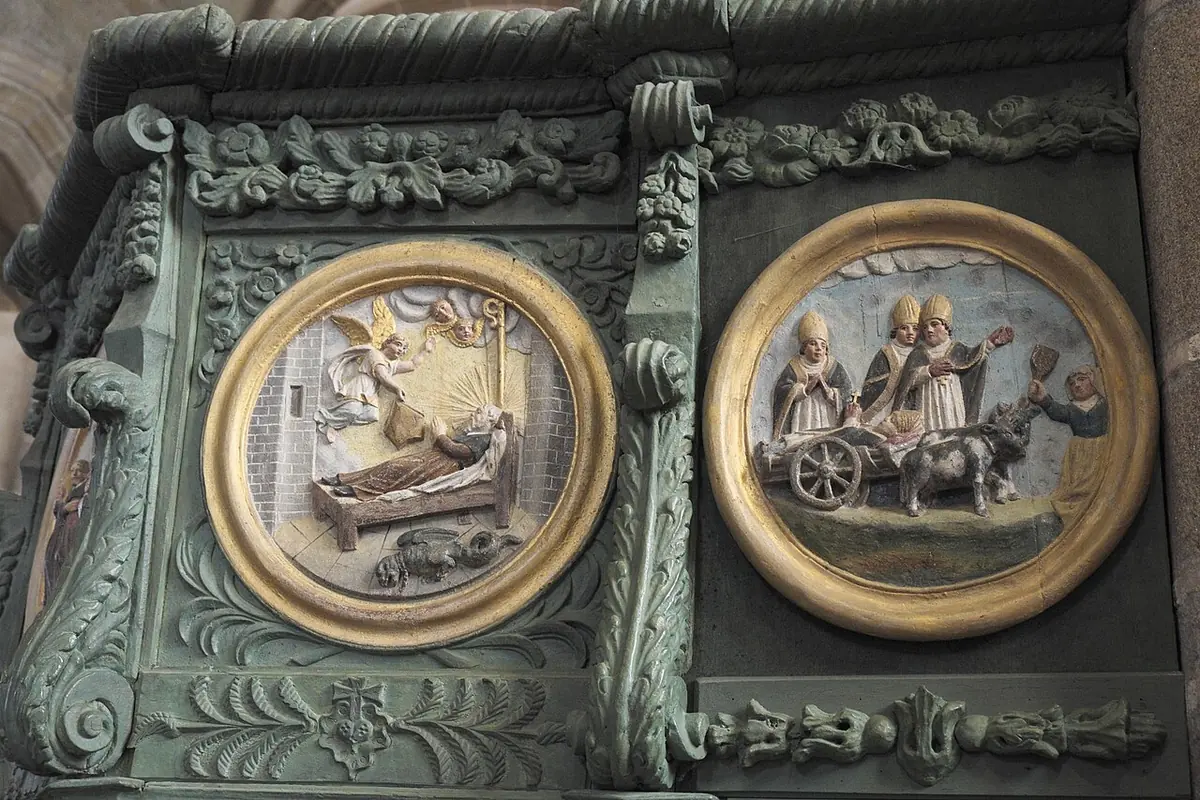
His body was carried back to the forest of Nevet in a cart drawn by two oxen. By tradition, when the cart passed Keban washing clothes, she struck at the oxen with her washing bat and broke one of their horns, shouting that Ronan was no saint. A cross stands where tradition says this happened, and Baring-Gould noted in 1913 that no local peasant would raise his hat passing it.
Locronan, its church and the Troménie
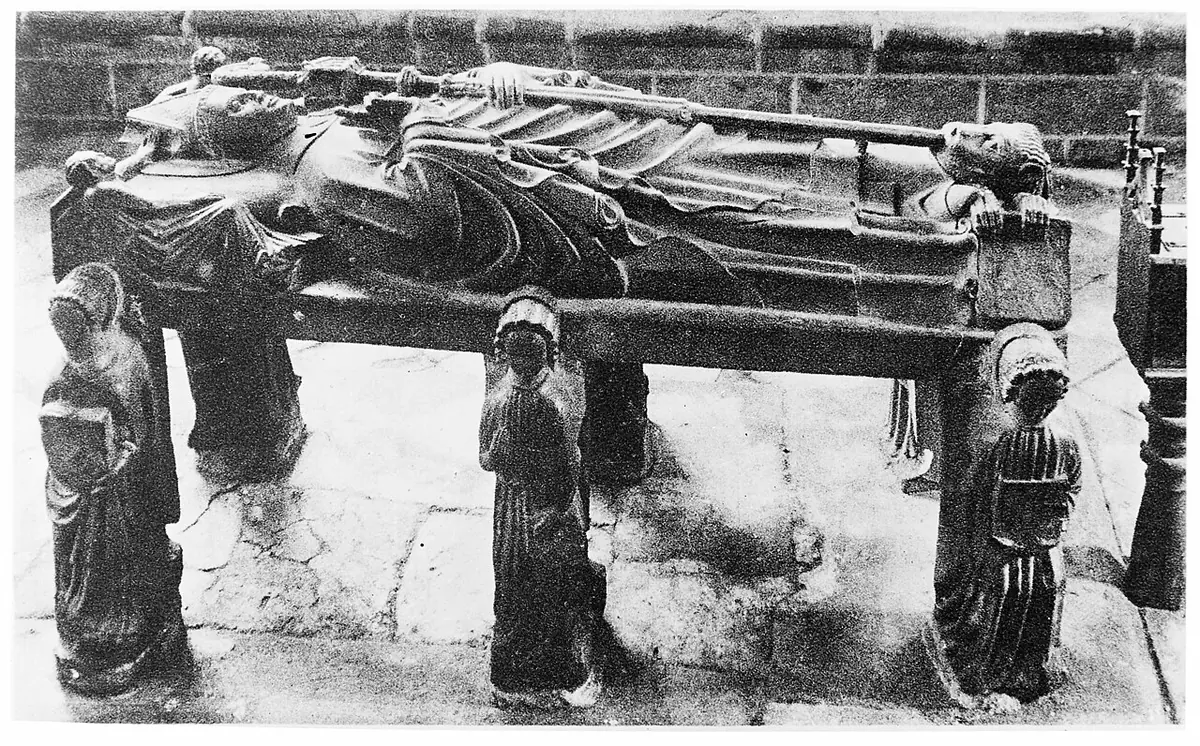
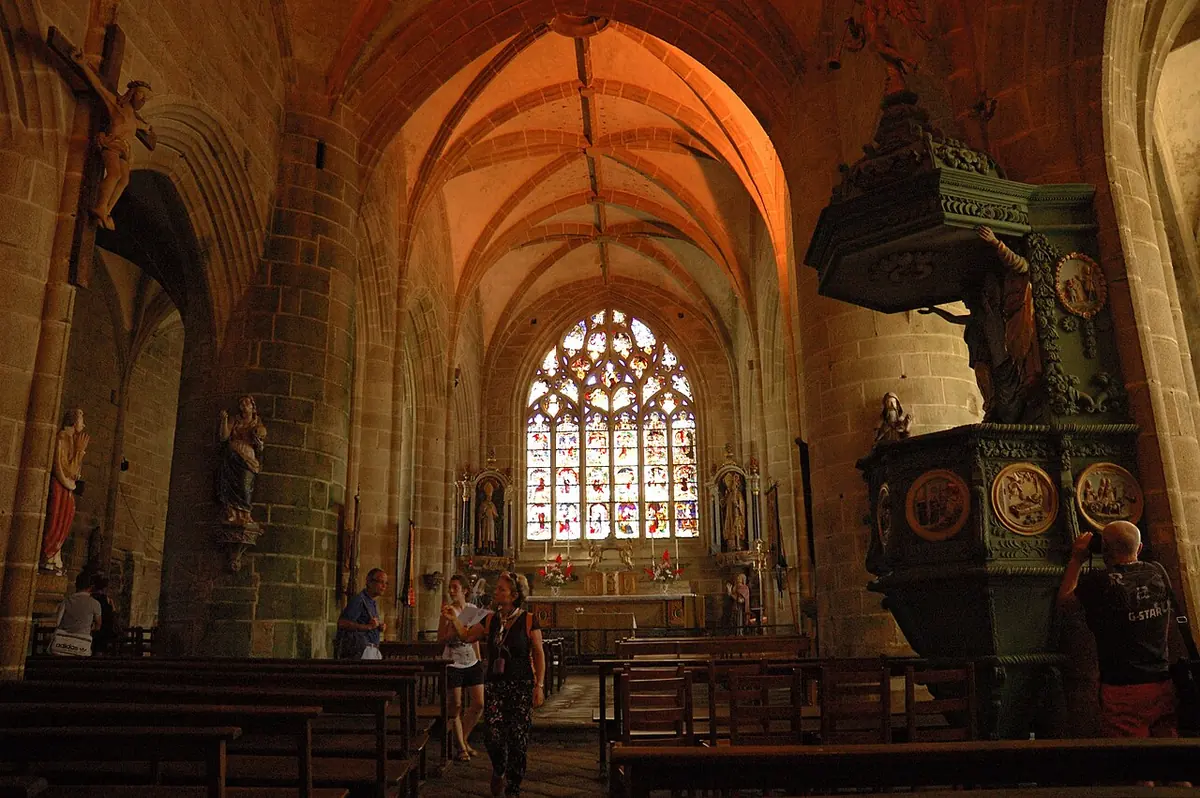
The body was laid at Locronan, and a town of pilgrims grew up around the grave. The Dukes of Brittany favored it, and between 1424 and 1480 they paid for the granite church of Saint-Ronan, built like a small cathedral. Beside it stands the Pénity chapel, which Anne of Brittany helped finish after her visit in 1505. It holds the saint's tomb, a sixteenth-century monument on which Ronan lies carved as a bishop. The great pulpit in the church tells his life in a row of painted medallions.
The relics themselves have a hidden history. Baring-Gould thought they were carried off during the Viking raids of the tenth century, and he records that relics of St. Ronan were in Quimper Cathedral in 1219. What remains of them today is not known.
Every July, on the second Sunday, Locronan walks the Troménie, a procession around the boundary of the saint's sanctuary, the minihi, singing a Breton hymn of St. Ronan. Every sixth year it becomes the Grande Troménie, a walk of about twelve kilometers over the hill, with crosses and banners from Locronan and the neighboring parishes and many pilgrims in Breton dress. Baring-Gould watched it and wrote of women "in white with headdresses of mediaeval cut" and drums rolling at the elevation of the Host.
St. Ronan in Cornwall and Devon
Cornwall has three parishes named for a St. Ruan, and Tavistock Abbey in Devon claimed the relics of a St. Rumon, said to be an Irishman who made his oratory in "the forest of Nemea." Medieval Tavistock already took Rumon and Ronan to be the same man, and Baring-Gould agreed. Not everyone has been convinced, so we hold it as a likely identification, not a certainty.
Symbols of St. Ronan in art
Breton art usually shows St. Ronan as a bishop, with miter and crozier, as on his tomb at Locronan, even though the Life calls him only a priest and hermit. Baring-Gould noted that he has no fixed personal emblem. In the church at Locronan you recognize him by his story instead: the hounds lying at his feet, the king and the accusing woman, and the ox-cart carrying his body home. Banners carried in the Troménie show him the same way, a bearded bishop above the hills of Cornouaille.
Feast day and prayer
The old breviaries of Léon and Quimper keep his feast on June 1, and Locronan celebrates him with the Troménie in July. No traditional prayer to St. Ronan in his own words has come down to us; pilgrims ask his help simply as they walk his boundary.
Let us ask St. Ronan, who was slandered and answered with patience, to pray for all who are falsely accused, and to teach us to keep walking faithfully, as the pilgrims of Locronan still do.
Frequently asked questions
Who was St. Ronan of Locronan?
An Irish monk and priest who crossed to Brittany around 500 and lived as a hermit in the forest of Nevet above the Bay of Douarnenez, preaching to the pagan people there. He died, by tradition, around 540, and the town of Locronan grew up around his tomb.
When is the feast of St. Ronan of Locronan?
June 1, the date in the old Breton breviaries of Léon and Quimper. At Locronan the great celebration is the Troménie procession on the second Sunday of July, with the Grande Troménie every six years.
What is the Troménie of Locronan?
A pilgrimage procession that follows the boundary of St. Ronan's sanctuary (the minihi) over the hill above the town. The Petite Troménie, about 6 km, is walked every year; the Grande Troménie, about 12 km, every sixth year, with banners and crosses from the neighboring parishes and people in Breton dress.
Is St. Ronan of Locronan the same as the Irish St. Ronans?
Ireland honors at least twelve saints named Ronan. The Ronan of Locronan is a distinct saint, though his Latin Life calls him Irish. Sabine Baring-Gould argued that he is the same man as St. Ruan of Cornwall and St. Rumon of Tavistock, an identification the Tavistock monks already made in the Middle Ages.
Keep exploring
Sources
- Sabine Baring-Gould and John Fisher, The Lives of the British Saints, vol. 4 (1913): S. Ruan or Ronan. The 13th-century Latin Life (Paris BnF MS lat. 5275), the Keban story, the tomb, the Troménie, the relics at Quimper in 1219, the Breton feast of June 1 and the identification with Ruan and Rumon (pp. 120–125)
- Catholic Encyclopedia (1912): St. Ronan. The twelve Irish saints named Ronan
- Locronan Tourist Office: Small City of Character in Brittany. The church of Saint-Ronan (1424–1480), Anne of Brittany's gift for the Pénity, and the Grande and Petite Troménie