Pope St. Eugene I, the Gentle Pope Who Would Not Bend
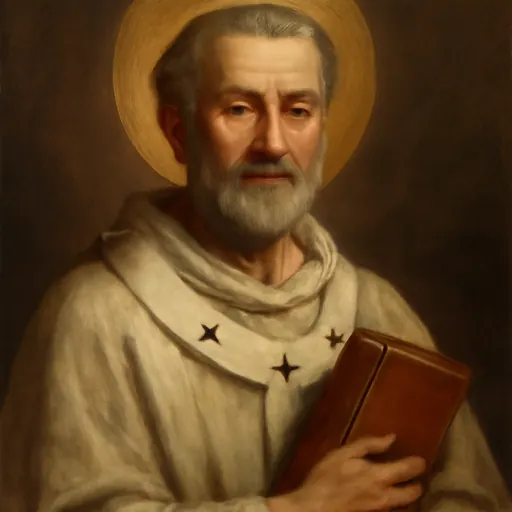
Pope St. Eugene I was a Roman priest who led the Church from August 10, 654, to his death on June 2, 657, while his predecessor St. Martin I died in exile. Remembered as gentle and generous, he still refused a vague creed that dodged the truth about Christ's two wills. We keep his feast on June 2.
Who was St. Eugene I?
Pope St. Eugene I led the Church of Rome for less than three years, from 654 to 657, at one of the darkest moments in the history of the papacy. His predecessor, St. Martin I, had been dragged out of Rome by the soldiers of the Byzantine emperor and was dying in exile. Eugene was a Roman, the son of Rufinianus, a cleric from his boyhood. His early biographer in the Liber Pontificalis remembered him for his gentleness, his holiness and his generosity.
Gentle does not mean weak. When the emperor's court tried to draw him into a compromise on the faith, the clergy and people of Rome refused, and Eugene kept the faith they defended. We keep his feast on June 2, the day he died.
The life of Pope St. Eugene I
A Church without its shepherd
The quarrel of those years was over Monothelitism, the teaching that Christ has only one will. The Church, following St. Maximus the Confessor and St. Sophronius of Jerusalem, held that Christ, true God and true man, has two wills, divine and human, the human freely obeying the divine. In Gethsemane we hear both: "not my will, but thine, be done" (Luke 22:42, King James Version).
Emperor Constans II wanted silence on the question. Pope Martin I had condemned the error at a council in the Lateran in 649, and on June 18, 653, the emperor's men carried him off. For about fourteen months Rome was governed, as was usual during a vacancy or a long absence, by the archpriest, the archdeacon and the chief of the notaries. Then, on August 10, 654, Eugene was elected.
An election in hard times
The circumstances are murky, and the Catholic Encyclopedia is honest about it. If the court hoped for a pliable pope, it was disappointed. If Eugene was chosen while Martin still lived and against his wishes, Martin later seems to have accepted the election; the Catholic Encyclopedia points to one of his letters from exile.
The letter that Rome refused
One of Eugene's first acts was to send legates to Constantinople with a profession of faith. The legates came back with a synodal letter from the new patriarch, Peter, and a request that the pope enter into communion with him. Peter's letter was written, says the Catholic Encyclopedia, "in the most obscure style," and never said plainly how many wills or operations there are in Christ.
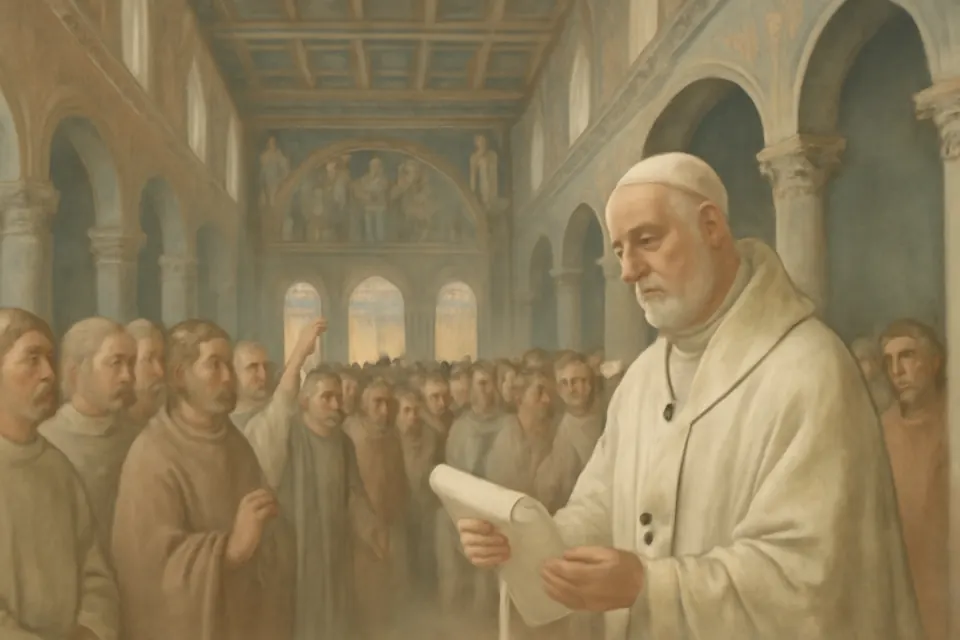
When it was read aloud in the basilica of St. Mary Major in 656, the clergy and people of Rome rejected it with indignation. They would not let the pope leave the church until he promised not to accept it. Eugene promised.
The imperial officials were furious. They threatened that, when politics allowed, they would roast Eugene and all the talkers at Rome along with him, as they had roasted Pope Martin. The threat is preserved in the record of a disputation held with St. Maximus. What saved Eugene was the advance of the Arab fleets, which took Rhodes and in 655 defeated Constans himself at the naval battle of Phoenix. The emperor had no time for Rome.
A blessing for a young Englishman
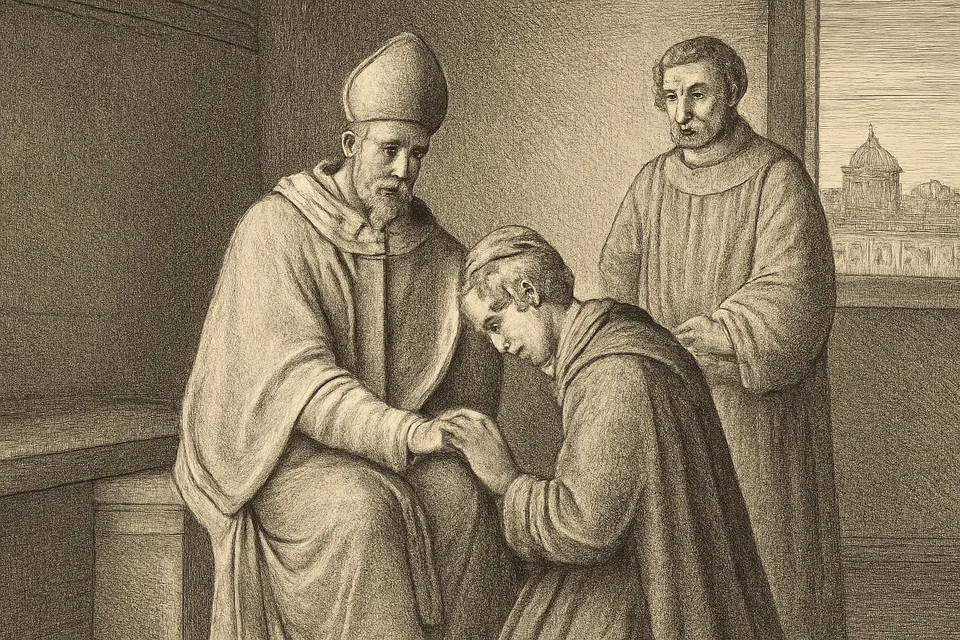
A small, warm scene from these years reaches us through England. A young Northumbrian named Wilfrid, the future St. Wilfrid, came to Rome about 654 to learn "the ecclesiastical and monastic rites" in use there. St. Bede tells how he won the friendship of the archdeacon Boniface, "counselor to the pope," who taught him the four Gospels and the right reckoning of Easter. Wilfrid's biographer Eddius adds that Boniface presented him to the pope, who "placed his blessed hand on the head of the youthful servant of God, prayed for him, and blessed him." The Catholic Encyclopedia judges that the pope was almost certainly Eugene.
Little else is known. He consecrated twenty-one bishops for different parts of the world, died at Rome on June 2, 657, and was buried in St. Peter's.
Miracles of St. Eugene I
No miracles are recorded for him in the early sources: there are no approved or reported miracles, and not even a traditional legend of wonders attached to his name. His holiness was the quiet kind: a pastor's patience, an open hand to the poor, and the steadiness to keep the faith when an empire wanted it blurred. Rome honored him as a saint from early times, and the Roman Martyrology lists him on the day of his death.
Symbols of St. Eugene I in art
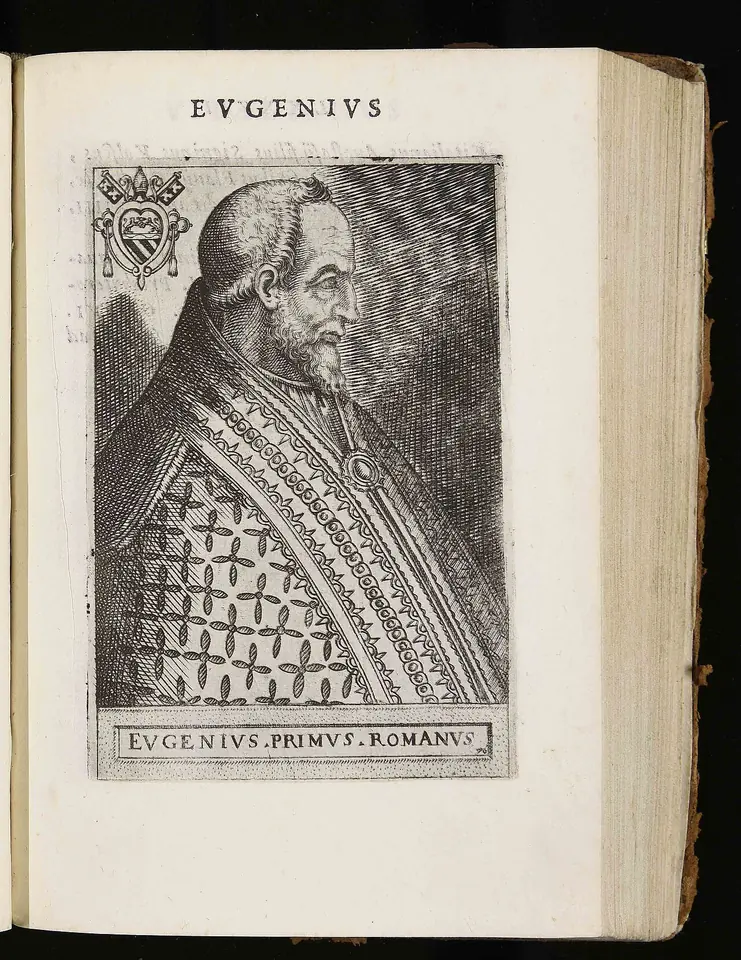
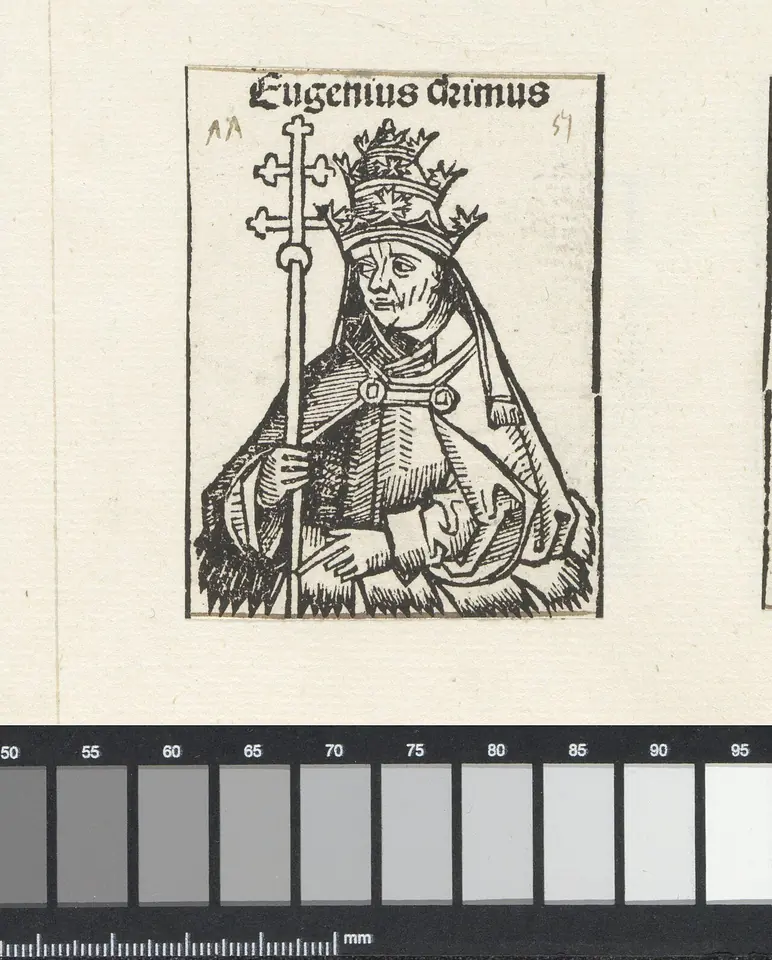
There is no portrait from his lifetime. Later artists drew him as they drew every early pope, so he is recognized by his name more than by any personal attribute.
- Papal tiara: worn in late medieval and Renaissance images such as the Nuremberg Chronicle. No seventh-century pope wore one; it is the artist's way of saying "pope."
- Cross with two bars: the papal processional cross, carried in the same woodcut.
- Pallium: the white wool band of the bishop of Rome, the earliest sign of his office.
- Book: the Gospel he guarded.
The two images on this page come from printed series of papal portraits: the 1493 Nuremberg Chronicle and Cavalieri's 1580 Pontificum Romanorum effigies.
Feast day and burial
We keep his feast on June 2. He was buried in St. Peter's, in the old basilica built by Constantine. His tomb did not survive the rebuilding of the church in the sixteenth and seventeenth centuries, and no separate relics of him are known today. See the other saints of June on our feast days page.
Prayer to Pope St. Eugene I
No traditional prayer to St. Eugene I has come down to us. We can ask his intercession simply, in words of our own like these, for the pope and for the bishops, and for all who are pressed to water down the truth to keep the peace:
St. Eugene, gentle shepherd of Rome, you kept the faith in Christ, true God and true man, when the powerful asked you to blur it. Pray for the Holy Father, for our bishops, and for us, that we may say "not my will, but thine" with Christ, and hold to the truth with your patience and your kindness. Amen.
Frequently asked questions
Who was Pope St. Eugene I?
A Roman cleric, the son of Rufinianus, elected pope on August 10, 654, after the emperor had carried St. Martin I off to exile. He reigned less than three years and died at Rome on June 2, 657.
When is the feast of St. Eugene I?
June 2, the day of his death, as listed in the Roman Martyrology.
Why is Pope Eugene I considered a saint?
For a holy, gentle life and for holding to the faith of the Church on Christ's two wills, human and divine, under the same imperial pressure that destroyed his predecessor. He was honored as a saint from early times, long before formal canonization.
Was Eugene I elected while Pope Martin I was still alive?
Yes. Martin was taken from Rome in 653 and died in exile in 655. The Catholic Encyclopedia notes that Martin, writing from exile, seems to have accepted Eugene's election.
Keep exploring
Sources
- Pope St. Eugene I, Catholic Encyclopedia (1909), New Advent. Election on August 10, 654, death on June 2, 657, the rejected letter of Patriarch Peter at St. Mary Major, the threat against him, St. Wilfrid's visit, twenty-one bishops consecrated, burial at St. Peter's
- Bede, Ecclesiastical History of the English People, Book V, Medieval Sourcebook, Fordham University. Wilfrid's first stay in Rome and his friendship with the archdeacon Boniface, counselor to the pope