The Seven Sleepers of Ephesus
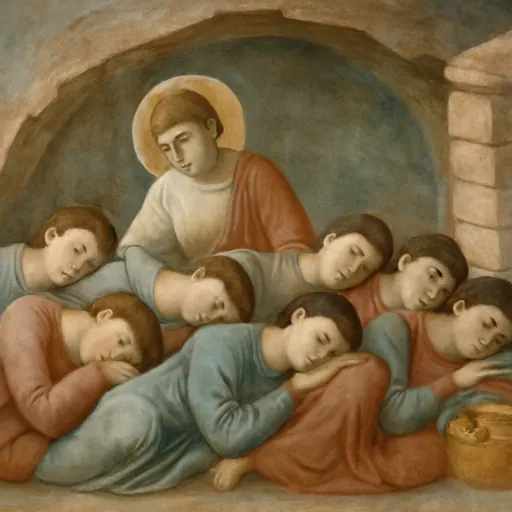
The Seven Sleepers of Ephesus were seven young Christians who, the legend says, hid in a cave near Ephesus during the persecution of Emperor Decius around 250, were walled in, and fell asleep. They woke about two centuries later, under the Christian emperor Theodosius II, and their waking was taken as a sign of the resurrection of the body. The Roman Martyrology keeps them on July 27; the Orthodox Church on August 4 and October 22.
Who were the Seven Sleepers?
The Seven Sleepers of Ephesus were seven young Christians who, the legend says, refused to sacrifice to the Roman gods when the emperor Decius came to Ephesus around the year 250. They hid in a cave outside the city, Decius had the mouth of the cave walled up, and they fell asleep inside. Nearly two centuries later, in the reign of the Christian emperor Theodosius II, workmen opened the cave and the seven woke up, thinking they had slept a single night. They told their story to the bishop and the emperor, then lay down and died in peace.
Their story is a traditional one. It circulated in Syriac and Greek by the 6th century, and the Catholic Encyclopedia credits St. Gregory of Tours with a Latin Passion of the Seven Holy Martyrs Sleeping at Ephesus, which carried it to the West. The Muslim tradition knows a version too: the 18th chapter of the Qur'an tells of the "companions of the cave."
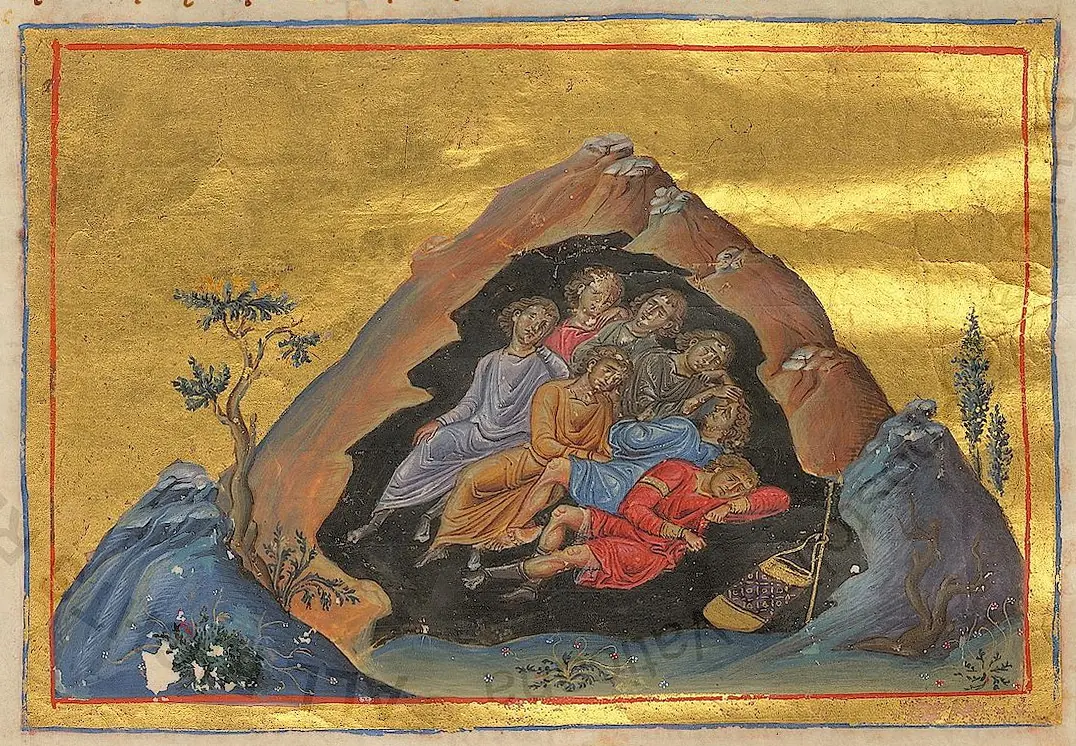
The Church honors them for what the story teaches. They are confessors who would not deny Christ, and their waking is a parable of the resurrection of the body. We call on them as the Seven Holy Youths, and some families ask their prayers when sleep won't come.
The story of the Seven Sleepers
The fullest Western telling is in the Golden Legend, the 13th-century book of saints' lives that William Caxton printed in English in 1483. The Orthodox life, on the Orthodox Church in America's website, follows the same outline with different names.
The hiding place
When Decius ordered every citizen to sacrifice, seven young men of good family, all officers at court, were denounced as Christians. The emperor gave them time to change their minds while he was away. They gave their goods to the poor and hid in a cave on a mountain the Golden Legend calls Celion (the Orthodox life says Mount Ochlon). The youngest, Malchus, called Iamblicus in the East, dressed as a beggar and slipped into the city to buy bread.
Walled in
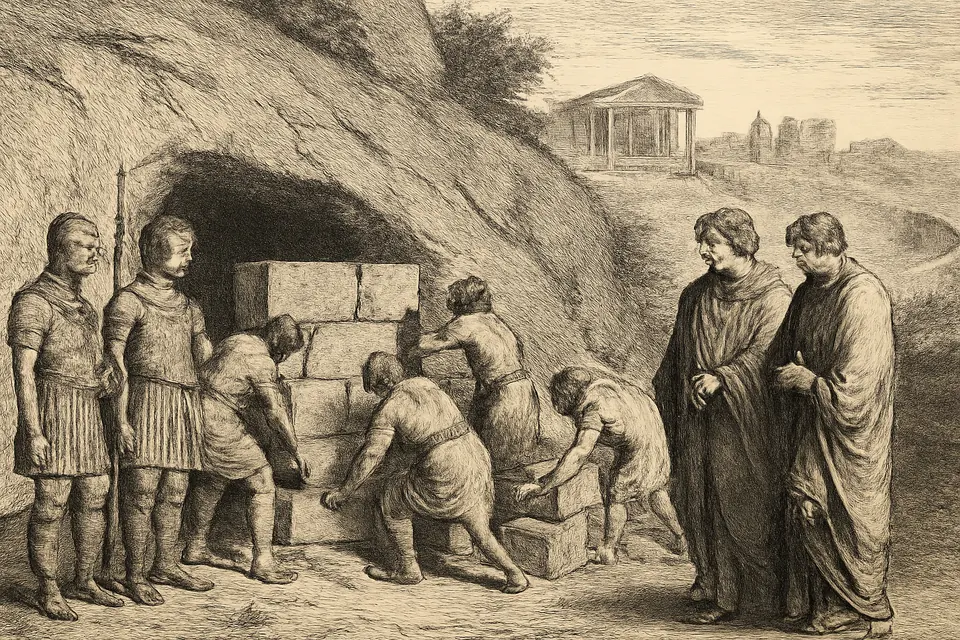
When Decius returned, Malchus came back frightened with the news. The friends ate their bread in tears and, "as God would," fell asleep. Decius learned where they were and had the cave sealed with stones so they would die of hunger. Two Christians among his officials, named in the Golden Legend as Theodorus and Rufinus, wrote the story of the martyrs on tablets and hid them among the stones.
The waking
Generations passed and the empire became Christian. Under Theodosius II some people in Ephesus denied the resurrection of the body, and the emperor, the Golden Legend says, wept over it in sackcloth. Then a landowner had masons cut stone near the old cave for a cattle shed, and the entrance was opened.
The seven woke and greeted each other. Malchus went down to buy bread and was astonished to see crosses carved over the city gates. When he paid with coins of Decius, the bakers thought he had found buried treasure and took him to the bishop. He led the bishop and the townspeople up to the cave, where they found the sealed tablets.

The emperor's visit
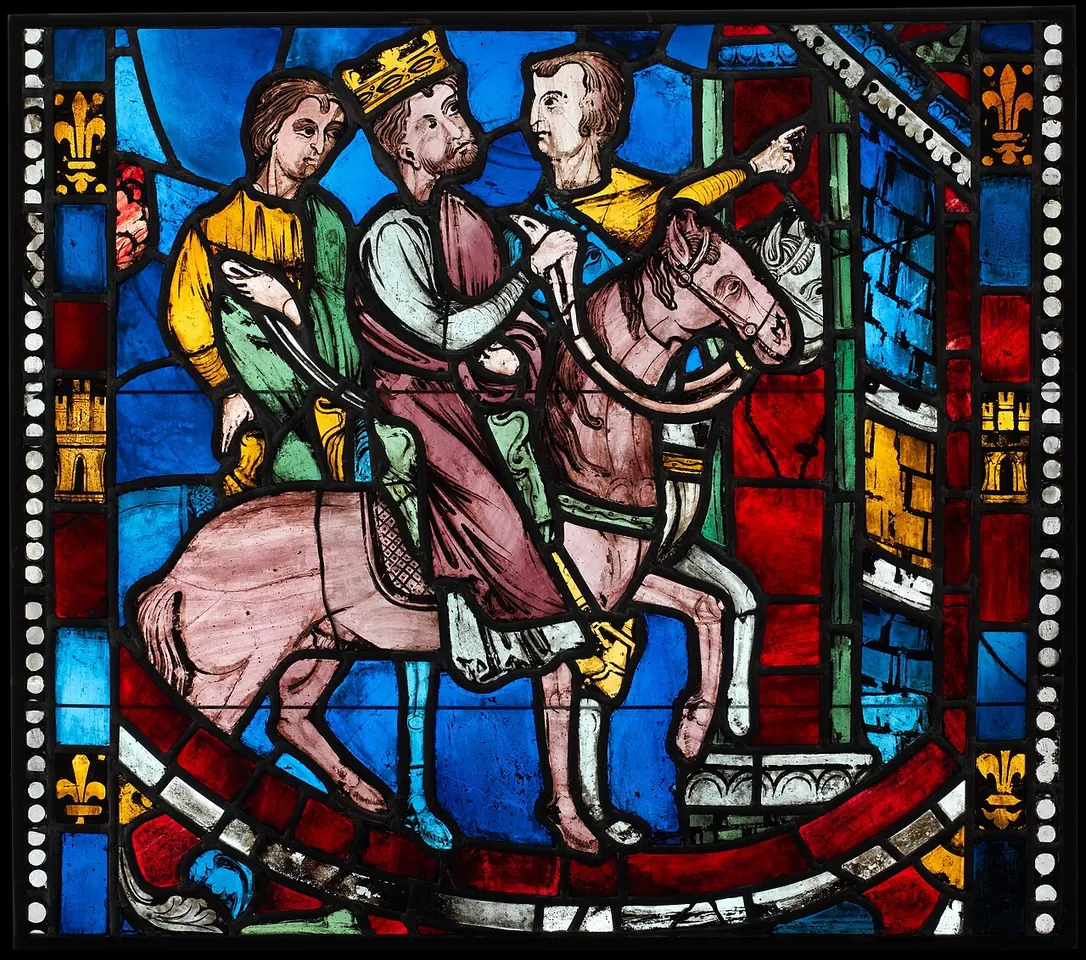
Theodosius came from Constantinople. In the Golden Legend he embraced the youths and said, "I see you now like as I should see our Lord raising Lazarus." Maximian answered that God had raised them before the great resurrection so that the emperor might believe. Then the seven bowed their heads and died. When Theodosius planned gold and silver coffins for them, they appeared to him in a dream and asked to be left lying on the earth of the cave until the last day.
Miracles and the meaning of the legend
Everything in the story is traditional. No miracle of the Seven Sleepers has been investigated in the modern way, and the old writers knew the story had problems. The Golden Legend itself stops at the end to do the arithmetic: Decius reigned in the 250s and the waking was placed in the 400s, so the author concluded they "slept but two hundred and eight years," not the 362 or 372 the story claims.
The meaning was never in doubt. The Orthodox life says the Lord used the seven youths to reveal "the mystery of the Resurrection of the Dead and of the future life." The Orthodox Church even mentions them in the service for the Church New Year on September 1, and the prayer book of the Russian Church, the Book of Needs, has a prayer to them for the sick who cannot sleep.

Symbols of the Seven Sleepers in art
The Seven Sleepers are easy to recognize: seven young men asleep together, usually packed side by side in a cave. Look for:
- A cave or a walled-up opening: the center of almost every image.
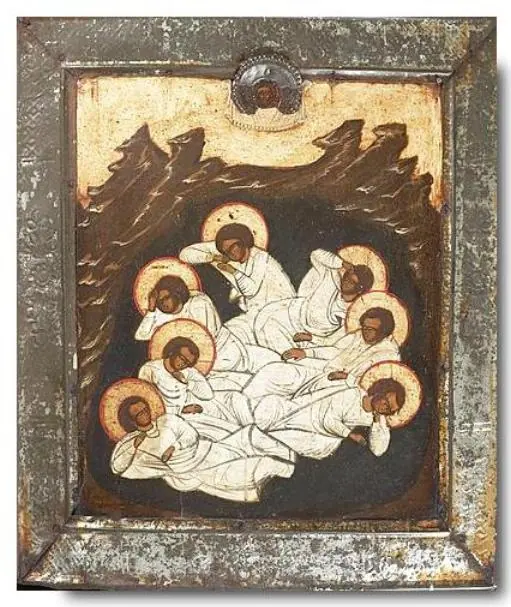
- Seven figures asleep: in Byzantine and Russian icons they lie in two rows, often in white or bright tunics, with halos.
- Coins and loaves: Malchus's bread and his old coins of Decius.
- Tablets or a sealed box: the record of their confession hidden among the stones.
- An emperor: Decius giving orders, or Theodosius arriving on horseback.
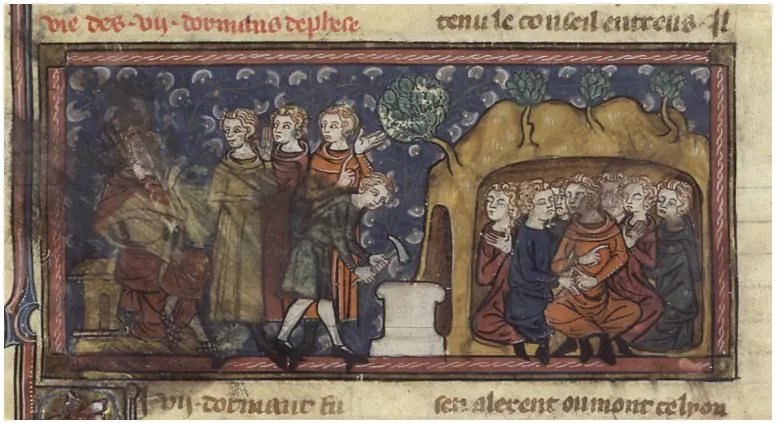
The Montbaston miniature below tells the story in two halves: Decius commands on the left, and the youths wait inside their walled cave on the right.
Russian icon painters returned to the subject again and again, sometimes adding Christ above the cave or putting the seven inside a vine border.
Feast days and where the Seven Sleepers are honored
The Roman Martyrology lists them on July 27: "At Ephesus, the birthday of the seven holy sleepers." The Orthodox Church keeps August 4, with a second commemoration on October 22; the Greek Menaion of 1870 says they fell asleep on August 4 and woke on October 22. In Germany their old feast on June 27 lives on as Siebenschläfertag, a weather day: rain on Seven Sleepers' Day is said to bring seven weeks of rain. See our feast days calendar for the rest of the summer.
The traditional cave is on the slope of Panayırdağ, the hill east of the ancient city of Ephesus, near Selçuk in Turkey. The Russian abbot Daniel saw relics of the seven youths there in the 12th century. Today it is a ruin of rock tombs and a church built over a catacomb, close to the places where we also remember St. John the Apostle.
Prayer to the Seven Sleepers
The Orthodox Book of Needs (Trebnik) contains a prayer to the Seven Youths of Ephesus for those who are ill and cannot sleep. The Orthodox Church also sings a troparion and kontakion on their feast. In the West there is no standard prayer to them, and Catholics simply ask their intercession: "Holy Seven Sleepers of Ephesus, pray for us."
Let us ask their prayers for anyone lying awake tonight, and for ourselves, that we may hold on to the hope they were raised to proclaim: the resurrection of the body and the life of the world to come.
Frequently asked questions
Who were the Seven Sleepers?
Seven young men of Ephesus who refused to sacrifice to the Roman gods under Emperor Decius. The Golden Legend names them Maximian, Malchus, Marcian, Denis, John, Serapion and Constantine; the Orthodox Church calls them Maximilian, Iamblicus, Martinian, John, Dionysius, Exacustodianus (Constantine) and Antoninus.
Is the story of the Seven Sleepers true?
It is a traditional story, not a documented event. It was told in Syriac and Greek by the 6th century and put into Latin by St. Gregory of Tours. The Church has long honored the seven as martyrs without ruling on the details, and the Golden Legend itself doubted the length of the sleep, working out that it was closer to 208 years than 362.
When is the feast of the Seven Sleepers?
July 27 in the Roman Martyrology. The Orthodox Church remembers them on August 4 and again on October 22. In Germany, June 27 is Siebenschläfertag, "Seven Sleepers' Day," tied to a weather saying that rain on that day brings seven weeks of rain.
Is there a prayer to the Seven Sleepers for sleep?
Yes. The Orthodox Book of Needs (Trebnik) has a prayer to the Seven Youths of Ephesus for the sick who cannot sleep, and people of both East and West ask their prayers for insomnia.