Blessed Robert Sutton, Priest and Martyr of Stafford

Blessed Robert Sutton (about 1544–1587) was the Church of England rector of Lutterworth who told his parish from the pulpit that he had taught them false doctrine, rode away to the English College at Douai, and came home a Catholic priest. He was arrested while saying Mass at Stafford and martyred there on July 27, 1587. Pope John Paul II beatified him in 1987.
Who was Blessed Robert Sutton?
Blessed Robert Sutton was an English priest and martyr of the reign of Elizabeth I. For six years he was the Protestant rector of Lutterworth in Leicestershire, the parish once held by John Wycliffe. Then, won over by his younger brother's letters, he told his whole congregation from the pulpit that he had led them astray, rode off to the English College at Douai, and returned as a Catholic priest. He was taken while saying Mass at Stafford and was hanged, drawn and quartered there on July 27, 1587. Pope John Paul II beatified him with 84 other martyrs on November 22, 1987.
Most of what we know comes from three witnesses: Father Christopher Grene, who copied out the martyrs' records in the 17th century; Father John Gerard, the Jesuit, who knew him; and the diary of Thomas Worswick of Stafford.
The life of Blessed Robert Sutton
Oxford scholar and Lutterworth rector
Robert was born at Burton-on-Trent around 1544. Father Grene's notes say his father was a carpenter, that he went to Oxford at fifteen or sixteen, was chosen a scholar of Christ Church, took his bachelor's and master's degrees, and lectured there in logic, philosophy, Greek and Hebrew. He stayed in the college eleven or twelve years and then served as parson of Lutterworth for six.
He had three younger brothers, William, Abraham and John, and all of them came back to the old faith. William went first. He studied at Douai from 1573 and wrote again and again to Robert, urging him to leave the established Church.

The farewell from the pulpit
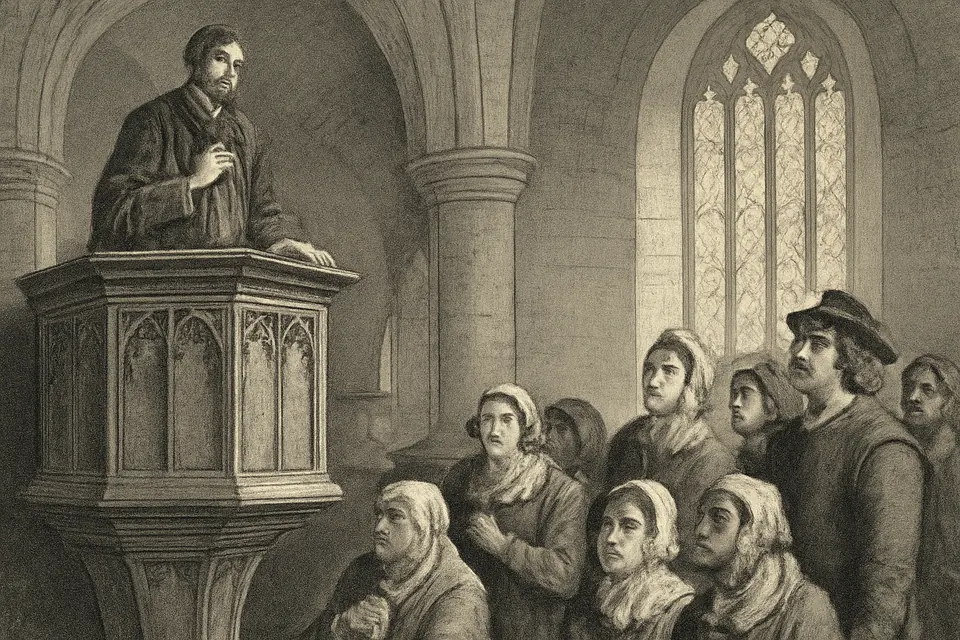
His leaving was not quiet. A catalog of martyrs kept at Stonyhurst records that "he first tould all his parishe owt of the pulpit that he had taught them falce doctrine, and willed them to embrace the Catholicke Faith." Father Gerard gives the fuller story. Robert gathered his people, begged their pardon for having been "a blind guide," and declared that there was no hope of salvation outside the Roman Church. Then he came down from the pulpit, threw off his gown (he was already booted for the road), and rode away with his brother Abraham on horses a servant held ready outside the churchyard.
Douai and the English mission
The Douay Diary records their arrival on March 23, 1577, and their reception into the Church the next day. The brothers moved quickly: subdeacons at Cambrai in September, deacons in December, priests by February 1578. They said their first Masses on March 7 and set out for England on March 19, less than a year after they arrived.

Few details of Robert's ministry survive. Father Grene says that he and Abraham were arrested, imprisoned and banished together in 1585. Robert came back. Father Gerard knew him in England, "labouring strenuously and holily in the Lord's vineyard," and the story points to Stafford as the place of his work.
Arrest at Stafford
Worswick's diary says the bailiff took "a seminary priest called Sutton saying of Mass in the town," together with several Catholic gentlemen. The sheriff, Sir Walter Aston, wrote out an examination to suit himself; when Robert denied it was his confession, the sheriff struck him to the ground with his staff. At the assizes he was condemned for high treason, for being a priest of the Roman Church in England. Worswick, no friend of his cause, called him "a very Reverend learned man" who "disputed very stoutly and learnedly." The gentlemen taken with him were condemned too, but they were not executed.
The light in the cell
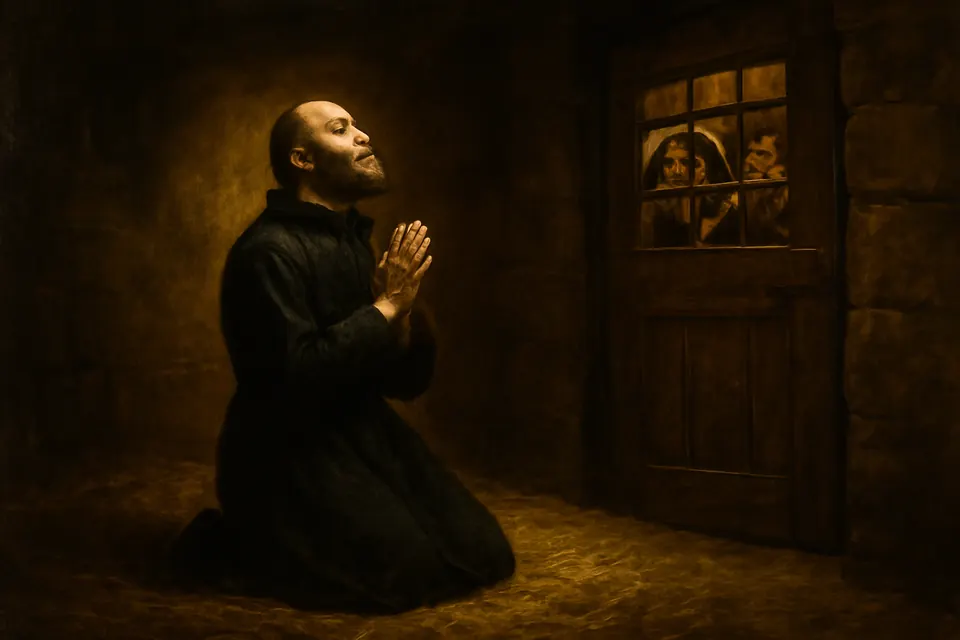
Three old sources speak of a grace given the night before he died. Catholic prisoners heard him talking in his locked cell, crept down to see who was with him, and through a window saw him praying, surrounded by light. In the morning he blessed his fellow prisoners and said:
God comfort you all, for I am comforted.
This is a reported grace, set down by Father Gerard and Father Grene from the prisoners' testimony.
His martyrdom
At the gallows he asked to speak and was refused. Father Grene says he took out his handkerchief and held it up as a sign that he lived and died in the light of the Catholic faith, after speaking of the candle given at baptism and at the hour of death. He was cut down while still alive, and he died forgiving the man who butchered him, calling on Jesus and Mary. It is believed the gallows stood at Gallows Flat, near Stafford.
His relics
A year later Catholics secretly took down a shoulder and an arm. The flesh was gone except on the thumb and forefinger, the fingers anointed at his ordination. Abraham Sutton kept one and gave the other to Father Gerard, who set it in a small silver-gilt reliquary. In 1914 that reliquary was at Stonyhurst College with Gerard's own Latin note, which describes the thumb and the light in the prison. In 1850 a box of relics found hidden in the old chapel at Sutton Place in Surrey held a rib bone with the label "R. Sutton, Staffordiae."
Where the relics of Blessed Robert Sutton are kept: see them on the relics map →
Symbols of Blessed Robert Sutton in art
No old portrait of him is known. In modern images look for:
- A black cassock: the dress of a seminary priest.
- A white handkerchief: the sign he raised on the scaffold to show he died in the light of faith.
- A rope and martyr's palm: his death by hanging and his victory as a martyr.
- Light around him in a cell: the grace the prisoners saw the night before he died.
Feast day and prayer
We keep his feast on July 27, and the Church in England and Wales remembers him again on May 4 with all its martyrs of the Reformation. See more on our feast days page. A different martyr, Robert Sutton the layman of Kegworth, died at Clerkenwell on October 5, 1588.
We know of no traditional prayer to Blessed Robert Sutton to reprint. Let us ask him to pray for priests who must preach unwelcome truths, for all who return to the Church at great cost, and for the people of Lutterworth and Stafford.
Frequently asked questions
Who was Blessed Robert Sutton?
A carpenter's son from Burton-on-Trent who became a scholar of Christ Church, Oxford, and rector of Lutterworth. Converted by his brother William, he trained for the Catholic priesthood at Douai in 1577–1578, worked in Staffordshire, and was executed at Stafford for being a priest.
When is the feast of Blessed Robert Sutton?
July 27, the day of his martyrdom. In England and Wales he is also remembered on May 4 with all the beatified martyrs of the Reformation.
Is Blessed Robert Sutton the same as the martyr Robert Sutton of Clerkenwell?
No. A different Robert Sutton, a layman from Kegworth in Leicestershire, was hanged at Clerkenwell in London on October 5, 1588. The Catholic Encyclopedia warns readers not to confuse the two.
Where are the relics of Blessed Robert Sutton?
Catholics took an arm and shoulder from the gallows a year after his death. His thumb was kept at Stonyhurst College in Father John Gerard's reliquary, and in 1850 a rib labeled with his name turned up in a box of relics hidden at Sutton Place in Surrey.
Keep exploring
Sources
- Francis E. Ross, Venerable Robert Sutton, in Edwin H. Burton and J. H. Pollen, eds., Lives of the English Martyrs, second series, vol. 1 (London: Longmans, Green, 1914), pp. 301–312. The pulpit farewell at Lutterworth, the Douay Diary dates, the arrest at Mass, the light seen in his cell, his words on the scaffold, and the relics at Stonyhurst and Sutton Place
- John Wainewright, Ven. Robert Sutton, Catholic Encyclopedia, vol. 14 (1912). The 1587 date and the warning not to confuse him with the layman Robert Sutton
- John Paul II, Homily for the Beatification of 85 English Martyrs, November 22, 1987. The 1987 beatification of George Haydock and 84 companions