St. Peter the Aleut
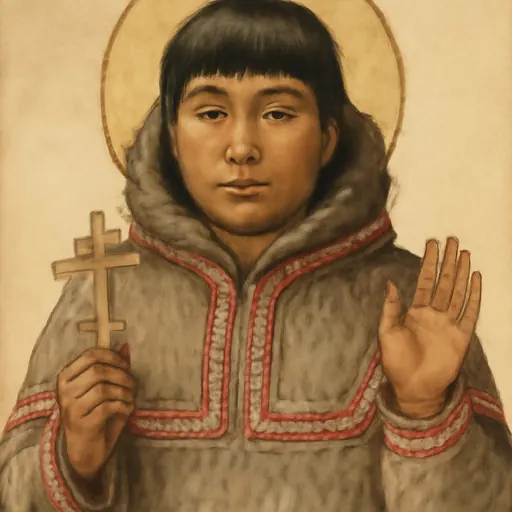
St. Peter the Aleut was a young Alutiiq hunter from Kodiak Island, Alaska, baptized in the Russian Orthodox mission, who the Orthodox Church honors as a martyr. According to the account of a fellow captive, he died in 1815 at a Spanish mission in California after refusing to give up his faith. The Orthodox Church glorified him in 1980 and keeps his feast on September 24.
Who was St. Peter the Aleut?
St. Peter the Aleut was a young Alaska Native man from Kodiak Island, baptized in the Russian Orthodox mission, whom the Orthodox Church honors as a martyr. He belonged to the Alutiiq, or Sugpiaq, people of Kodiak; his own name has come down in several spellings, among them Cungagnaq and Chunagnak. In 1815 he was one of a party of Kodiak hunters captured by Spanish soldiers on the coast of California. According to a fellow captive, he was tortured to death at a Spanish mission for refusing to give up his Orthodox faith. The Orthodox Church glorified him as a saint in 1980.
He is not a saint of the Catholic Church. We include him here because he is one of the best-known saints of the Orthodox churches in America and because his story touches our own Church closely: the men accused of his death were Catholics. We tell it as the Orthodox Church tells it, and then set out honestly what historians have found. Whatever happened in 1815, a young Christian far from home who would not deny Christ deserves our respect and our prayers.

Kodiak, the mission and the hunters
The first Russian Orthodox missionaries reached Kodiak Island in 1794, among them the monk Herman, now venerated as St. Herman of Alaska. Many Alutiiq people were baptized, and Orthodoxy took deep root among them. It has remained the faith of many Native families in southern Alaska ever since.
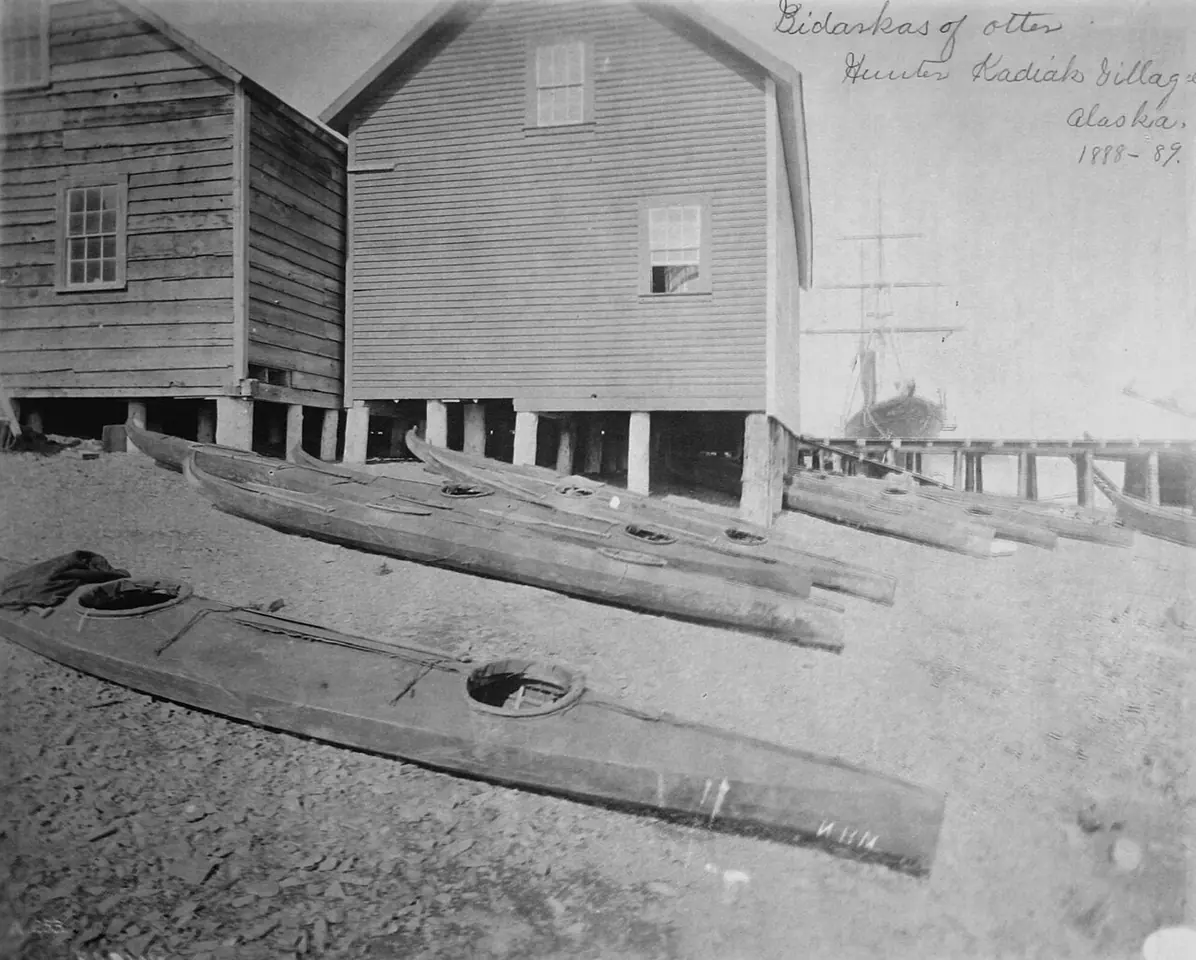
The Russian-American Company, which ran the colony, sent Native hunters far down the Pacific coast in their skin kayaks, called baidarkas, to hunt sea otters for the fur trade. In 1812 the company built Fort Ross on the coast north of San Francisco. California was then Spanish territory, and Spain did not welcome Russian hunters in its waters.
The martyrdom of St. Peter the Aleut
Capture in California
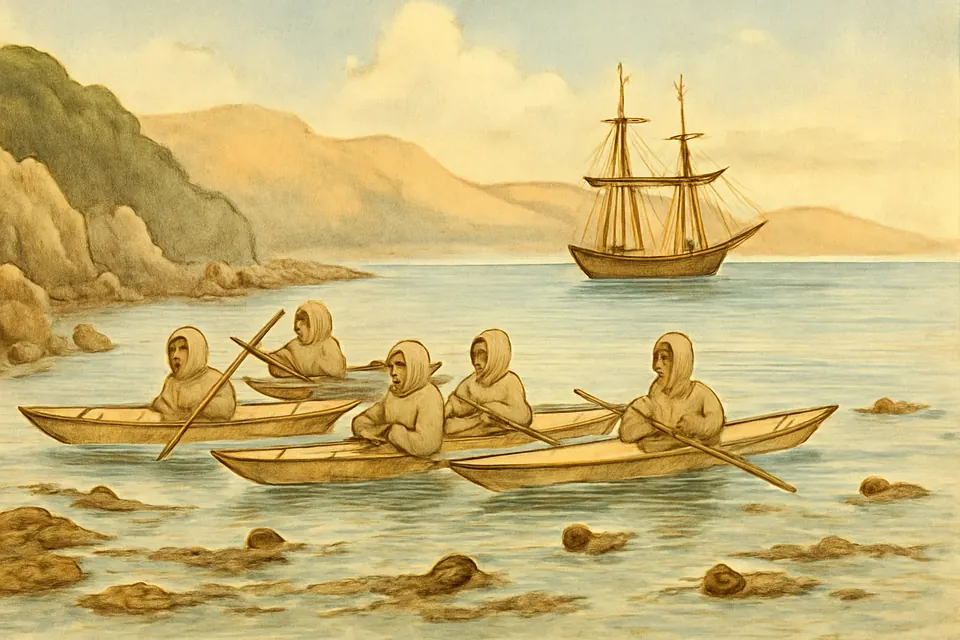
In 1815 a party of Native hunters under Boris Tarasov of the Russian-American Company was surprised and captured by Spanish soldiers. Matthew Namee, writing for OrthodoxHistory.org, notes that this raid and the taking of Native Alaskan captives are confirmed by Spanish records. One of the hunters, a Kodiak man named Chunagnak, was wounded in the head. The prisoners were taken to a mission. Later Orthodox tradition places Peter's death in San Francisco, though the early accounts are not clear about which mission it was.
"I am a Christian"
The fullest early account is a report sent to Tsar Alexander I by the head of the Russian-American Company in 1820, built on the testimony of one witness: Peter's fellow captive, a Kodiak man the Russian reports call Kykhaklai or "Keglii Ivan." In Namee's summary of that report, the head of the mission wanted the new arrivals to become Catholic. Two runaway Kodiak Islanders living at the mission carried the message. The Alaskans answered that they were already Orthodox Christians and would not change.
Most of the prisoners were moved elsewhere, leaving Peter and Keglii Ivan in a cell. The next morning, the witness said, a Spanish cleric came with a group of California Indians and had them cut off Peter's fingers and hands, one joint at a time, and then kill him. A paper was brought to the cleric, and the killing of the second man was called off. Keglii Ivan was later enslaved, escaped, and at last reached Fort Ross, where he gave his testimony.

Yanovsky's letter and St. Herman
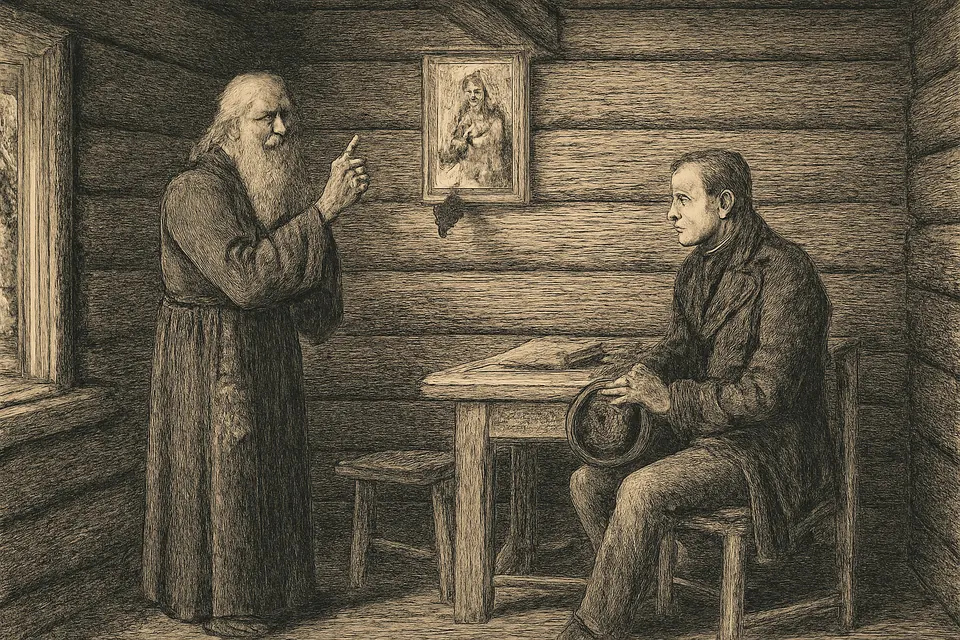
The version most people know comes from a letter written in 1865, fifty years after the events, by Simeon Yanovsky, a Russian official in Alaska who ended his life as the schemamonk Sergius. Yanovsky recalled telling the story to St. Herman. In his letter the Aleut answers every threat with the words "We are Christians," and the martyr dies repeating "I am a Christian." When Yanovsky finished, he wrote, Herman asked the martyr's name. "Peter," Yanovsky answered; he did not remember the family name. Then, the letter says, "The Elder stood reverently before an icon, made the Sign of the Cross and said, 'Holy New Martyr Peter, pray to God for us!'"
What historians say
Here we owe our readers plain honesty, as the Orthodox historians themselves have shown. The story of St. Peter the Aleut is traditional: it rests on one witness, and no independent record of his death has been found.
- One witness. All four known accounts go back to Keglii Ivan's testimony, given years after the events. His original deposition was taken at Fort Ross, and Yanovsky reported in 1820 that he had interviewed the man himself and judged that "He is not the type who could think up things."
- "Jesuits." Yanovsky's 1865 letter blames Jesuits. There were none in California in 1815; the missions were run by Franciscans. The Orthodox Church in America's life of Peter now inserts "(actually Franciscans)" into the quotation.
- Spanish evidence. The raid and the captivity are documented. No Spanish record of a killing has been found, and an 1816 letter between mission priests, cited by the Jesuit scholar Raymond Bucko, suggests the missions treated Alaskan captives with indifference rather than cruelty.
- Age and people. Icons and hymns often show Peter as a boy, but the early reports give no age, and they call him a Kodiak Islander rather than an Aleut. "Peter" and "the Aleut" both come from the late Yanovsky letter.
The Orthodox priest and historian Oliver Herbel argued in 2011 that Peter's martyrdom never happened. Matthew Namee, answering him, found the evidence too thin either to prove or to dismiss the story, judged the 1980 glorification premature, and asked for a full search of the Spanish and Russian archives. That is where the question stands.
None of this takes anything from the faith of the Alutiiq Christians who honor him. If a Kodiak hunter died rather than deny the faith in which he was baptized, the whole Church can honor his courage. If the story grew in the telling, it still tells the truth about a people who held fast to Christ.
Glorification and the saints of Alaska
The Orthodox Church in America's Diocese of Alaska and the Russian Orthodox Church Outside of Russia glorified Peter as a saint in 1980. The OCA remembers him on September 24, the Synaxis of All Saints of Alaska, the anniversary of the Russian missionaries' arrival in Alaska in 1794. That day the OCA also remembers St. Herman, St. Innocent, St. Jacob Netsvetev, St. Olga of Kwethluk and the hieromonk St. Juvenaly, the protomartyr of America, killed near the mouth of the Kuskokwim River in 1796.
Peter has no formal patronage. Orthodox Christians in Alaska honor him as one of their own. He belongs on our patron saints list as an intercessor for Alaska Native Christians. You'll find him on September 24 in our feast days calendar.

Symbols of St. Peter the Aleut in art
Peter's icons are all modern, painted since his glorification in 1980, and they follow a few clear patterns:
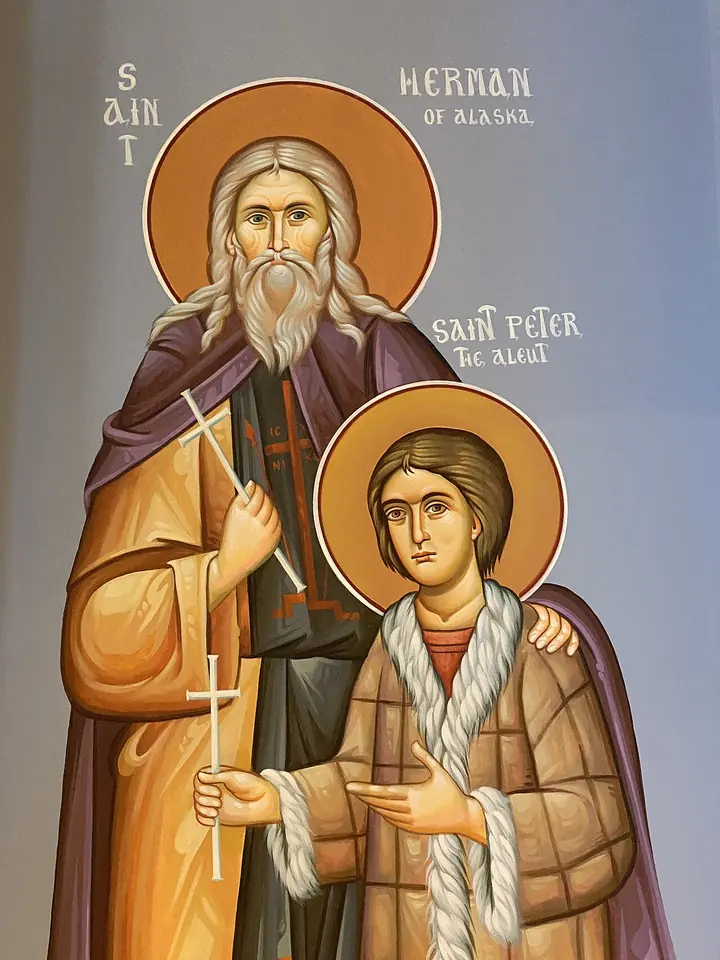
- A young Alaska Native man: usually beardless with straight black hair, sometimes shown as a boy.
- A parka: a hooded parka of bird skin, fur or gut skin, often with beaded trim, the clothing of Kodiak hunters.
- A cross: the martyr's sign, held in his hand.
- St. Herman beside him: many icons pair the two, with the old monk's arm around the young martyr, recalling Herman's prayer "Holy New Martyr Peter, pray to God for us!"
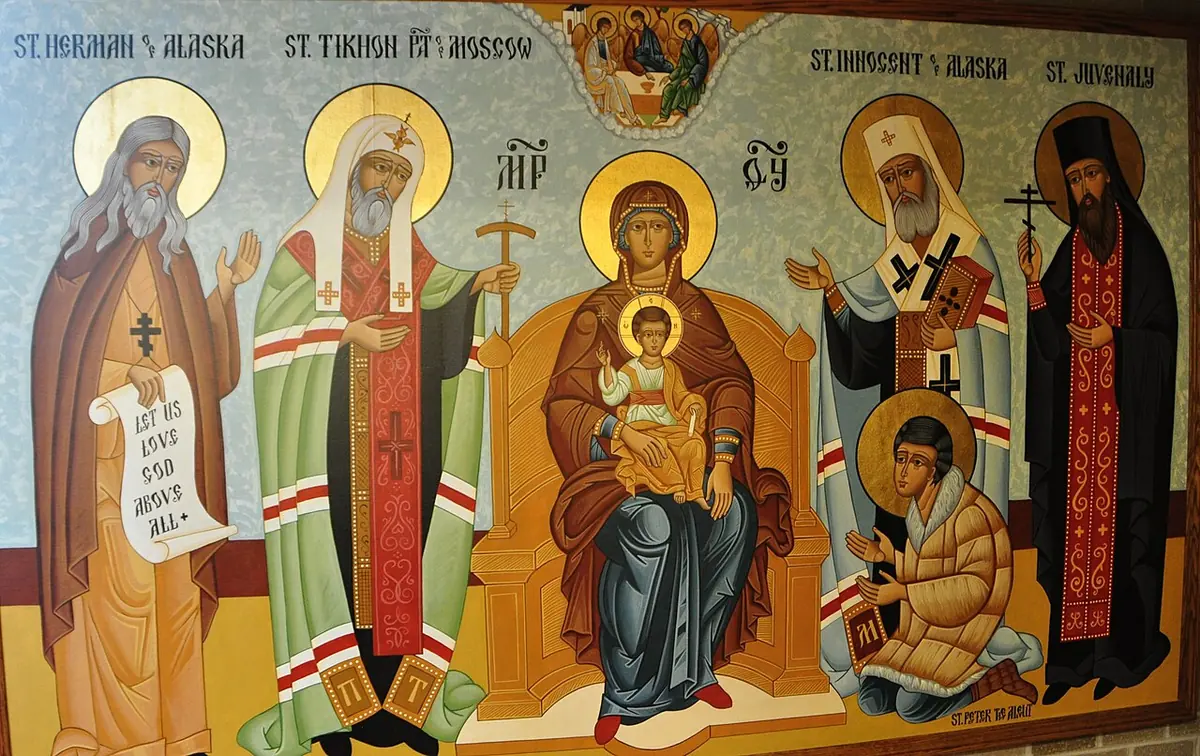
- The saints of Alaska: he often appears with St. Herman, St. Juvenaly, St. Innocent and St. Tikhon, the saints of the Orthodox mission in America.

Prayer to St. Peter the Aleut
The oldest prayer to Peter is the one Yanovsky remembered from St. Herman: "Holy New Martyr Peter, pray to God for us!" The Orthodox Church in America sings this troparion on September 24:
Today Alaska rejoices and America celebrates / for the New World has been sanctified by martyrdom. / Kodiak echoes with songs of thanksgiving, / Iliamna and Kenai observe the Festival of Faith. / The apostle and martyr Juvenaly is glorified / and Peter the Aleut is exalted by his voluntary sacrifice. / In their devotion and love for the Lord / they willingly endured persecution and death for the Truth. / Now in the Kingdom of Heaven they intercede for our souls.
As Catholics remembering this story, let us pray for every Christian who suffers for the faith, for the Native peoples of Alaska and California, and for the healing of the old wounds between East and West, that all who bear Christ's name may one day be one.
Frequently asked questions
Who was St. Peter the Aleut?
He was an Alutiiq (Sugpiaq) man from Kodiak Island, baptized Peter by the Russian Orthodox missionaries, who hunted sea otters for the Russian-American Company. Captured by Spanish soldiers in California in 1815, he is said to have been tortured to death for refusing to accept another baptism. The Orthodox Church honors him as a martyr.
Is St. Peter the Aleut a Catholic saint?
No. He was glorified as a saint by the Orthodox Church in America and the Russian Orthodox Church Outside of Russia in 1980. He is not on the Catholic calendar. This encyclopedia describes him as the Orthodox Church keeps him, and also sets out what historians have found.
When is the feast of St. Peter the Aleut?
September 24, the Synaxis of All Saints of Alaska in the Orthodox Church in America, when he is remembered together with the priest-martyr St. Juvenaly.
Was St. Peter the Aleut killed by Catholic missionaries?
The 1865 letter of Simeon Yanovsky blames "Jesuits," but there were no Jesuits in California in 1815, and the Orthodox Church in America's own life now notes that the missionaries there were Franciscans. The earlier Russian reports rest on a single witness, and no Spanish record of the killing has been found. Historians, Orthodox and Catholic alike, have questioned the story. The Orthodox historian Matthew Namee concluded in 2011 that the question cannot yet be settled.
Was Peter really an Aleut?
Not in the narrow sense. The Russian reports of 1820 call him a Kodiak Islander, so he was Alutiiq (Sugpiaq). Russians of the time used "Aleut" for many Native peoples of southern Alaska. His Alutiiq name is spelled Cungagnaq, Chunagnak and other ways.