St. Silouan the Athonite (Silouan of Mount Athos)

St. Silouan the Athonite (1866–1938) was a Russian peasant who became a monk of the Monastery of St. Panteleimon on Mount Athos and one of the best-loved teachers of prayer of the 20th century. He is known for his vision of Christ, for the word he received, "Keep thy mind in hell, and despair not," and for teaching love of enemies. The Ecumenical Patriarchate glorified him in 1987, and his feast day is September 24.
Who was St. Silouan the Athonite?
St. Silouan the Athonite was a Russian peasant who spent forty-six years as a monk of the Monastery of St. Panteleimon on Mount Athos, the monastic peninsula in northern Greece. He had almost no schooling. He never became a priest or an abbot, and for most of his life he ran the monastery's workshops and stores. Yet the notes he wrote in his cell, gathered after his death by his disciple Sophrony, have made him one of the most read teachers of prayer of the last hundred years, among Orthodox and Catholic Christians alike.
His teaching comes down to two things he learned by hard experience: that the soul must be humbled, and that a Christian must love his enemies. Both came to him through a long struggle in prayer, and both he wrote about with a plain, sorrowful warmth that still reaches readers.
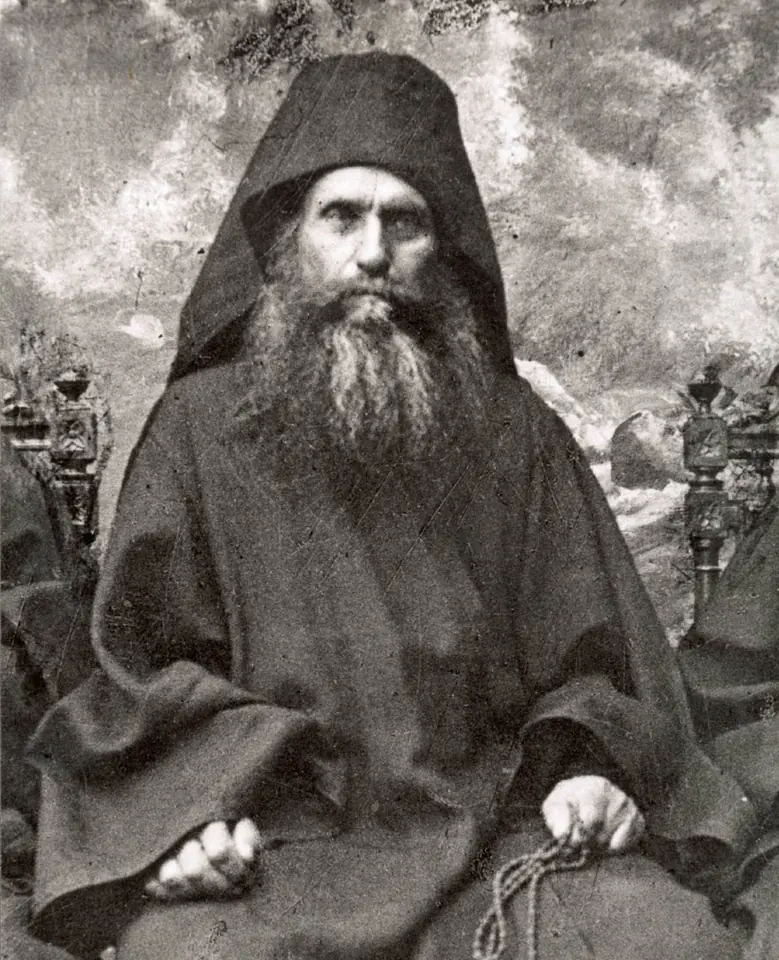
Because he lived so recently, his life is well documented. It is known mainly through Saint Silouan the Athonite, the book written by Archimandrite Sophrony (Sakharov), who lived beside him on Athos. The Holy Synod of the Ecumenical Patriarchate of Constantinople glorified him as a saint on November 26, 1987, and his feast is September 24.
The life of St. Silouan
A village boy in Tambov
He was born Simeon (Semyon) Ivanovich Antonov in 1866 to devout peasant parents in the village of Shovskoye, also written Sovsk, in the Tambov province of Russia. Pemptousia's life of the saint tells that at four he was already asking where God was, and planned to search the whole world for him. As a boy he heard about a holy recluse whose grave was the scene of miracles, and he said to himself that if there were holy men, God was with us. His heart burned with love of God, and for about three months he wanted nothing but to become a monk.
Then the fire went out. Simeon grew into a strong village youth and drifted back into an ordinary worldly life. In a brawl he struck another young man so hard that he nearly killed him. He later told Sophrony of a dream from that time in which a snake crawled into his mouth, and he heard the voice of the Mother of God: "Well, I don't like what I see of your actions." The words shook him.
The army and the road to Athos
After his military service, in 1892, when he was about twenty-six, Simeon went to St. John of Kronstadt to ask for his prayers so that the world would not hold him back. He then left Russia for Mount Athos and entered the Russian Monastery of St. Panteleimon, known as the Rossikon, one of the largest communities on the Holy Mountain.
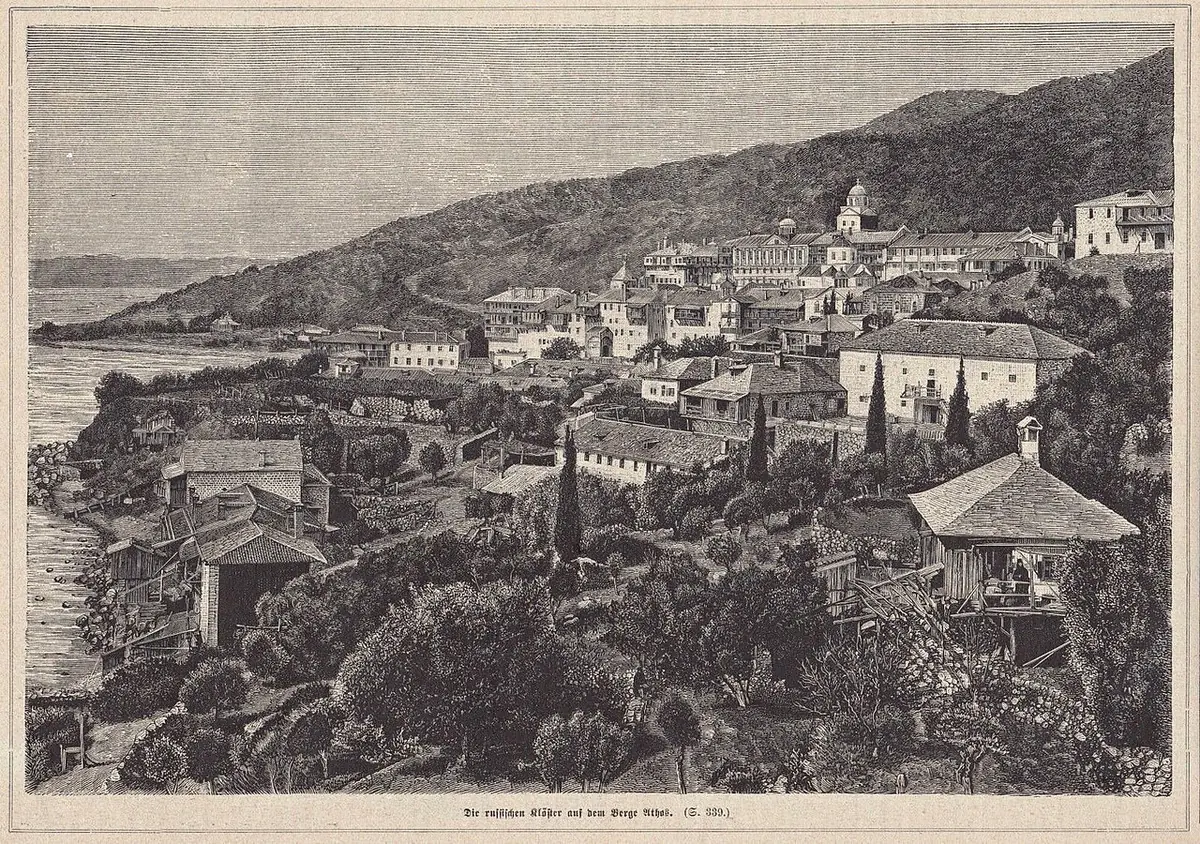
His spiritual father taught him to turn away every evil thought with the name of Jesus. Three weeks after he arrived, the Jesus Prayer began to pray itself in his heart. He was set to work at the mill, slept only a few hours a night, and fought a long battle with temptations.
The vision of Christ
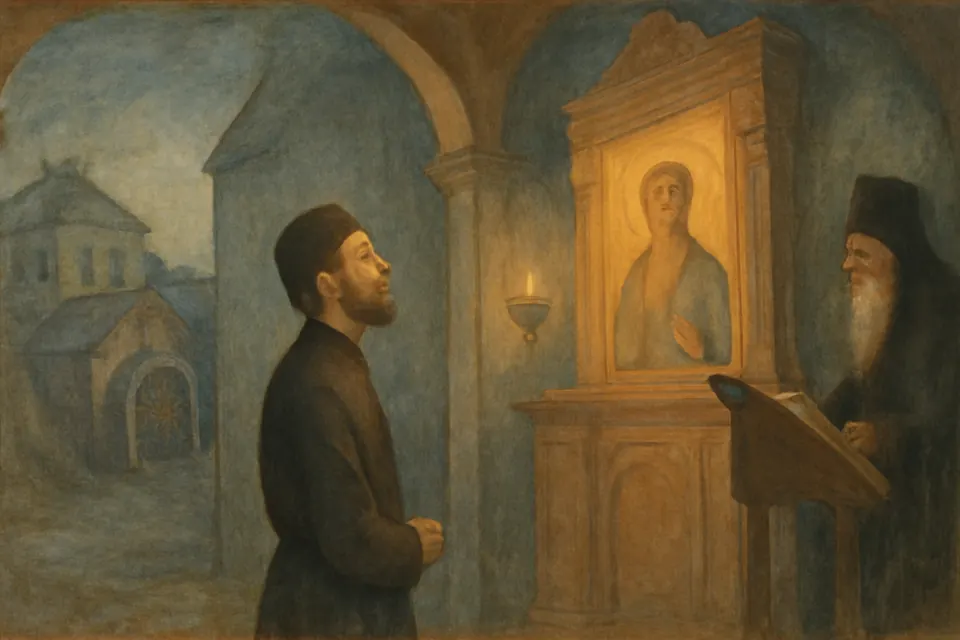
About six months after his arrival, worn out and close to despair, Simeon stood at Vespers in the little church of the Prophet Elijah beside the mill. There, the life tells, he saw the living Christ in the place of the icon, looking at him with indescribable gentleness. This is a reported grace, known from his own account as Sophrony recorded it; the Church has not examined it the way it examines miracles for a canonization, and nothing like that is asked of a vision of this kind.
He received the monastic tonsure in 1896 and the name Silouan, and in 1911 the great schema, the habit of the most strict monastic profession.
"Keep thy mind in hell, and despair not"
The grace of that vision withdrew, and for about fifteen years Silouan suffered what he called the loss of God. One night, exhausted, he wanted to bow before the icon of Christ, but felt the presence of a demon barring his way. He asked the Lord what he must do, and heard in his heart, "The proud always suffer from demons." When he asked how to become humble, the answer came:
Keep thy mind in hell, and despair not.
The word became the center of his life. It does not mean dwelling in fear or self-hatred. It means seeing oneself truthfully, as one who has deserved condemnation, while never letting go of hope in God's mercy. Silouan practiced it for the rest of his life.
The steward who prayed for his workers
After a time at the Old Rossikon, higher up the mountain, where he suffered from a facial palsy and severe headaches, Silouan was called back and made a steward, in charge of the monastery's workshops and hired laborers. He kept that work until his death. Pemptousia's life says he went around the workshops every day and prayed with tears for the workers and for all "God's people." "Praying for people means shedding blood," he said.

In the 1930s a young Russian monk and painter named Sergei Sakharov, later Archimandrite Sophrony, became his disciple. Silouan died in the monastery infirmary on the morning of September 24, 1938.
Miracles and graces of St. Silouan
Silouan's life is not a story of public wonders. What the Church remembers is grace given in prayer:
- The vision of Christ in the mill chapel: reported, from his own testimony.
- The word "Keep thy mind in hell, and despair not": reported, an inner word received in prayer.
- Healings and help through his prayers since his death: reported by the faithful, especially since his relics left Athos for the first time in 2016. None has been formally investigated.
Symbols of St. Silouan in art
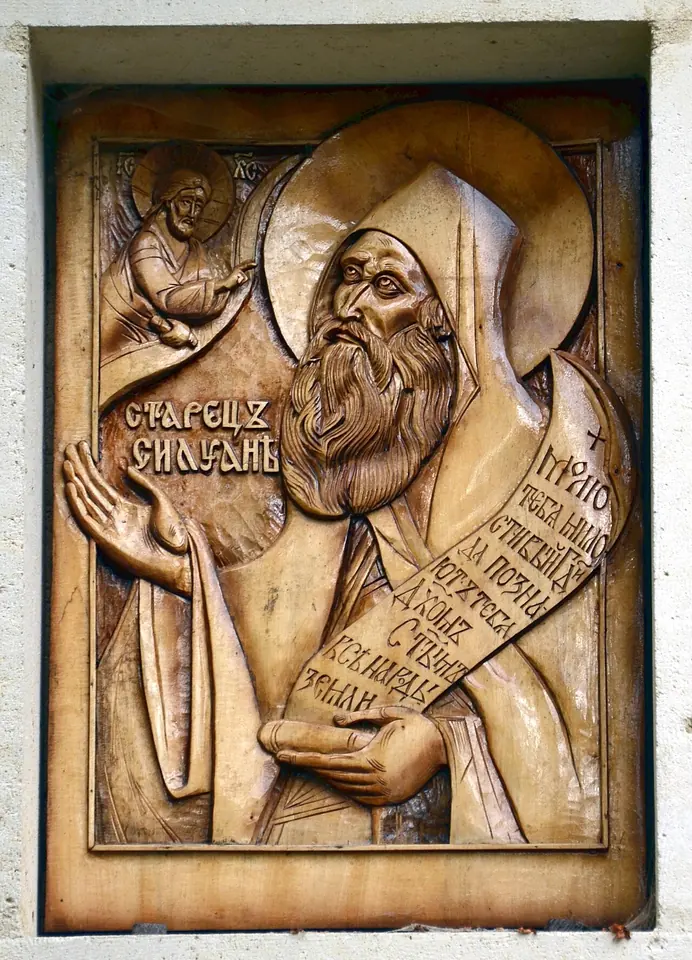
Icons of St. Silouan follow the pattern for Orthodox monastic saints, and his face is drawn from the photographs taken in his last years. Look for:
- The black habit and the schema: the hood and robe of a monk of the great schema, often with the embroidered cross of the schema on his chest.
- A long gray beard and a broad, weathered face: taken from the 1930s photographs, the face of a peasant who worked hard all his life.
- A scroll: usually inscribed with his most famous word, "Keep thy mind in hell, and despair not," or with words on loving enemies.
- A prayer rope: for the Jesus Prayer, which shaped his whole life.
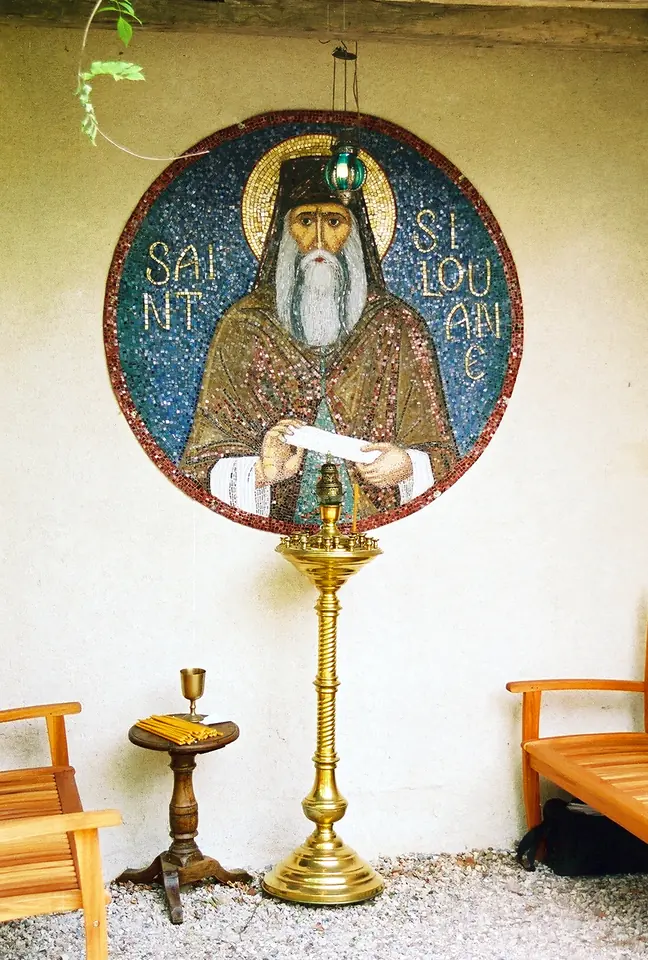
Some icons show him bowing toward Christ, who appears in the upper corner, in memory of the vision at Vespers. The carved icon below, at the entrance of the Monastery of St. Silouan in France, shows him that way.
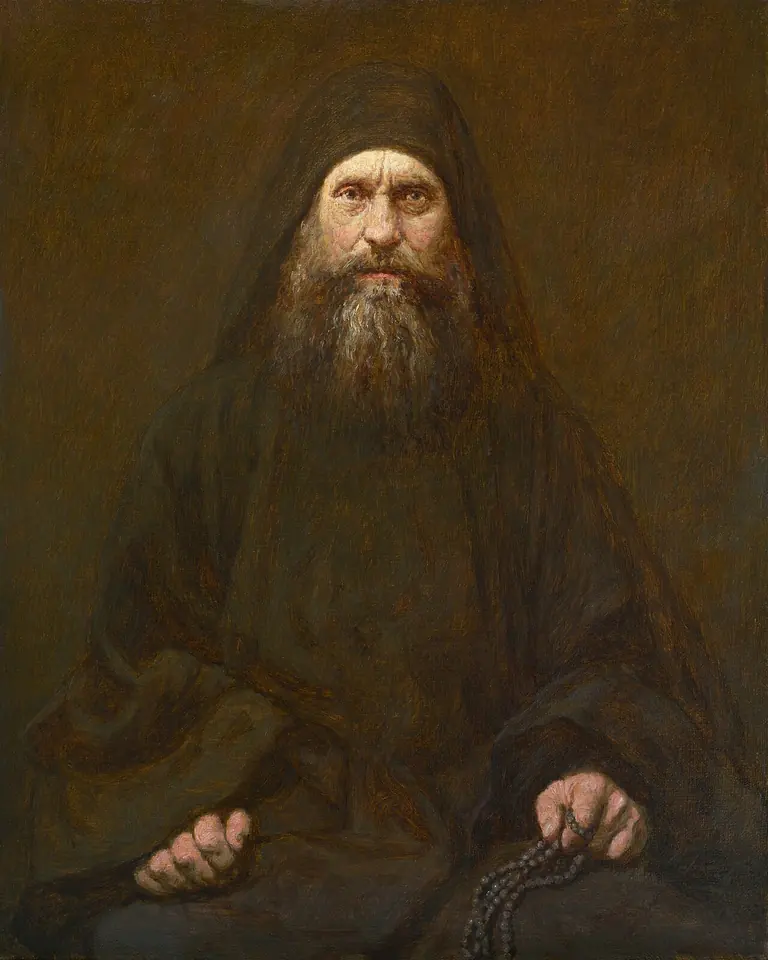
Modern painters have also portrayed him in the realist manner of Russian portraiture. Andrey Mironov's 2018 portrait follows the old photographs closely.
Feast day and where St. Silouan is honored
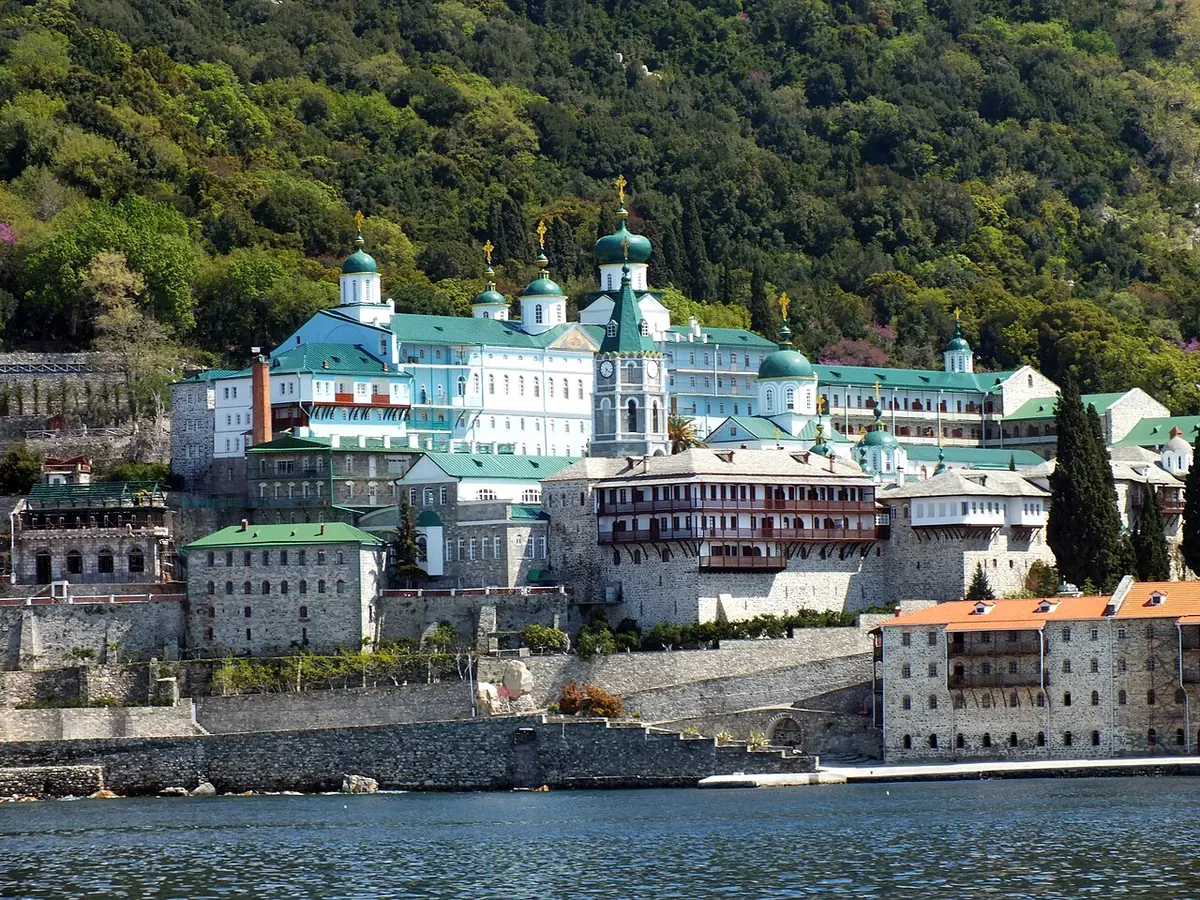
His feast is September 24. Churches on the Old Calendar keep it on September 11, the same day. His head is kept at the Monastery of St. Panteleimon on Mount Athos. In September 2016, for the thousandth anniversary of Russian monks on Athos, it left the Holy Mountain for the first time and was carried to Belarus, to his home village of Shovskoye, which it reached on September 8, and to Moscow. OrthoChristian reported that about 150,000 people venerated the relics in Russia in the first weeks.
The other great center of his memory is the Patriarchal Stavropegic Monastery of St. John the Baptist at Tolleshunt Knights in Essex, England, founded in 1959 by St. Sophrony. Its community still lives by Silouan's teaching. His words have also been translated into many languages, and Catholic as well as Orthodox readers come to them for help with prayer and with forgiving those who hurt them.
Prayer to St. Silouan
The Orthodox Church honors him with a troparion and kontakion on his feast, sung in the services of September 24. Silouan's own prayers, written in his notebooks, are the best way to pray with him. When someone wrongs us, he told his readers, we should say:
O Lord, we are all Thy creatures. Have pity on Thy servants and turn their hearts to repentance.
And he asked for this grace for himself:
O Lord, grant me tears to shed for myself, and for the whole universe.
Let us ask St. Silouan to pray for us, that we may learn humility without despair and love even those who make themselves our enemies. In his own words: "The Lord taught me to love my enemies. Without the grace of God we cannot love our enemies."
Frequently asked questions
What does "Keep thy mind in hell, and despair not" mean?
These are the words Silouan heard in prayer, about fifteen years after his vision of Christ, when he asked how to be freed from pride. His disciple Sophrony and later Orthodox writers explain them as a call to humility: to see oneself honestly as worthy of condemnation, while never losing trust in God's mercy. The second half matters as much as the first. The word is not about fear but about humility held together with hope.
When is the feast of St. Silouan the Athonite?
September 24, the day he died in 1938. Churches on the Old (Julian) Calendar keep it as September 11, which is the same day. He is honored above all at the Monastery of St. Panteleimon on Mount Athos and at the Monastery of St. John the Baptist in Essex, England.
When was St. Silouan canonized?
The Holy Synod of the Ecumenical Patriarchate of Constantinople added him to the calendar of saints on November 26, 1987, less than fifty years after his death. He is a saint of the Orthodox Church and is not on the Roman Catholic calendar, though many Catholics read his words and ask his prayers.
Who wrote the life of St. Silouan?
His disciple, Archimandrite Sophrony (Sakharov), who knew him on Athos in the 1930s. Sophrony gathered Silouan's notes and wrote his life in the book published in English as Saint Silouan the Athonite. Sophrony later founded the Monastery of St. John the Baptist at Tolleshunt Knights, Essex, in 1959, and has himself been glorified as a saint.
What did St. Silouan teach about loving enemies?
He made it the test of the Christian life. "The Lord taught me to love my enemies," he wrote, and "The soul cannot know peace unless she prays for her enemies." He taught that only the grace of the Holy Spirit makes such love possible, and that when we are wronged we should pray, "O Lord, we are all Thy creatures. Have pity on Thy servants and turn their hearts to repentance."
Keep exploring
Sources
- OrthoChristian: St. Silouan the Athonite (with writings edited by Archimandrite Sophrony)
- Archimandrite Sophrony (Sakharov), Saint Silouan the Athonite (St. Vladimir's Seminary Press)
- Alexandros Christodoulou, Saint Silouan, the great spiritual figure of the 20th century (Pemptousia, 2021)
- Jesse Dominick, On the Word to St. Silouan, 'Keep Thy Mind in Hell and Despair Not' (OrthoChristian, 2015)
- OrthoChristian: Around 150,000 people have venerated relics of St. Silouan in Russia already (2016)