St. Liborius of Le Mans, Bishop and Patron of Paderborn

St. Liborius of Le Mans was a 4th-century bishop of Le Mans in Gaul. In 836 his relics were carried to Paderborn in Saxony, and he has been patron of Paderborn and its archdiocese ever since. He is invoked against kidney stones and gallstones, and Paderborn honors him each July with the Libori festival. His feast is July 23.
Who was St. Liborius of Le Mans?
St. Liborius of Le Mans was a bishop of the Gallo-Roman city of Le Mans, in western France, in the 4th century. We know very little about his life. What we do know is the long journey his relics made after his death: in 836 they were carried more than 500 miles east to Paderborn, a new missionary diocese among the Saxons, and he has been the patron of that city and its church for nearly twelve centuries. He is the saint people turn to with kidney stones and gallstones. We keep his feast on July 23.
The oldest accounts of the bishops of Le Mans were compiled in the 9th century under Bishop Aldric. They place Liborius after Bishop Pavatius and make him a contemporary of the Emperor Valentinian, who reigned from 364 to 375. The Catholic Encyclopedia warns that these Acts are full of chronological "absurdities" (one early bishop would have lived over two hundred years), so even his dates are uncertain. Medieval legend adds that he was a friend of St. Martin of Tours and that Martin came to bury him. That is a pious tradition, not history.
What is certain is that the people of Le Mans honored him as a saint from early times, and that his body lay among the first bishops of the city, the shepherds who had planted the faith in a small Roman town on the Sarthe river. He belongs to the generation of bishops who led the Church of Gaul in the years after the persecutions ended, when the Gospel was spreading from the walled towns into the countryside.

From Le Mans to Paderborn
In 799 Pope Leo III met Charlemagne at the springs of the Pader river, where a church already stood, and Paderborn became a bishop's see for the newly conquered Saxons. Its second bishop, Badurad, wanted to strengthen the faith of his people, and he asked for the relics of a saint. Aldric of Le Mans, who had gathered the bodies of his city's early bishops into his cathedral, gave him Liborius.
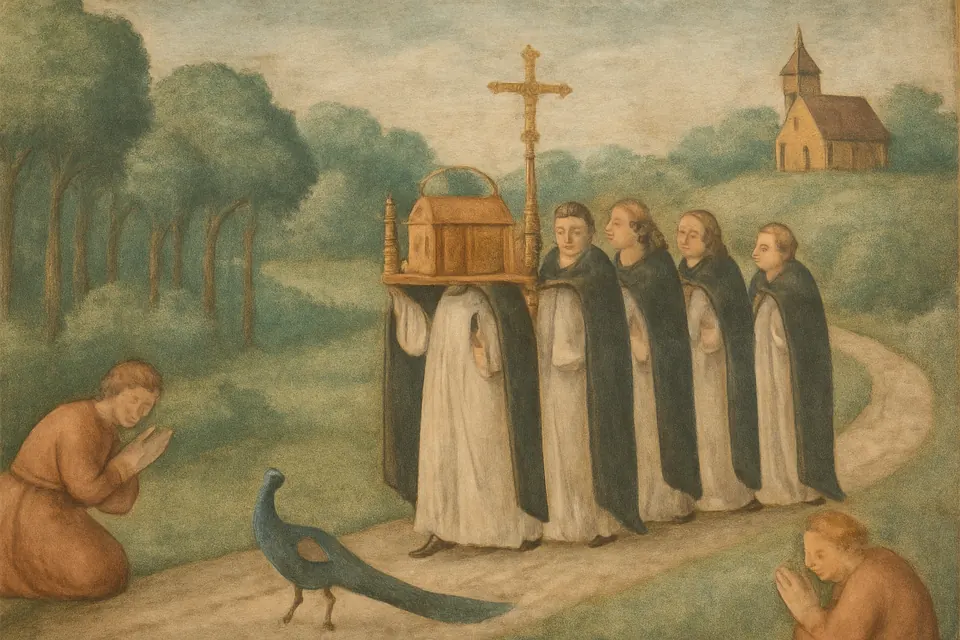
In 836 the relics arrived in Paderborn. Badurad enlarged his cathedral with a transept and a ring crypt to house them. Tradition holds that a peacock walked ahead of the procession and led it to the city.
The gift bound the two cities together, and the friendship between Le Mans and Paderborn has lasted to this day. The Archdiocese of Paderborn calls Liborius a "bridge-builder."
- Traditional: the peacock that led the relics to Paderborn. It comes from the legend of the translation, and a fan of peacock feathers is still raised beside his shrine.
The stolen shrine
During the Thirty Years' War, in 1622, the Protestant commander Christian of Brunswick-Wolfenbüttel plundered Paderborn Cathedral and carried off the shrine of St. Liborius. The relics came home on October 25, 1627, and the shrine still used today dates from that time. Paderborn still celebrates their return as "Klein-Libori," the little Libori.

Why St. Liborius is the patron of kidney stones
In the late Middle Ages Liborius became the saint for those suffering from stones of the kidney and gallbladder. In art, small stones lie on a book or a plate beside him. The Archdiocese of Paderborn tells how Prince-Bishop Clemens August tried in 1736 to send relics to his brother, the future Emperor Charles VII, who suffered from kidney stones, only to find that an earlier bishop had destroyed the key to the shrine so the relics could not be divided any further. In 1746 a relic taken from a statue in the cathedral treasury went to Munich instead. It is still kept in the treasury of St. Peter's Church there.
Symbols of St. Liborius in art
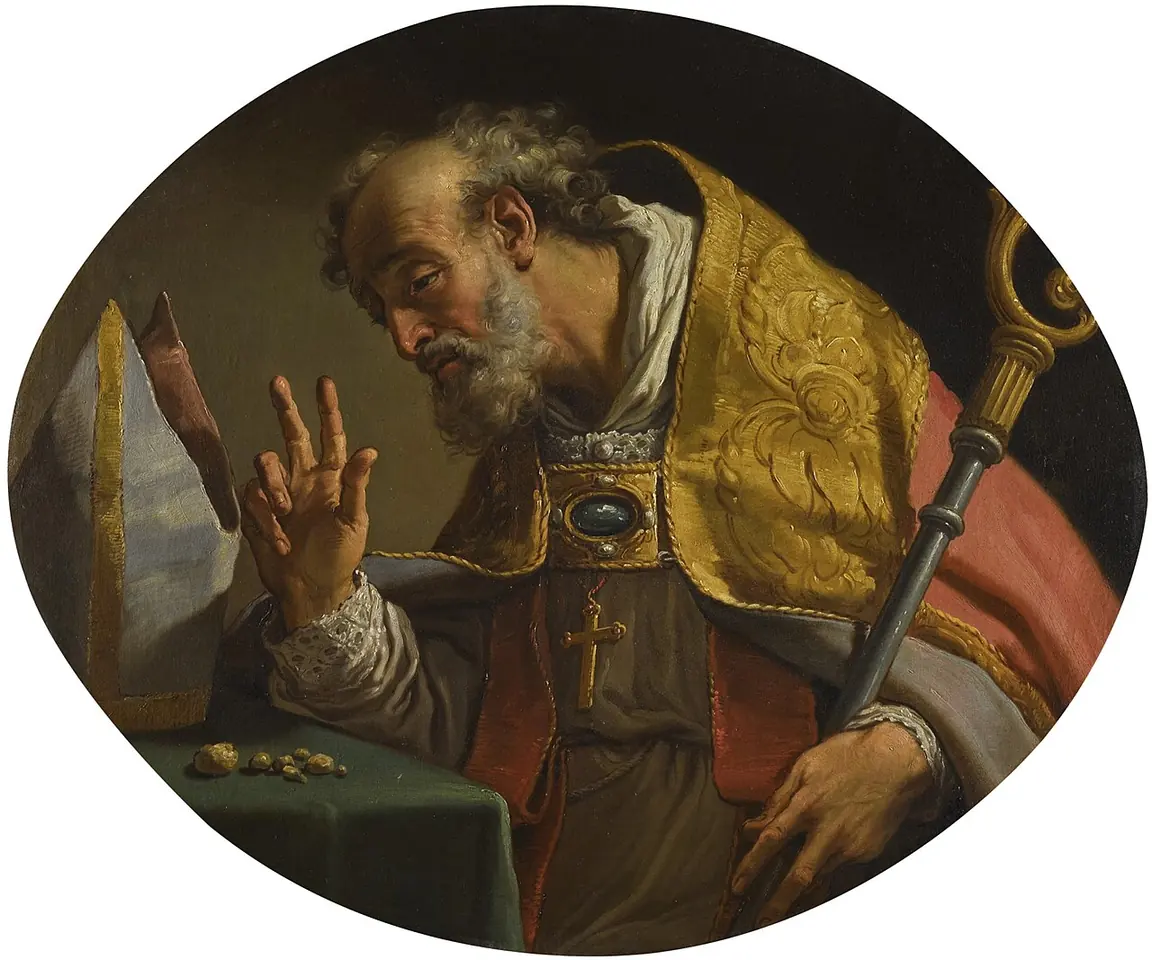
Liborius is shown as a bishop, usually old and bearded, in cope and miter with a crozier. Look for:
- Small stones: on a closed or open book, on a plate held by an angel, or on a table beside him, for his help against kidney stones and gallstones.
- A peacock: the bird of the translation legend, and a symbol of immortality in early Christian art.
- A shrine or church: in a window of Paderborn Cathedral's tower he is shown enthroned before the cathedrals of Paderborn and Le Mans.

Feast day and the Libori festival
We keep his feast on July 23. In Paderborn it opens Libori, a nine-day feast that is both a pilgrimage and one of Germany's oldest folk festivals. The shrine is brought up from the crypt, carried through the streets in procession and set on the high altar for the week. The City of Paderborn counted about 1.4 million visitors in 2026.

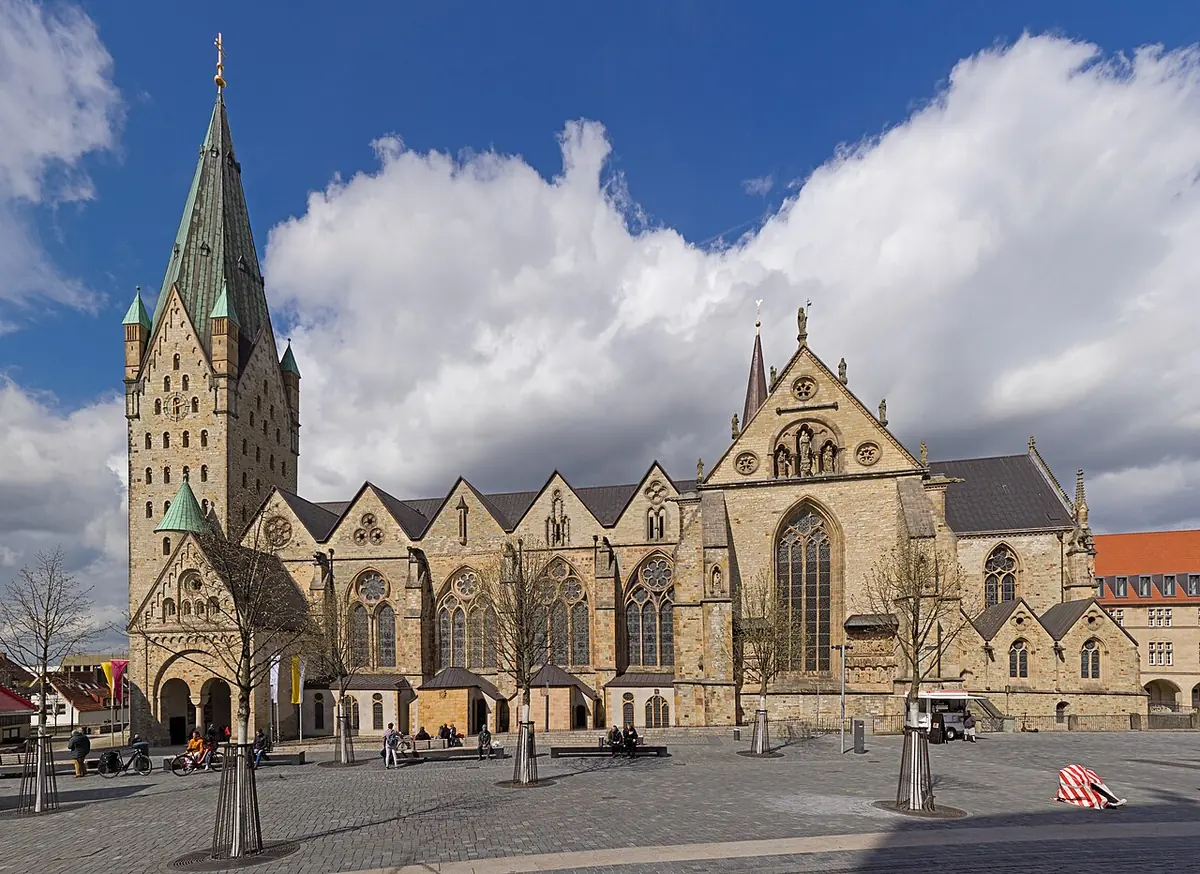
His relics rest in the crypt of Paderborn Cathedral.
Prayer to St. Liborius
We have not found a traditional English prayer to St. Liborius. Let us ask him to pray for all who suffer from kidney stones and gallstones and for those who care for them, and for the friendship of the peoples of Europe that his relics have served for so long. St. Liborius, pray for us.
Frequently asked questions
Who was St. Liborius?
A bishop of Le Mans in the 4th century. Little is known of his life for certain. His fame rests on the transfer of his relics in 836 from Le Mans to Paderborn, where the young diocese took him as its patron.
Why is St. Liborius the patron saint of kidney stones?
In the late Middle Ages people suffering from kidney stones and gallstones came to Paderborn to ask his help, and the stones became his emblem. Paintings show small stones lying on a book or a plate beside him. The Archdiocese of Paderborn still describes him as the intercessor for those with kidney and gallstone ailments.
What is Libori in Paderborn?
Libori is Paderborn's nine-day festival around his feast on July 23. The shrine with his relics is carried in procession through the city, and the week combines Masses and processions with one of Germany's oldest and largest fairs. About 1.4 million people came in 2026.
Why is St. Liborius shown with a peacock?
Tradition holds that a peacock walked ahead of the procession that carried his relics to Paderborn in 836 and showed it the way. A fan of peacock feathers is still raised beside his shrine.
Keep exploring
Sources
- Catholic Encyclopedia (1910): Le Mans. The Acts of the bishops of Le Mans, the doubtful early chronology, and Bishop Aldric sending his relics to Paderborn
- Hoher Dom zu Paderborn: Geschichte. Bishop Badurad and the relics in 836, the new crypt, the theft of the shrine in 1622 and its return on October 25, 1627
- Erzbistum Paderborn: Reliquienreise mit Hindernissen: Wie der heilige Liborius nach München kam (2025). The kidney and gallstone patronage, the locked shrine and the relic sent to Munich
- Stadt Paderborn: 1,4 Millionen Menschen besuchen rundum gelungenes Libori-Fest (2026). Visitor figure for Libori 2026