St. Phanourios the Great Martyr

St. Phanourios is a Great Martyr of the Orthodox Church known almost entirely from one icon, found in a ruined church on Rhodes. His name sounds like the Greek word for "to reveal," so the faithful ask his help to find lost things and bake a sweet cake, the phanouropita, when they are found. His feast day is August 27.
Who was St. Phanourios?
St. Phanourios is a holy martyr whom the Orthodox Church honors with the title of Great Martyr, though we know almost nothing about his earthly life. We do not know where he was born, when he lived, or under which emperor he died. The Orthodox Church in America says it plainly: "We know nothing for certain about the background of Saint Phanourius, nor exactly when he lived."
What we do have is his icon. Tradition says it was found in the ruins of a buried church on the island of Rhodes, fresh and bright among icons that had crumbled away, with the name "Saint Phanourios" written on it and a young soldier painted at its center. Around him were small scenes of his sufferings, which told the faithful that he had died for Christ. From that day the Greek Church has kept his memory, and the Orthodox sometimes call him the "Newly Revealed," because God made him known again centuries after his death.
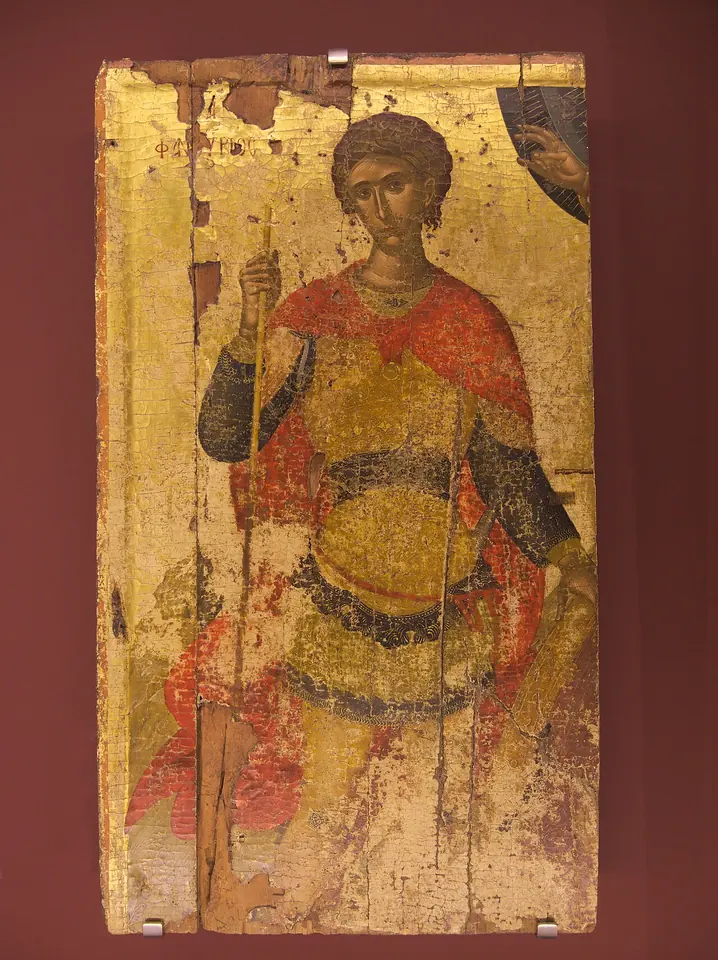
Today he is one of the most loved saints in Greece and Cyprus, and wherever Greek Christians have settled. When something goes missing, they say a prayer to St. Phanourios, and when it turns up, they bake a cake in his honor.
The finding of the icon on Rhodes
The story comes from his synaxarion, the short life read in Orthodox services. When Rhodes was under Muslim rule, the governor of the island set out to repair the city walls, and his workmen took stone from ruined buildings near the old fortress. Digging there, they uncovered a beautiful church, partly buried, with many icons on its floor. Most were decayed and broken. One, the icon of St. Phanourios, "looked as if it had been painted that very day."
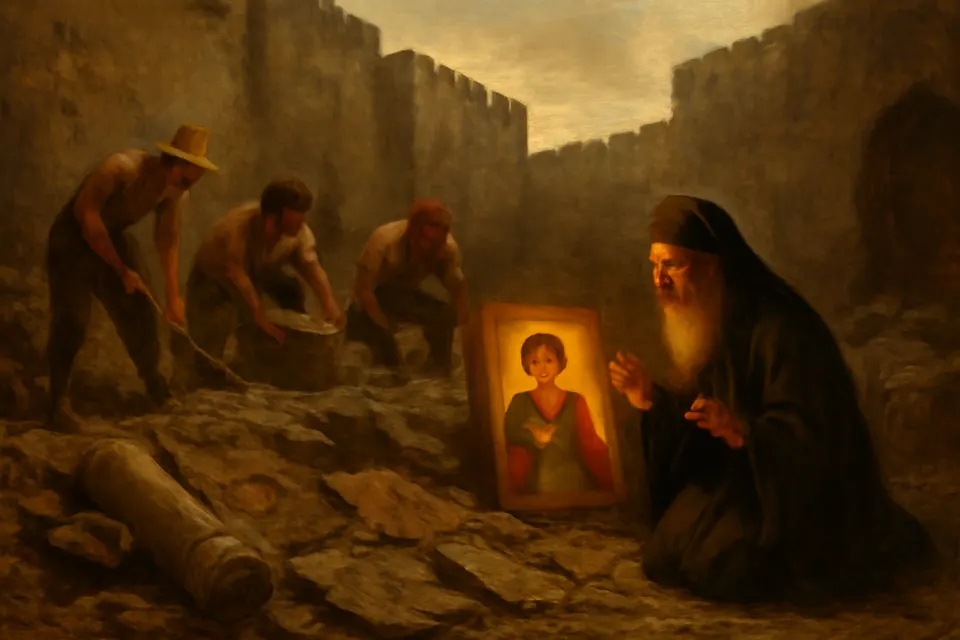
The local bishop, named Nilus (Neilos), came to see it and read the inscription. According to the synaxarion the icon showed twelve scenes around its border: the saint questioned by an official, stoned by soldiers, whipped, his sides torn with iron hooks, locked in prison, burned with candles, stretched on a rack, thrown to wild beasts, crushed under a great stone, holding burning coals before the idols while a demon laments, and at last standing in fire with his arms raised in prayer. Bishop Nilus asked the governor's leave to restore the church. When he was refused, he went to Constantinople and came back with a decree allowing him to rebuild it.
When was the icon found?
The date is not certain. The OCA's life places the discovery at the end of the 15th or beginning of the 16th century. The Greek Byzantinist Helen Rossidou-Koutsou places it after 1350, under Metropolitan Neilos of Rhodes, who held the see from 1355 to 1369. The evidence from Crete favors the earlier date: by the 1420s a Cretan monastery had a chapel in his honor and the painter Angelos Akotantos was painting his icons, so his feast was already well known there long before 1500. The detail about a Muslim governor fits the Ottoman period better than the 14th century, when the Knights of St. John held Rhodes, and is one of the places where the story may have grown in the telling.
The miracles of St. Phanourios
Every miracle told of St. Phanourios is traditional: none has been examined the way the Catholic Church examines miracles for a canonization today. They are stories handed down in the Orthodox synaxaria and in the memory of the people.
The three priests from Crete
The best-known story explains how his feast came to Crete. Crete was then ruled by Venice, which would not allow a new Orthodox bishop to be consecrated there. Men seeking ordination had to sail to the island of Kythera. Three deacons made that journey and were ordained priests, but on the way home Muslim raiders captured them at sea, carried them to Rhodes and sold each to a different master.
In Rhodes they heard of the wonders of St. Phanourios. Each of them prayed to him in tears, not knowing what the others were doing, and by God's providence all three were allowed to visit his church at the same hour. That night, the synaxarion says, the saint appeared to their masters and ordered them to free the priests. The masters thought it was sorcery and chained the priests more tightly. Phanourios then came to the priests, loosed their chains, and promised them freedom the next day. In the morning everyone in the three households woke blind, paralyzed and in great pain. The masters sent for the priests, who answered, "We will pray to God. May His will be done!" After a third vision, each master wrote a letter of freedom and sent it to the church, to be laid before the icon. The sick were healed before the messengers returned.

The freed priests sailed home with a copy of the icon and kept his feast every year. A Cretan tradition about the same men says that a storm caught them on the voyage, and that the saint and the Mother of God appeared and drove off the demons that had raised it.
The shepherds' oath
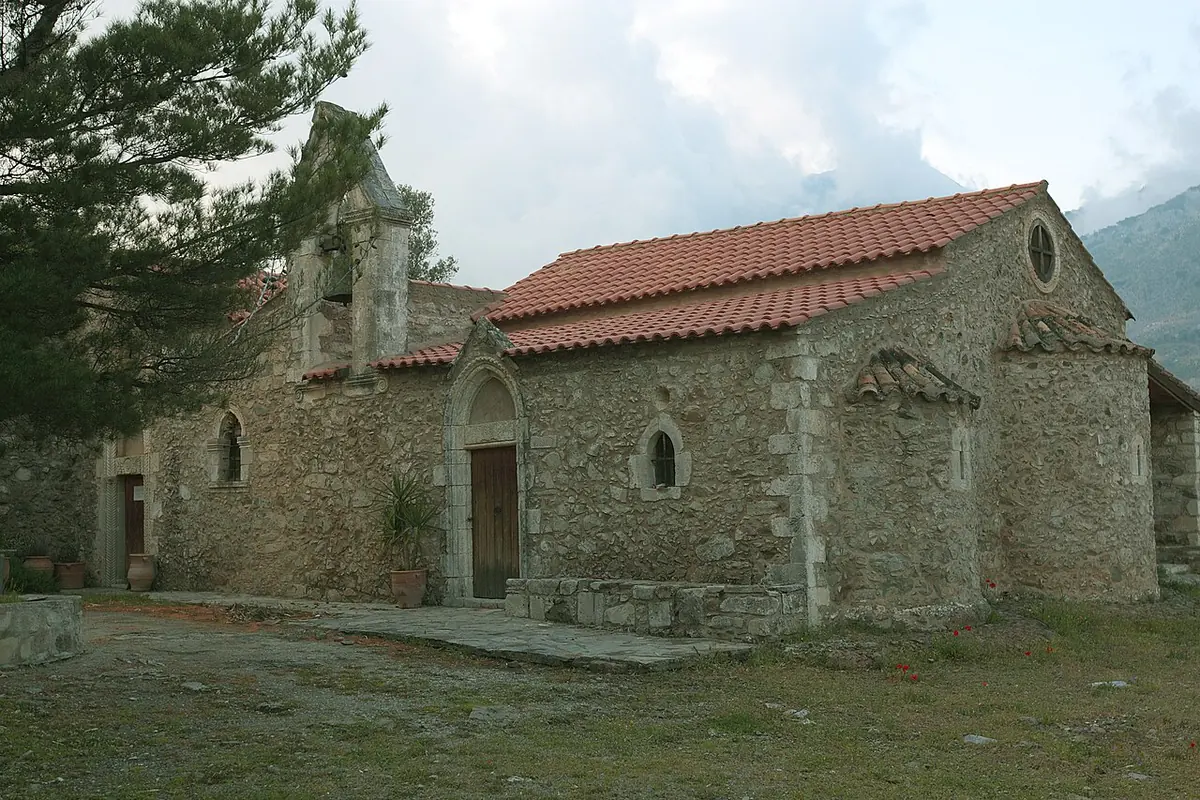
In Crete the saint's fame grew around the monastery of Valsamonero, south-west of Heraklion. Its abbot in the early 15th century, Jonas Palamas, built a chapel in honor of St. Phanourios, and its walls were painted in 1431 with the only surviving fresco cycle of his life. The Church of Crete credits Abbot Jonas with spreading his cult across the island. A processional icon of the saint there became the place where Cretan shepherds accused of stealing animals were taken to swear their innocence. These oath stories, in which the saint "reveals" the thief, are traditional.
Why St. Phanourios is the patron saint of lost things
His name is the reason. Phanourios sounds like phanerono, the Greek verb "to reveal" or "to make known." The OCA explains, "For this reason, people pray to Saint Phanourius to help them find lost objects." There is something fitting in it: a saint who was himself lost to memory for centuries, and found again, now helps the faithful find what they have lost.
According to Rossidou-Koutsou, the custom spread mainly from Crete, where shepherds prayed to him for strayed or stolen goats, and Cretan shepherds still call him their protector. In some places he is asked to heal headaches, and young women ask him to "reveal" a good husband. Western Christians turn for the same help to St. Anthony of Padua; see our page on the patron saint of lost things and the full list of patron saints.
Symbols of St. Phanourios in art
St. Phanourios is easy to recognize once you know him. Look for:
- A young, beardless soldier with short curls, in armor and a short tunic, high boots and a red cloak.
- A cross on a slender staff, often with a lit candle set on top of the cross. The candle is his own sign: the light by which lost things are found.
- Twelve small scenes of his tortures framing the central figure, as on the icon found on Rhodes.
- A dragon underfoot in some Cretan icons of the 15th century, which make him look very like St. George.
The resemblance to St. George, and to other soldier martyrs such as St. Demetrius, is real. Rossidou-Koutsou notes how much Akotantos's Phanourios shares with George, and the Orthodox writer John Sanidopoulos has asked whether "Phanourios" on the Rhodes icon might once have been an epithet of St. George himself. The Church has honored Phanourios as his own person for six centuries, and we honor him so.
Akotantos, who knew Abbot Jonas of Valsamonero, did much to fix the saint's image, and later Cretan painters kept his type. In a 17th-century icon now in the Louvre, he stands before the enthroned Christ as a young warrior receiving his cross.

The phanouropita
When Orthodox Christians ask St. Phanourios for help, or give thanks when something lost is found, they bake a phanouropita, "Phanourios cake." It is a plain, sweet cake. Rossidou-Koutsou lists flour, water, sugar, clove, orange peel, orange or lemon juice, salt, raisins and walnuts; many families use olive oil and cinnamon, and some insist on an exact number of ingredients, often seven. The cake is often taken to church to be blessed, then cut and shared with neighbors, friends and the poor.

Those who share it pray for the saint's mother: "May God forgive the mother of Saint Phanourios." Her name is unknown. Folk tradition says she was a hard woman who refused bread to the poor and could not be saved even by her son's prayers, and that Phanourios promised to help anyone who prays for her. The folklorist Marianthi Kaplanoglou, studying Greek and Cypriot archives in 2006, showed that these tales are a Greek form of the international folktale usually told of St. Peter's mother, who was lifted toward heaven on an onion stalk and fell back because she would not share it. The legend is folklore, and the Church has never taught it. But the custom behind it is a good one: an answered prayer is repaid with bread for the poor and a prayer for a soul in need.
Feast day and where St. Phanourios is honored
His feast is August 27, the day his icon was found. Churches on the Old Calendar keep it on September 9 of the civil calendar. See the saints who share the season on our feast days page.
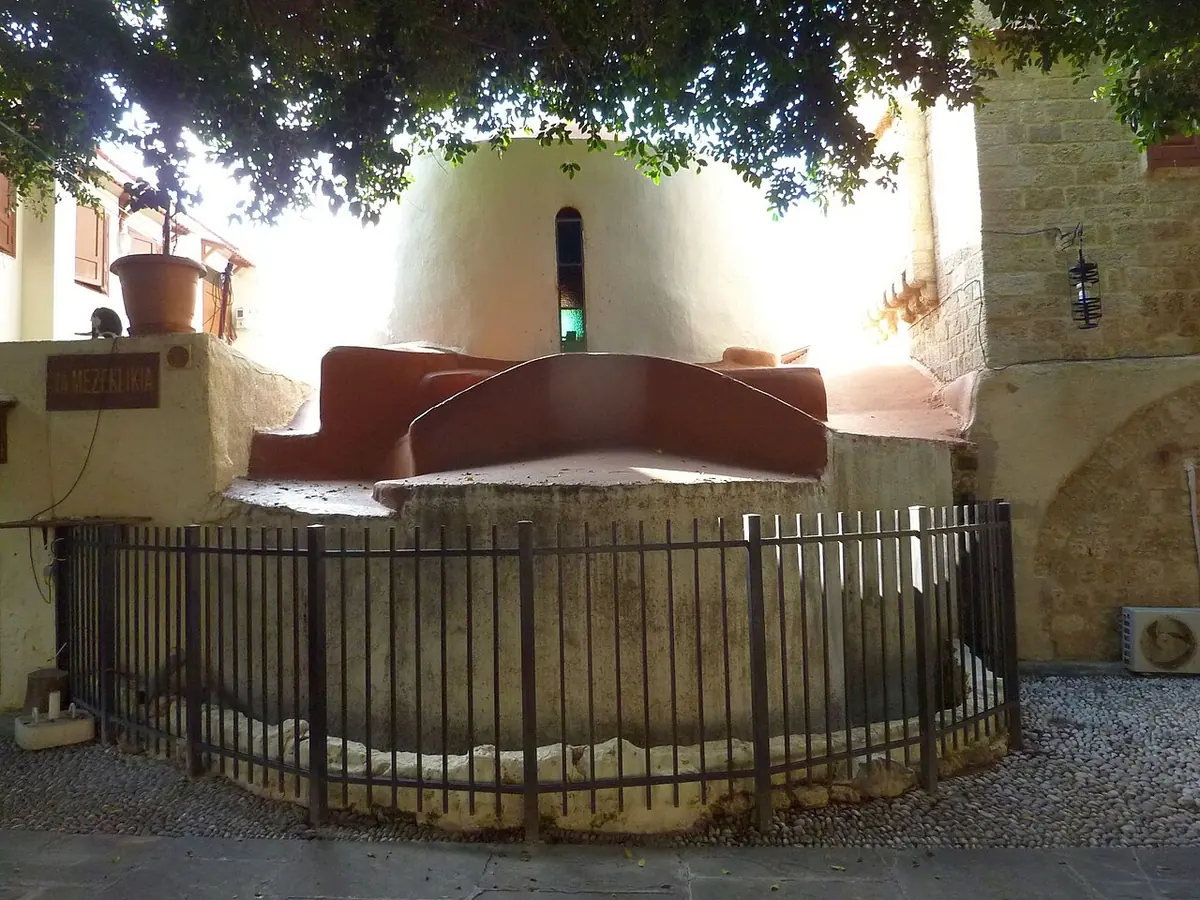
The center of his cult is still his small church in the Old Town of Rhodes. In Crete the monastery of Valsamonero, now a dependency of Vrontisi Monastery, keeps the chapel built for him by Abbot Jonas, and Akotantos's icons from that chapel are kept at Vrontisi. Churches and chapels named for Agios Fanourios stand across Greece, Cyprus and the Greek diaspora. No relics of St. Phanourios are known.
Prayer to St. Phanourios
The Orthodox Church sings these hymns on his feast. The texts below are the English translation published by the Orthodox Church in America.
The Orthodox Church sings a troparion (Tone 4) and a kontakion (Tone 3) for him. The troparion tells of angels and people rejoicing together over his contests, and the kontakion praises him for freeing priests from an ungodly captivity and putting the tyrants to shame.
When we have lost something, let us do as the faithful of Greece have done for centuries: ask St. Phanourios to pray for us, search again with patience, and when the lost thing is found, give thanks to God, share a cake with the poor and pray for his mother. Holy Great Martyr Phanourios, pray to God for us.
Frequently asked questions
What is St. Phanourios the patron saint of?
Above all, of lost things. His name sounds like the Greek verb phanerono, "to reveal," and Orthodox Christians ask him to reveal what has been lost, from keys to a stolen animal. In Crete shepherds have long counted him their protector, and in some places he is invoked for headaches and by young women hoping to find a husband.
When is the feast of St. Phanourios?
August 27, the day his icon is said to have been found on Rhodes. Orthodox churches on the Old Calendar keep it on September 9 of the civil calendar. He is not on the Roman Catholic calendar.
What is phanouropita?
A simple sweet cake, often made with flour, oil, sugar, orange juice and peel, cinnamon or clove, walnuts and raisins. Families bake it when they ask St. Phanourios for help or when a lost thing is found, bring it to church to be blessed, and share it with neighbors and the poor, praying "May God forgive the mother of St. Phanourios."
Why do people pray for St. Phanourios's mother?
Folk tradition says his mother was a hard, sinful woman who refused to help the poor, and that Phanourios promised to help those who pray for her. The Orthodox Church in America repeats the custom while saying her name is not known. The folklorist Marianthi Kaplanoglou showed in 2006 that the stories about her are a Greek form of an international folktale told elsewhere about St. Peter's mother.
Is St. Phanourios a real saint?
The Orthodox Church honors him as a Great Martyr, and his feast has been kept for some six centuries. Nothing certain is known of his life; as the Orthodox Church in America puts it, "We know nothing for certain about the background of Saint Phanourius." What we have is his icon, the miracles told of him, and the faith of the people who have prayed to him ever since.
Keep exploring
- Patron saint pages
- Lost things
- Feast-day calendar
- Saints remembered in AugustSaint of the dayWhat saint is my birthday?
- More
- Saints A to ZPatron saints A to ZExplore every section
Sources
- Orthodox Church in America: Saint Phanourius (August 27)
- Orthodox Church in America: Troparion and Kontakion of Saint Phanourius
- Marianthi Kaplanoglou, "The Folk Cult of St Phanourios in Greece and Cyprus, and its Relationship with the International Tale Type 804," Folklore 117, no. 1 (2006)
- Orthodox Crete (Church of Crete): Holy Monastery of Valsamonero
- Helen Rossidou-Koutsou, The Life and Lore of Saint Phanourios (trans. John Sanidopoulos, 2014). English translation of a Greek Byzantinist's article; the source for the Metropolitan Neilos dating, the Cretan shepherds' devotion and the phanouropita recipe
- John Sanidopoulos, Saint Phanourios the Great Martyr and Newly-Revealed of Rhodes (2010). For the question whether the name is an epithet of St. George