St. Joanna, Wife of Chuza
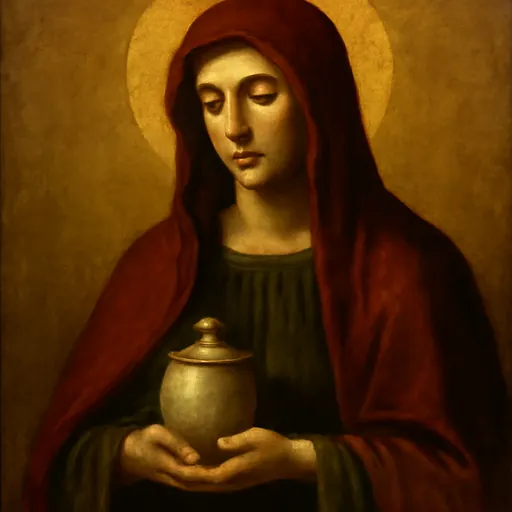
St. Joanna was one of the women disciples of Jesus named in the Gospel of Luke: the wife of Chuza, the steward of Herod Antipas, who helped support Jesus and the Twelve from her own means, brought spices to His tomb, and was among the first to tell the apostles He had risen. The Eastern churches keep her feast on June 27, and the Roman Martyrology on May 24.
Who was St. Joanna?
St. Joanna was a woman of Herod's court who became a disciple of Jesus. St. Luke tells us she was "the wife of Chusa, Herod's steward," that Jesus had healed her, that she traveled with Him and helped pay for His mission, and that on Easter morning she was at the empty tomb and carried the news to the apostles. She is one of the myrrh-bearing women, the first witnesses of the Resurrection.
There are many saints named Joan, Jane and Jeanne, from St. Joan of Arc to St. Jane Frances de Chantal. This Joanna is the first of them all, a disciple who knew the Lord in person. The Eastern churches keep her feast on June 27; the Roman Martyrology names her on May 24.
What the Gospel tells us about Joanna
A disciple from Herod's household
Luke introduces her as Jesus travels through Galilee, preaching the kingdom of God with the Twelve:
And certain women who had been healed of evil spirits and infirmities; Mary who is called Magdalen, out of whom seven devils were gone forth,
And Joanna the wife of Chusa, Herod's steward, and Susanna, and many others who ministered unto him of their substance.
That short verse (Luke 8:3) says a great deal. Chuza managed the household of Herod Antipas, the ruler of Galilee who had imprisoned and beheaded St. John the Baptist. His wife was a woman of rank and money, close to the court that feared and mocked Jesus. Yet Jesus had healed her, and she left the comfort of the palace to follow Him on the roads of Galilee with fishermen and with Mary Magdalene, who had been freed of seven demons.
"Ministered unto him of their substance" means she gave her own money and goods to feed and house Jesus and His disciples. It's a quiet line, but the Gospel would not have traveled far without women like her.

At the cross and the tomb
Luke tells us the women who had followed Jesus from Galilee stood at a distance at the crucifixion, watched where Joseph of Arimathea laid His body, and went home to prepare spices and ointments. They rested on the Sabbath. At dawn on the first day of the week they came to the tomb and found the stone rolled away and the body gone. Two men in shining garments told them, "He is not here, but is risen."
Then Luke names them:
And it was Mary Magdalen, and Joanna, and Mary of James, and the other women that were with them, who told these things to the apostles. And these words seemed to them as idle tales; and they did not believe them.
So Joanna is among the first people in history to tell anyone that Christ is risen, and among the first to be disbelieved for it. Peter ran to the tomb to see for himself.

History and tradition
The Gospel is all the history we have. Joanna appears only in Luke, twice, and we don't know where she came from, how Jesus healed her, what Chuza thought of her choice, or how she died. Everything beyond Luke is tradition.
The best-known tradition comes from the East. The Orthodox Church in America's life of the saint says that, according to Tradition, Joanna recovered the head of St. John the Baptist after Herodias had disposed of it, and gave it reverent burial. It fits her story well, since she lived inside the household where John was killed. We count it as traditional: an old and honored belief that the Gospel does not record.
A modern suggestion comes from biblical scholarship. Richard Bauckham, in Gospel Women (2002), argued that Joanna may be the "Junia" whom St. Paul greets in Romans 16:7 as "of note among the apostles," Junia being a Latin name that a Jewish Joanna could have used among Romans. It is an interesting proposal, not a teaching of the Church.

Symbols of St. Joanna in art
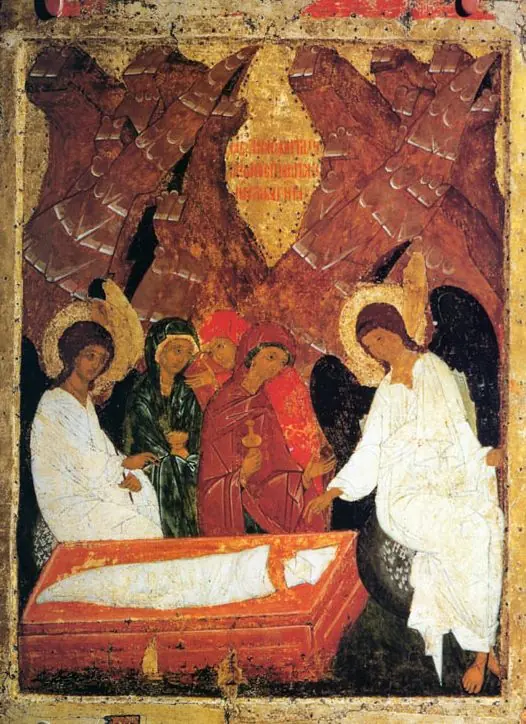
Joanna is rarely shown alone. Look for her among the myrrh-bearing women:
- Jar of myrrh or spices: the ointments the women prepared for Jesus' body. In icons each myrrh-bearer carries one.
- The empty tomb and the angel: the scene of the women at the tomb, one of the oldest subjects in Christian art, which Eastern icons call the Myrrh-bearers.
- The head of St. John the Baptist: in Eastern icons made for her own feast, she is shown finding or burying the Forerunner's head, often in a covered vessel on a mountainside.
- Rich dress: a few painters give her finer clothes than the other women, as the wife of a royal official.
Telling the women apart is hard, because artists didn't agree on how many went or who they were. Mary Magdalene, usually in red with her long hair loose, is the easiest to spot. Joanna is often one of the two or three others.

Feast day and devotion
The Orthodox and Byzantine Catholic churches honor Joanna on June 27, and again on the Sunday of the Myrrh-bearing Women, the third Sunday of Pascha, with St. Mary Magdalene, Mary the wife of Clopas, Salome, Martha and Mary of Bethany, and Susanna. In the West, the Roman Martyrology remembers her on May 24: "blessed Joanna, wife of Chuza, Herod's steward, mentioned by the evangelist St. Luke." See the feast day calendar.
There's no traditional prayer to St. Joanna that we can cite, and we won't write one in her name. The Eastern churches sing hymns for the myrrh-bearing women on their Sunday, and any Christian can ask her prayers. Let us ask St. Joanna to pray for women who serve the Church with their gifts and their means, for all who believe without being believed, and for us, that we may bring the news of the Resurrection to people who think it an idle tale.
Frequently asked questions
Who was Joanna in the Bible?
Joanna was the wife of Chuza, the steward of Herod Antipas. St. Luke names her twice, in Luke 8:3 among the women Jesus had healed who supported Him from their own means, and in Luke 24:10 among the women who found the tomb empty and told the apostles.
Is St. Joanna the same as St. Joan of Arc?
No. St. Joanna is a first-century disciple of Jesus from the Gospel of Luke. St. Joan of Arc was a French peasant girl who died in 1431. Many other saints are named Joan, Jane or Jeanne; this page is about Joanna, wife of Chuza.
When is the feast day of St. Joanna?
The Orthodox and Byzantine Catholic churches keep June 27 and also honor her on the Sunday of the Myrrh-bearing Women, two weeks after Easter. The Roman Martyrology commemorates her on May 24.
Was Joanna the same person as Junia in Romans 16?
Some scholars think so. Richard Bauckham argued in Gospel Women (2002) that Joanna may have used the Latin name Junia, whom St. Paul greets in Romans 16:7. It is a proposal, not something the Church teaches.
Sources
- Luke 8:1–3, Douay-Rheims 1899 American Edition (Bible Gateway)
- Luke 24:9–11, Douay-Rheims 1899 American Edition (Bible Gateway)
- Orthodox Church in America: Saint Joanna the Myrrhbearer. The tradition that she recovered the head of St. John the Baptist; the June 27 feast
- The Roman Martyrology (1916 English translation): May 24. "Also, blessed Joanna, wife of Chuza, Herod's steward"
- Richard Bauckham, Gospel Women: Studies of the Named Women in the Gospels (Eerdmans, 2002). The proposal that Joanna is the Junia of Romans 16:7