St. Agrippina of Mineo, Roman Virgin Martyr and Patron of Mineo
St. Agrippina of Mineo was a young Roman woman who gave her life for Christ under the emperor Valerian in the third century. Three Christian women carried her body to Mineo in Sicily, where her grave became a place of pilgrimage. We keep her feast on June 23, and she is the patron of Mineo, invoked against evil spirits, storms and leprosy; Boston's North End still honors her with a great street feast every August.
Who was St. Agrippina of Mineo?
St. Agrippina of Mineo was a young Christian woman of Rome who died for her faith during the persecution of the emperor Valerian, in the middle of the third century. Her body was carried to the hill town of Mineo, in eastern Sicily, and there she has been honored as patron ever since. Her name has crossed the ocean too: every August, Boston's North End carries her statue through the streets.
We should be honest about how much we know. Her story comes from her Acts, a martyr's account written long after the events, which survives in the Greek Church and in Sicilian tradition. The dates do not even agree: the Italian Santi e Beati gives June 23, 258, while other accounts say 256 or 262. A Boston University writer put it plainly: "Little is known of the true identity of Agrippina." What we have is an old and much-loved tradition, and the long devotion of the Church in Sicily and the East.
The life and martyrdom of St. Agrippina
A Roman girl who gave herself to God
Her Acts, as the Orthodox Church in America tells them, say that Agrippina was Roman by birth and "did not wish to enter into marriage." She gave her life to God instead. Later Sicilian tradition adds that she came from a noble family, and in Boston she is often called a princess with golden hair; that detail belongs to the legend, not to the oldest account.
Before the judge under Valerian
Valerian ruled from 253 to about 260, and in his last years he turned hard against the Church, aiming at bishops, clergy and prominent Christians. According to her Acts, Agrippina confessed her faith openly before the court. She was beaten with rods so savagely that her bones were broken, and then she was put in chains. An angel came and loosed her bonds, but she died of her wounds, faithful to the end.
Three women and a voyage to Sicily
Three Christian women, named Bassa, Paula and Agathonike, took her body in secret and brought it by sea to Sicily. The story told in Boston adds small wonders to the journey: a sweet fragrance that went with the body wherever it was carried, a ship that crossed the sea with unusual speed, and a cloud that sheltered the women from danger.

The miracles of St. Agrippina
Everything about her life and death comes to us through her Acts and local tradition, so we count these wonders as traditional: the angel who freed her from her chains, and the protection of the women on their voyage.
The healings at her grave belong to a different kind of memory. The Orthodox account says "many miracles" took place there, and her tomb at Mineo drew pilgrims for centuries. These are reported wonders, kept alive by the people who came to pray, though no Church inquiry ever examined them.
The Orthodox life adds that her relics were moved from Sicily to Constantinople in the eleventh century. Mineo, for its part, has never stopped honoring her as the saint who rests among its people.
Why St. Agrippina is the patron of Mineo, storms and the sick
She is patron of Mineo because the town received her body and has kept her grave. Over the centuries Sicilians came to invoke her against evil spirits, thunderstorms and leprosy, and in modern times against bacterial infections as well. There is no single story behind each of these; they grew out of the prayers of people who found help at her tomb. See more causes on our patron saints page.
Symbols of St. Agrippina in art
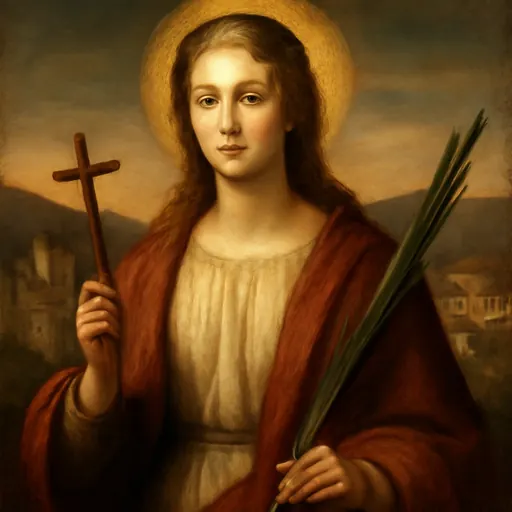
- Martyr's palm: the sign of victory that every martyr carries.
- Cross: her open confession of faith before the judge, which Orthodox icons place in her hand.
- Long golden hair: the young Roman noblewoman of the legend, as Boston and Sicily picture her.
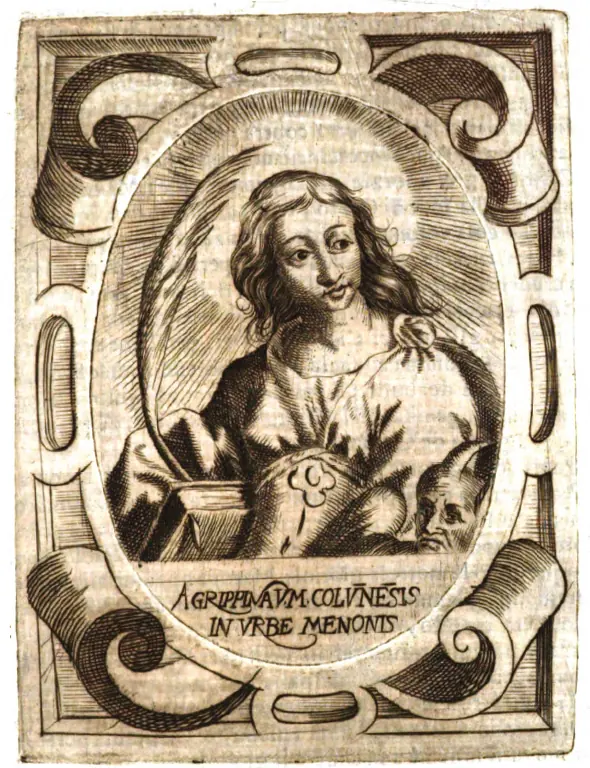
In Orthodox icons she appears as a young woman in a mantle and veil, holding a small cross, like most virgin martyrs. In the West, as in the 1658 engraving on this page, she is a girl with loose, flowing hair. In Boston her procession statue rides under a tall canopy hung with ribbons and offerings.
Her church at Mineo and her feast in Boston
The Church of Sant'Agrippina stands in the old center of Mineo, in the province of Catania, where tradition places her grave. Mineo honors her as its patron, and its emigrants carried her feast across the world.

Families from Mineo who settled in Boston's North End brought her with them. Since 1914 the Benefit Society of Saint Agrippina di Mineo has held her feast there in the first week of August. Twenty men carry a life-size statue of the saint under an ornate canopy through the streets near Hanover Street, and the faithful pin dollar bills to it to support the chapel that bears her name. A solemn Mass at St. Leonard's Church is part of the weekend. In 2024 BU Today counted it as the 110th annual feast.

Praying with St. Agrippina
We know of no traditional prayer to St. Agrippina in English with a clear origin; the Orthodox Church honors her with hymns on her feast, and Mineo has its own local devotions. Let us ask her simply, as Sicilians and Bostonians have done for generations: St. Agrippina, who loved Christ more than your own life, pray for us. Keep us from the power of evil, protect us in storms and sickness, and help us to confess our faith without fear. Find other saints of June on our feast days page.
Frequently asked questions
Who was St. Agrippina of Mineo?
A Roman virgin martyr of the third century. According to her Acts she refused marriage, confessed her faith openly under the emperor Valerian, and died of the beatings she received. Christian women took her body to Mineo in Sicily, which honors her as its patron.
When is the feast of St. Agrippina?
June 23. The Orthodox Church keeps that day, and it is the date of her martyrdom honored in Sicily. Boston's North End celebrates her with a feast in the first week of August.
What is St. Agrippina the patron saint of?
She is the patron of the town of Mineo in Sicily, and she is invoked against evil spirits, thunderstorms and leprosy, and by extension against infections.
Why does Boston celebrate St. Agrippina?
Immigrants from Mineo brought her feast to Boston's North End. The Benefit Society of Saint Agrippina di Mineo has held it since 1914, with a procession of her statue on Hanover Street; 2024 was the 110th annual feast.
Keep exploring
Sources
- Martyr Agrippina of Rome, Orthodox Church in America. Her Acts, the three women who carried her body to Sicily, and the transfer of relics to Constantinople
- Santa Agrippina, Vergine e martire, Santi e Beati
- From Sicily, with Love, BU Today (Boston University), August 4, 2011. The legend as told in Boston, her patronages, the procession and the Benefit Society
- To Do Today: Attend the Annual Feast of Saint Agrippina in the North End, BU Today, August 1, 2024. The 110th annual feast in 2024