St. Moses of Optina
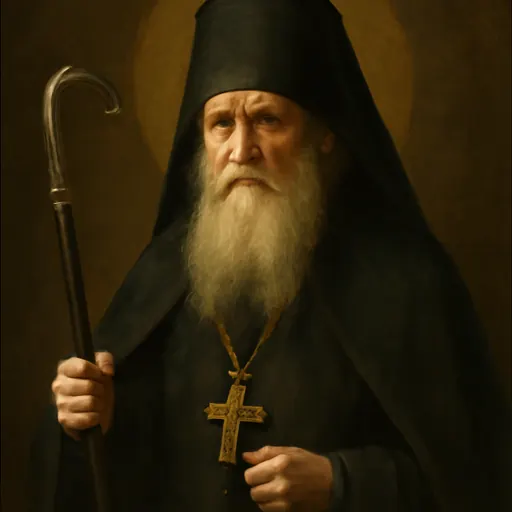
St. Moses of Optina (1782–1862) was a Russian Orthodox monk who, with his brother St. Anthony, founded the skete of Optina Monastery and served as the monastery's superior for thirty-seven years. He rebuilt Optina, fed the hungry in famine years and welcomed the elders Leonid and Macarius. His feast is June 16 (Julian), June 29 on the civil calendar.
Who was St. Moses of Optina?
St. Moses of Optina was the abbot who built the house in which the Optina elders lived. A monk of the Russian Orthodox Church, he came to Optina Monastery as a forest hermit, founded its skete with his brother St. Anthony, and then governed the whole monastery for thirty-seven years. Under him a poor, half-empty cloister became one of the great spiritual centers of Russia.
He was not the most famous of the Optina elders. He made room for the ones who were. He welcomed St. Leonid and St. Macarius, protected them, sent visitors to them, and would not tonsure a monk without their counsel. Without him there might have been no St. Ambrose of Optina.
The life of St. Moses
A merchant's son from Borisoglebsk
He was born on January 15, 1782, in Borisoglebsk in the Yaroslavl province and baptized Timothy, after the Apostle Timothy. His father was John Putilov. Of the six Putilov children, three sons would become monks: Timothy, Jonah and the youngest, Alexander, the future St. Anthony.
At nineteen Timothy went with his brother Jonah to work in Moscow. There they met the elders Alexander and Philaret of the Novospassky Monastery, spiritual heirs of St. Paisius Velichkovsky, and the brothers resolved to become monks.
Sarov and the Roslavl forests
In May 1805 Timothy went to Sarov, where his widowed brother-in-law had entered the year before. There he met St. Seraphim and stayed about two and a half years, working first in the bakery. At Sarov, the Orthodox Church in America's life says, he resolved to own nothing, and he kept that resolution for the rest of his life.
In 1811 he joined the hermits of the Roslavl forests under Elder Athanasius, another disciple of St. Paisius, who tonsured him and named him Moses. On January 15, 1816, his youngest brother Alexander came to visit and never left. Moses guided him for the rest of their lives.
The skete at Optina
In 1821 Bishop Philaret of Kaluga asked the brothers to found a skete, a small community of hermits, in the woods beside Optina Monastery. They came, cleared the forest and built cells and a church of St. John the Baptist. Moses did not want to be a priest, but the bishop warned him that he would answer for his refusal at the Dread Judgment. He was ordained deacon on December 22, 1822, and priest three days later, on Christmas Day.
Thirty-seven years as abbot
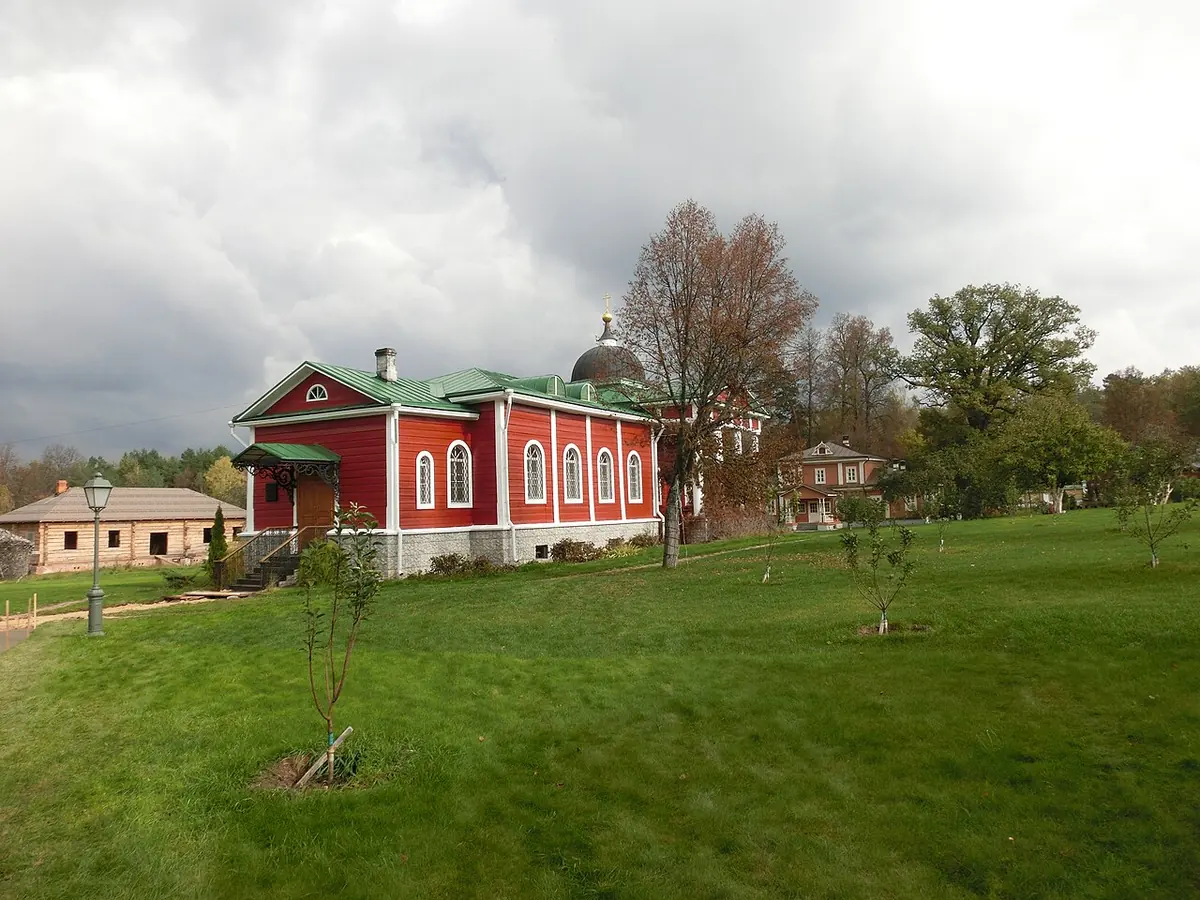
In 1826, at forty-three, Moses became superior of Optina. Under him the number of monks grew, the monastery's land doubled, orchards were planted, a library was founded, and a cathedral and two churches were built. He raised the money himself, often traveling to Moscow. When a monk asked anxiously where the money would come from, he answered: "Are you forgetting about God? I may have nothing, but He has everything."
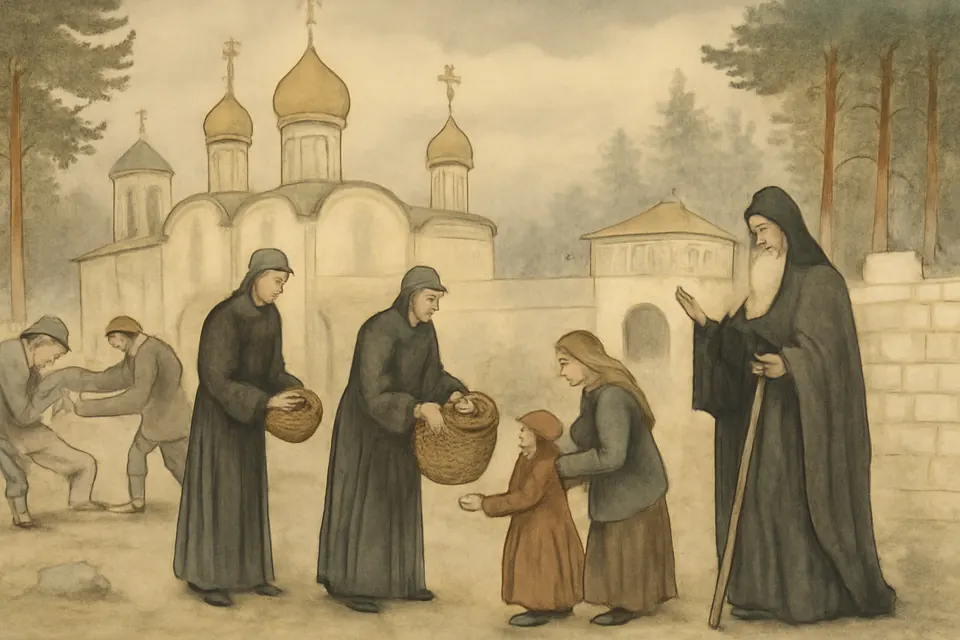
When famine came, he opened guest houses and hired the local peasants to work at the monastery, so that the monastery's wages fed their families. He also sent out, free of charge, the sixteen volumes of the Fathers that Optina published under St. Macarius.
He was by nature quick-tempered, and he fought it all his life by withdrawing to pray. He loved St. Dorotheus of Gaza's teaching on peace and often repeated it: "Do not desire that things turn out the way you would like." When anyone praised him, he would say, "I do not agree with you. I have my doubts."
His death
On June 15, 1862, he grew very weak. He received Holy Communion sitting up, held by the brothers, and again at midnight, lying down. In the hours that followed he blessed everyone in the room and then went on blessing the absent. The Gospel was read beside him, and at about ten in the morning he died, as the reader reached the words of Matthew 16:27–28.
After his death the brothers opened his coffer. It held a single ten-kopek coin. "Father Moses probably did not notice it," said his brother Anthony, "otherwise he would have spent it."
Miracles and spiritual gifts
The Orthodox Church in America's life records two signs, both reported by those who knew him rather than formally investigated. At the hour of his death, a man in St. Petersburg saw him in a dream. Several years later, his relics were found incorrupt. The life adds that he had the gift of eldership but hid it, preferring to send people to Leonid and Macarius.
Symbols of St. Moses of Optina in art
Icons of the Optina elders look much alike, so read the inscription.
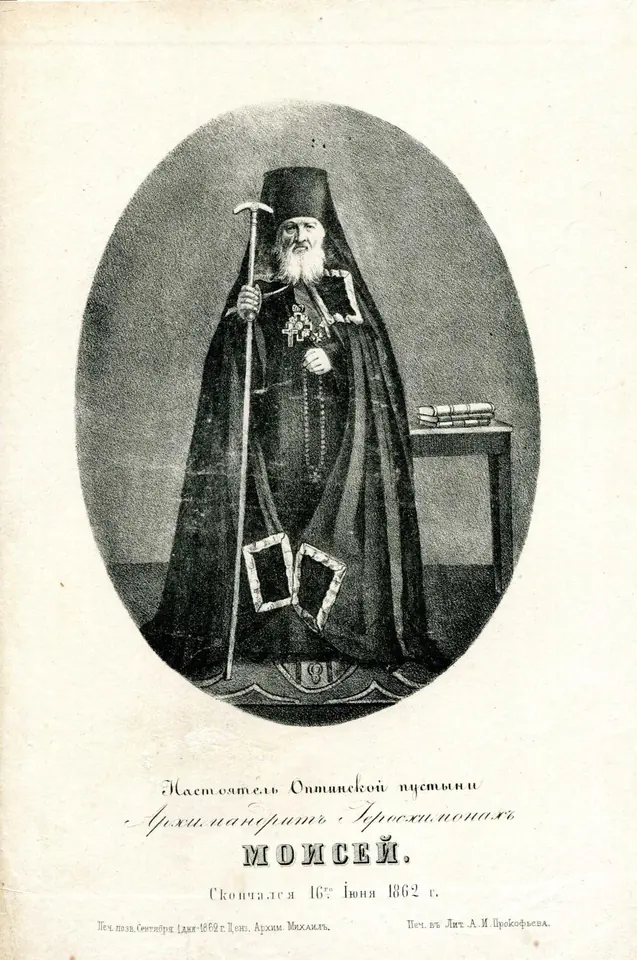
- Black klobuk and mantle: the dress of a Russian monk; Moses received the rank of archimandrite.
- Abbot's staff: the sign of the superior who governed Optina for thirty-seven years, as in the 1862 lithograph above.
- Pectoral cross: a priest-abbot.
- Prayer rope and scroll: the prayer and counsel shared by all the elders.
In the group icon of the Optina elders he usually stands beside his brother Anthony.
Feast day and where he is honored
We keep his memory on June 16 on the Julian calendar (June 29 on the civil calendar), and with all the Optina elders on October 11 (24). He was buried in a side altar of the monastery's cathedral, and in 1865 his brother Anthony was laid beside him. The Moscow Patriarchate approved local veneration of the Optina elders in 1996 and glorified them for the whole Russian Church on August 7, 2000. See other saints of the day on our feast days page.

Praying with St. Moses of Optina
On his feast the Orthodox Church sings the troparion (Tone 8) for holy monastic fathers, which praises the monk's tears and longing for God and the miracles that lit up the whole world, and asks him to pray for our souls. The OCA prints the full text on its website.
Let us ask St. Moses to pray for abbots, pastors and everyone who must provide for others, for the hungry, and for all who struggle against a quick temper.
Frequently asked questions
Who was St. Moses of Optina?
Born Timothy Putilov in 1782, he became a monk in the Roslavl forests, came to Optina with his brother Anthony to found a skete, and in 1826 became superior of the whole monastery. Over thirty-seven years he doubled its lands, built churches and a library, cared for the poor and gave the elders Leonid and Macarius the freedom to guide souls.
When is the feast of St. Moses of Optina?
June 16 on the Julian calendar (June 29 on the civil calendar), the day he died in 1862. He is also honored with all the Optina elders on October 11 (24).
Was St. Moses of Optina one of the Optina elders?
Yes. He is counted among the glorified Optina elders, though he preferred to send people to St. Leonid and St. Macarius for spiritual counsel. The Orthodox Church in America says he had the gift of eldership but hid it out of humility.
When was St. Moses of Optina canonized?
The Moscow Patriarchate approved local veneration of the Optina elders on June 13, 1996, and glorified them for the whole Russian Orthodox Church on August 7, 2000.
Keep exploring
Sources
- Venerable Moses of Optina, Orthodox Church in America. His full life: Moscow, Sarov, the Roslavl forests, the founding of the skete, his ordination, his thirty-seven years as superior, his death, incorrupt relics and glorification
- Venerable Moses of Optina: Troparion, Orthodox Church in America. Full text of the troparion
- Venerable Anthony of Optina, Orthodox Church in America. Moses's burial in a side altar of the monastery cathedral, where Anthony was later laid beside him
- Synaxis of the Venerable Fathers of Optina, Orthodox Church in America. The common feast of the Optina elders