St. Gall of Clermont: Bishop of Auvergne and Uncle of St. Gregory of Tours
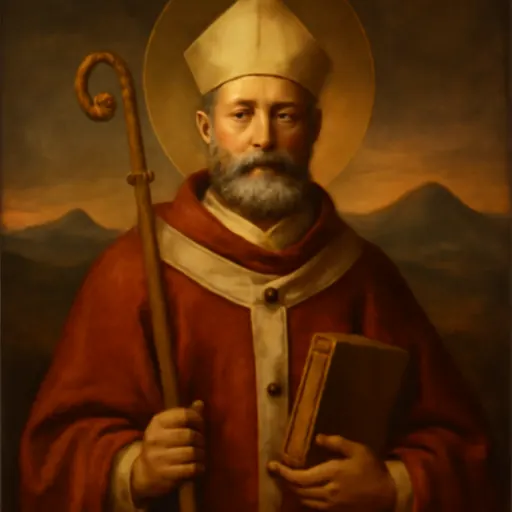
St. Gall of Clermont (Gallus, died about 551) was bishop of Clermont in the Auvergne from about 527. When plague swept through Gaul, he prayed day and night for his people, and Gregory of Tours writes that the sickness never reached his city. He was Gregory's uncle and teacher. His feast is July 1.
Who was St. Gall of Clermont?
St. Gall of Clermont, called Gallus in Latin, was bishop of Clermont in the Auvergne, in central France, from about 527 until his death about 551. He was a shepherd who feared more for his flock than for himself, and the people of the Auvergne remembered him as the bishop whose prayers kept the plague away. We keep his feast on July 1.
He is also the uncle of a far more famous saint. His nephew Georgius Florentinus, whom we know as St. Gregory of Tours, probably received his schooling and entered the clergy under him, and later wrote about him in both his History of the Franks and his Life of the Fathers. The Catholic Encyclopedia lists Gallus among the holy bishops of Clermont as the one "of whom Gregory of Tours was the biographer and nephew."
He is a different saint from St. Gall, the Irish monk whose hermitage in Switzerland became the great Abbey of St. Gall.
Bishop of Clermont
When the holy bishop Quintianus died, Gregory writes that "St. Gallus, with the king's help, was put in his chair." Clermont lay in the kingdom of the Frankish king Theuderic I, and royal favor mattered in those years. Gall used it for his people.
The plague and the angel
The great plague of the sixth century, the disease Gregory calls the lues inguinaria, the swelling sickness of the groin, swept through Gaul. It struck hardest in the province of Arles. Gregory says his uncle "was afraid not so much for himself as for his people."
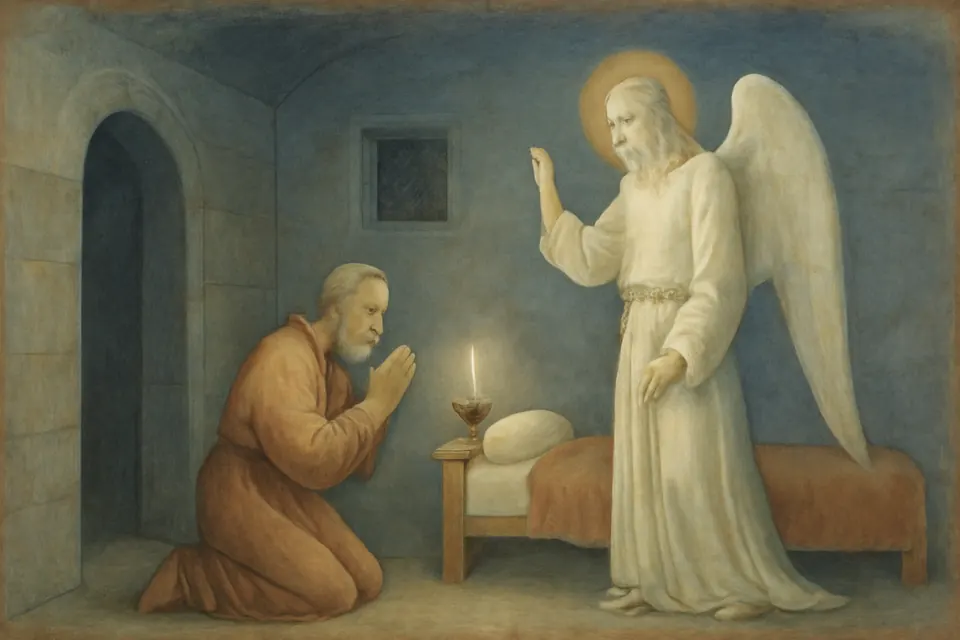
What follows is Gregory's account (our own translation from his Latin). Gall prayed to the Lord day and night that he would not live to see his flock destroyed. In a vision of the night an angel of the Lord appeared to him, with hair and clothing "white as snow," and said:
You do well, O priest, to pray to the Lord like this for your people. Your prayer has been heard. You and your people will be freed from this sickness, and while you live no one in this region will die of this plague. Do not be afraid now; but after eight years, be afraid.
Gregory adds that the meaning became clear later: Gall died when those eight years had passed.
When the bishop woke he thanked God for the comfort. Gregory then records a strange sign. The walls of houses and churches seemed suddenly to be marked, and the country people called the writing a Thau, the cross-shaped letter of the prophet Ezekiel's vision, where the mark of Tau spared the faithful. And the plague, Gregory writes, ravaged the regions around, yet "through the prayer of St. Gall it did not touch the city of the Arverni."
These are reported wonders: Gregory wrote them down as family and diocesan history within a generation, but no formal inquiry ever examined them. The angel's promise was kept, as Gregory tells it, and he called it "no small grace" that a shepherd should not see his sheep devoured.
The Lenten procession to Brioude
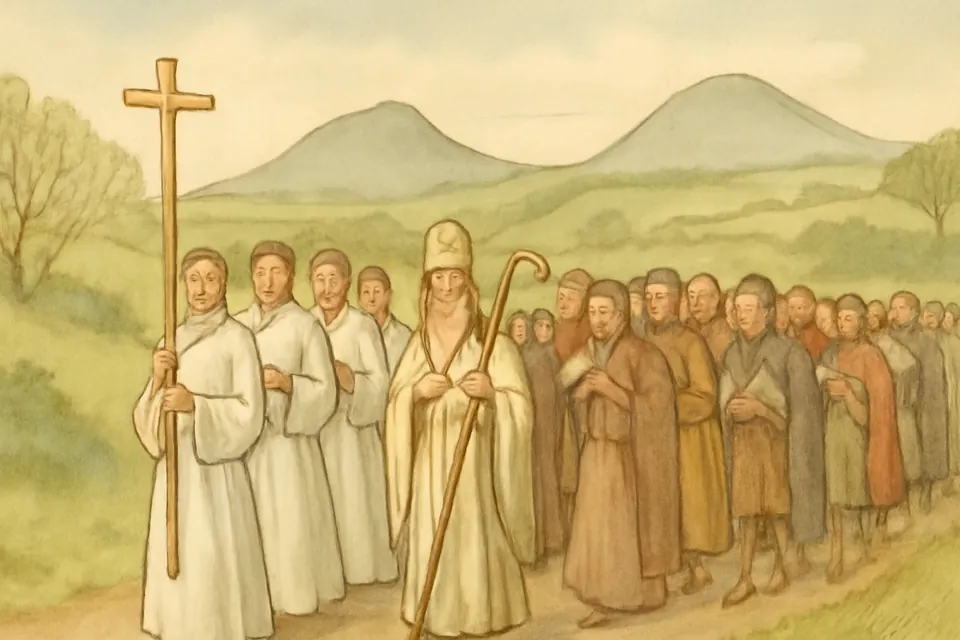
In thanksgiving Gall began a public penance that outlived him by centuries. In the middle of Lent, the people of Clermont were to walk on foot, singing psalms, to the basilica of the martyr St. Julian at Brioude. Gregory puts the road at about 360 stadia, more than forty miles. Years later he mentions that his successor Cautinus set out on the same procession "according to the custom established by St. Gall."
The Romanesque basilica that pilgrims see at Brioude today is a later building, but it still keeps the cult of the martyr Julian that drew Gall's people there.

His death and the struggle for his chair
Gall died about 551. His body was washed and carried into the church, and the bishops who came to bury him found the priest Cato already acting as though the diocese were his. Gregory tells the sorry story of Cato's ambition at length in the chapters that follow. It is a reminder of how much the Church of Clermont had lost: a bishop who wanted nothing for himself.
Symbols of St. Gall in art
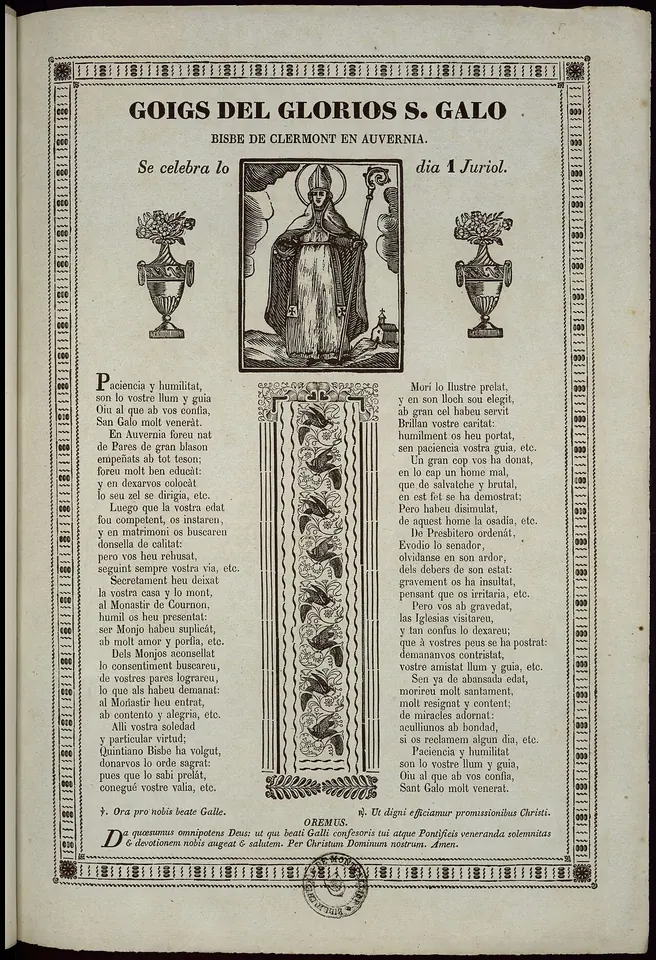
St. Gall of Clermont has no fixed emblem of his own. He is shown as a bishop with miter and crozier, often with a book. In Catalonia, where devotion to him traveled, nineteenth-century goigs, the printed hymn sheets sung on a saint's day, show him as a mitered bishop blessing, with his feast given as July 1.
Feast day and prayer
We keep his feast on July 1; see our feast day calendar. There is no traditional English prayer to him. In time of epidemic let us ask his help as the people of Auvergne did: St. Gall of Clermont, shepherd who prayed day and night for your flock, pray for the sick, for those who care for them, and for all of us, that God may spare his people.
Frequently asked questions
Who was St. Gall of Clermont?
A sixth-century bishop of Clermont (today's Clermont-Ferrand) in the Auvergne, who governed the diocese from about 527 to about 551. He was the paternal uncle of St. Gregory of Tours, who was probably educated under him and later wrote his life.
Is St. Gall of Clermont the same as St. Gall of Switzerland?
No. St. Gall of Switzerland was an Irish monk, companion of St. Columbanus, whose hermitage became the Abbey of St. Gall; his feast is October 16. St. Gall of Clermont was a Gallo-Roman bishop of the Auvergne, honored on July 1.
Why is St. Gall of Clermont invoked against plague?
Gregory of Tours tells that when bubonic plague ravaged Gaul, Gall prayed for his people, an angel promised him that no one in his region would die of it while he lived, and the plague did not reach Clermont. He also began a Lenten procession on foot to the shrine of St. Julian at Brioude.
Keep exploring
Sources
- Gregory of Tours, History of the Franks, tr. Ernest Brehaut (1916), Internet Medieval Sourcebook. Book IV, chapters 5, 6 and 13 (the plague, Cato, the procession to Brioude); introduction on Gregory's uncle Gallus
- Gregory of Tours, Historiarum Libri Decem, Book IV (Latin text, The Latin Library). Chapter 5, "De sancto Gallo episcopo," translated here by the editors
- Catholic Encyclopedia (1908): Clermont. St. Gallus (527-51), of whom Gregory of Tours was the biographer and nephew
- The Roman Martyrology (English edition, 1916), Internet Archive. July 1