St. Alban of Mainz, Priest and Martyr

St. Alban of Mainz was a priest and missionary who, by the oldest account, came north from Milan with his teacher Theonestus and was beheaded at Mainz around 406, perhaps when the Vandals stormed the city. Legend says he carried his own head to his chosen grave. We keep his feast on June 21, and he is the patron of Mainz and of farmers.
Who was St. Alban of Mainz?
St. Alban of Mainz was a priest who preached the Catholic faith in the Rhineland at the end of the Roman age and was beheaded at Mainz around the year 406. He is not the British protomartyr St. Alban of Verulamium, though the two were often confused. Very little is known for certain about him. What we have is a ninth-century martyrology entry, a church over his grave that was already old by then, and a longer legend written in the eleventh century. We honor him as the first martyr of Mainz, with his feast on June 21.
What the oldest source says
The earliest account is in the martyrology of Hrabanus Maurus, the great abbot of Fulda who became archbishop of Mainz, written around 845. As the Ökumenisches Heiligenlexikon summarizes it, Alban and his teacher Theonestus were priests who stood against the Arian heresy in the reign of Emperor Theodosius. They were sent from Rome to St. Ambrose in Milan, traveled on through Gaul to Augsburg, and came at last to Mainz. There they restored the exiled Bishop Aureus to his see. When the Vandals stormed the city in 406, Aureus was killed, and Alban was seized while at prayer and beheaded. Theonestus buried him in a fine church at Mainz and was then killed as well.
The Catholic Encyclopedia confirms that Bishop Aureus of Mainz was put to death in 406, the year the barbarian peoples crossed the Rhine. Beyond that, the details of Alban's own life cannot be checked.
The legend of Gozwin
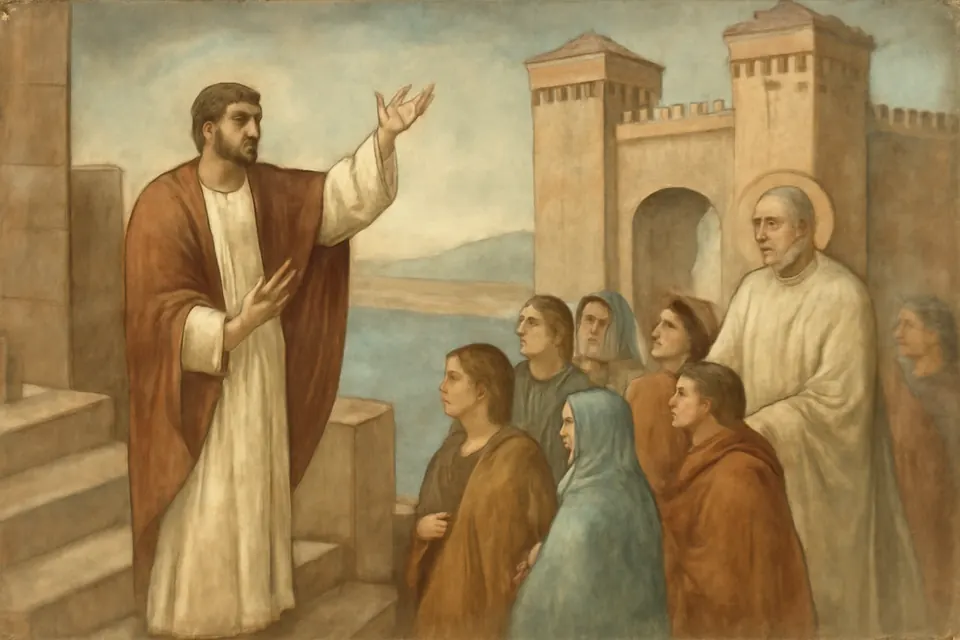
Around 1061 Gozwin, a schoolmaster at Mainz, wrote the story down at greater length. He worked Bishop Aureus into it and set the martyrdom in the time of the Huns, who sacked Mainz in 451, so even the medieval tellers did not agree on the date. We should read his work as a pious tale, not a chronicle.
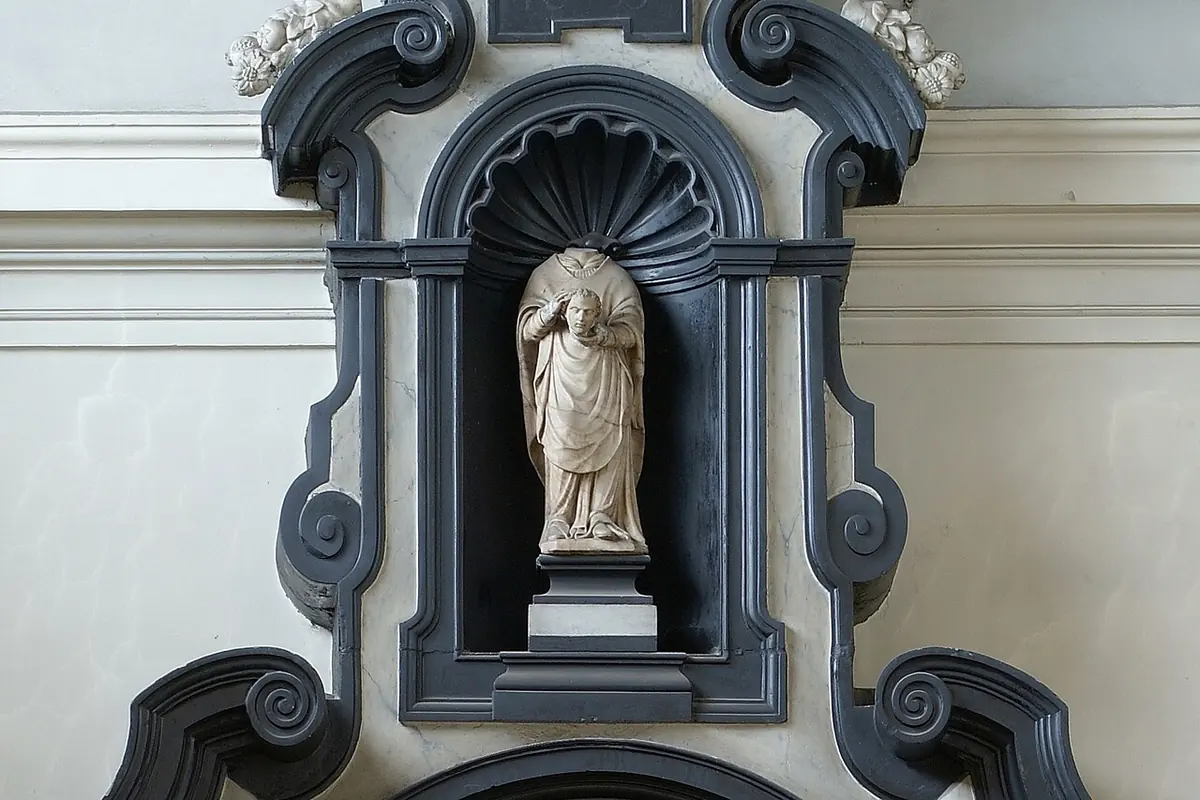
The best-known part of Gozwin's story is traditional: after the executioner struck off his head, Alban picked it up and carried it to the spot where he wished to be buried. That is why he is shown holding his own head, like St. Denis of Paris.
The abbey of St. Alban
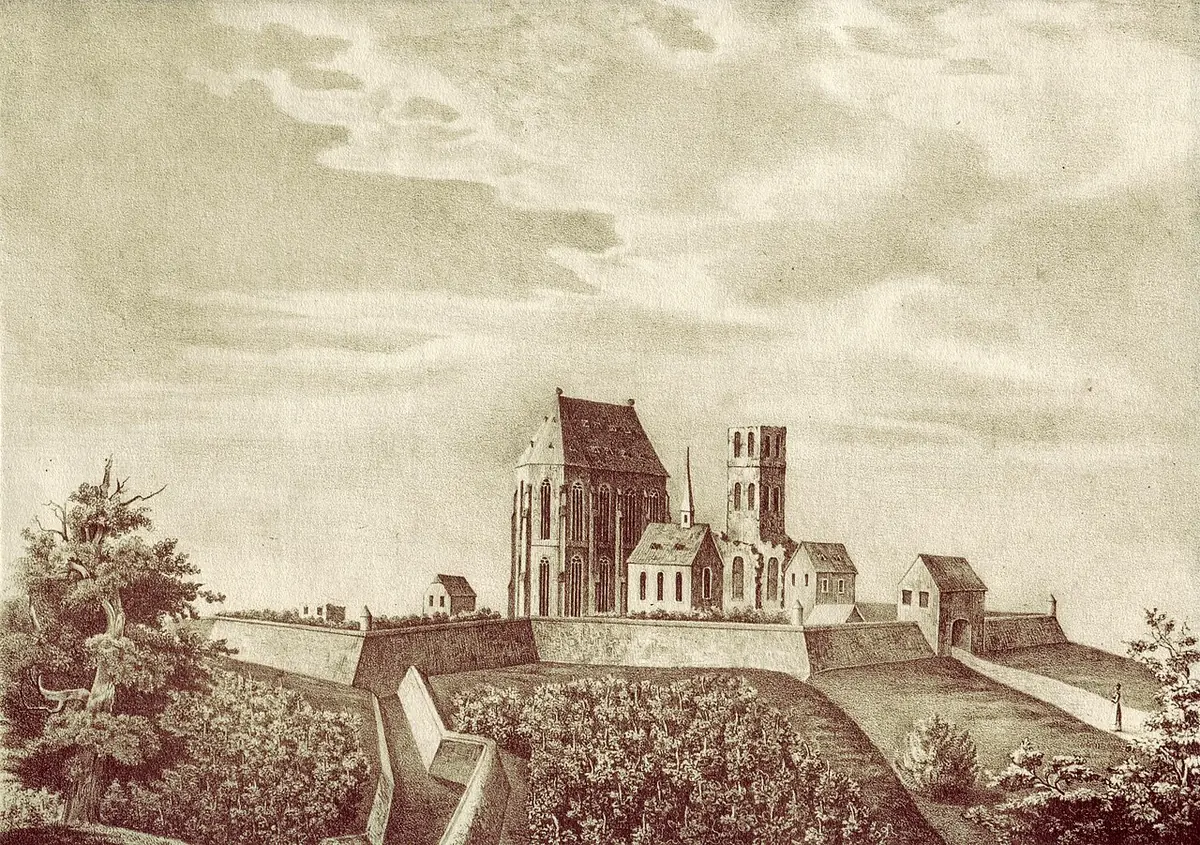
His grave is the firmest fact we have. A large church dedicated to Alban stood on a Roman cemetery south of the city as early as the first half of the fifth century. Archbishop Richulf (787–813) built the Abbey of St. Alban, famous for its school; it was rebuilt with Charlemagne's support in 805 and became the burial place of his third wife, Fastrada, who died in 794. For centuries the archbishops of Mainz were laid to rest in it. The abbey was destroyed in 1329 and again in 1552, in the wars of the Reformation era, and with it went most of the local cult. Today the Abtsgasse, a lane in the western part of the city park, recalls it.
Why St. Alban of Mainz is a patron saint
He is the patron of Mainz, as its first martyr. He is invoked as patron of farmers and against storms. Perhaps because he was beheaded, he became a helper against headaches and sore throats, and he is also invoked against plague, epilepsy and urinary illness. The cult spread far from the Rhine: the Benedictine priory of St. Alban in Basel was founded in 1083 by a bishop who had served in Mainz, and his relics were honored in Lisbon. The Cathedral of Saint-Aubain in Namur, Belgium, also bears his name.
Symbols of St. Alban of Mainz in art
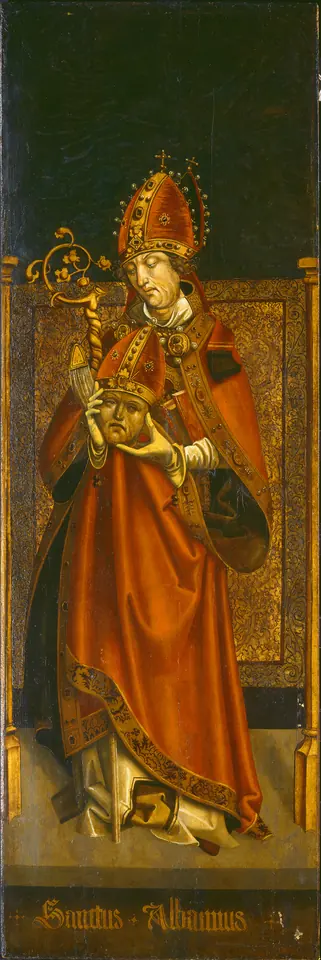
- His own head held in his hands, from the legend that he carried it to his grave. This is the surest sign.
- A sword, the instrument of his death.
- Priestly or bishop's vestments. Late medieval painters, like the Tyrolean master of the Washington panel, often gave him a miter, though the sources call him a priest.
Because the British St. Alban is also shown beheaded, the two are easily mixed up. Look at the setting: a German, Austrian or Belgian church with a head-carrying saint on June 21 almost certainly means Alban of Mainz.
Feast day and prayer
We keep his feast on June 21, the day after which the British Alban follows on June 22. His cult never died out in Old Bavaria, where churches and villages still bear his name. See the feast day calendar.
No traditional prayer to St. Alban of Mainz is in wide use. Let us ask him, who gave his life on the Rhine when the old world was falling, to pray for the Church in Germany, for farmers and their harvests, and for all who suffer pain in the head.
Frequently asked questions
Who was St. Alban of Mainz?
A priest who preached in Mainz around the year 400 and died there as a martyr, beheaded around 406. The oldest account, in the martyrology of Hrabanus Maurus written about 845, says he came from Milan with St. Theonestus in the time of Emperor Theodosius. Almost everything else about him is legend.
Is St. Alban of Mainz the same as St. Alban of England?
No. St. Alban of Verulamium was the first martyr of Britain, killed around 304; St. Alban of Mainz died a century later on the Rhine. Both were beheaded and are honored on neighboring days (June 22 and June 21), and medieval storytellers mixed them up.
Why is St. Alban of Mainz shown holding his head?
A legend told by Gozwin of Mainz around 1061 says that after he was beheaded he took up his head and carried it to the place where he wished to be buried. He is one of the "cephalophores," the head-carrying saints, like St. Denis of Paris.
What is St. Alban of Mainz the patron saint of?
Mainz, farmers, and protection against storms, headaches and sore throats, plague, epilepsy and urinary illness.
Keep exploring
Sources
- Joachim Schäfer, "Alban von Mainz," Ökumenisches Heiligenlexikon (in German). Hrabanus's account, Aureus and the Vandals in 406, the fifth-century church on the Roman cemetery, the abbey of 805 and Fastrada, Gozwin's legend about 1061, the destruction of 1329 and 1552, the Abtsgasse, Basel, patronages and attributes, the Lisbon relics
- Joseph Lins, "Mainz," Catholic Encyclopedia, vol. 9 (1910). Bishop Aureus killed in 406; Archbishop Richulf (787–813) built the Monastery of St. Alban, famous for its school
- Herbert Thurston, "St. Alban," Catholic Encyclopedia, vol. 1 (1907). The legend of the British St. Alban confused with Alban or Albinus martyred at Mainz