St. Peter of Canterbury
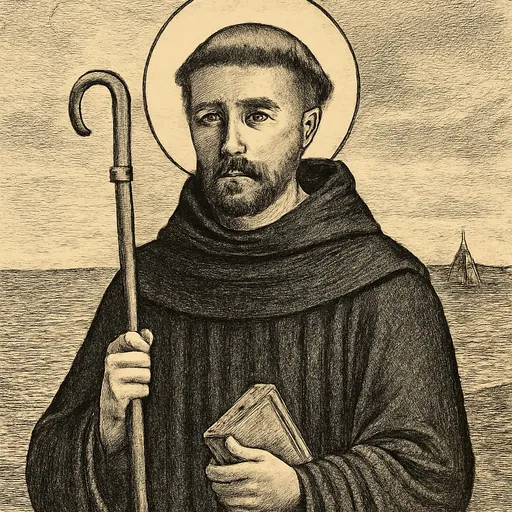
St. Peter of Canterbury was a monk of the Roman mission that St. Augustine brought to Kent in 597, and the first abbot of the monastery of Sts. Peter and Paul at Canterbury, later called St. Augustine's Abbey. He drowned near Boulogne about 607 while on a mission to Gaul, and Bede tells how a light from heaven shone over his grave. We keep his feast on January 6.
Who was St. Peter of Canterbury?
St. Peter of Canterbury was one of the monks who came with St. Augustine from Rome to Kent in 597 to bring the Gospel to the English, and he became the first abbot of the monastery Augustine founded just outside Canterbury. That monastery, first dedicated to Sts. Peter and Paul, later took Augustine's own name. Peter drowned off the coast of Gaul about 607, and Bede tells how God showed his holiness by a light that shone over his grave. We keep his feast on January 6.
Nearly all we know of him comes from two short passages in St. Bede's Ecclesiastical History of the English People, finished in 731. They are enough to show a quiet, faithful man at the very start of English Christianity.

The mission to Kent
In 596 Pope St. Gregory the Great sent a band of monks from his own monastery in Rome to the Anglo-Saxons. They landed in Kent in 597, where King Ethelbert, whose Christian wife Bertha had brought a chaplain from Gaul, received them kindly. The king was baptized, and thousands of his people followed.
Peter was one of those monks. Bede does not say where he was born; like the other members of the mission, he probably came from Rome or elsewhere in Italy.

Messenger to Rome
After Augustine was consecrated archbishop, he wanted the pope to know what had happened and needed answers to hard questions about the new Church. Bede writes that he "sent Laurentius the priest and Peter the monk to Rome, to acquaint Pope Gregory, that the English nation had received the faith of Christ, and that he was himself made their bishop." The two men carried Augustine's questions on how a bishop should live with his clergy, on marriage, on worship and on much else. Gregory's long replies, which Bede copies into his history, came back with them in 601, along with more missionaries.
Peter's companion on that journey, St. Laurence, later succeeded Augustine as archbishop of Canterbury.

First abbot of St. Augustine's
Augustine built a monastery east of the city walls, and King Ethelbert raised its church from the foundations in honor of the Apostles Peter and Paul. It was meant to be the burial place of the archbishops of Canterbury and the kings of Kent. Bede says simply: "The first abbot of that monastery was the priest Peter." He was a monk and a priest, and he ruled the community that would grow into one of the great Benedictine abbeys of England. Today its ruins are part of the Canterbury World Heritage Site.
Death at Amfleat
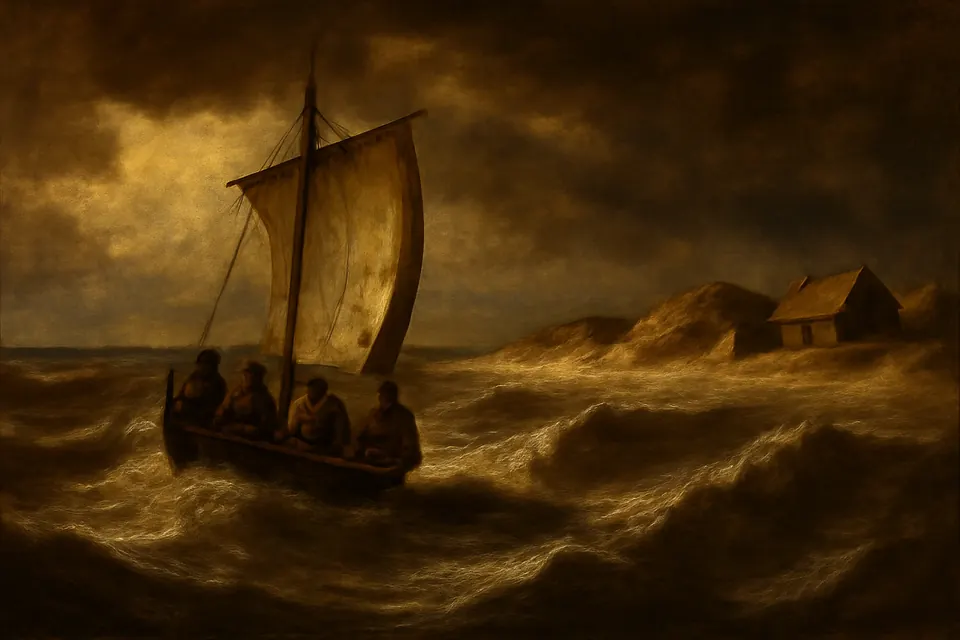
Bede tells the end of Peter's life in a single sentence. Peter, "being sent on a mission into Gaul, was drowned in a bay of the sea, which is called Amfleat, and committed to a humble tomb by the inhabitants of the place." Sellar's note identifies Amfleat as Ambleteuse, a small port about six miles north of Boulogne.
We do not know the purpose of his journey. The 1921 Book of Saints calls it an "embassy to France" and dates his death to about 606 or 607.
The light over his grave
What happened next is the one miracle told of St. Peter of Canterbury, and it is a traditional one, resting on Bede's account written more than a century later. Bede writes:
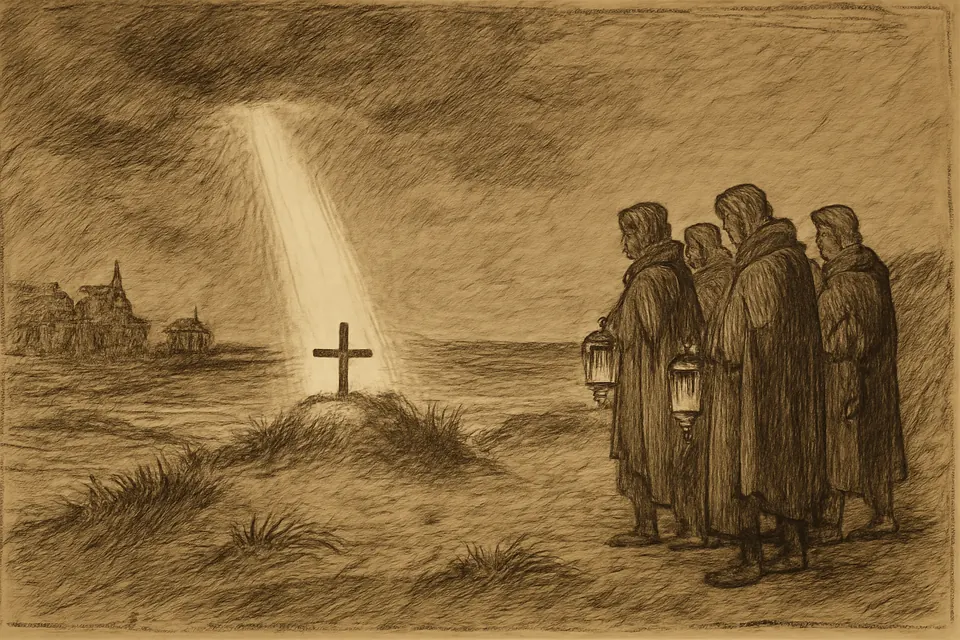
But since it was the will of Almighty God to reveal his merits, a light from Heaven was seen over his grave every night; till the neighbouring people who saw it, perceiving that he had been a holy man that was buried there, and inquiring who and whence he was, carried away the body, and interred it in the church, in the city of Boulogne, with the honour due to so great a person.
Strangers on that coast did not know who the drowned monk was. They learned his story only because they asked, and they honored him because the light had shown them he was holy.
Symbols of St. Peter of Canterbury in art
No medieval image of Peter is known to survive, and there is no fixed way of showing him. Pictures of him draw on Bede:
- A Benedictine habit and an abbot's staff: the first abbot of St. Augustine's.
- A boat or the sea: his death by drowning on the way to Gaul.
- A light shining over a grave: the sign that revealed his holiness.
He may also appear among the companions of St. Augustine in scenes of the mission to Kent, such as the baptism of King Ethelbert, though he is rarely named there.

Feast day and cult
The monks of St. Augustine's kept Peter's memory through the Middle Ages, and Boulogne, where his body was laid, honored him too. The Book of Saints records that "his memory has been perpetuated to our own times, and in 1915 his right to a liturgical cultus was formally recognised in Rome." We keep his feast on January 6; some calendars give December 30. No relics of him are known today. See the feast day calendar for other saints of the day.
Prayer to St. Peter of Canterbury
We know of no traditional prayer to St. Peter of Canterbury. His life invites us to pray for missionaries, for those who carry messages and serve others far from home, and for all who die at sea. Let us ask God, through his intercession, to make us faithful in the small tasks given to us: St. Peter of Canterbury, pray for us.
Frequently asked questions
Who was St. Peter of Canterbury?
One of the monks sent by Pope St. Gregory the Great with St. Augustine to convert the English. He carried Augustine's report and questions to Rome about 600 and became the first abbot of the monastery St. Augustine founded outside Canterbury.
How did St. Peter of Canterbury die?
Bede says he was sent on a mission into Gaul and drowned in a bay called Amfleat, today's Ambleteuse, a few miles north of Boulogne. The local people buried him there and later moved his body into a church in Boulogne.
When is the feast of St. Peter of Canterbury?
January 6 in the Benedictine Book of Saints, which notes that Rome recognized his cult in 1915. Some calendars keep him on December 30.
Where was St. Peter of Canterbury buried?
First in a humble grave at Ambleteuse, then, after a light was seen over it every night, in a church in the city of Boulogne. No surviving relics are known today.
Keep exploring
Sources
- Bede, Ecclesiastical History of England, translated by A. M. Sellar (London, 1907; Project Gutenberg). Book I, chapters 27 and 33 (quoted), with Sellar's note identifying Amfleat as Ambleteuse
- The Book of Saints, compiled by the Benedictine monks of St. Augustine's Abbey, Ramsgate (London, 1921). Peter (St.) Abbot (Jan. 6): death about 606–607 and the recognition of his cultus in Rome in 1915