St. Abo of Tiflis, the Perfumer from Baghdad Martyred in Georgia

St. Abo of Tiflis (about 756–786) was an Arab perfumer from Baghdad who came to Georgia as a teenager in the service of Prince Nerses, was baptized a Christian, and openly confessed Christ in Tbilisi under Arab rule. He was beheaded on January 6, 786, the feast of Theophany. He is honored as a patron of Tbilisi, and his feast is kept on January 8.
Who was St. Abo of Tiflis?
St. Abo of Tiflis was a young Arab perfumer from Baghdad who found Christ in Georgia and died for him in Tbilisi (old Tiflis) on January 6, 786, the feast of Theophany. He came of pure Arab stock, as his biographer stresses, and was about seventeen or eighteen when he left his family in Baghdad to enter the service of the Georgian prince Nerses. He has long been considered a patron of Tbilisi, and Orthodox Christians everywhere keep his feast on January 8.
We know his story from a rare source: an account written by a Georgian who knew him. John, son of Saban (Ioane Sabanisdze), wrote the Passion of St. Abo soon after his death at the command of Samuel, Catholicos of Georgia, to strengthen Christians who were wavering under Arab rule. In David Marshall Lang's translation, John says some of his people were "shivering like reeds in a high wind."
The life of St. Abo
From Baghdad to Georgia
In 772 Prince Nerses of Kartli was summoned to Baghdad and thrown into prison by the caliph. When he was released three years later, under the caliph al-Mahdi, he went home with a new servant: young Abo, who was good at preparing "fragrant scents and lotions" and was also learned in Arabic letters. In Georgia Abo learned to read, write and speak Georgian, began reading the Old and New Testaments, went to church, and questioned the priests. Little by little he came to love Christ with all his heart. But under Arab rule a Muslim could not openly become a Christian, so he prayed and fasted in secret.
Baptized among the Khazars
Around 779 or 780, Nerses had to flee again, through the Darial Pass over the Caucasus to the land of the Khazars. Abo was among the three hundred men of his escort. Far from the reach of the caliph's officials, he was baptized by priests in a Christian town in the north. Nerses then took his household to Abkhazia on the Black Sea, where Abo rejoiced to find a whole Christian people. The king of Abkhazia urged him to stay there safely. Instead, the OCA's life says, Abo asked to go back: "Let me go, and I will freely declare my Christian Faith to those who hate Christ!"
Confessing Christ in Tbilisi
He returned to Tbilisi and lived there openly as a Christian. According to his Passion, he took up the hard fasting of St. Anthony the Great on that saint's feast, January 17, living like a desert monk in the middle of the city. He was arrested once and released at the request of the ruling prince Stephen. When a new emir came to power, Christians begged him to hide. He answered, as the OCA tells it: "I am prepared not only to be tortured for Christ, but to die for His sake as well."
The martyrdom of St. Abo
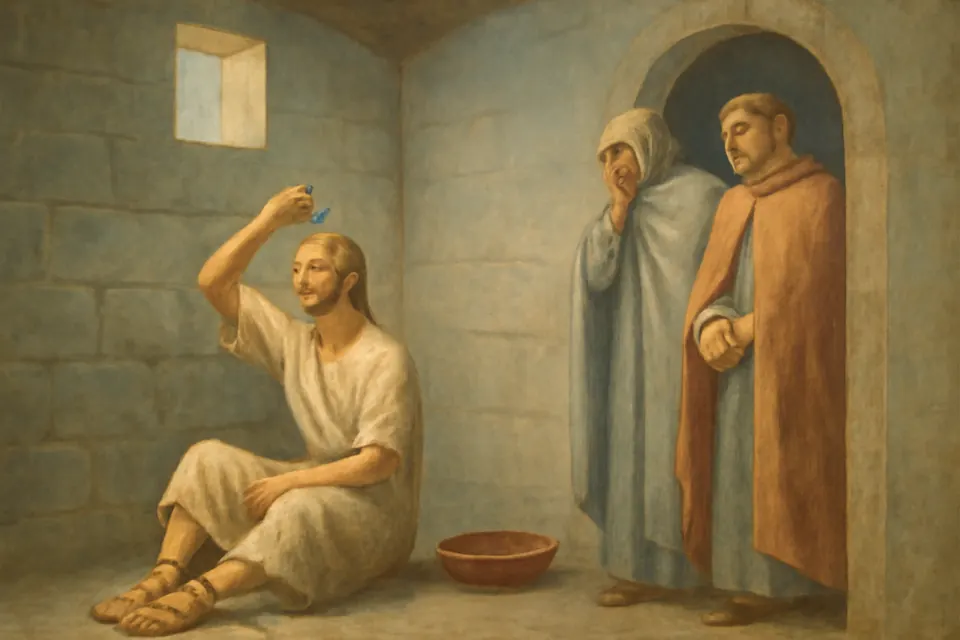
The emir's men arrested him and brought him before a judge, who tried in vain to win him back to Islam and then sent him to prison in chains. Abo asked his friends to sell his clothes and buy candles and incense for the churches.
On the day he was to die he washed his face and anointed his head with oil. In Lang's translation of the Passion he said: "Once upon a time I myself was a skilled perfumer and mixer of fragrant oils. But today this is my anointing for the grave." He received Holy Communion and told the Christians around him: "Weep not, but rejoice, for I am going to my Lord."
He went to the judgment seat praying Psalm 118 (119), "Blessed are the undefiled in the way," and the words of the good thief, "Lord, remember me when Thou comest into Thy kingdom." On Friday, January 6, 786, he was beheaded. His body, his clothes and the bloodstained earth were burned near the river, and the ashes were thrown into the Mtkvari (Kura).
The miracle of the star
John son of Saban reports a sign that the whole city saw, which we count as traditional: on the night of the martyrdom "a flaming star like a fiery torch" stood over the place where Abo's body had been burned, until the third hour of the night or longer, so bright that even the judge's men came to look and could not approach for fear. On the second night, he writes, an even stronger light rose from the river where the ashes lay.

Why St. Abo is the patron of Tbilisi
Abo preached and died in Tbilisi, and the city's Christians have honored him ever since as one of its own. Because of his trade, perfumers also ask his prayers, and because he came to Christ from another faith at great risk, he is dear to converts. See more on our patron saints page.
Symbols of St. Abo in art
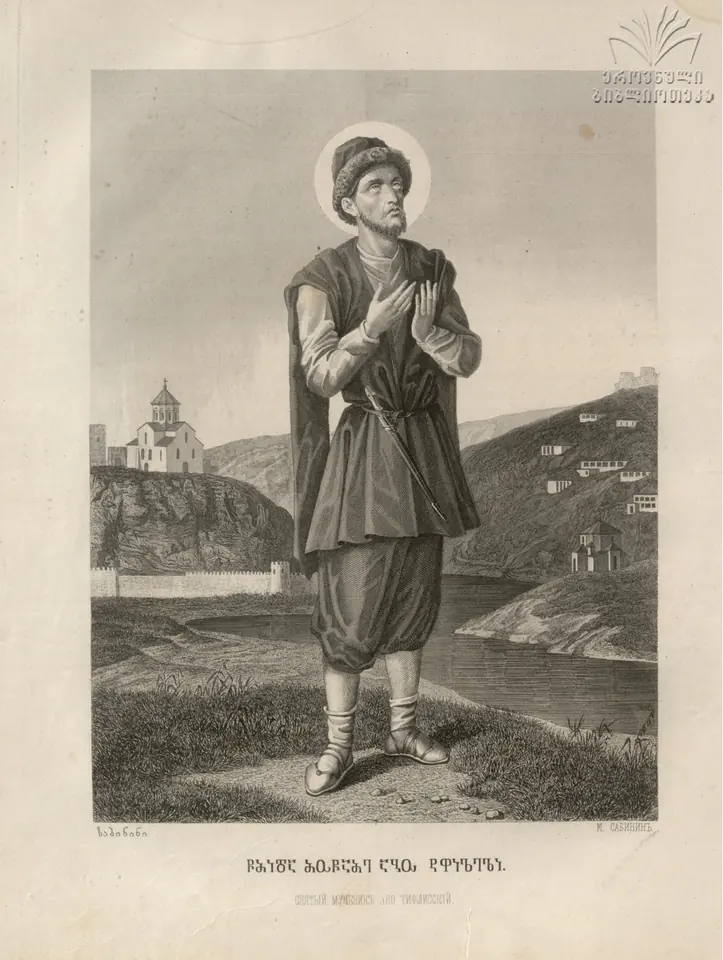
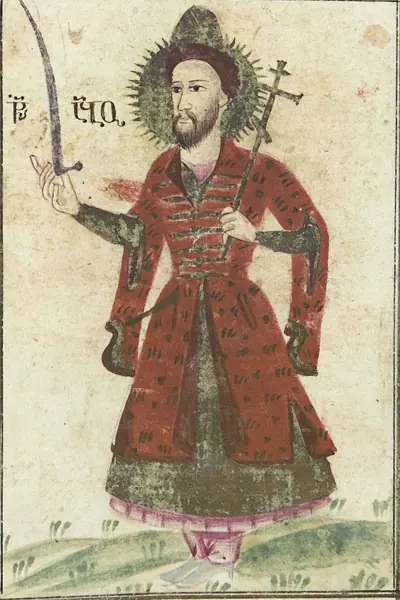
Georgian images show St. Abo as a young man, usually bearded, in long Caucasian dress, sometimes the red coat and tall hat of a Georgian nobleman, as in the 18th-century miniature on this page. He holds a martyr's cross, and a sword recalls his beheading. Sabinin's 19th-century engraving sets him beside the river with the Metekhi church on its cliff behind him, the place where he died. In Georgian icons his name is written in the old Georgian script.

Feast day and the chapel on the river
We keep his feast on January 8. Because the Georgian Church follows the Julian calendar, that is January 21 on the civil calendar. A small chapel in his honor stands on the bank of the Mtkvari below the Metekhi cliff, near the place where his ashes were cast into the river. There are no relics: the river took them all. See other feasts on our feast days page.

Praying with St. Abo
We know of no traditional English prayer to St. Abo. In the Orthodox Church he is honored with the hymns of a martyr. Let us ask him to pray for all who come to Christ at great cost, for the Christians of Georgia and the Middle East, and for all who are tempted to hide their faith.
Holy Martyr Abo, pray to God for us.
Frequently asked questions
Who was St. Abo of Tiflis?
A young Arab from Baghdad, skilled in making perfumes, who came to Georgia in 775 with Prince Nerses, learned Georgian, was baptized, and was put to death in Tbilisi in 786 for refusing to give up his Christian faith.
When is the feast of St. Abo of Tiflis?
January 8 in the Orthodox calendar (January 21 on the civil calendar in Georgia, which keeps the Julian calendar). He died on January 6, 786.
Who wrote the life of St. Abo?
John, son of Saban (Ioane Sabanisdze), a Georgian contemporary, at the request of Catholicos Samuel of Georgia. His Passion of St. Abo was written soon after Abo's death, in the 8th century.
Is St. Abo the patron saint of Tbilisi?
Yes. The Georgian national encyclopedia notes that he was considered a patron of Tbilisi, the city where he preached and died.
Keep exploring
Sources
- Orthodox Church in America: Martyr Abo the Perfumer of Tbilisi, Georgia. The feast on January 8, his words before his death, and the chapel on the Mtkvari
- David Marshall Lang, Lives and Legends of the Georgian Saints (1956), ch. 7: The Martyrdom of Abo, the Perfumer from Baghdad. Translation of John son of Saban's Passion; the date of January 6, 786, Abo's journey to the Khazars, his final anointing and the star over the river, quoted
- Georgian Encyclopedia: Abo Tbileli. His patronage of Tbilisi and the feast on January 8 (21)