St. Lawrence Giustiniani, First Patriarch of Venice

St. Lawrence Giustiniani (1381–1456) was a Venetian nobleman who gave up wealth to become a poor canon of San Giorgio in Alga, reformed his community, and became bishop of Castello in 1433 and then the first Patriarch of Venice in 1451. He was famous for his prayer, his humility and his gifts to the poor. He was canonized in 1690, and we keep his memory on January 8.
Who was St. Lawrence Giustiniani?
St. Lawrence Giustiniani was a Venetian nobleman who became a poor canon, then bishop of his city, and in 1451 the first Patriarch of Venice. English books often call him St. Lawrence Justinian. He lived in a rich, proud and powerful republic, and he kept a straw bed, earthenware dishes and an open door for every beggar in Venice. We keep his memory on January 8, the day he died in 1456.
Most of what we know about his inner life comes from a biography written by his nephew, Bernardo Giustiniani, who knew him well. Alban Butler drew on that life for his account in the eighteenth century, and the stories below come from there.
A young noble called by Wisdom
Lawrence was born in Venice in 1381 into the Giustiniani, one of the old patrician families of the republic. His father died young, and his mother, a Querini, raised the children alone and in deep piety. When she chided the boy for aiming at things above his age, he told her that his only wish was to become a saint.
At about nineteen he had the experience that decided his life. According to his nephew, he seemed to see the Eternal Wisdom of God in the form of a shining young woman who said to him: "Why seekest thou rest to thy mind out of thyself, sometimes in this object, and sometimes in that? What thou desirest is to be found only with me." He asked counsel of his uncle Marino Querini, a canon at San Giorgio in Alga, a small island monastery in the lagoon. When his family arranged a good marriage to hold him back, he slipped away to the island and took the habit.

A beggar at his mother's door
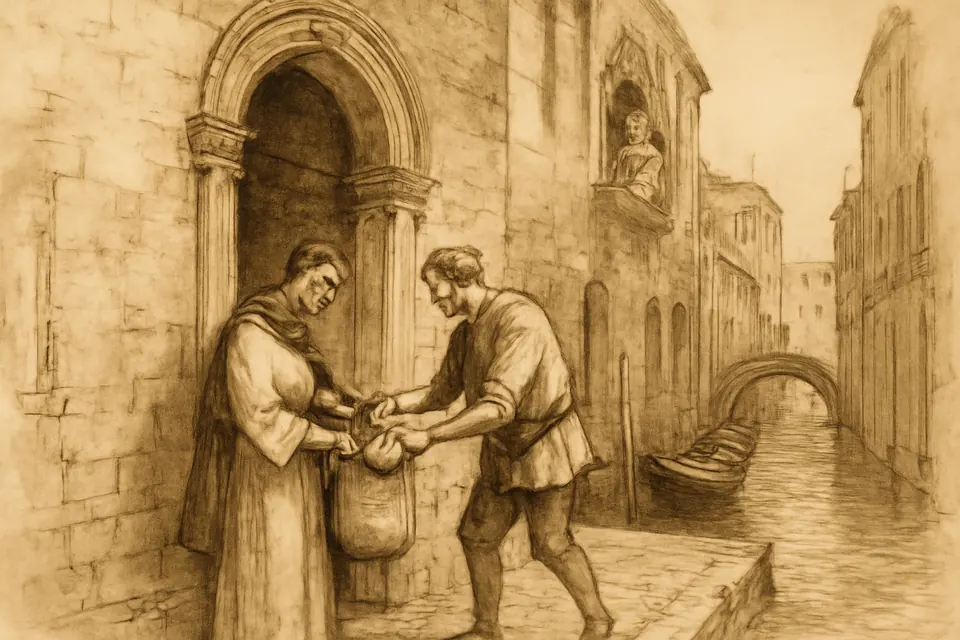
The young canon went out through Venice with a sack on his back, begging bread for the community, and he deliberately walked into crowds of nobles who might laugh at him. "Let us go boldly in quest of scorn," he told a companion. "We have done nothing if we have renounced the world only in words." He sometimes begged at the house where he was born. His mother would have filled the sack, but he took two loaves, wished the household peace and walked on as if he were a stranger.
He was ordained a priest in 1406 and soon chosen prior and then general of the canons. He wrote their rule with such care that later generations counted him as their founder. He accepted few novices and tested them hard, and he taught them that humility "is silent in prosperity" but full of courage in adversity.
Bishop and first Patriarch of Venice
In 1433 Pope Eugene IV named him bishop of Castello, the diocese that covered Venice. Lawrence and his whole congregation begged the pope to change his mind, without success. He took possession of his church so quietly that his friends heard of it only afterward, and he spent the night before in prayer at the foot of the altar.
As bishop he kept the life of a canon. His household was small, his bed was straw, and he said that all the poor of the diocese were the bishop's family. He gave alms in bread and clothing rather than money, and he quietly sent devout women to find families who were too ashamed to beg. The Catholic Encyclopedia notes that he restored churches, founded new parishes in Venice and reformed the life of the clergy. When a poor man arrived with a note of recommendation from the bishop's own brother Leonard, Lawrence sent him back: Leonard could help him himself.
In 1451 Pope Nicholas V united the see of Castello with the old patriarchate of Grado and moved the patriarch's seat to Venice. Lawrence became the first Patriarch of Venice. Butler tells that he went to the Senate and offered to resign rather than cause a quarrel over the new dignity, and that the doge was moved to tears and begged him to stay.
His death and the miracles of St. Lawrence Giustiniani
Lawrence finished his last book, The Degrees of Perfection, at seventy-four, and a fever took hold of him. When his servants made up a feather bed, he refused it: "My Lord was stretched on a hard and painful tree." He asked to be laid on straw and died on January 8, 1456.
The wonders told of him are of two kinds:
- Reported: his nephew, who wrote as an eyewitness, records several miracles and prophecies. One concerned a young noble disciple, Marcellus, who wept at his bedside. Lawrence told him they would meet again by Easter. Marcellus fell sick in Lent and was buried in Easter week.
- Reported: while the Venetians argued over where to bury him, his body lay unburied for sixty-seven days without any sign of corruption, according to Butler's account.
- Traditional: a hermit of Corfu was said to have declared that Venice had been preserved by the bishop's prayers. Venetians later asked his help in the plague of 1630, and a painting of his intercession hangs in San Pietro di Castello.
Clement VII ratified his beatification in 1524, and Alexander VIII canonized him in 1690.
Symbols of St. Lawrence Giustiniani in art
Venice is full of his image, and he is easy to recognize once you know the signs:
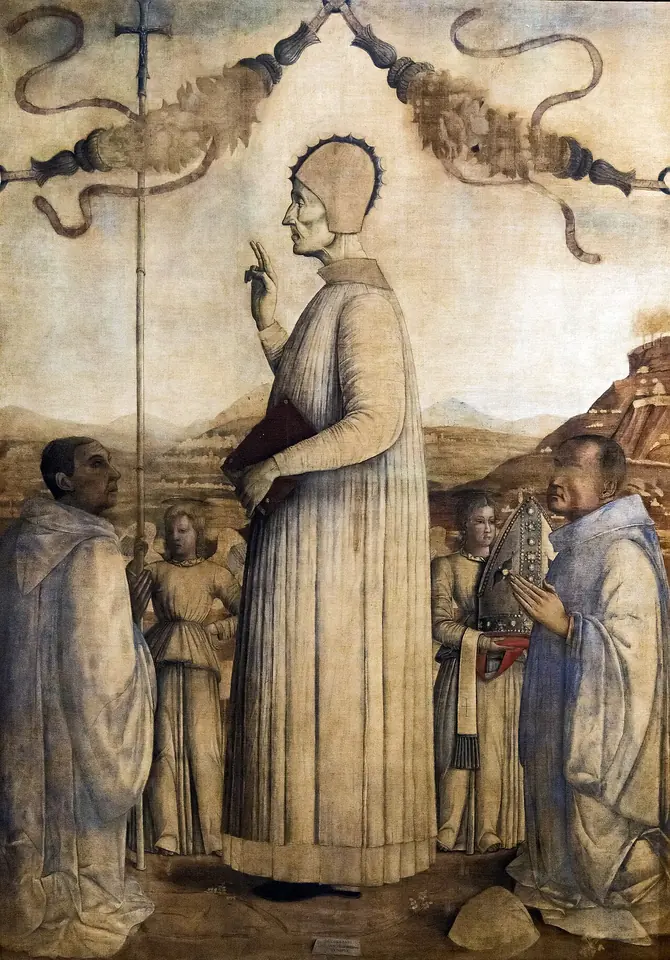
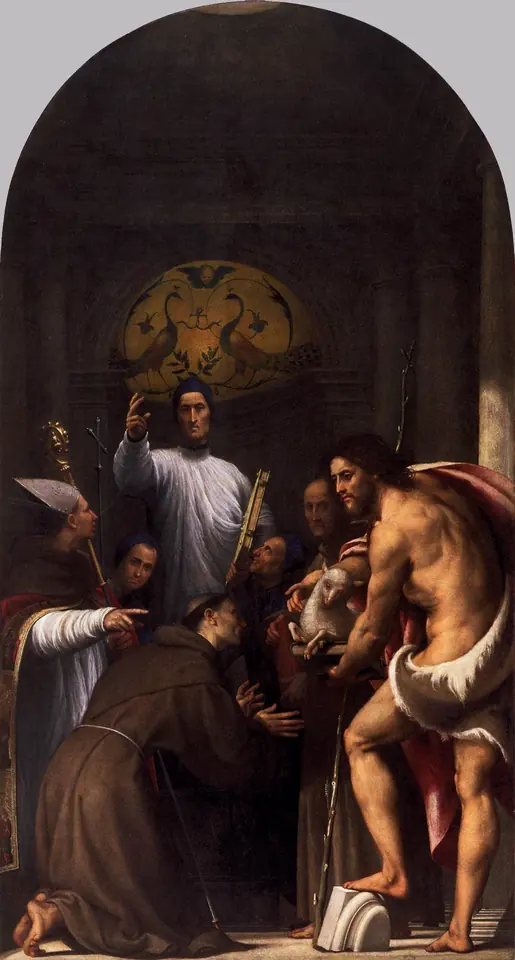
- The white rochet and blue cap of the canons of San Giorgio in Alga, which he wore even as patriarch. Bellini and Pordenone both paint him this way.
- A gaunt profile and raised hand of blessing. Bellini's early banner fixed his lean, ascetic face for later painters.
- A crozier, a book or a cross: his office as bishop, his spiritual writings, and his love of the Crucified.
Northern engravers, who had never seen him, sometimes drew him quite differently, as in the Galle print below.

Feast day and where he is honored
We keep his memory on January 8. For centuries the whole Church kept it on September 5, the day he was consecrated bishop, and Venice still holds him in honor as its first patriarch. His body rests in an urn in the high altar of the Basilica of San Pietro di Castello, the old cathedral of Venice, set there in Baldassare Longhena's altar of 1649. See the feast day calendar for the other saints of January.

We know of no traditional prayer to St. Lawrence Giustiniani that we can cite. Let us ask him to pray for bishops and priests, for all who are tempted by wealth or pride, and for the poor of our own cities: St. Lawrence Giustiniani, pray for us.
Frequently asked questions
Who was St. Lawrence Giustiniani?
A Venetian noble who joined the canons of San Giorgio in Alga at about nineteen, became their leader and lawgiver, was made bishop of Castello in 1433, and in 1451 became the first Patriarch of Venice when Pope Nicholas V moved the patriarchate of Grado to the city. He died on January 8, 1456.
When is the feast of St. Lawrence Giustiniani?
January 8, the day of his death, in the Roman Martyrology. Before 1969 his feast was kept on September 5, the anniversary of his consecration as bishop.
Where is St. Lawrence Giustiniani buried?
His body rests in an urn in the high altar of the Basilica of San Pietro di Castello in Venice, his old cathedral. He had asked to be buried simply at San Giorgio in Alga, but the Venetian Senate decided otherwise.
Is Lawrence Giustiniani the same as Lawrence Justinian?
Yes. Lawrence Justinian (or Laurence Justinian) is the older English form of his family name, Giustiniani, and it is the name used in Butler's Lives of the Saints and the Catholic Encyclopedia.
Keep exploring
Sources
- Catholic Encyclopedia (1910): St. Lawrence Justinian. His dates, the union of Castello with Grado in 1451, his beatification in 1524 and canonization in 1690
- Alban Butler, The Lives of the Fathers, Martyrs and Other Principal Saints, vol. 9 (1866), September 5. Drawn from the life by his nephew Bernardo Giustiniani; the vision of Wisdom, his begging at his mother's door, his sayings, his deathbed and the burial dispute
- The Roman Martyrology (1916), January 8 and September 5
- Chorus Venezia: Basilica of San Pietro di Castello. The urn with his remains in Longhena's high altar of 1649