St. Adrian of Canterbury
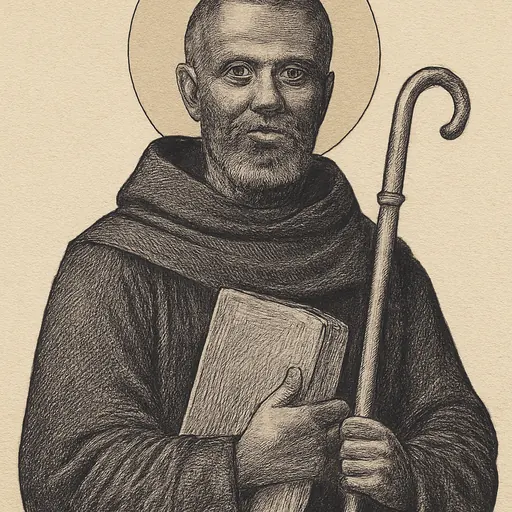
St. Adrian of Canterbury (also called Hadrian) was a learned abbot born in North Africa who twice refused to become Archbishop of Canterbury and went to England with his friend Theodore in 668. As an abbot in Canterbury for about forty years, he built a school that taught Greek and Latin to the English. His feast day is January 9.
Who was St. Adrian of Canterbury?
St. Adrian of Canterbury, whom Bede and most English writers call Hadrian, was an abbot born in North Africa who became one of the great teachers of Anglo-Saxon England. He came to Canterbury in the 670s as the companion of Archbishop Theodore, ruled the monastery of St. Peter and St. Paul there for nearly forty years, and made it a school whose students spoke Greek and Latin "as in their own" tongue. He died in 709 or 710 and was buried in his abbey.
Bede gives the only early account of him, in the Ecclesiastical History of the English People, finished in 731. Bede's main informant for Canterbury was Albinus, Adrian's own pupil and successor as abbot, so the history is close to its source. In the 11th century the Flemish monk Goscelin wrote a Life of Hadrian at Canterbury, which English Heritage notes survives in a 12th-century copy in the British Library. Everything below comes from Bede unless we say otherwise.
The life of St. Adrian
From Africa to Naples
Bede calls Adrian "by nation an African." English Heritage thinks he most likely came from Cyrenaica, the Greek-speaking coast of what is now Libya, which was then part of the Byzantine Empire. He was born between about 630 and 637, and his family may have fled to Italy when Arab armies took Cyrenaica around 644.
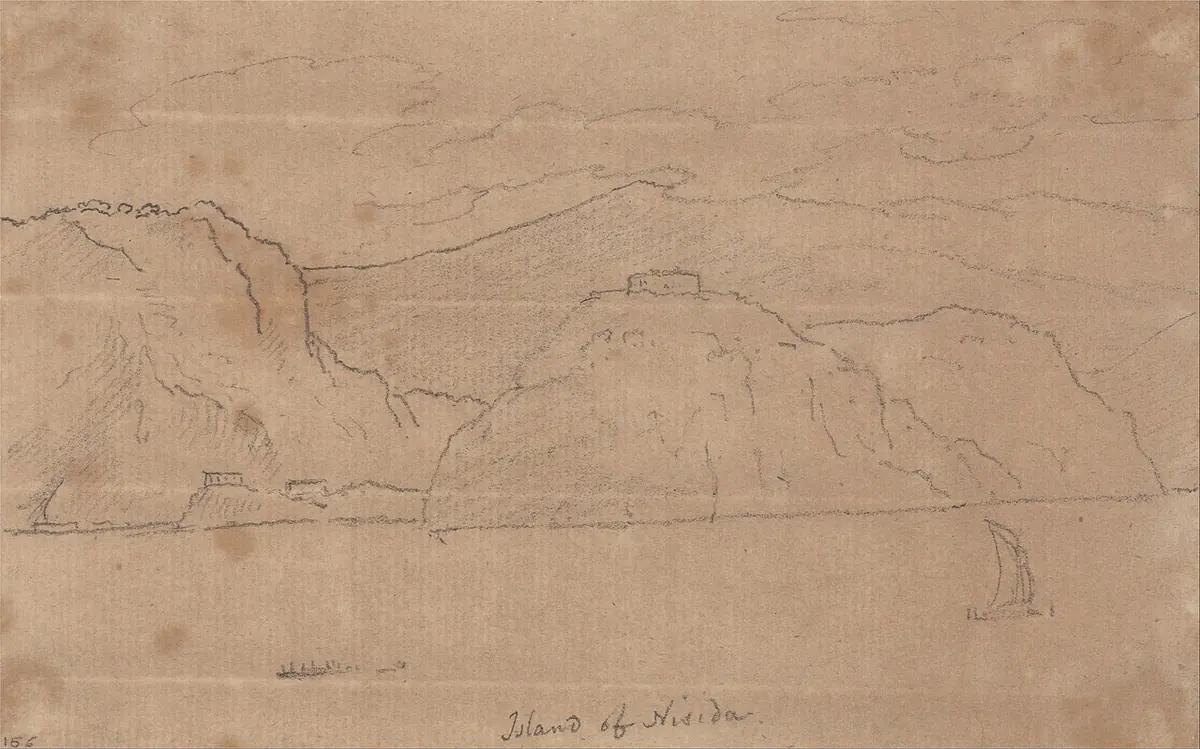
By the 660s he was abbot of a monastery Bede calls Niridanum, "not far from Naples in Campania." The name may be a slip for Nisida, a small island in the Bay of Naples. Bede describes him as "well versed in Holy Scripture, trained in monastic and ecclesiastical teaching, and excellently skilled both in the Greek and Latin tongues."
Twice he said no
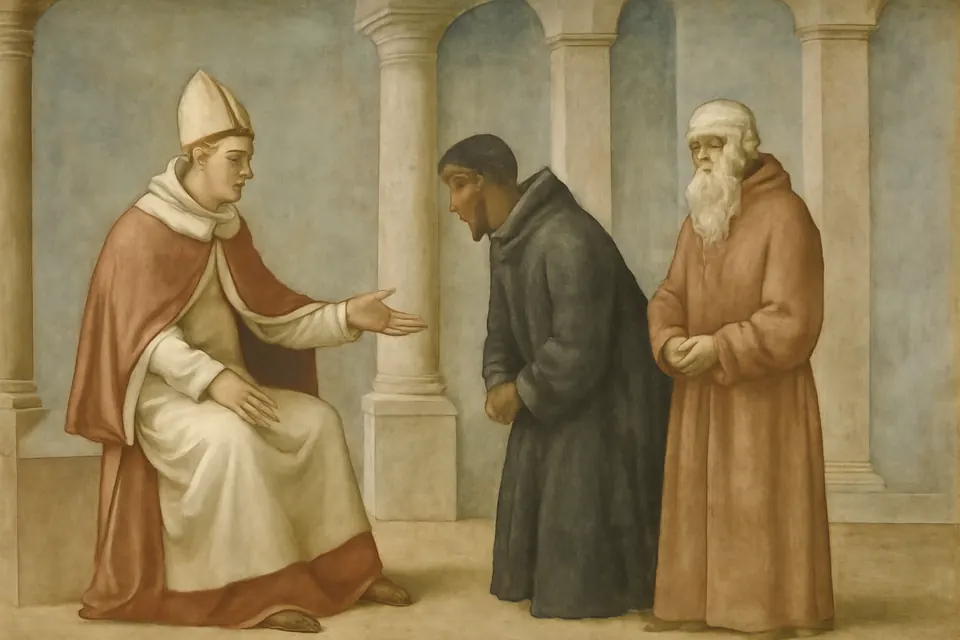
In 664 Archbishop Deusdedit of Canterbury died. The priest Wighard, sent to Rome to be consecrated in his place, died there of the plague with almost all his companions. Pope Vitalian looked for someone else and sent for Adrian. Adrian answered "that he was unworthy of so great a dignity" and proposed a monk named Andrew from a nearby convent, who was too ill to accept. Pressed a second time, he asked for time to find another candidate.

He found one: Theodore, a monk from Tarsus in Cilicia, the birthplace of St. Paul, then sixty-six years old and learned in Greek and Latin. Vitalian agreed, on one condition. Adrian had to take Theodore to Britain himself, because he had already crossed Gaul twice and knew the road, and because he was to stay at Theodore's side as a fellow teacher.
Held in Gaul
Theodore was consecrated on March 26, 668, and the two set out on May 27. They sailed to Marseille and went overland to Arles. Over the winter Theodore stayed with Bishop Agilbert in Paris, while Adrian stayed with the bishops of Sens and Meaux.
In the spring King Egbert of Kent sent for Theodore, who crossed to England. Adrian was stopped. Ebroin, the powerful mayor of the palace who ruled the Frankish kingdom of Neustria, suspected that this learned African from Byzantine Italy was an agent of the emperor sent to the English kings. Only when Ebroin was satisfied that there was no such mission did he let Adrian go.

Abbot in Canterbury
When Adrian reached Canterbury, Theodore gave him the monastery of St. Peter the Apostle, outside the city walls, where the archbishops were buried. St. Augustine of Canterbury had founded it some seventy years earlier, and later centuries called it St. Augustine's. English Heritage dates Adrian's abbacy from about 670.
Bede says that Theodore traveled through every part of England "everywhere attended and assisted by Hadrian," teaching "the right rule of life, and the canonical custom of celebrating Easter." Theodore was the first archbishop whom the whole English Church agreed to obey, and Adrian was his closest partner. English Heritage adds that Adrian obtained papal privileges for his monastery, helped spread church music beyond Kent, and brought the feasts of several saints of central Italy into the English calendar.
The school of Canterbury
This is what Adrian is remembered for. Bede says the two men "gathered a crowd of disciples, and rivers of wholesome knowledge daily flowed from them to water the hearts of their hearers." Along with Scripture they taught "the metrical art, astronomy, and ecclesiastical arithmetic," which meant Latin poetry, the movements of the heavens and the calculation of the date of Easter. Bede, writing about sixty years later, said that some of their students were still alive and knew Greek and Latin "as well... as in their own, in which they were born." He added that there had never been happier times since the English came to Britain.

Their pupils carried this learning across England. Albinus, Adrian's successor as abbot, knew Greek well and supplied Bede with the Canterbury material for his history. Tobias, bishop of Rochester, knew Greek and Latin as his native language, Bede says. St. Aldhelm, later bishop of Sherborne and the first great Latin poet of England, studied under Adrian. English Heritage quotes Aldhelm calling him a "respected father and a reverend teacher."
None of Adrian's own writings survive complete. But notes from the Canterbury classroom, glosses on hard words and comments on the Bible, were copied into later manuscripts such as the Leiden Glossary. English Heritage notes that these fragments show Adrian as a gifted theologian who knew the ancient Greek authors. English Heritage notes that Adrian may have brought to England a 4th-century copy of the letters of St. Cyprian, the African bishop of Carthage, and the riddles of the African poet Symphosius, which inspired Aldhelm's own book of riddles.

The splendid Gospel books made in southern England in the next generation, like the Codex Aureus, perhaps made at Canterbury about 750, came from the learned church that Theodore and Adrian had trained.

Death and veneration
Theodore died in 690. Adrian lived on for almost twenty more years. Bede writes that "the most reverend father, Abbot Hadrian, fellow labourer in the Word of God with Bishop Theodore of blessed memory, died, and was buried in the church of the Blessed Mother of God, in his own monastery." By Bede's reckoning that was the forty-first year after he left Rome, so 709 or 710.
English Heritage says his relics were rediscovered in 1091 and that "numerous miracles were attributed to Hadrian." We class these as reported: they were claimed at his tomb in the Middle Ages but never formally examined. No miracle is told of Adrian during his life, and Bede says nothing of wonders. His holiness, as Bede tells it, lay in humility, in learning, and in forty years of faithful work.
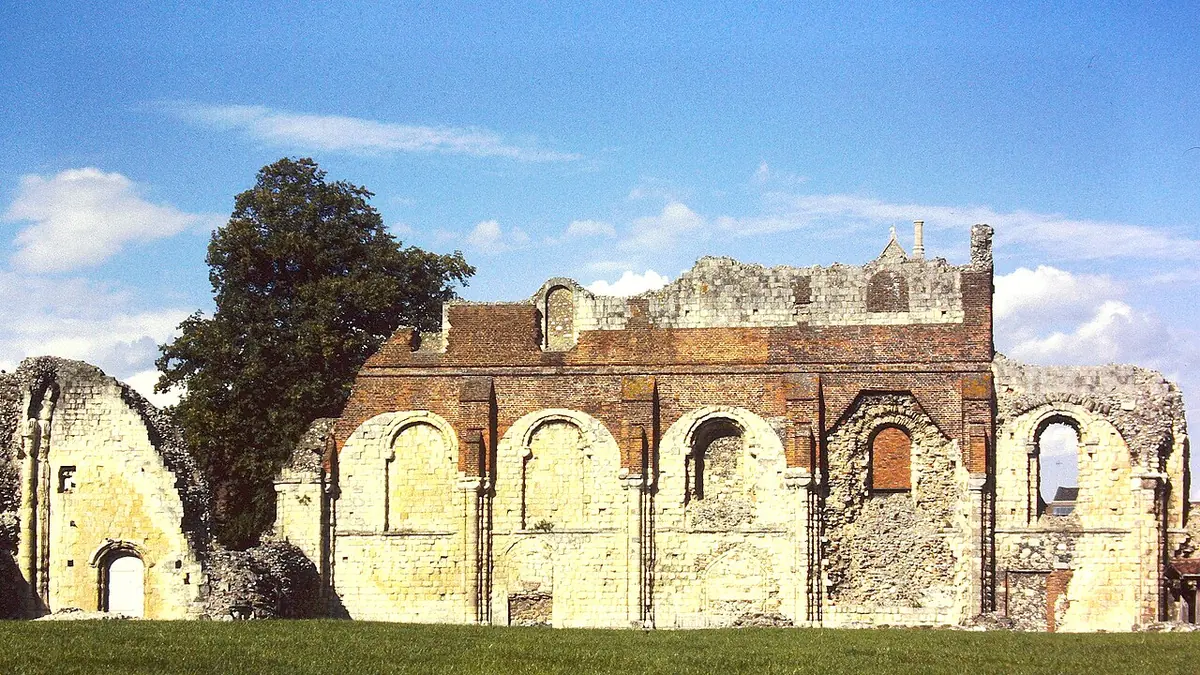
The abbey was dissolved by Henry VIII in 1538 and his shrine was lost. Today the ruins of St. Augustine's Abbey, part of the Canterbury World Heritage Site, are in the care of English Heritage.
Is St. Adrian a patron saint?
No formal patronage of St. Adrian is recorded. He belongs among the scholar saints, and teachers, students and anyone who loves learning in the service of the faith can rightly ask his prayers. He is also one of the African saints who helped build the Church in Europe, alongside St. Augustine of Hippo and St. Moses the Black in the East. Browse our patron saints page for saints with formal patronages.
Symbols of St. Adrian in art
Adrian has no ancient iconography of his own, and we know of no medieval image of him that survives, which is why this page shows his world more than his face. When he is portrayed, he appears as any learned abbot would:
- In a black Benedictine habit: the dress of the abbey of St. Augustine's, which followed the Rule of St. Benedict in later centuries.
- With a crozier: the staff of an abbot.
- With a book or manuscript: for the scholar and teacher.
- With students around him: recalling the Canterbury school.
- As an African: a faithful portrait follows Bede's word that he was "by nation an African," as our own illustrations do.
If an image pairs an abbot with an elderly archbishop wearing the pallium, the archbishop is likely Theodore of Tarsus, Adrian's companion and friend.
Feast day and where St. Adrian is honored
St. Adrian's feast is January 9, in the Roman Martyrology and in Catholic and Anglican calendars in England. The Catholic Encyclopedia gives it as the day of his death. You can find him on our feast days page.
Pilgrims to Canterbury can walk the ruins of his abbey just outside the city walls, a few minutes from the cathedral. The graves of the first archbishops of Canterbury lie there, and so did Adrian's.

Prayer to St. Adrian of Canterbury
No traditional prayer to St. Adrian has come down to us in the standard prayer books, and we won't invent one in his name. We can still turn to him in our own words, as Christians at his tomb did for centuries: asking him to pray for teachers and students, for refugees and exiles like the young Adrian, and for the humility to say, as he did, "I am unworthy," and then to serve wherever we are sent.
Let us ask St. Adrian of Canterbury to pray for all who teach the faith, that like him they may pour "rivers of wholesome knowledge" into the hearts of their hearers.
Frequently asked questions
Who was St. Adrian of Canterbury?
Adrian, or Hadrian, was a monk born in North Africa, abbot of a monastery near Naples, whom Pope Vitalian chose for Archbishop of Canterbury in 667. He refused, proposed Theodore of Tarsus instead, and agreed to go with him to England. There he ruled the abbey of St. Peter and St. Paul in Canterbury from about 670 until his death in 709 or 710 and taught a generation of English churchmen.
Was St. Adrian of Canterbury African?
Yes. Bede calls him "by nation an African." English Heritage thinks he most likely came from Cyrenaica, in present-day Libya, then a Byzantine province, and may have fled to Italy as a refugee when Arab armies invaded around 644. He is often counted among the African saints of the early Church.
When is the feast day of St. Adrian of Canterbury?
January 9. It is kept in the Roman Martyrology and in English Catholic and Anglican calendars.
What did St. Adrian teach at Canterbury?
With Archbishop Theodore he taught Scripture, the art of Latin verse, astronomy and the arithmetic used to calculate the date of Easter. Bede wrote that some of their students still alive in his day knew Greek and Latin as well as their native English. St. Aldhelm was one of Adrian's pupils.