Blessed Lindalva Justo de Oliveira, Daughter of Charity and Martyr

Blessed Lindalva Justo de Oliveira (1953–1993) was a Brazilian Daughter of Charity who cared for elderly men in a nursing home in Salvador. A resident who wanted her and was refused stabbed her to death on Good Friday, April 9, 1993. Beatified as a martyr in 2007, she is remembered on January 7, the day of her baptism.
Who was Blessed Lindalva Justo de Oliveira?
Blessed Lindalva Justo de Oliveira was a Brazilian Daughter of Charity of St. Vincent de Paul who gave her short religious life to the forgotten old men of a public nursing home in Salvador, Bahia. On Good Friday 1993, a resident who had pursued her and been refused attacked her with a knife as she served breakfast. She died at thirty-nine. The Church honors her as a martyr, and in 2007 she became the first Brazilian Daughter of Charity to be beatified. We keep her memorial on January 7.
She once explained the secret of her constant cheerfulness: "The heart is mine and can suffer, but the face belongs to others, and it must be smiling" (our translation from the Italian).
The life of Sister Lindalva
A large, poor and faithful family
Lindalva was born on October 20, 1953, at Sítio Malhada da Areia, in a very poor area of the state of Rio Grande do Norte in northeastern Brazil. Her father, João Justo da Fé, was a farmer and a widower who married Maria Lúcia de Oliveira; Lindalva was the sixth of their thirteen children. She was baptized on January 7, 1954. Her father later moved the family to the town of Açu so the children could go to school.
Even as a child she was drawn to poorer children. She made her First Communion at twelve.
Work, nursing and a vocation
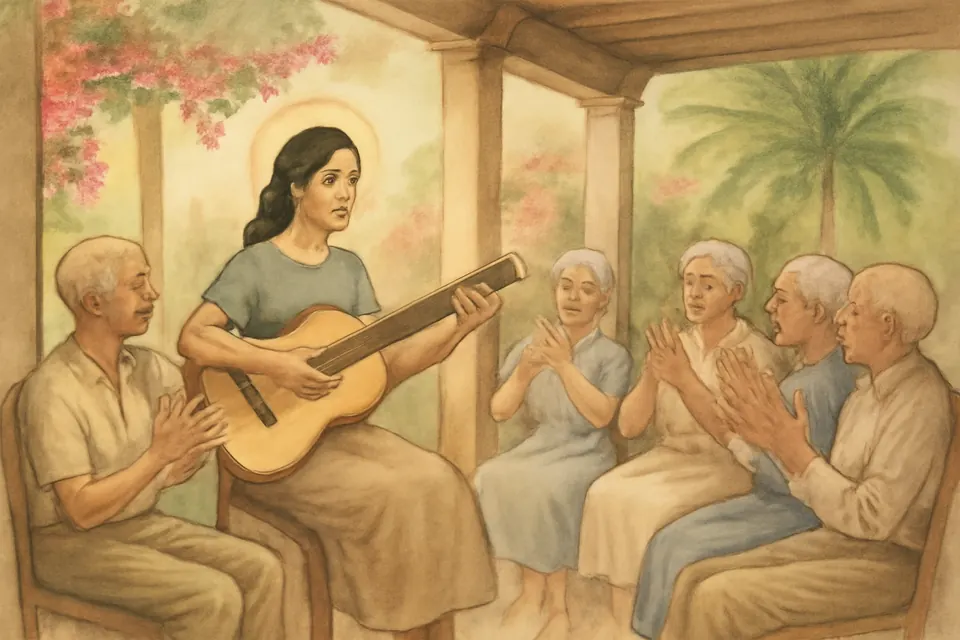
Living with her brother Djalma's family in Natal, she earned a diploma as an administrative assistant in 1979. From 1978 to 1988 she worked in stores and as a cashier at a gas station, sent part of her pay home to her mother, and went every day after work to visit the residents of a local home for the elderly. She also loved what young people love: friends, guitar lessons, music and study.
In 1982 she nursed her father through the last months of a terminal illness, and the experience made her decide to give her life to the poor. She took a nursing course. In 1986 she began attending the vocation meetings of the Daughters of Charity, was confirmed in 1987, and on February 11, 1988, the feast of Our Lady of Lourdes, she entered the postulancy.
She could be sweet and truthful at once. To her brother Antônio, who drank, she wrote: "Follow Jesus, who fought until death for the life of sinners and gave his own life... We must seek refuge in him; only in him is life worth living." A year later he stopped drinking.
Among the old men of Salvador
On January 29, 1991, Sister Lindalva was given charge of forty elderly men at the Dom Pedro II municipal home in Salvador da Bahia. She took the humblest tasks for herself, looked for the residents who suffered most, encouraged them to receive the sacraments, sang and prayed with them, and even got her driver's license so she could take them out for drives.

The martyrdom of Sister Lindalva
In January 1993 a 46-year-old man named Augusto da Silva Peixoto got himself admitted to the home through a recommendation, though he had no right to a place there. Sister Lindalva treated him with the same courtesy as everyone else, but he became infatuated with her and openly told her what he wanted. She kept her distance and was careful around him. The simplest solution would have been for her to leave the home, but she would not abandon the old men: "I prefer to shed my blood than to leave this place." In late March she asked a health official to intervene; the man promised to behave, but he was planning revenge.
On Good Friday, April 9, 1993, she walked the parish Way of the Cross at 4:30 in the morning and was back at work by seven to serve breakfast. As she poured coffee, he attacked her with a knife. She fell crying, "God protect me!" and he went on stabbing her many times. Then he sat down calmly and told the doctor to call the police; he said she "did not want" him.

The next day, Holy Saturday, Cardinal Lucas Moreira Neves, archbishop of Salvador and primate of Brazil, celebrated her funeral and said, "A few years were enough for Sister Lindalva to crown her religious life with martyrdom."
- Approved: her martyrdom. The Church recognized that she died defending her chastity and her consecration to God. As a martyr she was beatified without a miracle; a miracle is still needed for canonization.
She was beatified in Salvador on December 2, 2007, at a Mass presided over by Cardinal José Saraiva Martins for Pope Benedict XVI. Her mother was there.
Symbols of Blessed Lindalva in art
Sister Lindalva lived in our own time, and no old artwork of her exists. Devotional images usually show:
- The blue-gray habit and short veil of the Daughters of Charity today;
- A broad smile, for her saying that her face belonged to others;
- The martyr's palm, for her death on Good Friday;
- Sometimes a coffee pot or tray, for the breakfast she was serving, or a guitar, for the music she shared with the elderly.
Feast day and prayer
We keep the memorial of Blessed Lindalva Justo de Oliveira on January 7, the anniversary of her baptism, because the day of her death usually falls in Lent or Easter week. See more on our feast day calendar.
We know of no traditional prayer to her that we can quote. Let us ask her to pray for the elderly who live alone or in institutions, for those who care for them, for women who suffer harassment and violence, and for religious sisters everywhere. Blessed Lindalva, you kept smiling for others even when your heart was heavy; pray for us. Blessed Lindalva Justo de Oliveira, pray for us.
Frequently asked questions
Who was Blessed Lindalva Justo de Oliveira?
The sixth of thirteen children of a poor farming family in Rio Grande do Norte, Brazil. She worked as a store clerk and gas station cashier, studied nursing, and in 1988 entered the Daughters of Charity. From 1991 she cared for forty elderly men at the Dom Pedro II home in Salvador, Bahia, where she was killed on Good Friday 1993.
Why is Sister Lindalva considered a martyr?
The Church judged that she was killed for defending her chastity and her consecration to God. A resident of the home became obsessed with her; she kept her distance and refused him, and rather than abandon the old men in her care she stayed, saying, "I prefer to shed my blood than to leave this place." He killed her on April 9, 1993.
Why is her feast on January 7 and not April 9?
April 9, the day she died, usually falls in Lent or Easter week, so her memorial was set on January 7, the anniversary of her baptism in 1954.
When was Sister Lindalva beatified?
On December 2, 2007, in Salvador, Bahia, at a Mass presided over by Cardinal José Saraiva Martins in the name of Pope Benedict XVI.
Keep exploring
Sources
- Dicastery for the Causes of Saints: Lindalva Justo de Oliveira. Her family, work, vocation, the letter to her brother, her work in Salvador, the events of Good Friday 1993, Cardinal Neves's words, the beatification homily and her saying about her smiling face
- Vatican: Biography of Lindalva Justo de Oliveira for her beatification (December 2, 2007)
- FAMVIN: Blessed Lindalva, DC, Martyr (1953–1993). Why her memorial is kept on January 7