St. Charles of Sezze: The Franciscan Lay Brother Wounded by Love at Mass
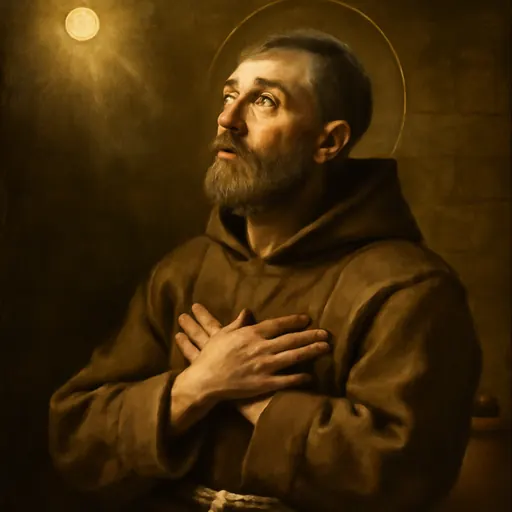
St. Charles of Sezze (1613–1670) was an Italian Franciscan lay brother who worked as a cook, porter, gardener and alms-collector in the friaries around Rome. In 1648 a ray of light from the Host at Mass left a wound in his breast. His feast day is January 6 (Franciscans keep it on January 18), and he was canonized in 1959.
Who was St. Charles of Sezze?
St. Charles of Sezze was a Franciscan lay brother of the seventeenth century who spent his life cooking, gardening, answering the door and begging bread for the friaries around Rome. He had almost no schooling, yet popes and cardinals sought his advice, and he wrote spiritual books at the command of his confessors. In 1648 a ray of light from the Host at Mass pierced his heart, and the mark it left was found on his body after death.
He was born in 1613 in Sezze, a hill town south of Rome, and died in Rome in 1670. We keep his feast on January 6; Franciscans celebrate him on January 18.
The life of St. Charles of Sezze
A shepherd's son from Sezze
He was born on October 19, 1613, to Ruggero Marchionne and Antonia Maccione, poor farmers, and baptized Giancarlo three days later. Poor health cut short his schooling, and he grew up a shepherd and farmhand. At seventeen he vowed perpetual chastity in honor of the Virgin Mary.
"A determination to become a lay brother"
His parents hoped he would be a priest. Charles chose the humbler road. "Our Lord put in my heart a determination to become a lay brother," he wrote later. He had read the lives of two Spanish Franciscan lay brothers, St. Salvator of Horta and St. Paschal Baylon, and wanted to live as they had. On May 18, 1635, he received the habit at the friary of San Francesco in Nazzano, and he made his vows the next year.
Cook, porter, gardener and beggar
For the rest of his life he moved among the friaries of the Roman province: Morlupo, Ponticelli, Palestrina, Carpineto Romano, Piglio, Castel Gandolfo, San Pietro in Montorio and finally San Francesco a Ripa in Trastevere. He served as cook, gardener, porter, sacristan and questor, the brother who went out each day with a sack to beg for the community. Franciscan Media keeps one homely story: as cook he once set a kitchen on fire while frying onions.

The wound of love, October 1648

In October 1648 he was at Mass in the church of San Giuseppe a Capo le Case, near the Spanish Steps. At the elevation, a ray of light went out from the Host and struck his breast, leaving a wound. Charles lived another twenty-one years with that hidden mark of love for the Eucharist.

Counselor to popes
The lay brother at the door became a counselor to the great. Clergy, religious and popes came to him, and Santi e Beati records that he was credited with knowing beforehand who would be elected pope. In December 1669, as Pope Clement IX lay dying, he asked for Brother Charles's blessing. Charles himself fell ill at the end of that month and died at San Francesco a Ripa on January 6, 1670.
Miracles of St. Charles of Sezze
- The mark on his breast (approved). After his death, the mark left by the wound of 1648 was found on his chest. A medical commission judged it to have no natural cause, and it was accepted as one of the two miracles for his beatification.
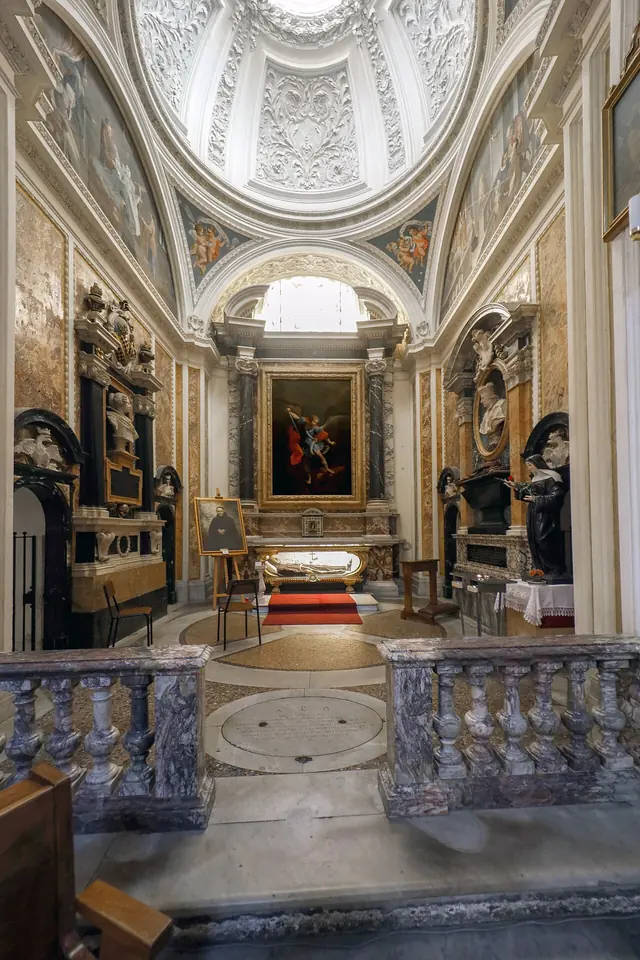
- Healings for beatification and canonization (approved). Two miracles were approved before Pope Leo XIII beatified him (the brief is dated October 1, 1881; the ceremony was January 22, 1882), and others before Pope John XXIII canonized him on April 12, 1959. Marcello Sozzi painted the beatification miracles in the lunettes of his chapel in 1882.
- Knowledge of hearts (reported). Witnesses credited him with good counsel and knowledge beyond his schooling, including foreknowledge of papal elections.
Why St. Charles of Sezze is honored as a patron
He is the patron of his birthplace, Sezze, and of the Diocese of Latina-Terracina-Sezze-Priverno. Lay brothers, cooks and porters see in him one of their own: a man who found God among pots, keys and alms sacks. Browse more patron saints.
Symbols of St. Charles of Sezze in art
- The brown Franciscan habit and cord, often patched: his life as a lay brother.
- A ray of light from the Host to his heart: the wound of love of 1648, the scene most often painted.
- A monstrance or chalice: his devotion to the Eucharist.
- An alms sack: his years as questor.
To recognize him in a church, look for a Franciscan without a priest's stole, kneeling at Mass with a beam of light running from the Host to his breast.

Feast day and where St. Charles of Sezze is honored
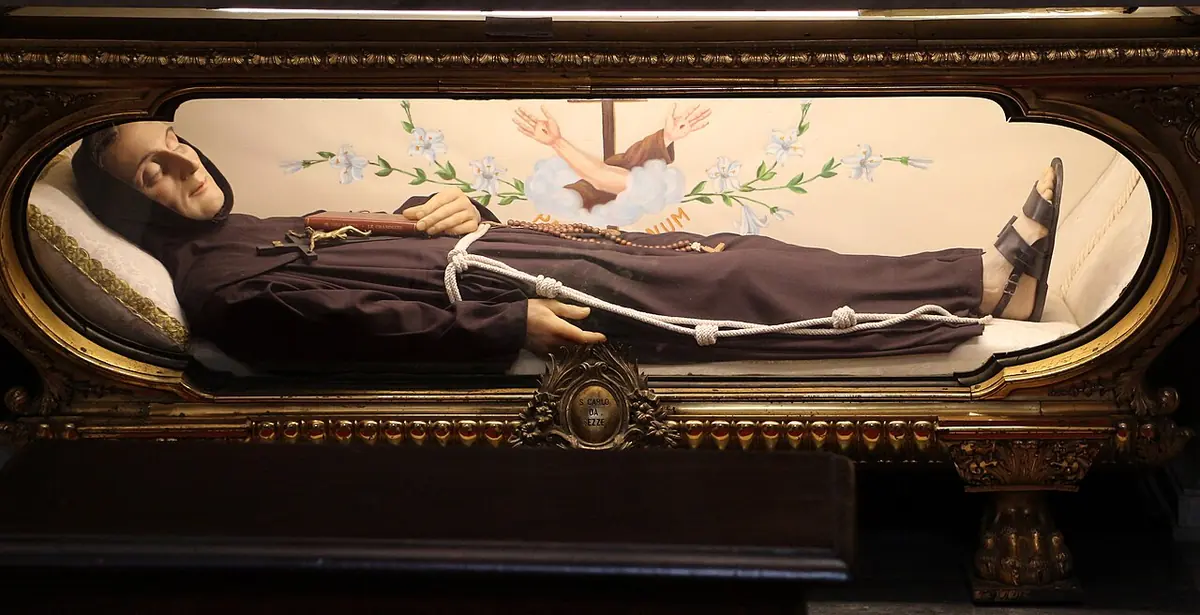
His feast is January 6 in the Roman Martyrology and January 18 among Franciscans; see the feast day calendar. His body lies in a bronze urn beneath the altar of his chapel in San Francesco a Ripa, the Trastevere church where St. Francis himself is said to have stayed. Pope Clement XIV declared his heroic virtues on June 14, 1772.
His writings
Though he barely learned to read as a boy, Charles wrote a great deal on the spiritual life, always under obedience. His best-known book is his autobiography, written at the order of his confessor and known in English as The Grandeurs of the Mercies of God.
Prayer to St. Charles of Sezze
We have found no traditional prayer from Charles himself in the standard prayer books. Since his whole life turned on the Eucharist, a good way to ask his help is in adoration before the Blessed Sacrament: "St. Charles of Sezze, pray for us."
Let us ask him to wound our hearts too with love for Jesus in the Host, and to make us content with humble work.
Frequently asked questions
When is the feast day of St. Charles of Sezze?
January 6, the day he died in 1670, in the Roman Martyrology. Because that is the solemnity of the Epiphany, Franciscans keep his memorial on another day; Franciscan Media gives January 18.
What happened to St. Charles of Sezze at Mass?
In October 1648, while he knelt at Mass in the church of San Giuseppe a Capo le Case in Rome, a ray of light from the Host at the elevation struck his breast and left a wound. After his death a medical commission examined the mark on his chest and judged it supernatural; it was counted among the miracles for his beatification.
Where is St. Charles of Sezze buried?
In a bronze urn beneath the altar of his chapel in the church of San Francesco a Ripa in Trastevere, Rome, the friary where he died.
Did St. Charles of Sezze write books?
Yes. Though he had little schooling, he wrote several spiritual works, including an autobiography written at his confessor's command, known in English as The Grandeurs of the Mercies of God.
Keep exploring
Sources
- Santi e Beati: San Carlo da Sezze, Religioso dei Frati Minori. friaries, the 1648 wound of love, the medical commission, causes and dates, patron of Sezze
- San Francesco a Ripa: Cappella di San Carlo da Sezze. the bronze urn under the altar, Sozzi's 1882 lunettes of the beatification miracles
- Franciscan Media: Saint Charles of Sezze. his words about becoming a lay brother, the kitchen fire, the January 18 memorial