St. Dominic of Sora, Abbot, Founder and Protector Against Snakebite

St. Dominic of Sora (951–1031) was a Benedictine monk and abbot from Foligno who founded hermitages and monasteries across Umbria, Lazio and Abruzzo and died at the abbey he built at Sora. His feast is January 22. He is the patron of Sora and is invoked against snakebite, fever and toothache; the village of Cocullo honors him each May 1 by carrying his statue covered with live snakes.
Who was St. Dominic of Sora?
St. Dominic of Sora was a Benedictine monk, priest and abbot who lived at the turn of the first millennium, from 951 to 1031. Born at Foligno in Umbria, he wanted nothing more than to live alone with God as a hermit, but wherever he went, people followed him, and so he kept founding monasteries. He spent his last twenty years at the abbey he built at Sora, south of Rome, and died there on January 22, 1031. We keep his feast on January 22.
In Italy he is often called simply San Domenico Abate, "St. Dominic the Abbot." He is not the founder of the Dominicans, who came two centuries later. Today he is best known for an unusual festival: every May 1 the mountain village of Cocullo carries his statue through the streets covered with live snakes.
The life of St. Dominic of Sora
A hermit who could not stay hidden
His life was written by the monk John, who traveled with him everywhere, so it rests on a companion's memory. Dominic was born in 951 at Foligno, in the district of Colfornaro; the abbey names his parents as Giovanni and Ampa. As a boy he was given to the monks of San Silvestro in Foligno for his schooling. As a young man he entered the monastery of Santa Maria di Pietrademone, made his profession and was ordained a priest.
But he longed for the hermit's life, and he moved back and forth between solitude and community. He retired to a mountain near Scandriglia, in the province of Rieti; disciples came, and he built them the monastery of San Salvatore and became their abbot. His reputation for holiness drew crowds, so he moved on into Abruzzo, where he founded San Pietro del Lago and, in the Sangro valley, San Pietro di Avellana. At Trisulti he lived unknown for three years until hunters recognized him, and the sick began to come. There he founded the monastery of San Bartolomeo. He met Pope John XVIII and asked papal protection for his houses.
The abbey of Sora counts his work in twenty-five years, from 986 to 1011: five hermitages with churches and two without, eight monasteries of monks and one of nuns.
The abbey at Sora
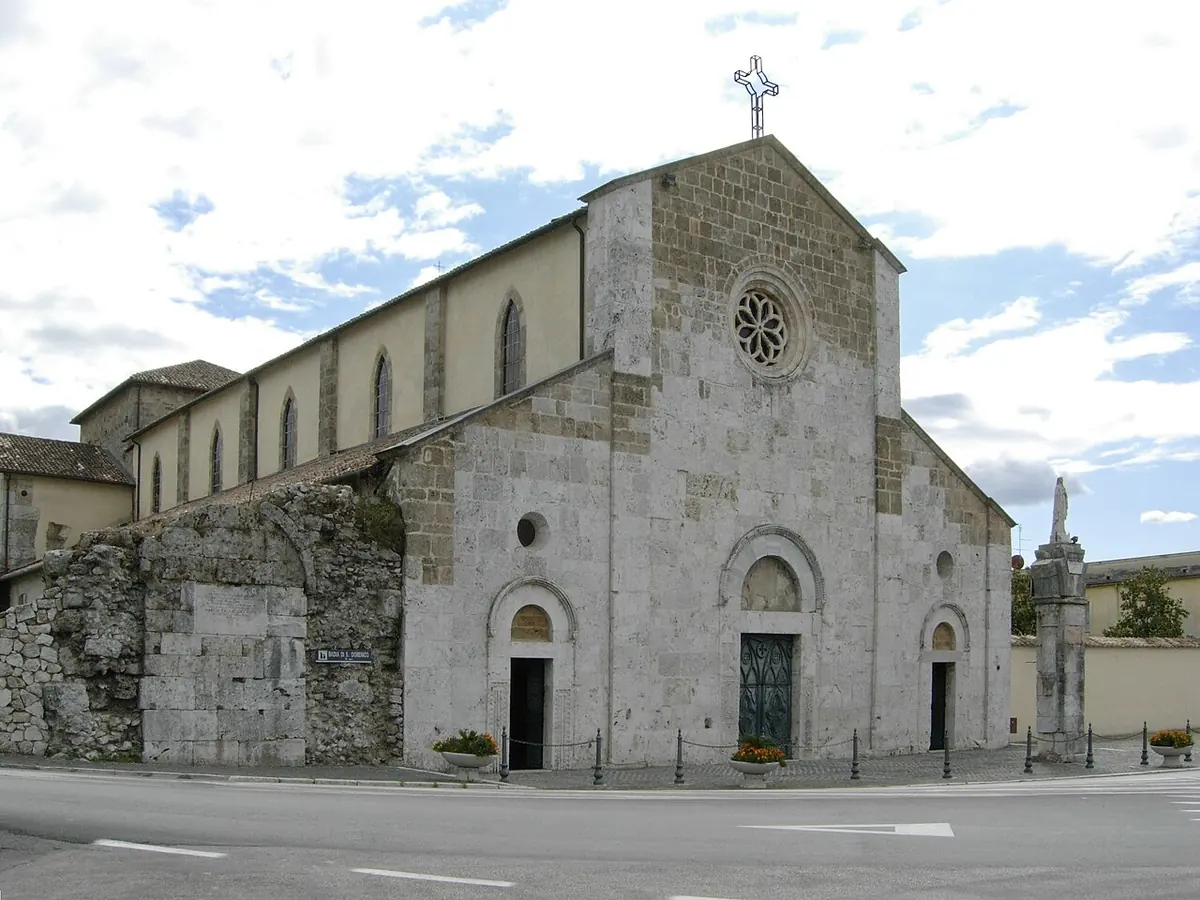
The last foundation came from a conversion. Pietro Rainerio, count and governor of Sora and Arpino, and his wife Doda gave Dominic land as a public act of penance. There, where the Fibreno River flows into the Liri, on the ruins of a villa that once belonged to Cicero, Dominic founded the abbey of the Blessed Mother of God in 1011.

He fell ill while setting out on yet another journey, to Tusculum, turned back, and died at Sora on January 22, 1031. He was buried in the abbey church, where his body is still kept in the crypt. In 1104 Pope Paschal II reconsecrated the church and added the title of St. Dominic to its dedication; the abbey keeps that year as the year of his canonization, and in 2004 it celebrated nine hundred years.
The miracles of St. Dominic of Sora
When the people of Trisulti discovered the hidden hermit, the sick came to him in crowds. Medieval chronicles and popular tradition, as Santi e Beati summarizes them, remember his healings above all as cures of snakebite. These are traditional miracles: they come to us through chronicles and the memory of his towns, and none has been formally examined. One story from his time at Trisulti, shown today on the bronze doors of his abbey, tells that he stopped a boulder rolling down the mountain while he was preaching to his monks and nuns. That is a traditional miracle.
Why St. Dominic of Sora is the patron saint against snakebite
Because of those healings, people throughout the Liri valley invoke him against the bites of poisonous snakes and rabid dogs, against storms and hail, and against fever and toothache. He is the patron saint of Sora, where his feast is kept with great solemnity, and he is honored in Arpino and many nearby towns.
The serpari of Cocullo
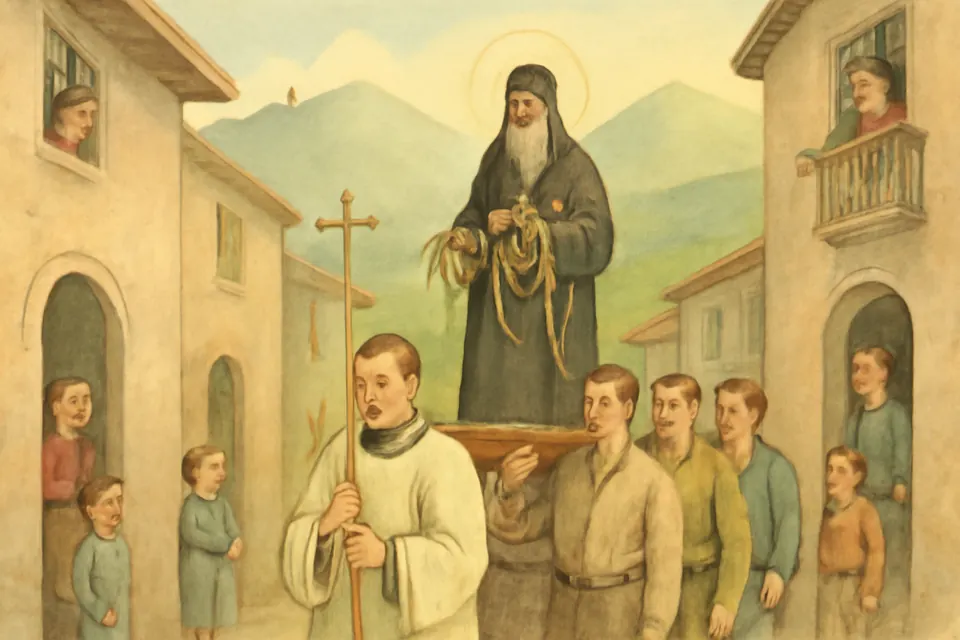
The most famous sign of this devotion is in Cocullo, a small village in the mountains of Abruzzo. In the days before the feast, the serpari, the snake catchers, gather snakes in the hills, taking care to catch only harmless species and to leave the vipers alone. On the day of the festival the statue of St. Dominic is carried in procession draped with the live snakes. The town council of Cocullo announces it each year as the Festa di San Domenico Abate e Rito dei Serpari on May 1. In the past the snakes were killed or sold afterward; now they are released back into the wild.
Santi e Beati notes that the people's reverence for the snakes is probably older than Christianity in these mountains, and that the Church received it into the feast of the great wonder-worker. The procession is not snake worship. It is a village asking its saint for protection against a real danger of mountain life.
Symbols of St. Dominic of Sora in art
- Black Benedictine habit and abbot's crosier: his monastic life and his office as founder and abbot.
- Snakes: his protection against snakebite, often coiled at his feet or in his hand.
- Book: the Rule of St. Benedict that he spread through his foundations.
In the churches of Lazio and Abruzzo he is an old, bearded monk in black with a crosier, often with snakes. Be careful with the name: paintings labeled "San Domenico" usually show St. Dominic Guzmán, in the black-and-white Dominican habit with a lily, a star or a dog with a torch. The abbot of Sora wears Benedictine black. At Sora itself, the bronze doors of 2009 show him stopping the falling boulder at Trisulti, hearing the confession of Count Pietro Rainerio, and walking as a wandering hermit with his disciple John.
Feast day and where he is honored
We keep his feast on January 22. At Sora the abbey also celebrates August 22, the anniversary of the 1104 dedication, and on both days the faithful kiss his relics. The abbey, which joined the Cistercian abbey of Casamari in 1222, became a minor basilica in 2011 at its thousandth anniversary. For that millennium, the abbey named three communities privileged in his cult: Capodacqua di Foligno near his birthplace, Villalago in Abruzzo, and Sora.
Praying with St. Dominic of Sora
We have not found a traditional English prayer to St. Dominic of Sora with a source we can cite, so we ask his help simply: "St. Dominic of Sora, pray for us."
Let us ask him to protect shepherds, hikers and farmers in the mountains, to pray for the sick and for all who suffer pain, and to teach us his love of silence and prayer, which drew so many to God.
Frequently asked questions
Who was St. Dominic of Sora?
A Benedictine abbot born at Foligno in 951 who became a wandering hermit and founder. Wherever he went disciples gathered, and he left behind hermitages and monasteries in Lazio and Abruzzo. He spent his last twenty years at the abbey of Sora, where he died on January 22, 1031.
Why is St. Dominic of Sora connected with snakes?
Medieval chronicles and popular tradition remember his healings above all as cures of snakebite. He is invoked against snakes and rabid dogs, and at Cocullo his statue is carried in procession draped with harmless snakes caught by the serpari.
When is the Cocullo snake festival?
On May 1, the Festa di San Domenico Abate and the Rito dei Serpari. His liturgical feast is January 22.
Where are the relics of St. Dominic of Sora?
In the crypt of the abbey church of San Domenico at Sora, in the province of Frosinone, where he died. The church became a minor basilica in 2011.
Keep exploring
Sources
- San Domenico di Sora, Santi e Beati. The Roman Martyrology text, the life by his companion the monk John, his foundations, his healings of snakebite, his patronages and the Cocullo procession (in Italian)
- La storia, Abbazia di San Domenico, Sora. The abbey's founding in 1011 with Count Pietro Rainerio and Doda on the ruins of Cicero's villa, his count of foundations, the 1104 reconsecration and canonization, the union with Casamari, the relics and feasts (in Italian)
- Il millenario dell'abbazia, Abbazia di San Domenico, Sora. Capodacqua di Foligno, Villalago and Sora as the three communities privileged in his cult (in Italian)
- Festa di San Domenico Abate e Rito dei serpari del 1 maggio, Comune di Cocullo. The date of the festival, May 1 (in Italian)