Blessed John of Ruysbroeck, the Admirable Mystic of Groenendael
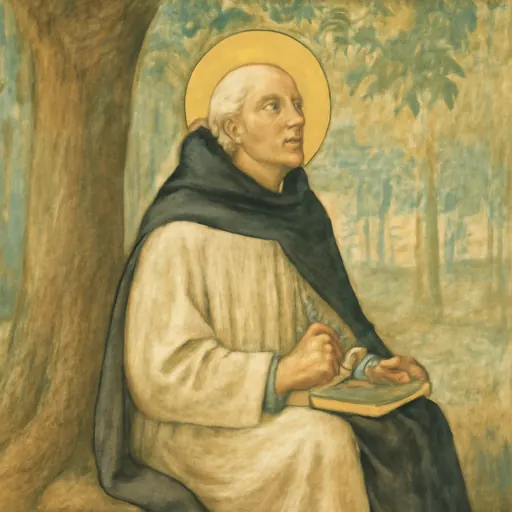
Blessed John of Ruysbroeck (1293–1381) was a Flemish priest and mystic, called the Admirable Doctor, who left Brussels for Groenendael and became the first prior of its canons regular. His book The Spiritual Espousals shaped the spiritual life of the Low Countries. Pope Pius X confirmed his cult in 1908, and we keep his feast on December 2.
Who was Blessed John of Ruysbroeck?
Blessed John of Ruysbroeck, in Flemish Jan van Ruusbroec, was a priest and mystic of the fourteenth century who wrote about the soul's union with God in the everyday language of Brabant. He was born in 1293 in the village of Ruisbroek, just south of Brussels, and spent the last thirty-eight years of his life in a small priory called Groenendael, the "green valley," in the Forest of Soignes. His readers called him the Admirable Doctor. We keep his feast on December 2, the day he died in 1381.
He took his only family name from his birthplace. Of his father nothing is known. His mother was devout and taught him to pray.
The life of John of Ruysbroeck
A boy who ran away to his uncle
At eleven he left home without a word to place himself under his uncle, John Hinckaert, a canon of the collegiate church of St. Gudula in Brussels. Hinckaert and another canon, Francis van Coudenberg, were living a simple, austere life modeled on the first Christians, and they saw to the boy's education for the priesthood. His mother followed him to Brussels, entered a beguinage there and died shortly before he was ordained in 1317.
For twenty-six years John served as a chaplain at St. Gudula's and lived quietly with his uncle and van Coudenberg. In those years a woman named Bloemardinne, of the movement known as the Brethren of the Free Spirit, was spreading a false mysticism in Brussels through popular pamphlets. Ruysbroeck answered her with pamphlets of his own, written in Flemish so the same people could read them. None of them survives, but for the rest of his life he wrote in his own tongue for that reason.
Groenendael
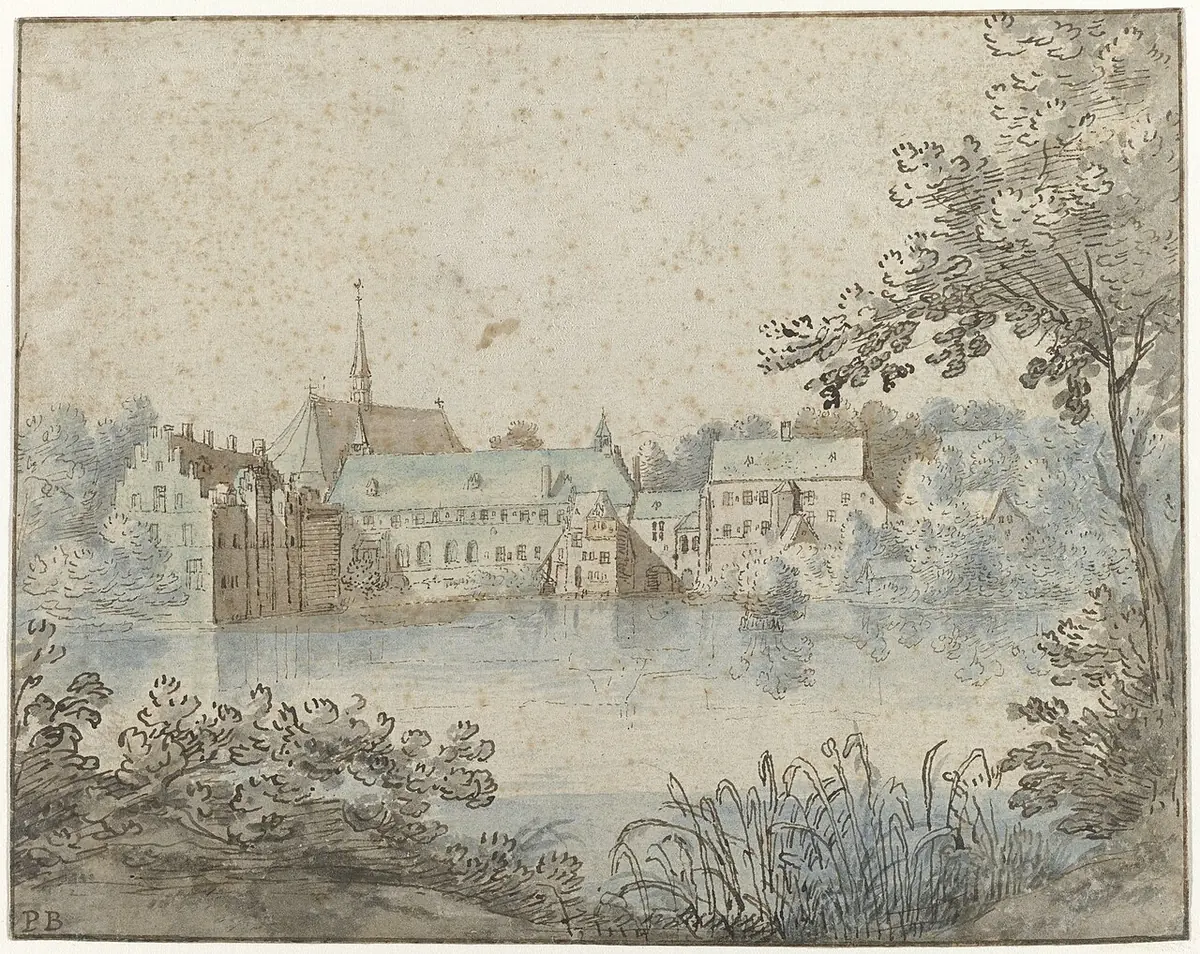
In 1343 the three friends left Brussels for a hermitage in the Forest of Soignes that Duke John III of Brabant gave them. Disciples came, and on March 13, 1349, the hermitage became a house of canons regular following the Rule of St. Augustine. Van Coudenberg was its first provost and Ruysbroeck its first prior. His uncle, too old for the full discipline, lived in a cell outside the cloister until his death.

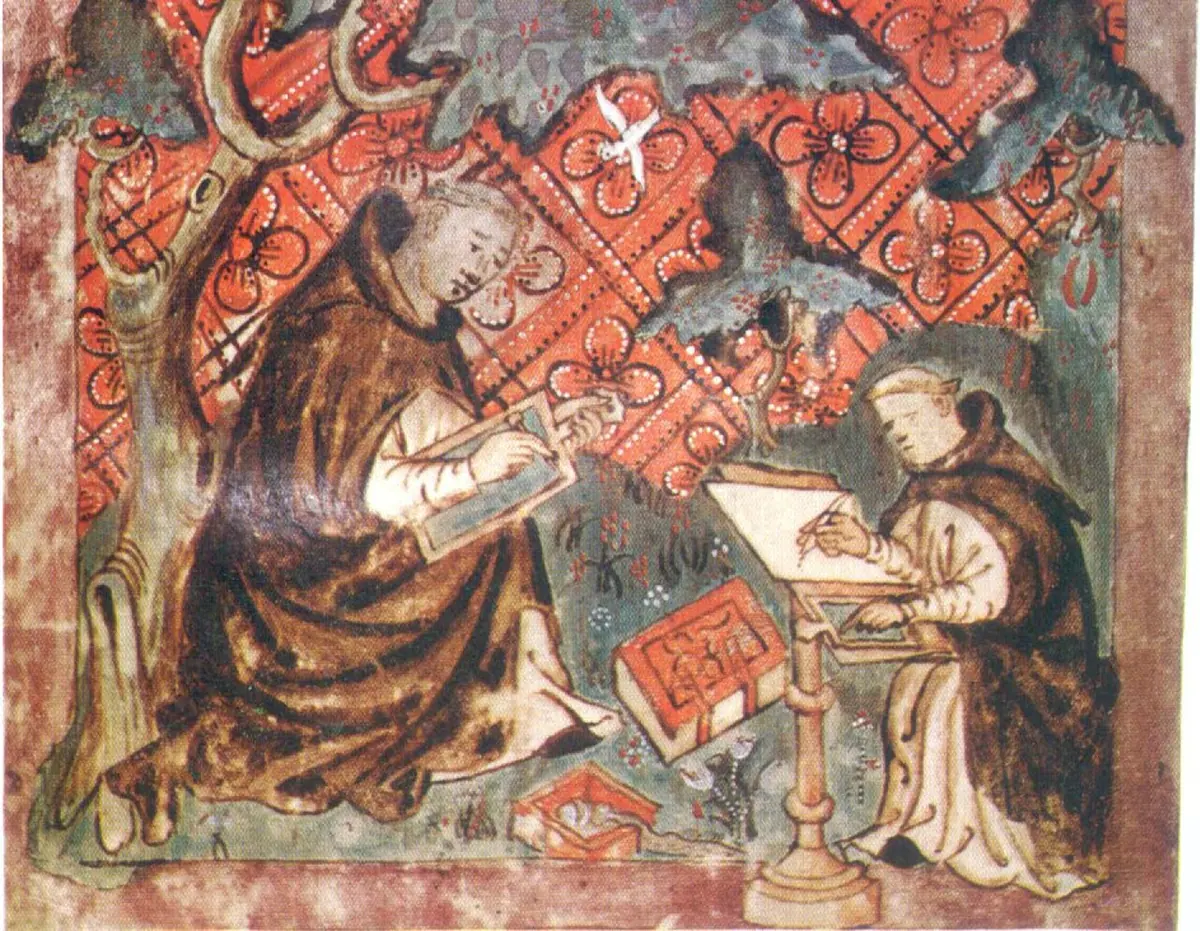
Ruysbroeck wrote as the Spirit moved him. Vincent Scully, following the early life by Henry Pomerius, a canon of Groenendael, says he would walk into the forest with a wax tablet and stylus and write down what came to him in prayer, and that when his eyes failed, a brother went with him to take dictation. Late in life he said he had never written anything except by the motion of the Holy Spirit.
Visitors came from Flanders, Holland, Germany and France. The Dutch preacher Gerard Groote loved him as a father, and through Groote his teaching flowed into the Windesheim canons and the Devotio Moderna, the world of Thomas à Kempis.
His writings
His best-known work is The Spiritual Espousals, in three books on the active, the interior and the contemplative life, built on the words of the parable of the ten virgins, "Behold the bridegroom cometh, go ye forth to meet him" (Matthew 25:6, Douay-Rheims). Other works include The Sparkling Stone, The Spiritual Tabernacle, The Mirror of Eternal Blessedness, The Seven Steps of the Ladder of Spiritual Love and The Book of the Twelve Beguines.
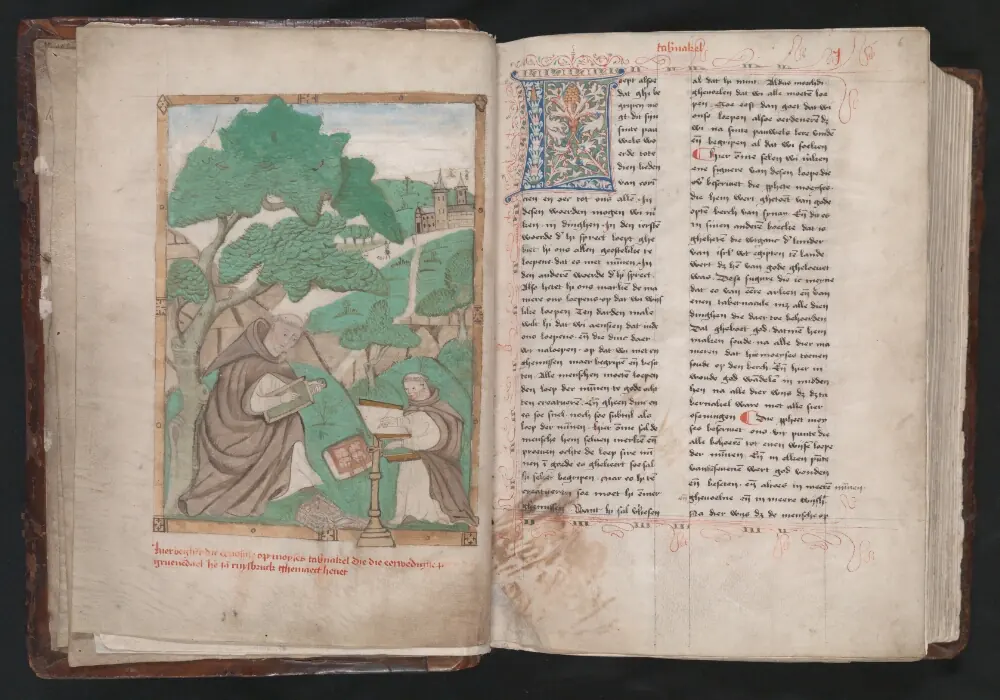
Some of his phrases about union with God are bold, and even Gerard Groote asked him to soften a few for the sake of weaker readers. Ruysbroeck was careful to explain himself: "There where I assert that we are one in God, I must be understood in this sense that we are one in love, not in essence and nature." He insisted on the sacraments, above all the Eucharist, as the ordinary road to God.
The miracles and stories of Blessed John of Ruysbroeck
- Traditional: One day he stayed in the forest so long that the brothers went looking for him. A canon who loved him found him sitting rapt in prayer under a tree that seemed to be surrounded by fire, which did not burn it. The brothers honored the spot as Ruysbroeck's Tree, and at the end of the fifteenth century Prior James van Dynter planted a lime tree there.
- Traditional: Two clerics from Paris asked him for a word to guide them. He said, "You are as holy as you wish to be." They went away offended, thinking he mocked them, until the brothers brought them back. "Your good-will is the measure of your sanctity," he told them, and they left at peace.
- Reported: According to Scully, when his body was exhumed some years after his death to be buried beside van Coudenberg, it was found incorrupt except for the tip of the nose, and the people came for three days to venerate it. Water used to wash his bones at the translation of 1622 was later credited with cures.

Death, relics and beatification
He died in the community infirmary at Groenendael on December 2, 1381, in his eighty-eighth year, after asking to be treated like the least of the brothers. Pilgrims came to his tomb and hung ex-votos there, and each year the canons of St. Gudula's came out to Groenendael for a Mass sung in his honor.
The Archbishop of Mechelen moved his bones to a new shrine in 1622. When Emperor Joseph II suppressed the priory in 1783, the relics went to St. Gudula's in Brussels, and after the church was sacked in 1793 they were lost. On December 1, 1908, the Congregation of Rites confirmed the honor paid to him "from time immemorial" as Blessed, and Pope Pius X approved it on December 9.
Where the relics of Blessed John of Ruysbroeck are kept: see them on the relics map →
Symbols of Blessed John of Ruysbroeck in art
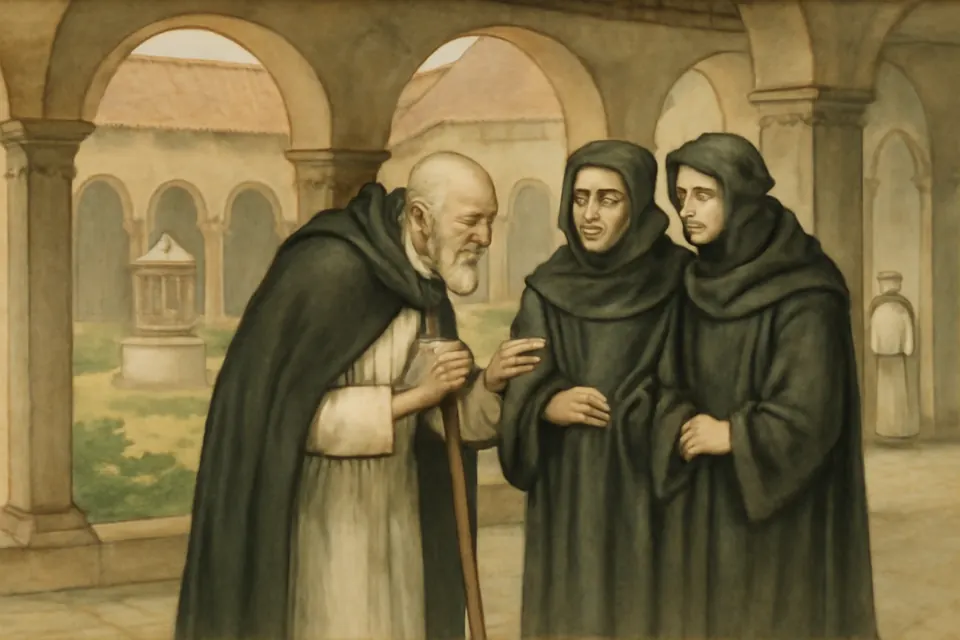
No authentic portrait of him exists. Tradition shows him as an old canon regular in a white rochet and dark cape, seated under a tree in the forest with a wax tablet and stylus on his knee. Often the tree is ringed with flames or rays of light, after the story of Ruysbroeck's Tree. In manuscript pictures a younger brother sometimes sits nearby taking down his words.
Feast day and prayer
We keep his feast on December 2. See the feast day calendar. In 1909 the Holy See granted an Office and Mass in his honor to the clergy of Mechelen and to the Canons Regular of the Lateran. Its collect, in Scully's translation, reads:
O God, Who didst vouchsafe to adorn Blessed John, Thy Confessor, with sublime holiness of life and with heavenly gifts, grant us, through his merits, and after his example, to despise the fleeting things of the world, and to desire only the joys of heaven.
Let us pray it with him, and ask him to teach us to go out and meet the Bridegroom. Blessed John of Ruysbroeck, pray for us.
Frequently asked questions
Who was Blessed John of Ruysbroeck?
A Flemish priest and mystical writer, born at Ruisbroek near Brussels in 1293. He served as a chaplain at St. Gudula's in Brussels, then in 1343 withdrew to Groenendael in the Forest of Soignes, where he became the first prior of a community of canons regular. He died there on December 2, 1381, aged eighty-eight.
What did John of Ruysbroeck write?
About a dozen spiritual treatises in Middle Dutch, among them The Spiritual Espousals, The Sparkling Stone, The Spiritual Tabernacle, The Mirror of Eternal Blessedness, The Seven Steps of the Ladder of Spiritual Love and The Book of the Twelve Beguines. The Spiritual Espousals is built on the verse "Behold the bridegroom cometh, go ye forth to meet him" (Matthew 25:6, Douay-Rheims).
Was Ruysbroeck's teaching orthodox?
Gerard Groote and later Jean Gerson were uneasy with some of his bolder phrases about union with God, but Ruysbroeck himself wrote that "we are one in love, not in essence and nature," and his books were praised by Thomas à Kempis, Denis the Carthusian and Louis de Blois. The Church confirmed his cult in 1908.
When is the feast of Blessed John of Ruysbroeck?
December 2, the anniversary of his death at Groenendael in 1381.
Keep exploring
Sources
- Catholic Encyclopedia (1912): Blessed John Ruysbroeck. Birth and early life, Bloemardinne, the move to Groenendael and the foundation of 1349, his writings and their reception, the fate of the relics and the decree of December 1, 1908
- Vincent Scully, A Mediaeval Mystic: A Short Account of the Life and Writings of Blessed John Ruysbroeck (1910). The wax tablet, the tree of fire and Ruysbroeck's Tree, the Paris clerics, his last illness and death, the incorrupt body at the exhumation, the translations of 1622, 1783 and 1793, Pius X's approval of December 9, 1908, and the text of the collect of his Mass