St. Patricia of Naples, Virgin
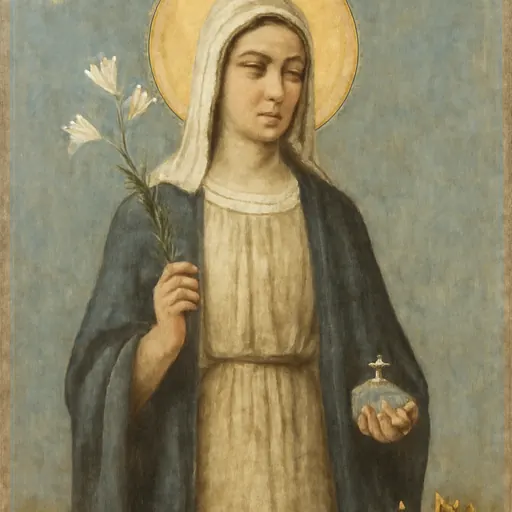
St. Patricia of Naples was, according to her legend, a noblewoman of Constantinople who refused an imperial marriage, consecrated her life to God and was shipwrecked at Naples, where she died around 665. Naples made her one of its patrons in 1625, and her relics are kept at San Gregorio Armeno. Her feast is August 25.
Who was St. Patricia of Naples?
St. Patricia of Naples is one of the beloved holy women of that city, a virgin whose body has rested among Neapolitans for some thirteen centuries. The Roman Martyrology names her in one line on August 25: "At Naples, St. Patricia, virgin." Naples remembers much more.
We should say plainly what kind of story this is. Antonio Borrelli, writing for Santi e Beati, calls the sources for her life "mostly scarce and legendary." What follows is the legend as Naples tells it, together with the history of her relics, which is far firmer ground.
The legend of St. Patricia
A princess who chose Christ
The legend makes Patricia a descendant of the emperor Constantine, born in Constantinople and raised at court by her nurse, Aglaia. She vowed her virginity to God while still young. When her kinsman the emperor Constans II arranged a marriage for her, she fled to Rome with Aglaia and a few maidservants, and there, the story says, she received the veil of a consecrated virgin from Pope Liberius.
Here the legend shows its age. Constans II reigned in the seventh century, and Pope Liberius died in 366, three centuries earlier. Whatever the true details were, the old writers clearly wanted to tell of a young woman who gave up a crown for Christ.
Shipwreck at Naples
After her father's death, she went back to Constantinople, renounced any claim to the throne and gave her goods to the poor. Then she set out as a pilgrim for the Holy Land. A storm drove her ship onto the tiny island of Megaride, off the shore of Naples, where Castel dell'Ovo stands today. In a small hermitage there she fell ill and died after a very short sickness, around the year 665.

The cart that chose her grave
Aglaia, the story continues, received a revelation about the funeral. The bishop, the duke of Naples and a great crowd came out for her. Her body was placed on a cart drawn by two young bulls with no one to guide them, and the bulls stopped of their own accord at the monastery of Sts. Nicander and Marcian on Caponapoli, the high ground of the old city, where Patricia had foretold she would be buried. Her companions stayed by her tomb and became known as the Patrician sisters.


The miracles of St. Patricia
Two wonders are tied to her tomb, and both should be read for what they are.
- Manna (traditional): Santi e Beati records that a fragrant liquid, called manna, seeped from her tomb, with a great outflow on September 13 in a year between 1198 and 1214.
- The blood (reported): the story goes that a Roman knight, out of excessive devotion, pulled a tooth from her body, and blood flowed from it. That blood is kept in a reliquary at San Gregorio Armeno and is reported to liquefy along the walls of its ampoule after prayers. The Church has not formally examined it.
No miracles through her intercession have been investigated for any process. Her cult is ancient and local, and the Church has long accepted it.
Why St. Patricia is a patron of Naples
Naples has many patrons. In 1625 the city added Patricia to them, according to Santi e Beati, as one of more than fifty co-patrons who stand beside St. Januarius. Neapolitans honor her especially on Tuesdays, besides her feast day. See more on our patron saints page.
Symbols of St. Patricia in art
- White veil: the consecration she received as a virgin.
- Crown laid aside: the imperial claim she gave up.
- Lily: purity.
- Ampoule of blood: the relic kept at San Gregorio Armeno.
- Ship: her voyage and shipwreck.
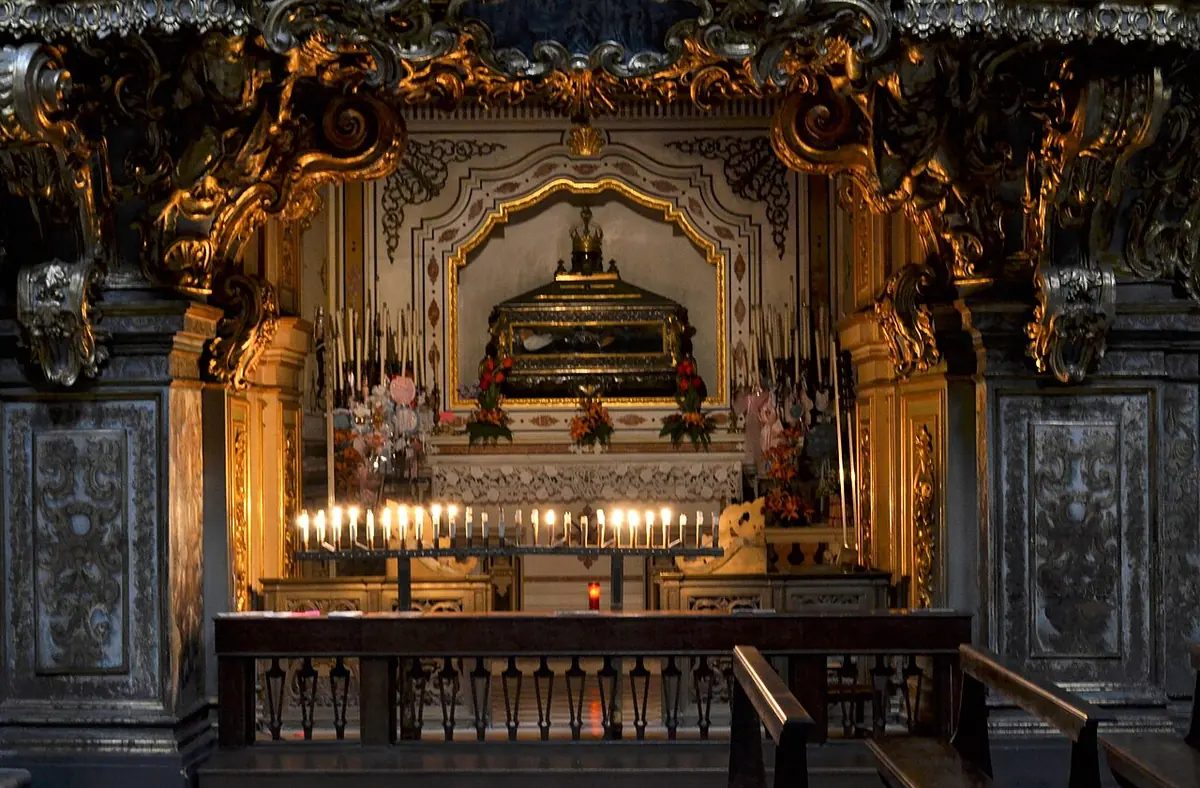
In Naples you will meet her mostly in Baroque altarpieces and in the gilded chapel that holds her urn.
Feast day and relics
We keep her feast on August 25. For centuries her body stayed with the nuns at Caponapoli; later Benedictine nuns took over the monastery. After the suppressions of the nineteenth century, her relics were moved in 1864 to the monastery of San Gregorio Armeno, on the street famous for its Christmas crib makers. They lie in a gilded and silver urn set with gems, in a chapel on the right side of the nave. Today the Sisters Crucified Adorers of the Eucharist care for her shrine. See other saints of late August on our feast days page.
If you visit, look for her chapel on the right as you face the altar. The urn sits high above the altar table, and the ampoule of her blood is kept in the same church. Pray there as Neapolitans have prayed for centuries, for the city, for the sick and for those who have given up much to follow Christ. Close by, in the same street, are the workshops where Naples makes its Christmas cribs, so the saint who left a palace for a hermitage now rests among the craftsmen who carve the stable of Bethlehem.

Where the relics of St. Patricia of Naples are kept: see them on the relics map →
Prayer to St. Patricia
We know of no traditional prayer to St. Patricia in wide use outside Naples. Let us ask her simply: St. Patricia, you gave up a crown and a home for love of Christ; pray for the people of Naples, for families in trouble, for the sick, and for all of us who must make the hard choice to follow him.
Frequently asked questions
Who was St. Patricia of Naples?
A consecrated virgin honored in Naples since the early Middle Ages. Her legend says she came from the imperial family of Constantinople, fled an arranged marriage, gave her wealth to the poor and died at Naples after a shipwreck. The details come from late and legendary sources.
Where are the relics of St. Patricia?
In the church of San Gregorio Armeno in the historic center of Naples, in a chapel on the right side of the nave. They were moved there in 1864 from the monastery at Caponapoli where she was first buried.
Does St. Patricia's blood liquefy?
A reliquary of her blood is kept at San Gregorio Armeno, and it is reported to liquefy after prayers, much like the blood of St. Januarius. This is a reported wonder, not one the Church has formally examined.
When is the feast of St. Patricia of Naples?
August 25. Neapolitans also honor her every Tuesday.
Keep exploring
Sources
- Santa Patrizia di Costantinopoli, vergine (Antonio Borrelli), Santi e Beati. The legend, the cart drawn by young bulls, the translation of 1864, the manna and the blood, co-patron of Naples in 1625, Tuesday devotion
- The Roman Martyrology (Baltimore: John Murphy, 1897), Internet Archive. August 25: "At Naples, St. Patricia, virgin."