St. Aurea of Ostia
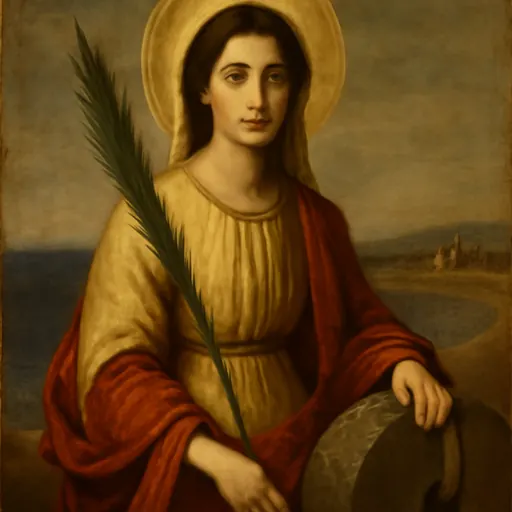
St. Aurea of Ostia was a young Christian woman of Rome, exiled to Ostia and put to death for the faith in the third century; the Roman Martyrology says she was thrown into the sea with a stone tied to her neck. We keep her feast on August 24, and Ostia honors her as its own saint.
Who was St. Aurea of Ostia?
St. Aurea of Ostia was a virgin martyr of the third century, put to death at Ostia, the old port of Rome at the mouth of the Tiber. The Roman Martyrology remembers her on August 24 in two short sentences:
At Ostia, St. Aurea, virgin and martyr, who was plunged into the sea with a stone tied to her neck. Her body, being cast on the shore, was buried by blessed Nonnus.
Her name is Latin for "golden." Greek-speaking Christians called her Chryse, which means the same thing. Over her grave rose one of the oldest churches of Ostia, and the town still carries her statue through its streets.

The story in her Acts
Most of what we are told about Aurea comes from a later Latin account, the Acts of the martyrs of Ostia. In that telling she was a young Christian woman of a noble Roman family, sent away from Rome to Ostia because of her faith. She lived there on her own estate outside the walls, a place called Euparisti, and kept close to the bishop of Ostia, Cyriacus, and the Christians of the port.
A Christian named Censorinus was being held in chains at Ostia. Aurea and her friends visited and comforted him. The Acts say his chains were loosened by a miracle, that seventeen soldiers who saw it believed, and that the little company raised a shoemaker's dead son to life.
Her martyrdom
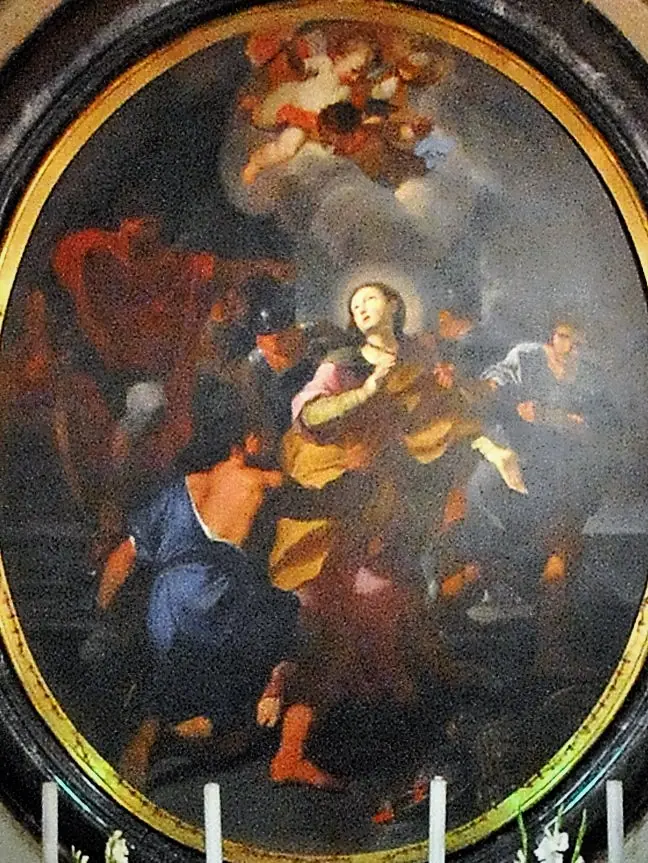
Then a high official came from Rome, named in the Acts as Ulpius Romulus. Aurea's companions were beheaded, and the converted soldiers were killed near the arch in front of the theater. Aurea herself was tortured and ordered to sacrifice to the gods. She refused.
So they tied a stone to her neck and threw her into the sea. The waves carried her body back to the shore, and a Christian named Nonnus buried her on her own land. Her death is usually placed under the emperor Claudius Gothicus (268–270), though it may have come earlier, under Trebonianus Gallus (251–253).

What history can tell us
The Acts were written long after her death, and they borrow freely from other martyr stories. Ostia's own Nonnus was later identified with St. Hippolytus: the Catholic Encyclopedia records "a legend of Porto" that does exactly this. So we read the details of her story as the Church's tradition, not as a court record.
Her memory, though, is very old and very real. In 1981 a fragment of a Christian tombstone turned up near her church, reading CHRYSE HIC DORM[IT], "Chryse sleeps here." It may be her own grave marker, or a later one placed at her tomb. A small marble column from about the fifth century, now near the altar, carries the letters S. AUR, for Sancta Aurea.
Archaeologists have found the first church of Sant'Aurea beneath and beside the present one. Its walls match buildings in Ostia from about 325 to 350, and graves crowd its floor, as Christians wanted to lie near a martyr. In 387 St. Monica, the mother of St. Augustine, died at Ostia and was buried there. Her epitaph was found beside the church in 1945.
The miracles of St. Aurea
- Traditional: the chains of Censorinus fell loose while Aurea and her companions prayed with him, and seventeen soldiers believed.
- Traditional: the raising of a shoemaker's dead son by the Christians of her circle.
- Traditional: the sea gave back her body, so that it could be buried with honor.
All three come from her Acts. None has been formally examined by the Church.
Symbols of St. Aurea in art
- The stone or millstone: the weight tied to her neck. In Jacques Callot's small engraving a soldier fastens a round stone to her while she stands quietly.
- The sea: Ostia's shore and harbor appear behind her.
- The rack: some prints show the tortures before her death, as in the Rijksmuseum engraving above.
- Palm and crown: the signs of a martyr's victory.
A young woman with a stone at her neck and the sea behind her, in a series for late August, is almost certainly Aurea of Ostia. A fourteenth-century triptych by the Sienese painter Lippo Vanni, now in the church of Santi Domenico e Sisto in Rome, tells her martyrdom in four small scenes.
Her church and her relics
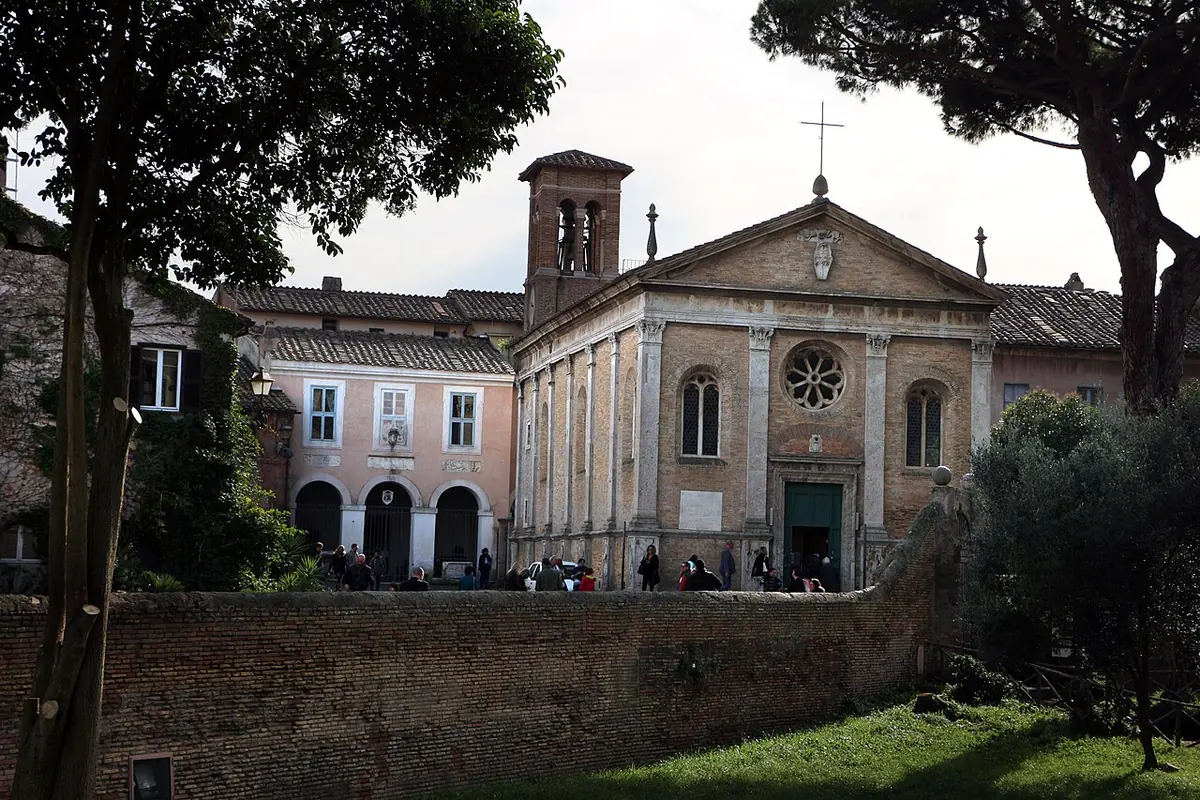
The present Basilica of Sant'Aurea, in the walled village of Ostia Antica, was begun in 1479 under Cardinal d'Estouteville and finished under Cardinal Giuliano della Rovere, the future Pope Julius II. It has long served as the cathedral of the ancient diocese of Ostia.
Her relics have traveled. In 1430 Pope Martin V had them taken to Rome along with Monica's. In 1736 they went to a convent chapel at Albano Laziale. In 2013 they came home to Ostia, to the church built on her grave.
Where the relics of St. Aurea of Ostia are kept: see them on the relics map →
Feast day and prayer
We keep the memory of St. Aurea on August 24, the day the Roman Martyrology gives her. Ostia still carries her statue in procession out of her church and through the old village. See the feast day calendar.
We have found no traditional prayer to St. Aurea in English. Let us simply ask her, in our own words, to pray for us: for courage when the faith costs us something, for those who are exiled or cut off from home for believing, and for all who live and work by the sea.

St. Aurea, golden in name and in faith, pray for us.
Frequently asked questions
Who was St. Aurea of Ostia?
A virgin martyr of the third century, honored at Ostia near Rome. Her name means "golden" in Latin; the Greek form is Chryse. Tradition says she was a well-born Roman Christian sent away to Ostia, where she was tortured and drowned for refusing to sacrifice to the gods.
How did St. Aurea die?
The Roman Martyrology says she "was plunged into the sea with a stone tied to her neck," and that her body, cast on the shore, was buried by blessed Nonnus.
When is the feast of St. Aurea of Ostia?
August 24, the same day as the apostle St. Bartholomew. St. Aurea of Paris, a different saint, is remembered on October 4.
Is St. Monica buried with St. Aurea?
St. Monica died at Ostia in 387 and was buried near Aurea's grave. Her epitaph was found beside the church of Sant'Aurea in 1945. Monica's body was later moved to Rome.
Keep exploring
Sources
- Roman Martyrology, August 24 (1916 English edition). Her death in the sea and her burial by Nonnus
- Ostia: Harbour City of Ancient Rome: Church of Sant'Aurea. The Acts, the Chryse inscription found in 1981, the early church, and the journeys of her relics
- Catholic Encyclopedia (1911): Ostia and Velletri. St. Monica's burial in the church of St. Aurea
- Catholic Encyclopedia (1910): St. Hippolytus of Rome. The legend of Porto that identifies Hippolytus with the martyr Nonnus
- Ostia Online: Church of Sant'Aurea. The fifth-century candlestick column inscribed with her name