St. Emily de Vialar

St. Emily de Vialar (1797-1856) was a French noblewoman from Gaillac who, at thirty-five, used her inheritance to found the Sisters of St. Joseph of the Apparition, one of the first missionary congregations of women of modern times. In twenty-four years she sent her sisters to Algeria, Tunisia, the Middle East and Burma, and opened more than forty houses. Pope Pius XII canonized her in 1951, and we keep her feast on August 24.
Who was St. Emily de Vialar?
St. Emily de Vialar was a French noblewoman who founded the Sisters of St. Joseph of the Apparition, a congregation of women that she led far beyond France: to Algeria and Tunisia, to Cyprus, Syria, Lebanon and the Holy Land, and as far as Burma. She began late, at thirty-five, and she lost almost everything along the way, including her fortune and her hometown. When she died in Marseille in 1856, her sisters had houses on three continents.
We keep her feast on August 24.
A baron's daughter in Gaillac
She was born on September 12, 1797, in Gaillac, in the Tarn, the eldest child and only daughter of Baron Jacques-Augustin de Vialar and his wife, Antoinette Portal. She was sent to Paris for her schooling, but her mother died while she was still young, and Emily came home to keep house for her father.
Pope Pius XII, speaking to her sisters after her canonization, painted a picture of those years. She was wealthy, aristocratic and well educated, and she felt drawn to religious life, but she could not see where or how. So she lived "a kind of double life," he said, passing in the same day "from the salons where she was loved and admired to the hovels that her visits lit up and consoled." Her father did not want her to become a nun, and his opposition hurt her deeply.
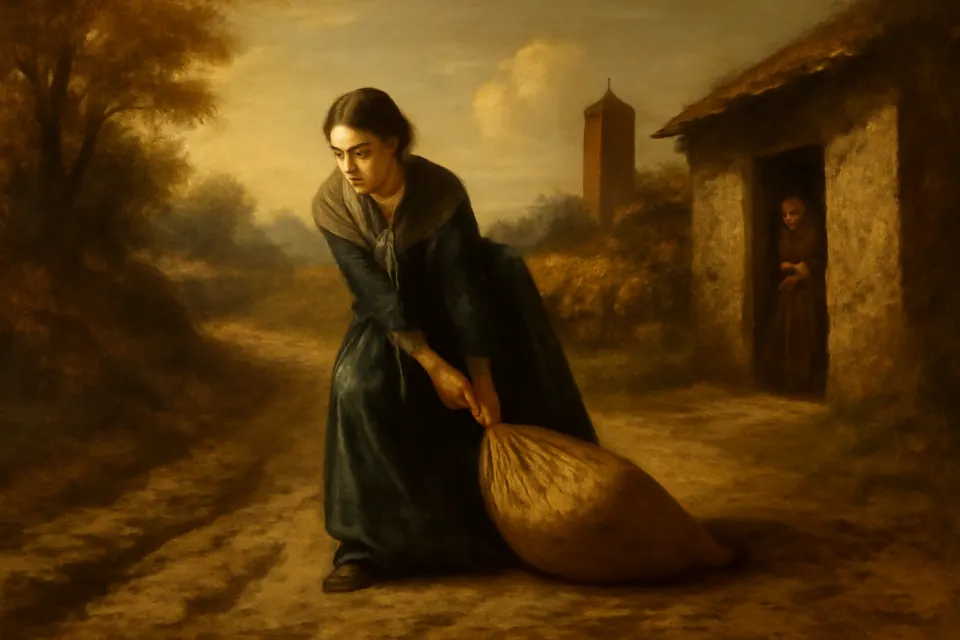
On one of her rounds, the Pope recounted, she dragged a sack of wheat alone along a bad road. It was too heavy for her, and the strain left her with a painful infirmity. She carried it for forty years, until it killed her, and almost no one knew.
The Sisters of St. Joseph of the Apparition
When she was thirty-five, an inheritance from her grandfather, Baron Antoine Portal, physician to the king, made her free. She bought a house in Gaillac, and at Christmas 1832 she and three companions began a new religious family there, with the support of the Archbishop of Albi. She named it for the angel's appearance to St. Joseph in the Gospel of Matthew (1:20). Like Joseph, the sisters were to help bring about God's saving plan "by witnessing that God loved the world so much as to give His only begotten Son," in the words of the Urbaniana biography.
Their work was every kind of charity: visiting the poor, caring for the sick and the dying, schools for the poor paid for by schools for families who could afford them. Her rule of 1841 put it this way:
The spirit of this Congregation is to dedicate the Sisters to the practice of the different works of charity. In order to acquire this divine virtue, they meditate every day of their lives on the immense charity which fills the Heart of Jesus Christ.
A missionary foundress
Since her youth, Pius XII said, Emily had felt drawn to the missions. In 1835 she went with her first sisters to Algeria, where they nursed the sick through an epidemic of cholera. A painful conflict with the bishop there forced them out, but she did not go home. In a few years she sent or led her daughters to Tunisia, Syria, the Holy Land, the islands of the Levant, Malta and Burma, to serve Christians, Jews and Muslims alike.

Her travels were hard. On a crossing to Tunis in 1843, she later wrote, she had almost nothing to eat and could rest only sitting up, yet "it pleased Almighty God to grant me a great facility in uniting myself to Him in the depths of my heart, and I spent eight days, as it were, in Retreat." Years before, she wrote, Our Lord had told her: "Remain in my Presence. If you stray from it, I shall recall you."
Loss, Marseille and a holy death
In the 1840s the house in Gaillac fell into debt through the dishonesty of a man who had won the local superior's trust. Lawsuits and slander followed, and Emily, her inheritance long spent on her foundations, had to leave her hometown. In 1852 she found a welcome in Marseille from its bishop, St. Eugène de Mazenod, and rebuilt her congregation there. She never lost heart. "The Lord causes to burn within me that same fire which He enkindled long ago," she wrote in 1844. "May He, in His goodness, grant that as long as I live this divine fire may not be extinguished."
She died in Marseille on August 24, 1856. Her congregation then had 42 houses. The Holy See approved it on March 31, 1862, six years after her death. In Marseille, a parish church now bears her name, with her words to her sisters across its front: "Go, and with what you have, do all the good you can."

Canonization and relics
No miracles are told of her life in the sources we consulted, and we have not found a reliable account of the approved miracles examined for her cause, so we do not describe them here. Pope Pius XII beatified Emily in 1939 and canonized her on June 24, 1951, together with St. Mary Domenica Mazzarello, cofoundress of the Salesian Sisters. In 1972 her remains were brought home to Gaillac, the town she had been forced to leave, and they rest in a shrine in the church of Saint-Pierre.
Symbols of St. Emily de Vialar in art
She lived into the age of portraits, so she is shown as she looked:
- The black habit with white bonnet and collar: the dress of her sisters in the nineteenth century.
- The crucifix: her sisters meditated daily on the wounds of the Savior.
- A rolled paper: the rule she wrote for her congregation.

Feast day and prayer to St. Emily de Vialar
We keep her feast on August 24; her sisters celebrate her on June 17. See the feast day calendar. This prayer to her was published by the Pontifical Urbaniana University on the Vatican's website:
O St. Emilie, you who in the church, wanted to continue to manifest the Father's love, as realised through the Incarnation of the Son, grant us your docility to the Spirit, your audacity and your apostolic courage.
Let us ask St. Emily to pray for missionaries, for religious sisters, and for everyone who has given everything to God and seemed to lose it all.
Frequently asked questions
Who was St. Emily de Vialar?
The daughter of a baron of Gaillac in southern France, who cared for the poor of her town for years before founding the Sisters of St. Joseph of the Apparition at Christmas 1832. She led them as missionaries to North Africa and the Middle East and died in Marseille on August 24, 1856.
What does "St. Joseph of the Apparition" mean?
The name recalls the angel who appeared to St. Joseph in a dream (Matthew 1:20) to tell him not to fear taking Mary as his wife. Like Joseph, the sisters want to serve God's plan of salvation by making his love known.
When is the feast of St. Emily de Vialar?
August 24, the day of her death. Her own congregation keeps her feast on June 17.
Where is St. Emily de Vialar buried?
In the church of Saint-Pierre in Gaillac, her hometown, where her remains were brought from Marseille in 1972.
Keep exploring
Sources
- Pope Pius XII, address to pilgrims for the canonization of Sts. Émilie de Vialar and Maria Domenica Mazzarello, June 27, 1951 (vatican.va). Her double life between the salons and the hovels, the sack of wheat and forty years of suffering, and the missions (our translation)
- Saint Emilie de Vialar: Recollection and apostolic zeal (vatican.va, Pontifical Urbaniana University, 2001). Quotations from her Account of her Interior Life (1842), her Rule (1841) and a letter of 1844, and the prayer to her
- Catholic Encyclopedia (1912): Sisters of St. Joseph (Sisters of St. Joseph of the Apparition). Papal approval of the congregation on March 31, 1862; its houses in Malta, Cyprus, Beirut, Burma, the Holy Land and Australia (Fremantle, 1854)
- Vatican News: Saint Emily de Vialar (August 24). The support of the Archbishop of Albi, the 42 houses, the transfer of her remains to Gaillac in 1972, and the June 17 feast of her congregation