St. Genesius of Rome

St. Genesius of Rome was a comic actor who, by tradition, mocked Christian baptism on stage before the Emperor Diocletian, was converted in the middle of the scene, and was beheaded for refusing to take it back. We keep his feast on August 25, and he is the patron saint of actors, comedians and musicians. He is not St. Genesius of Arles, a notary martyred in Gaul who shares the same day.
Who was St. Genesius of Rome?
St. Genesius of Rome was a comic actor who, by tradition, mocked Christian baptism on a stage in front of the Emperor Diocletian and came up out of the water a believer. He told the emperor so to his face, refused to take it back, and was beheaded. The Church keeps his feast on August 25, and for centuries actors, comedians and musicians have counted him as their own.
He is easy to mix up with a namesake. The Roman Martyrology names another St. Genesius on the same day: Genesius of Arles, a notary in Gaul who threw down his writing tablets rather than copy out a decree against Christians. Genesius of Rome is the actor.
The story of St. Genesius
The fullest account of his life comes from a set of Acts written down around the seventh century. The Catholic Encyclopedia calls their historical value "very doubtful," so read what follows as the legend the Church has told and loved, not as a court record.
The play before the emperor
Genesius led a troupe of actors in Rome during the persecution under Diocletian, which dates the story to about 286 or 303. Christians were a popular target for comedy. Their baptisms, their talk of a crucified king and their stubbornness before judges made easy laughs. Genesius had studied their rites, and he wrote a scene that mocked them.
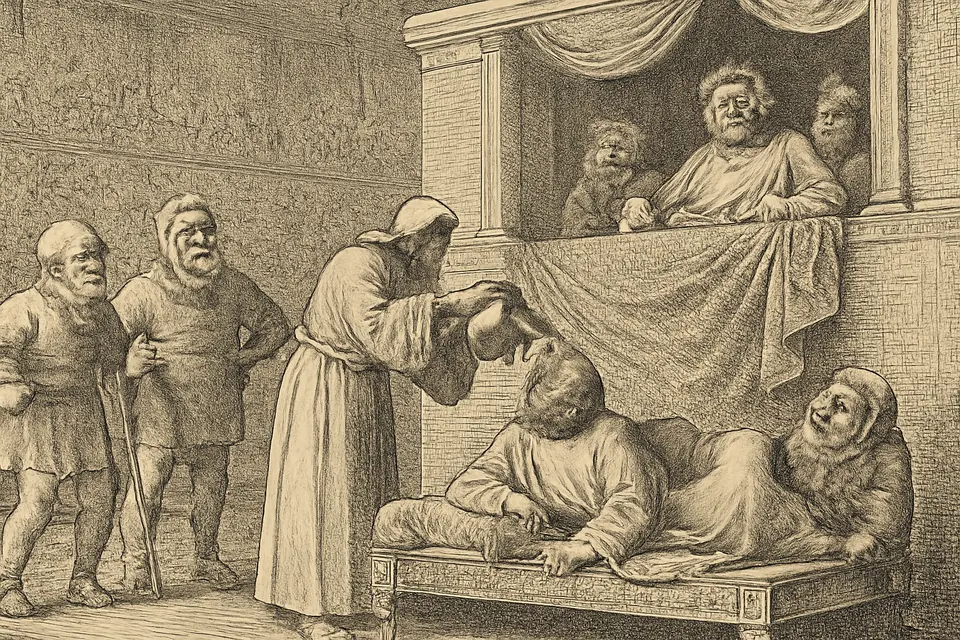
On the day of the performance he lay on a couch as a sick man who wanted to be baptized. Fellow actors played the priest and the exorcist. They poured the water over him, and the audience laughed. Diocletian, the story says, enjoyed it.
The actor who would not stop being a Christian
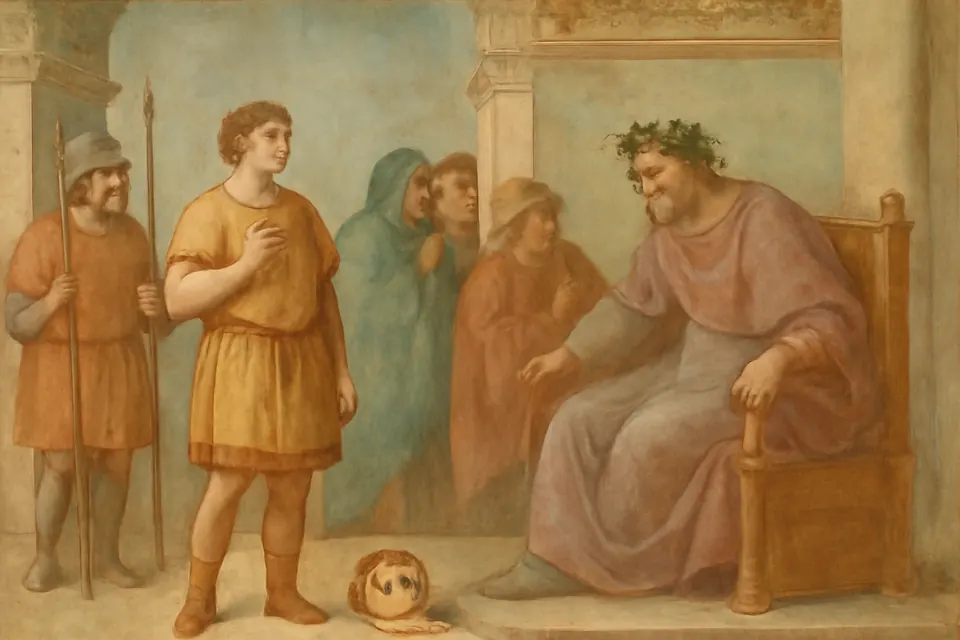
Then something happened that was not in the script. The Roman Martyrology says that "by the inspiration of God he was suddenly converted to the faith and baptized." When the other actors dressed him in white and led him before the emperor as a joke, Genesius stopped acting. He declared himself a Christian in earnest.
The laughter stopped. Diocletian had him beaten, racked and burned, but he would not deny Christ. The Martyrology gives his last words:
There is no king besides Christ. Should you kill me a thousand times, you shall not be able to take Him from my lips or my heart.
He was beheaded and, by tradition, buried on the Via Tiburtina.
History and legend
What can we say for certain? Genesius was honored in Rome very early. The Catholic Encyclopedia notes that he was venerated there in the fourth century, that a church was built in his honor, and that Pope Gregory III repaired and decorated it in 741. That is solid ground.
The written story is another matter. The same source reports that some scholars doubt Genesius existed at all and see him as a Roman counterpart of St. Gelasinus (or Gelasius) of Hierapolis, an Eastern martyr who died in 297. We honor what the Church has long honored: a man who found Christ where he least expected Him and would not give Him up. We mark the details of the stage play as traditional.
Why St. Genesius is the patron saint of actors
The reason is the story itself. Genesius was a working actor, and his conversion happened in a theater, in costume, in front of an audience. For people who spend their lives playing parts, his story shows that God can reach us through the parts we play.
His story also went back on the stage. The Catholic Encyclopedia notes a fifteenth-century dramatization, and later playwrights took it up, among them Lope de Vega in Spain and Jean Rotrou in France, whose Le Véritable Saint Genest ("The True St. Genesius") was first staged in the 1640s.
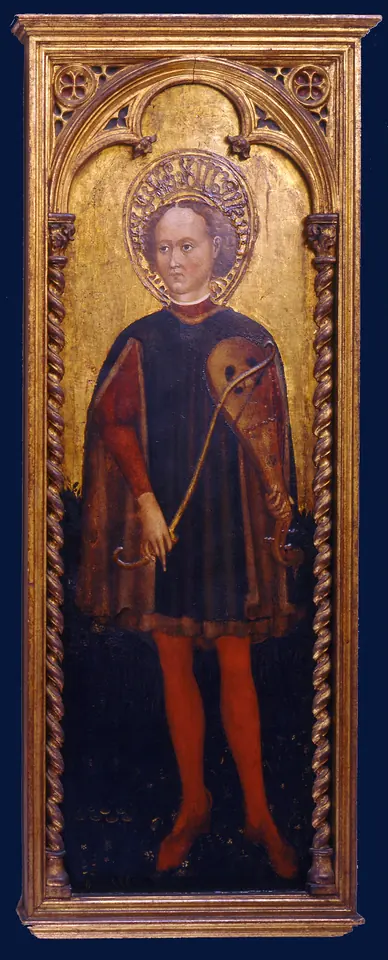
He is also an old patron of musicians, and Italian painters liked to show him with a viol. How that patronage began, and why he came to be invoked against epilepsy, isn't recorded; both were established customs by the time the Catholic Encyclopedia was written.
Symbols of St. Genesius in art
St. Genesius is not shown often, so his attributes vary from place to place:
- Theater mask: the plainest sign of his profession. Modern statues, like the one in St. Aegidien in Braunschweig, put a mask in his hand.
- Baptismal font or water jug: recalls the mock baptism that became real.
- Viol, fiddle or bow: in Italian art of the 1400s he appears as a young musician, as in Cristoforo Moretti's panel in Milan.
- Martyr's palm and sword: the usual signs of a martyr who was beheaded.
- Bright costume: some images dress him in an actor's or courtier's clothes rather than a tunic.
If you meet a young saint with a mask, or a musician-saint with a palm, in a church in Italy or Germany, it is likely Genesius. Don't confuse him with Genesius of Arles, who is usually shown with a book, pen or writing tablets.

Feast day, relics and devotion
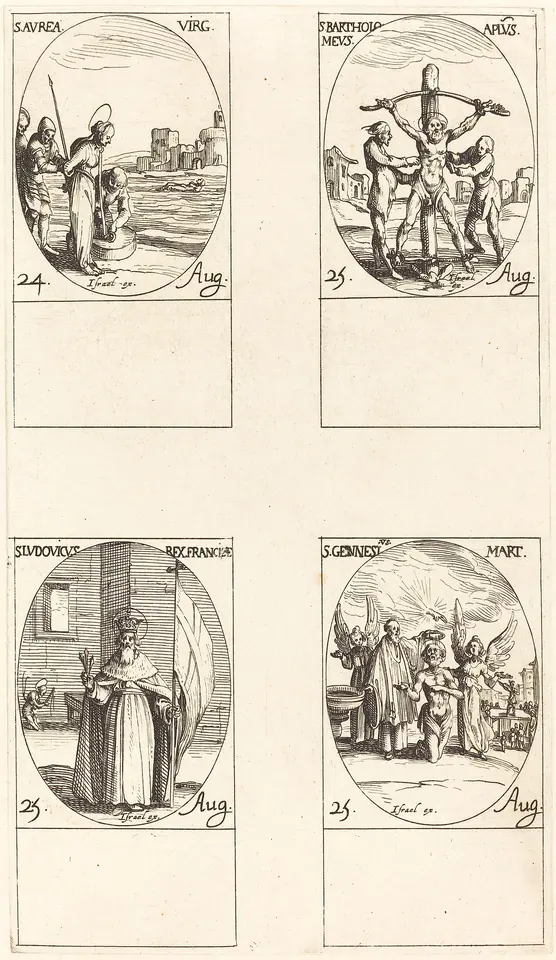
We keep the feast of St. Genesius on August 25. See the feast day calendar for the saints around him. According to the Catholic Encyclopedia, his relics were "said to be" divided among Roman churches, partly at San Giovanni della Pigna and partly at Santa Susanna, along with a chapel of St. Lawrence. These claims are old and can't be checked. His own ancient church in Rome no longer stands.
Theater people still keep his memory, and many Catholic actors ask his prayers before a performance.
Prayer to St. Genesius
No ancient prayer to St. Genesius has come down to us, and we won't invent one in his name. The best words to pray with him are his own, as the Martyrology records them: "There is no king besides Christ." Let us ask St. Genesius to pray for everyone who works on the stage, for those who have mocked the faith and may yet find it, and for us, that no one may take Christ from our lips or our hearts.
Frequently asked questions
What is St. Genesius the patron saint of?
St. Genesius of Rome is the patron saint of actors, comedians and other theater people, and of musicians. He has also long been invoked against epilepsy. The theater patronage comes straight from his story; the others are old traditions recorded in the Catholic Encyclopedia.
When is the feast day of St. Genesius?
August 25. The Roman Martyrology lists him that day, followed by St. Genesius of Arles, a different martyr who worked as a notary.
Was St. Genesius a real person?
He was honored in Rome by the fourth century, and a church there bore his name; Pope Gregory III repaired it in 741. The written account of his martyrdom, though, dates from about the seventh century, and its historical value is doubtful. Some scholars think he is a Roman counterpart of an Eastern martyr, St. Gelasinus (or Gelasius) of Hierapolis, who died in 297. The legend is old and much loved, but its details cannot be proved.
Is there a prayer to St. Genesius?
There is no single ancient prayer to him. Many theater people simply ask his intercession before a performance, and the words he is said to have spoken before he died, "There is no king besides Christ," make a fine prayer of their own.
Sources
- Catholic Encyclopedia (1909): Genesius. The legend, the seventh-century date of the Acts, doubts about his existence, the Roman church repaired in 741, and the relic claims
- The Roman Martyrology (1916 English translation): August 25. Source of the quoted words of Genesius