St. Amadeus of Lausanne
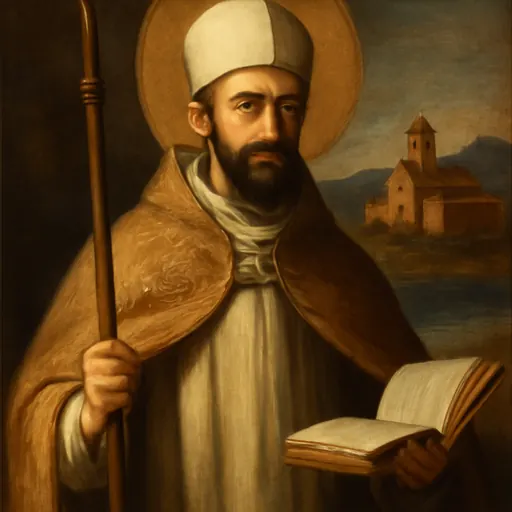
St. Amadeus of Lausanne (about 1110–1159) was a French nobleman who became a Cistercian monk under St. Bernard at Clairvaux, abbot of Hautecombe in Savoy and, from 1145, bishop of Lausanne. His eight homilies on the Virgin Mary made him one of the great Marian writers of the twelfth century; Pope Pius XII quoted him when defining the Assumption. He died on August 27, 1159.
Who was St. Amadeus of Lausanne?
St. Amadeus of Lausanne was a twelfth-century Cistercian monk and bishop: a nobleman who left the imperial court for the cloister, learned the monastic life under St. Bernard of Clairvaux, led the abbey of Hautecombe in Savoy, and spent his last fifteen years as bishop of Lausanne, in what is now French-speaking Switzerland. He died there on August 27, 1159, at about forty-nine.
He is remembered above all for eight homilies in praise of the Virgin Mary, and in 1950 Pope Pius XII quoted one of them when he defined the dogma of Mary's Assumption.
A noble family that chose the cloister
Amadeus was born about 1110 in the castle of Chatte, in the Dauphiné west of Grenoble. His father, also named Amadeus, was a lord of the house of Clermont, related to the royal family of Franconia. When Amadeus's mother died in 1119, his father became a monk at the Cistercian abbey of Bonnevaux and took his son with him to be schooled. The father is honored as Blessed Amadeus of Clermont.
In 1121 the boy moved to the great Benedictine abbey of Cluny to continue his studies, and he finished his education at the court of Emperor Henry V. A knight's career lay open to him. In 1125, at about fifteen, he turned it down and entered Clairvaux under Bernard.

Abbot of Hautecombe
In 1139 Bernard sent him to be abbot of Hautecombe, a Cistercian house on the Lac du Bourget in Savoy, near Aix-les-Bains. The abbey still stands on the lake shore, and the dukes of Savoy later made it their burial church.

Bishop of Lausanne
In 1144 the pope named him bishop of Lausanne. He accepted only reluctantly, out of obedience. The Catholic Encyclopedia lists him among the most distinguished bishops in the long history of that see.
It was a hard diocese in hard times. In one of his letters Amadeus tells how his vestments were stained red with the blood of a man he had tried, in vain, to protect from murderers. He worked to raise the learning and discipline of his clergy, and he moved among the powerful of his day. Near the end of his life he served as co-regent for the young Humbert III of Savoy, and four years before he died, Emperor Frederick Barbarossa made him chancellor of the Kingdom of Burgundy.
He died in Lausanne on August 27, 1159, and was buried in the cathedral.

The eight homilies on the Virgin Mary
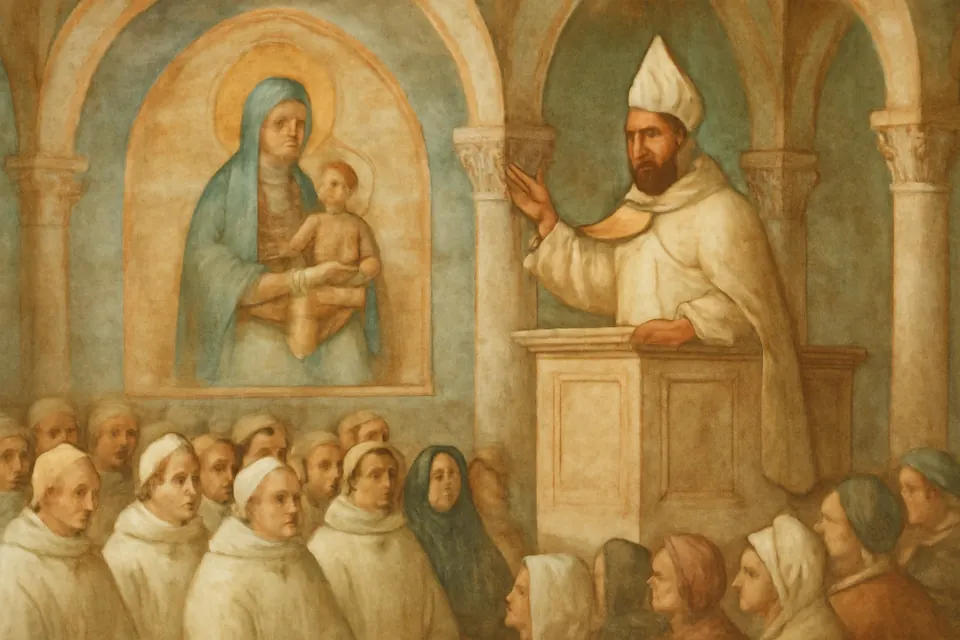
St. Amadeus's eight homilies praise Mary and her part in the mystery of Christ, in the warm, Scripture-soaked style of his teacher Bernard. Migne printed them in his Patrologia Latina (volume 188), and Cistercian Publications has published them in English.
In the seventh homily Amadeus taught that Mary's body did not see corruption but was united again to her soul in heaven. Pope Pius XII quoted it in Munificentissimus Deus, the 1950 constitution defining the Assumption:
For she was full of grace and blessed among women. She alone merited to conceive the true God of true God, whom as a virgin, she brought forth, to whom as a virgin she gave milk, fondling him in her lap, and in all things she waited upon him with loving care.
Miracles and veneration
No miracles of St. Amadeus are recorded in the sources we have. His fame rests on his life and his writing. Several older sources say his cult was approved in 1710, but the Vatican's index of causes does not mention it. What is certain is that Pope St. Pius X confirmed his cult on December 9, 1903, together with a group of holy men of the region listed under Theobald of Vienne. In 1911 his tomb was found again in Lausanne Cathedral, and it still held some relics.
Symbols of St. Amadeus in art
Images of him are rare. When he does appear, look for these signs:
- Cistercian bishop: a white habit under a bishop's vestments, with miter and crozier.
- Princely insignia, for his noble birth and his offices at the imperial court.
- A pair of gloves received from the Mother of God, his special attribute, a sign of her favor to her devoted preacher. It is a traditional image, not a recorded event.
- A book, for his homilies.
Feast day and where he is honored
Calendars differ. He died on August 27, the date we use here; older calendars keep him on January 28. The Cistercians and the diocese of Lausanne, Geneva and Fribourg celebrate him on August 30. See the feast day calendar for other saints of late August.
Lausanne Cathedral, where his tomb lies, has been a Reformed church since the Reformation reached Vaud in 1536, so Catholic pilgrims today pray at his grave as visitors. The Catholic diocese now has its seat in Fribourg.
No traditional prayer to St. Amadeus has come down to us, and we do not invent one. We ask his help in our own words. Let us ask St. Amadeus to teach us his love for the Mother of God, and to pray for bishops who serve in hard places.
Frequently asked questions
Who was St. Amadeus of Lausanne?
A twelfth-century Cistercian monk from the Dauphiné in France, trained at Clairvaux under St. Bernard, who became abbot of Hautecombe and then bishop of Lausanne in Switzerland. He is best known for eight homilies in praise of the Virgin Mary.
When is the feast of St. Amadeus of Lausanne?
He died on August 27, 1159. Some calendars keep him on January 28, and the Cistercians and the diocese of Lausanne, Geneva and Fribourg celebrate him on August 30.
What did St. Amadeus write about the Assumption?
In his seventh homily he taught that Mary's body did not see corruption but was reunited with her soul in heavenly glory. Pope Pius XII cited him in Munificentissimus Deus (1950), the document that defined the dogma of the Assumption.
Was Amadeus of Lausanne canonized?
His cult was confirmed by Pope Pius X on December 9, 1903, together with a group of other holy men of the region. That confirmation is how most saints of his era came to be officially recognized.
Keep exploring
Sources
- Den katolske kirke: Den hellige Amadeus av Lausanne (~1110–1159), by Per Einar Odden (Norwegian). His family and schooling, Clairvaux in 1125, Hautecombe in 1139, the letter about his blood-stained vestments, the regency for Humbert of Savoy, the chancellorship of Burgundy, the cult confirmed in 1903, the 1911 discovery of his tomb, his feast days and his attribute of gloves from the Virgin
- Pius XII, Munificentissimus Deus (November 1, 1950). Paragraph 28 quotes Amadeus on the Assumption
- Catholic Encyclopedia (1910): Lausanne and Geneva. Lists him among the distinguished bishops of Lausanne (1144–1159) as the author of homilies on the Virgin, in Migne's Patrologia Latina 188
- Lay Cistercians of Gethsemani: Vigils reading for Sts. Warren and Amadeus (August 30). His Cistercian feast on August 30