St. Alexander Briant

St. Alexander Briant was a young English priest from the West Country, arrested in 1581, starved, racked and tortured in the Tower of London, and admitted to the Jesuits while in prison. He was martyred at Tyburn on December 1, 1581, the same day as St. Edmund Campion, aged about twenty-five. He is one of the Forty Martyrs of England and Wales, canonized in 1970.
Who was St. Alexander Briant?
St. Alexander Briant was a young English priest who gave his life for the Catholic faith at Tyburn on December 1, 1581, the same morning as St. Edmund Campion and St. Ralph Sherwin. He was about twenty-five. In the months before, he had been starved, racked and tortured in the Tower of London, and he had asked from his cell to be received into the Society of Jesus. The Church beatified him in 1886 and canonized him in 1970 as one of the Forty Martyrs of England and Wales.
Oxford, Douai and Reims
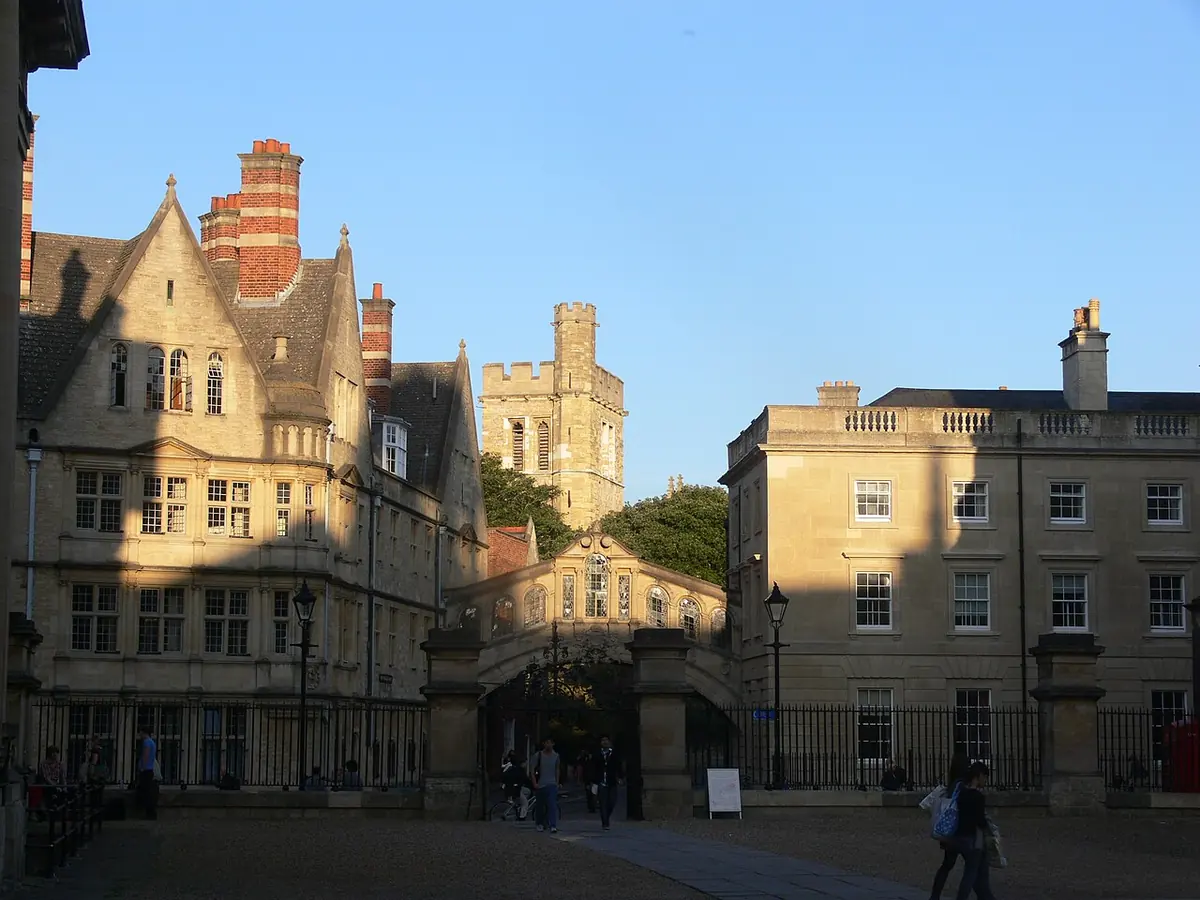
Alexander was born about 1556 in the West Country, of a family of farmers. The Catholic Encyclopedia says Somerset; Bishop Challoner, writing in the eighteenth century, says Dorset. He went up young to Hart Hall at Oxford, the forerunner of today's Hertford College, where his looks and purity of face won him the name "the beautiful youth."
At Oxford he became a pupil of Robert Persons, later a famous Jesuit, and he came to the Catholic faith through Persons and through Richard Holtby. He left England, entered the English College at Douai and then at Reims, and was ordained a priest on March 29, 1578. In August of the next year he came home secretly to work in his own county. One of the people he reconciled to the Church was Persons's own father.
Arrest, hunger and the rack
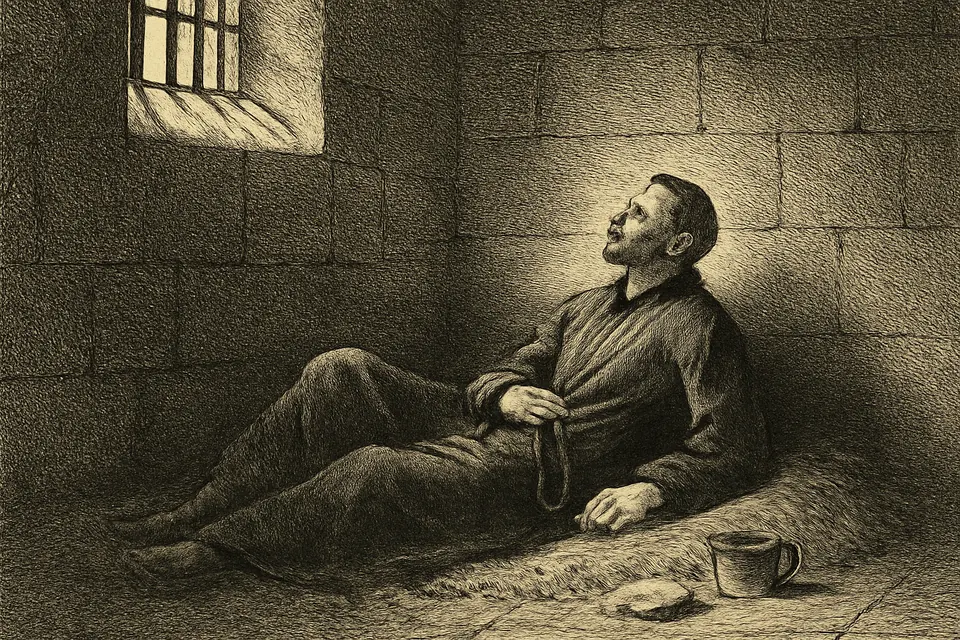
On April 28, 1581, priest-hunters looking for Father Persons broke into Briant's room at midnight. They took his money and a chest that held a silver chalice and sent him to the Counter prison in London, with orders that he be given neither food nor drink. Challoner's source tells us that, nearly starving, he got a little hard cheese and bread, and was so thirsty afterwards that he tried to catch raindrops from the eaves in his hat.
In the Tower he was asked where Persons was, where the secret press was, where he had said Mass and whose confessions he had heard. He would not answer. Needles were forced under his nails, and he prayed the Miserere, Psalm 51, asking God to forgive his torturers. Then he was racked so hard on two days running that he fainted, and afterwards lay for fifteen days in his clothes, unable to move. When the commissioners pressed him on the queen's headship of the Church, he answered simply: "I am a catholic, and I believe in this as a catholic should do."
The letter to the Jesuits
During those weeks he made a vow that, if God delivered him, he would enter the Society of Jesus. He wrote to the Jesuit fathers in England asking to be received, and they accepted him. In the same letter he described what happened on the rack:
The same day that I was first tormented on the rack, before I came to the place, giving my mind to prayer, and commending myself and all mine to our Lord, I was replenished and filled up with a kind of supernatural sweetness of spirit
Whether this that I will say be miraculous or no, God he knoweth; but true it is, and thereof my conscience is a witness before God. And this I say, that in the end of the torture, though my hands and feet were violently stretched and racked ... yet, notwithstanding, I was without sense and feeling, well nigh of all grief and pain.
He adds that he was praying the rosary at the time.
Trial and martyrdom
On November 16, 1581, he was tried in Westminster Hall with Campion and five other priests on a charge of treason over a plot that never existed; Challoner's eyewitness calls it "the pretended conspiracy." He made a little cross of whatever wood he could find and carried it openly into court. He had also shaved a tonsure on his head, because his captors had mocked him as a priest ashamed of his calling, and he wanted them to see that he was not.

On December 1 he was dragged to Tyburn with Campion and Sherwin and was the last of the three to die. From the cart he protested that he was innocent of any plot, declared himself a true Catholic, and was praying Miserere mei Deus when the cart was drawn away. The Catholic Encyclopedia says that "through either malice or carelessness of the executioner he was put to needless suffering."
Miracles
- Reported: in his own letter, Briant says he felt almost no pain at the end of the rack, "as it were comforted, eased and refreshed." He himself left the question open: "Whether this that I will say be miraculous or no, God he knoweth." It was never formally examined.
Symbols of St. Alexander Briant in art
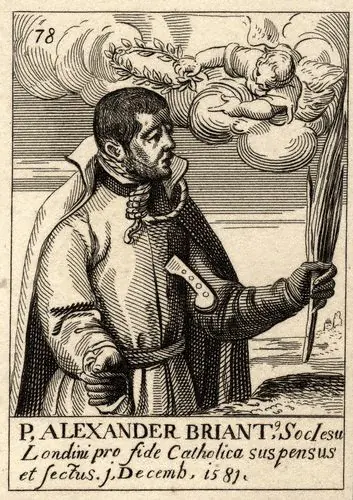
- The martyr's palm, and an angel bringing a crown, as in Greuter's engraving of 1608, made only a generation after his death.
- A knife in the breast and a rope around the neck: the marks of hanging, drawing and quartering, used for all the Tyburn martyrs.
- A small wooden cross: the one he made in prison and carried to his trial.
- The Jesuit cassock: he is painted among the Jesuit martyrs of England, often beside St. Edmund Campion.
Feast day and where he is honored
We keep his feast on December 1, the day he died. See the feast day calendar. Tyburn Convent in London, near the place where the gallows stood, keeps a shrine to the martyrs who died there.
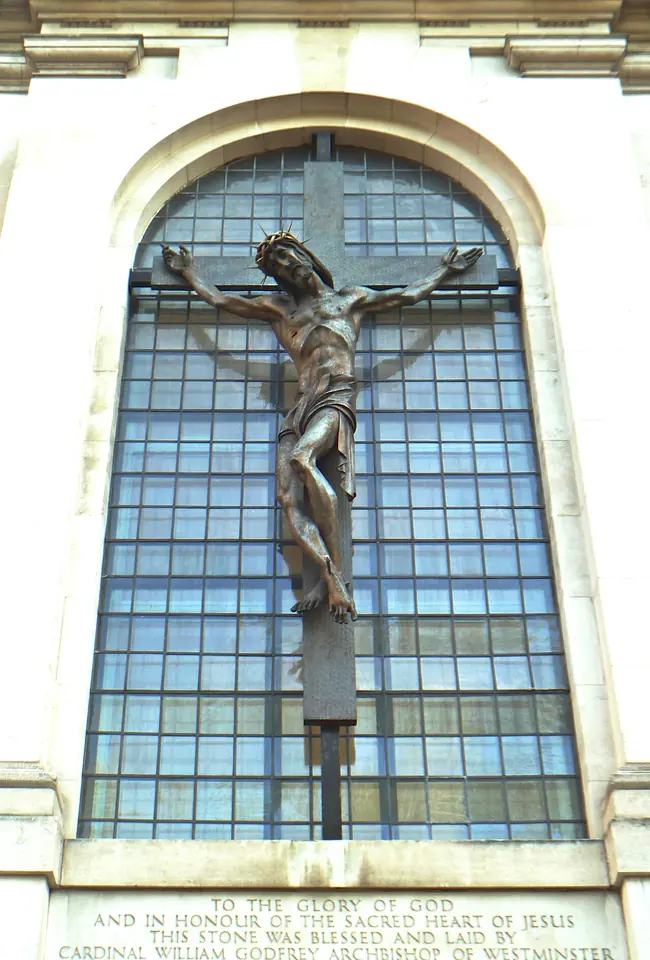
There is no traditional prayer to St. Alexander Briant in common use. Let us ask him, who prayed the Miserere for his torturers and the rosary on the rack, to pray for prisoners, for priests in danger, and for all who suffer for their faith.
Frequently asked questions
Who was St. Alexander Briant?
An English Catholic priest, trained at Douai and Reims, who worked in his native West Country from 1579. He was arrested in April 1581, tortured in the Tower of London, condemned for treason with St. Edmund Campion, and hanged, drawn and quartered at Tyburn on December 1, 1581.
When is the feast of St. Alexander Briant?
December 1, the day of his death, which the Jesuits keep as the feast of St. Edmund Campion and companions. He is also honored with the Forty Martyrs of England and Wales.
Was Alexander Briant a Jesuit?
Yes, at the end. From prison he wrote to the Jesuit fathers in England asking to be received into the Society of Jesus, keeping a vow he had made, and his request was granted before his death.
What did St. Alexander Briant say about his torture?
In his letter to the Jesuits he wrote that at the end of the rack he felt almost no pain, adding, "Whether this that I will say be miraculous or no, God he knoweth; but true it is."
Keep exploring
Sources
- Catholic Encyclopedia (1907): Blessed Alexander Briant. His Somerset birth, "the beautiful youth" at Oxford, ordination at Reims on March 29, 1578, arrest on April 28, 1581, the needles under his nails, admission to the Society of Jesus and age at death
- Richard Challoner, Memoirs of Missionary Priests, vol. 1 (1803 edition), pp. 35–38. The eyewitness account of his arrest, hunger in the Counter, the rack, the psalm Miserere, his letter to the Jesuits, the wooden cross and shaved crown at his trial, and his last words at Tyburn
- Pope Paul VI, homily at the canonization of the Forty Martyrs of England and Wales, October 25, 1970. The canonization of the forty martyrs