St. Swithun of Winchester, Bishop and Wonderworker

St. Swithun (also spelled Swithin; died 862) was a 9th-century bishop of Winchester in Anglo-Saxon England, remembered for his humility, his care for the poor and the bridge he built over the River Itchen. A century after his death, his relics were moved into Winchester's cathedral amid a wave of healings. His feast day is July 15, St. Swithin's Day, famous in English weather lore: if it rains that day, the saying goes, it will rain for forty more.
Who was St. Swithun?
St. Swithun, often spelled Swithin, was bishop of Winchester in the Anglo-Saxon kingdom of Wessex from 852 until his death on July 2, 862. He advised King Egbert and his son King Ethelwulf, cared for the poor of his city, and asked to be buried in the open air among his people. A hundred years later his tomb became one of the great healing shrines of England, and his feast on July 15 gave the English language St. Swithin's Day.
We know strikingly little about his life. Writing around the year 1000, the monk Ælfric admitted as much:
neither have we found in books how the bishop lived in this world, before he departed to Christ. Such was their carelessness who knew him in life that they would not write down his works and conversation for future generations who knew not his power; but God hath nevertheless brought his life to light by manifest miracles and wondrous signs.
The life of St. Swithun
Counselor of kings
Swithun appears in a handful of 9th-century charters as a priest of Winchester. The Catholic Encyclopedia names him as one of the two trusted counselors of Egbert, king of the West Saxons, who probably gave him charge of the education of his son Ethelwulf. When Ethelwulf became king, he had Swithun chosen bishop of Winchester, and Archbishop Ceolnoth of Canterbury seems to have consecrated him on October 30, 852. Later writers often called him a Benedictine monk and even prior of Winchester, but there is no evidence for either.
The bridge over the Itchen
His one documented building work is a stone bridge at Winchester's east gate over the River Itchen, remembered in a 10th-century poem. In his day Viking raiders sacked nearby Southampton and, in 860, Winchester itself, and a bridge and strong gate mattered.

A grave under the rain
Dying in 862, he asked to be buried outside the north wall of his cathedral, the Catholic Encyclopedia says, "where passers-by should pass over his grave and raindrops from the eaves drop upon it." The bishop who had served the poor wanted to lie where the poor walked.
The miracles of St. Swithun
The eggs on the bridge (traditional). The one miracle told of his lifetime comes from a Life written around 1100 and usually credited to Goscelin of Saint-Bertin. Workmen on the bridge jostled an old woman and smashed the eggs she was carrying to market, and Swithun made the sign of the cross over the basket and every egg was whole again.

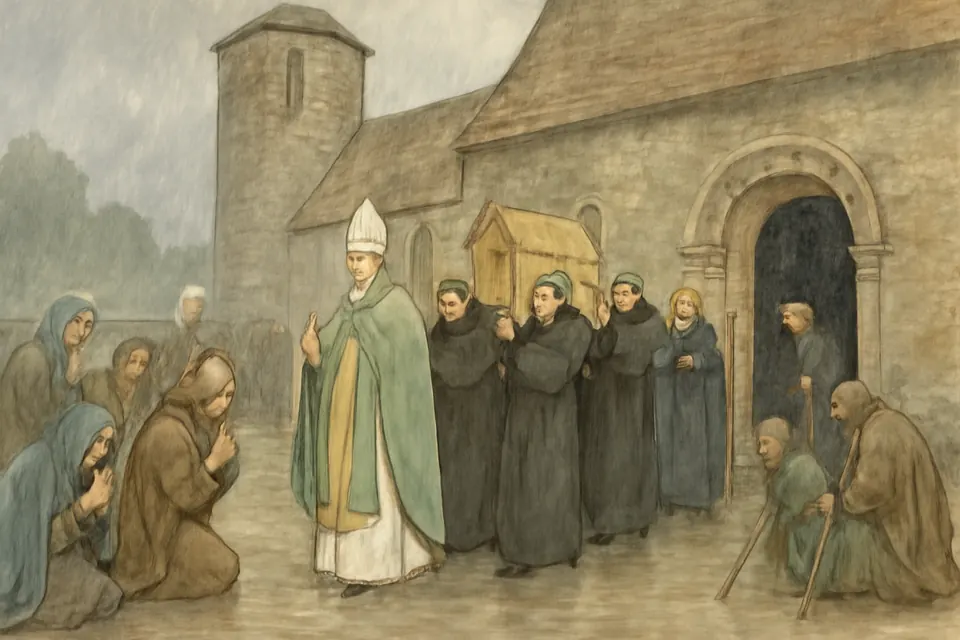
The translation of 971 (reported). In the 960s, Ælfric says, Swithun appeared in a vision to a smith and told him to send word to Bishop Ethelwold that his grave should be opened. Healings began at the tomb. On July 15, 971, with the support of King Edgar, Ethelwold and his monks raised the body and carried it into the Old Minster. The monk Lantfred, who lived at Winchester at the time, wrote up the cures within a few years, and Ælfric retold them:
Within ten days two hundred men were healed, and so many within twelve months that no man could count them.
The churchyard, he adds, "lay filled with crippled folk." These are reported miracles: careful contemporary accounts from the time before formal canonization, when the public translation of relics by the bishop was itself the Church's recognition of a saint.
St. Swithin's Day and the rain
English folklore puts it in a rhyme:
St. Swithin's day if thou dost rain For forty days it will remain St. Swithin's day if thou be fair For forty days 'twill rain nae mair.
The later legend explains it this way: Swithun was so unhappy at being moved indoors, away from the rain of his chosen grave, that he sent forty days of rain. That story is traditional and late. France tells the same of rain on St. Médard's day, June 8, and other countries of other feasts, so the proverb is older weather lore that settled on his feast. Rain on his day was said to be St. Swithun "christening the apples," which were not to be eaten before it.
Symbols of St. Swithun in art
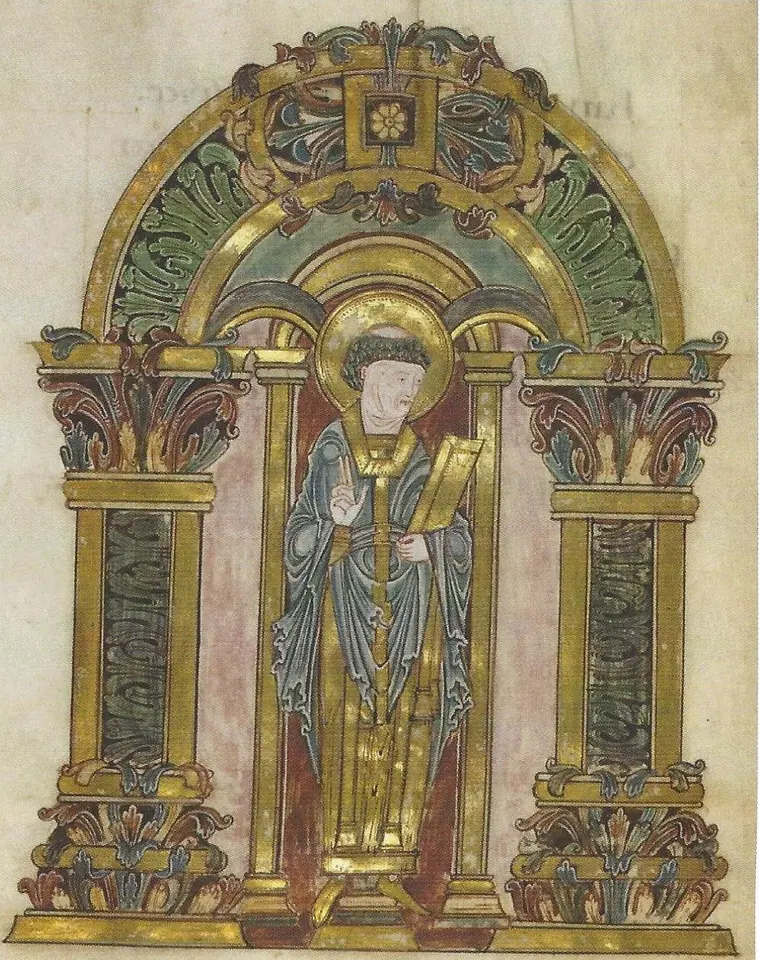
In art St. Swithun is a bishop with miter and crozier, often holding a book of the Gospels, as in the Benedictional of St. Æthelwold, where he wears no miter at all but has a tonsure and halo. Later images add his own signs: a basket of eggs, sometimes broken, for the bridge miracle; a bridge behind him; and, in modern prints, raindrops or rain clouds for St. Swithin's Day. In English parish churches dedicated to him, look for a bishop with eggs at his feet. Orthodox icons painted in recent years show him as a holy hierarch in a bishop's omophorion, blessing and holding the Gospels.
Feast day and where he is honored
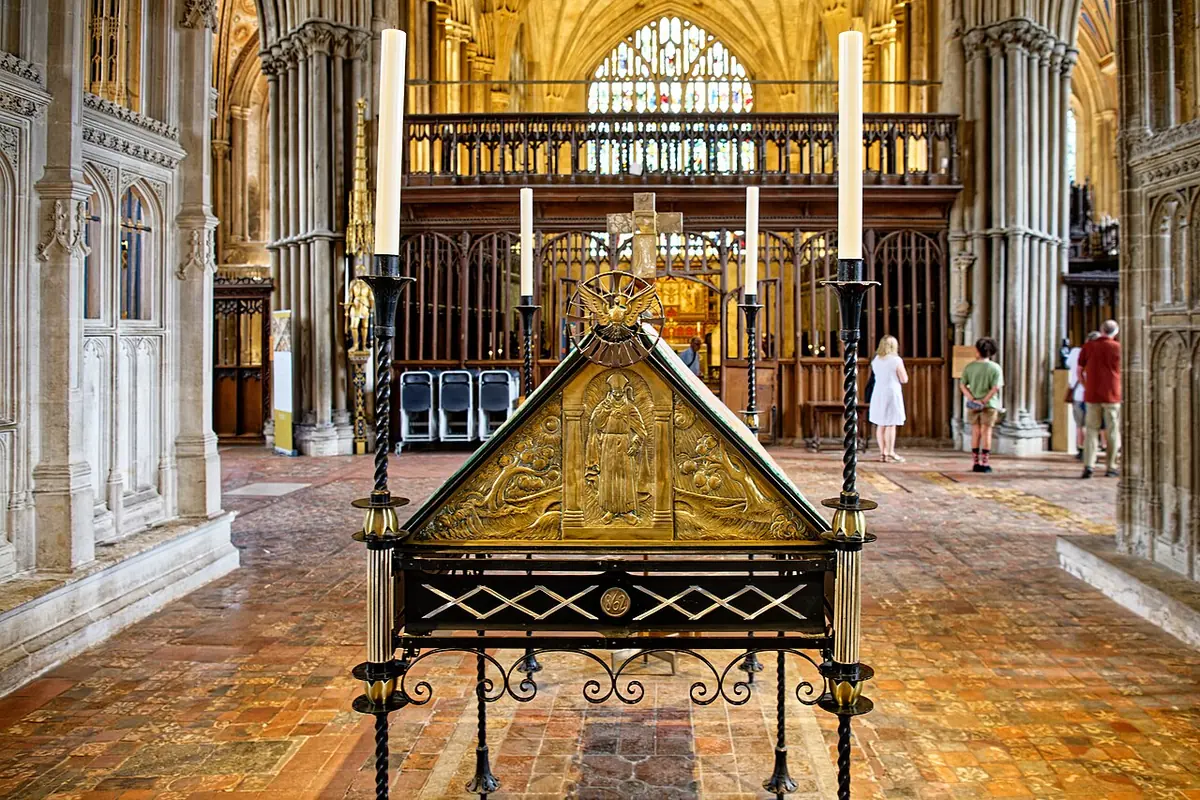
We keep his feast on July 15, the anniversary of the translation. His relics were moved again in 1093 into the new Norman cathedral, and in the early 1200s Bishop Godfrey de Lucy built the retrochoir so that pilgrims could gather around the shrine. Henry VIII's commissioners destroyed it in 1538 and the relics were scattered. A memorial shrine set up in 1962, for the 1,100th anniversary of his death, marks the spot today, and the Orthodox also come there to pray to him as a holy hierarch and wonderworker.
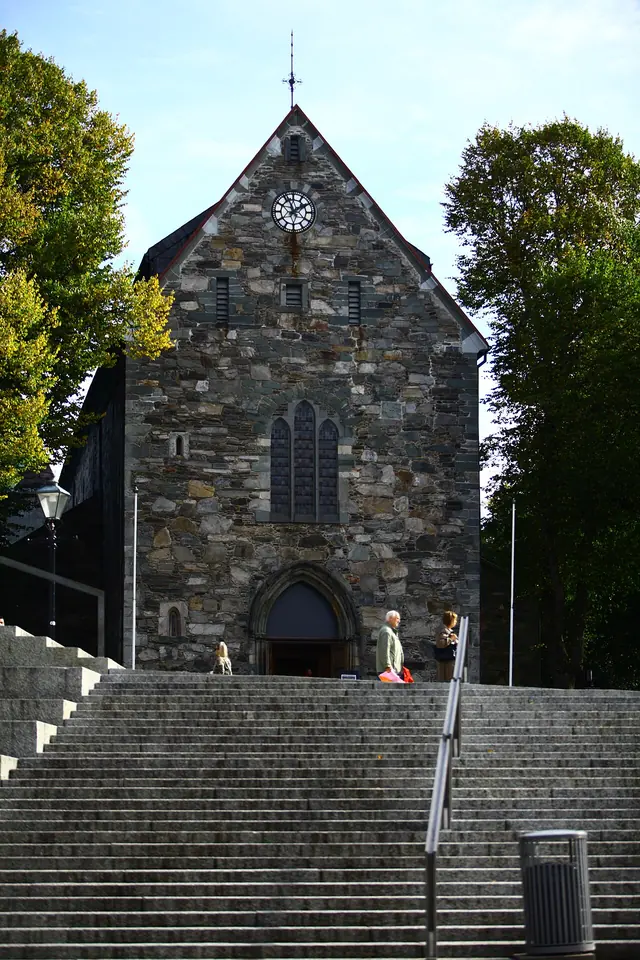
Pieces of his relics had traveled far before then. His head was taken to Canterbury, and in the 12th century an arm went to Stavanger in Norway, whose cathedral is still dedicated to him. Fifty-eight ancient English churches bear his name. Find more July saints on our feast days page.
Prayer to St. Swithun
There is no well-known traditional prayer to St. Swithun in common use. In the Catholic liturgy his feast uses the prayers of the Common of Pastors for a bishop. We can simply ask his help in our own words, as the sick of Winchester did at his grave: let us ask St. Swithun, the bishop who wanted to lie under the rain with the poor, to pray for the sick, for travelers on the roads he guarded, and for the Church in England and Norway that still honors him.
Frequently asked questions
What is St. Swithin's Day?
St. Swithin's Day is July 15, the feast of St. Swithun of Winchester. English folklore says that if it rains on that day it will rain for forty days, and if it is fair, forty days of fair weather will follow. The saying is a weather proverb, not Church teaching, and the Catholic Encyclopedia notes that no explanation of its origin has proved satisfactory.
Why is St. Swithun linked with rain?
The popular story says that Swithun asked to be buried outside the church, where rain from the eaves would fall on his grave, and that when monks moved his body indoors on July 15, 971, it rained for forty days in protest. The request for an outdoor grave is in the early sources; the forty days of rain are a traditional legend that appears much later.
Where is St. Swithun buried?
His relics rested in a shrine at Winchester Cathedral until 1538, when the shrine was destroyed and the relics scattered at the Reformation. A modern memorial shrine now stands in the retrochoir, where pilgrims still pray and light candles.
What is the eggs miracle of St. Swithun?
A late 11th-century Life says that while Swithun was overseeing the building of a bridge at Winchester, workmen jostled a poor woman and broke the eggs she was taking to market, and the bishop made the sign of the cross over them and they were whole again. It is a traditional story, first written down more than two centuries after his death.
Sources
- Douglas Raymund Webster, "St. Swithin," The Catholic Encyclopedia, vol. 14 (1912). Consecration in 852, the outdoor grave, the 1093 translation and the destruction of the shrine in 1538. It misprints the year of the first translation as 931; the right year is 971.
- Ælfric's Lives of Saints, ed. and trans. W. W. Skeat, vol. 1 (Early English Text Society, 1881), XXI: Saint Swithhun, Bishop. Source of the quotations and the numbers of healings after the translation
- Holy Hierarch Swithin, Bishop of Winchester and Wonderworker (OrthoChristian.com). The 971 translation, the dispersal of relics to Canterbury, Stavanger and Peterborough, and the 1962 memorial shrine
- Winchester Cathedral: Architecture (the retrochoir built for pilgrims to St. Swithun's shrine)