St. Theophan the Recluse
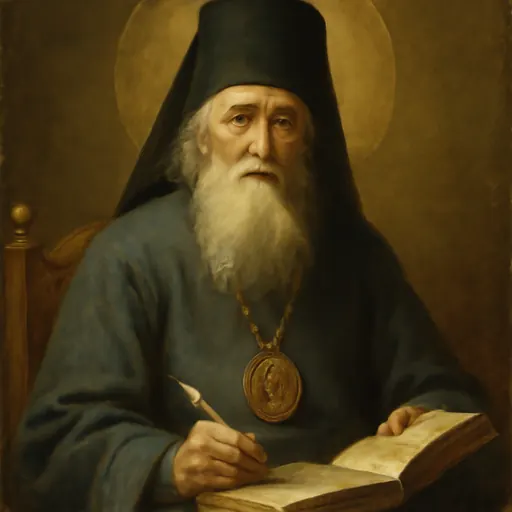
St. Theophan the Recluse (1815–1894), born Georgy Govorov, was a Russian Orthodox bishop who gave up his diocese in 1866 and spent his last 28 years in seclusion at the Vysha monastery, writing books and letters on prayer and the spiritual life. He translated the Philokalia into Russian, and the Russian Church glorified him as a saint in 1988. His feast is January 10.
Who was St. Theophan the Recluse?
St. Theophan the Recluse was a Russian Orthodox bishop of the 19th century who left his diocese to live alone with God, and from his small cell became one of the most widely read spiritual teachers in Russia. Born Georgy Govorov in 1815, he served as a scholar, a rector and the bishop of two dioceses. In 1866 he retired to the Vysha monastery, and from 1872 until his death in 1894 he saw almost no one. In those years he wrote a shelf of books, translated the Philokalia into Russian and answered twenty to forty letters a day.
The Russian Orthodox Church glorified him as a saint at its Local Council of 1988, the millennium of the Baptism of Rus'. His feast is January 10. Orthodox Christians read him today because, as the Orthodox Church in America puts it, his gift was "the ability to present the wisdom of the Fathers in terms which modern people can understand."
The life of St. Theophan the Recluse
A priest's son from Oryol
Georgy Vasilievich Govorov was born on January 10, 1815, in the village of Chernavsk in the Oryol province, where his father was the parish priest. He went to the church school at Livny, the Oryol seminary and, from 1837, the Kiev Theological Academy. Kiev and its Monastery of the Caves drew him to the monastic life, and in 1840, while still a student, he was tonsured with the name Theophan and ordained a hieromonk.
Teacher, missionary and rector
For the next eighteen years Father Theophan moved between the schools and missions of the Russian Church. He taught in Kiev, Novgorod and St. Petersburg. From 1847 he served with the Russian Ecclesiastical Mission in Jerusalem, where he studied the Greek Fathers and the old manuscripts of the Eastern monasteries. He was rector of the Olonets seminary, then chief priest of the Russian embassy church in Constantinople, and in 1857 rector of the St. Petersburg Theological Academy. The OCA notes he "was not completely happy with academic work."

Bishop of Tambov and Vladimir
On May 9, 1859, he was consecrated Bishop of Tambov. He preached constantly, visited his parishes, restored churches and founded a diocesan school for girls. He also found the secluded Vysha monastery in his diocese and came to love it. In 1861 he took part in uncovering the relics of St. Tikhon of Zadonsk, a saint he had loved since childhood, and the OCA says that at Tikhon's glorification "his joy knew no bounds." In 1863 he was moved to the diocese of Vladimir, where he founded another girls' school. He found it hard to correct anyone, and left disciplining to others.
Into seclusion at Vysha
In 1866 he asked to retire and was allowed to settle at Vysha. He said farewell to his diocese on July 24, 1866. For six years he attended every service in the monastery church, standing with his eyes closed so as not to be distracted. Then, from 1872, he withdrew completely. He saw only his confessor and the monk who looked after him, and built a tiny chapel of the Baptism of the Lord in his own quarters. For ten years he served the Liturgy there on Sundays and feasts. In his last eleven years he served it every day, alone.

The writer of Vysha
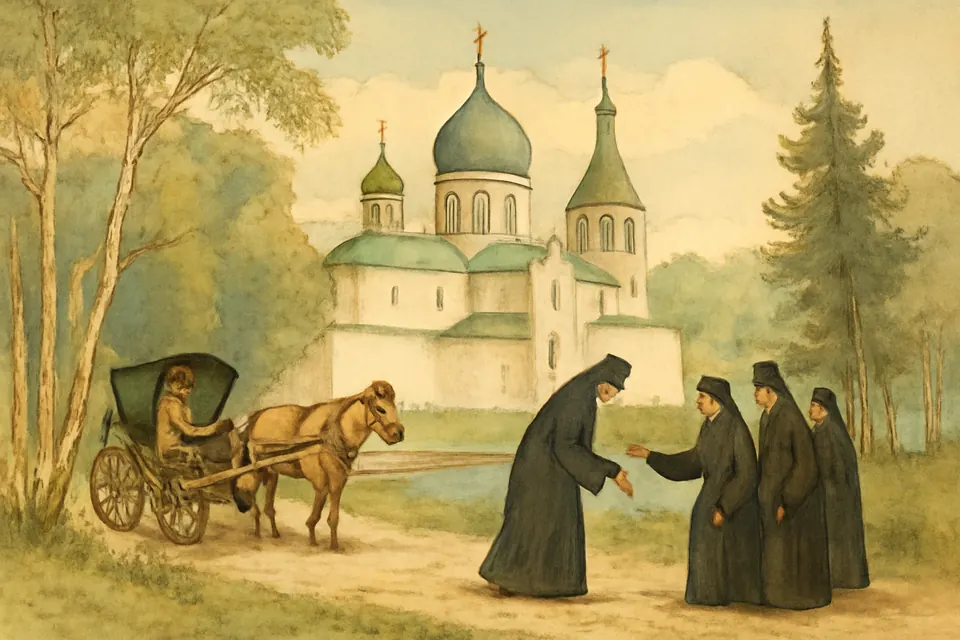
"The more silent was saint's tongue," says one Russian account, "the more loudly spoke his pen." Theophan wrote commentaries on the Psalms and the letters of St. Paul, and books on the Christian life such as The Path to Salvation and The Spiritual Life and How to Be Attuned to It, a series of letters to a young woman. He translated the Philokalia, the great collection of Greek writings on prayer, into Russian in five volumes, and the sermons of St. Symeon the New Theologian.
He also produced Unseen Warfare, an Orthodox version of The Spiritual Combat by the Italian Theatine priest Lorenzo Scupoli (1530–1610), which St. Nicodemus of the Holy Mountain had adapted into Greek and Theophan revised for Russian readers. A Catholic book of the Counter-Reformation became, through his hands, a classic of Russian Orthodox spirituality.
He took no money for his books and kept their prices low. Money people sent him went to the poor, except a little for books. When he wasn't writing or praying he worked at carpentry and painted icons. He answered every letter, and his letters fill several volumes.
His death on Theophany
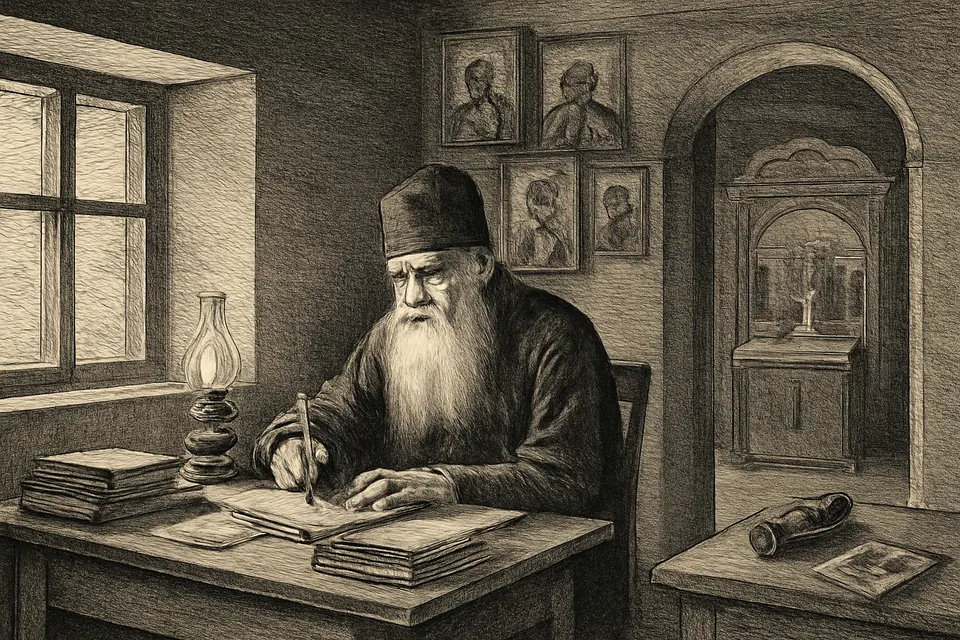
In his last years his eyesight failed, but he kept writing. On January 6, 1894, the feast of Theophany, he was still at work in the afternoon. At 4:30 his attendant found that he had died. His body lay in his cell chapel for three days and in the cathedral for three more, and the OCA says "there was no trace of corruption." He was buried in the Kazan church of the monastery.

The miracles of St. Theophan the Recluse
Anatoly Plevo's 2021 collection, published by Pravoslavie.ru, gathers accounts of healings and visions through Theophan's prayers. All are reported accounts kept by the monastery and by witnesses. They include:
- A nearly blind peasant woman who, in May 1904, came to his grave after a monk told her in a dream to go to Vysha, and went home healed. The monastery chronicler recorded it.
- A boy unable to walk from birth, brought three times to the relics in the village church at Emmanuilovka, who on the third visit got down and ran, as told by the rector, Archpriest George Glazunov.
- A Soviet-era exile in Karaganda, lost in a winter blizzard, who said a shining figure in a bishop's vestments led him back to the road.
The Orthodox Church does not hold formal miracle trials as the Catholic Church does, and the 1988 council glorified him above all for his holy life and teaching.
Why St. Theophan the Recluse is honored by writers and theologians
No church has formally made Theophan a patron, but his place among the Orthodox is clear. He is honored as a teacher of prayer, and writers, translators and those who guide others in the spiritual life look to him. His troparion calls him "teacher of piety and purity" who "by your writings explained the Word of God." Find other patrons of scholars and writers on our patron saints page.
His central teaching is that prayer of the heart belongs to everyone. In a letter to a woman who thought it was only for monks, he wrote that prayer is "the raising of the mind and heart to God," and that its essence is when "the mind stands in the heart consciously before the face of God." For busy people he had practical advice: "There is nowhere one needs to hide but in one's own heart." Catholics who know St. Francis de Sales will recognize the same conviction, that holiness is for people in the world.
Symbols of St. Theophan the Recluse in art
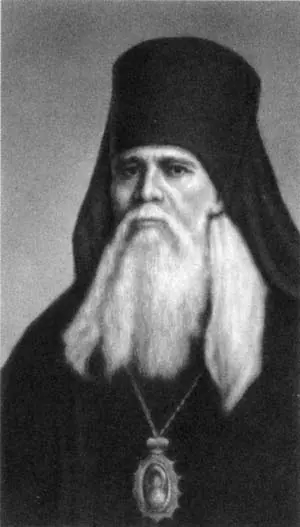
Theophan lived in the age of photography, and his icons follow his real face closely:
- A black monastic hood (klobuk) with a veil: the headdress of a Russian monk-bishop.
- A long white beard: the old recluse, as his photographs show him.
- A bishop's mantle and panagia: the striped mantle and the small oval icon of the Mother of God worn on the breast by Orthodox bishops.
- A scroll, an open book or a pen: the writer. Russian icons often write on his scroll words from his teaching on prayer.
- A bishop's staff: his office as a hierarch.
Look at the icon from Holy Trinity Orthodox Church in Parma, Ohio, below: the black klobuk, the blessing hand and the staff are all there. Earlier portraits, such as Borel's lithograph of 1860, show him younger, with a dark beard.

Feast day, relics and the Vysha monastery
The Orthodox Church keeps his feast on January 10, which is January 23 of the civil calendar in the Russian Church. A second feast on June 16 (June 29 civil) remembers the return of his relics to Vysha. Our feast days page lists the saints of each month.
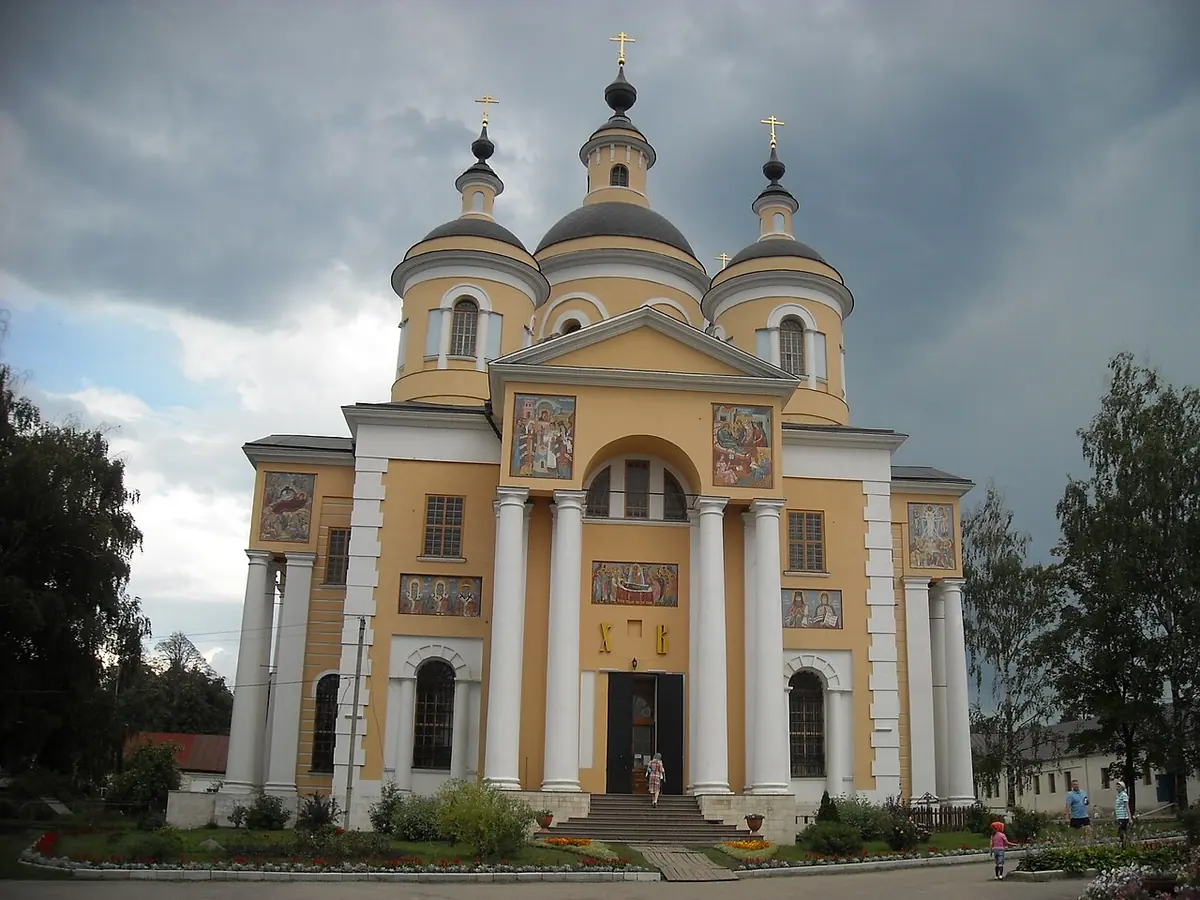
The story of his relics follows the history of his Church. After the revolution the monastery was closed and its buildings turned into a psychiatric hospital. In 1973, on the grounds of that hospital, Hieromonk Eleutherius and Fr. George Glazunov secretly opened his broken tomb and carried the relics to the Holy Trinity-St. Sergius Lavra near Moscow, where they were hidden in the crypt of the Dormition Cathedral. After his glorification in 1988 they were placed in the Church of St. Sergius in Emmanuilovka, near Vysha. On June 29, 2002, they were brought back to the restored Vysha monastery, where they rest in the Kazan Cathedral.
Prayer to St. Theophan the Recluse
The Orthodox Church sings this troparion on his feast, in the translation of the Orthodox Church in America:
O guide of Orthodoxy, teacher of piety and purity, / ascetic of Vysha, divinely wise and holy hierarch Theophan: / By your writings you explained the Word of God, / and showed the way of salvation unto all the faithful. / Entreat Christ God that our souls may be saved.
And the kontakion, which plays on his name:
Holy hierarch Theophan, namesake of Theophany, / you enlightened many people by your teachings. / Now that you stand before the throne of the Holy Trinity / together with the angels, / pray without ceasing for us all.
Let us ask St. Theophan to pray for us, that we too may learn to stand before God in our hearts, at home and at work, every day of our lives.
Frequently asked questions
Who was St. Theophan the Recluse?
A Russian bishop and spiritual writer. Born Georgy Govorov in 1815, a priest's son, he became a monk, a seminary and academy rector, and Bishop of Tambov and then of Vladimir. In 1866 he retired to the Vysha monastery, where from 1872 he lived as a recluse until his death in 1894, writing on prayer and answering thousands of letters.
When is the feast of St. Theophan the Recluse?
January 10 in the Orthodox calendar, which is January 23 of the civil calendar in churches that keep the Julian calendar. He died on January 6, the feast of Theophany, so his memory is kept four days later. The return of his relics to Vysha is remembered on June 16 (June 29 civil).
What books did St. Theophan the Recluse write?
His best known in English are The Path to Salvation, The Spiritual Life and How to Be Attuned to It (letters to a young woman) and his letters on the spiritual life. He translated the Philokalia into Russian in five volumes and prepared the Russian version of Unseen Warfare, an Orthodox adaptation of The Spiritual Combat by the Italian priest Lorenzo Scupoli.
What did St. Theophan teach about prayer?
That prayer is "the raising of the mind and heart to God," and that its heart is standing before God with attention, "the mind stands in the heart consciously before the face of God." He taught that this prayer of the heart is for every Christian, including people with families and jobs in the world, not only for monks.
Where are the relics of St. Theophan the Recluse?
In the Kazan Cathedral of the Vysha Dormition Monastery in the Ryazan region of Russia. They were secretly taken from his ruined tomb in 1973 and returned to the restored monastery on June 29, 2002.
Sources
- Orthodox Church in America: Saint Theophan the Recluse, Bishop of Tambov
- Orthodox Church in America: Saint Theophan the Recluse, Troparion and Kontakion
- Bishop Theophan the Recluse, "Prayer of the Heart: the Duty of Those Living in the World" (Orthodox America)
- OrthoChristian: Translation of the Relics of St. Theophan, the Recluse of Vysha
- Anatoly Plevo, "Miracles Through the Prayers of St. Theophan the Recluse" (OrthoChristian, 2021)
- Unseen Warfare: Being the Spiritual Combat and Path to Paradise of Lorenzo Scupoli, as edited by Nicodemus of the Holy Mountain and revised by Theophan the Recluse (Faber and Faber, 1952)