St. Paul of Obnora, Hermit of the Russian North

St. Paul of Obnora (1317–1429) was a Russian monk, a disciple of St. Sergius of Radonezh, who spent fifteen years as a recluse, three years living in a hollow linden tree and the rest of his long life as a hermit in the forests near Vologda, where he founded the Pavlo-Obnorsky Monastery in 1414. He died at 112. The Orthodox Church keeps his feast on January 10.
Who was St. Paul of Obnora?
St. Paul of Obnora was one of the great hermits of the Russian North, a disciple of St. Sergius of Radonezh who carried his teacher's way of prayer into the deep forests beyond the Volga. He lived as a recluse, then three years in the hollow of a linden tree, then as a hermit on the little Nurma River near Vologda. The monks who gathered around him became the Pavlo-Obnorsky Monastery. He died in 1429 at the age of 112, and the Orthodox Church keeps his feast on January 10.
Almost everything we know comes from his Life, written by an unnamed monk around 1546, more than a century after his death. The Russian Biographical Dictionary judged that it was probably drawn from the memories of the second generation of monks and deserves a historian's attention, "though not unconditionally." We read it in that spirit, grateful for what it preserves.
From Moscow to St. Sergius
Paul was born in Moscow in 1317 to a wealthy family who planned a worldly life for him. The OCA's life says that from his youth he was known for kindness to the poor and the suffering. At twenty-two, pressed to marry, he left home in secret and received the monastic tonsure at the Nativity Monastery on the Volga.
From there he went to the Holy Trinity Monastery in the forests of Radonezh, where St. Sergius was gathering disciples. Paul obeyed the elder in everything. With Sergius's blessing he moved into a separate cell near the monastery and lived there alone for fifteen years without going out. When at last he asked leave to go into the wilderness, Sergius blessed him and gave him a copper cross, which the monastery still guarded in the nineteenth century.
Three years in a linden tree
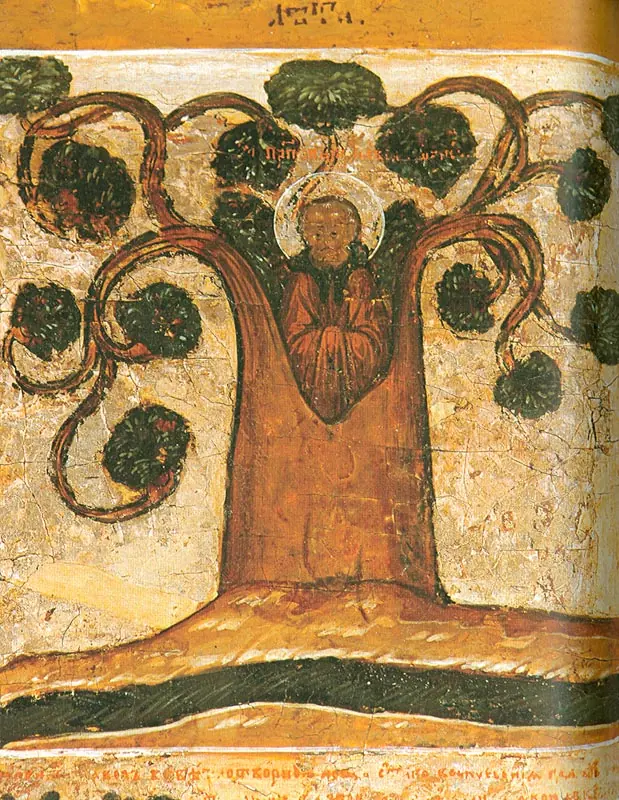
Paul wandered for years through the forests and hermitages of the north. He stayed for a time with St. Abraham of Chukhloma and finally settled in the Komel forest. On the bank of the Gryazovitsa River he found an old linden tree with a hollow trunk, made it his cell and lived in it for three years in complete silence, "not giving his body rest, that he might receive future rest," as the OCA's account puts it.

Then he moved a little farther, to the Nurma River, built a hut and dug a well. He kept vigil and prayed. For five days of the week he ate nothing; on Saturday and Sunday he took a little bread and water.
A monastery in the forest
A hermit who prays like that is soon found. People came to him for counsel, and Paul, for all his love of solitude, never sent anyone away without comfort. St. Sergius of Nurma, another disciple of Radonezh, lived in the same forests and became his close friend.
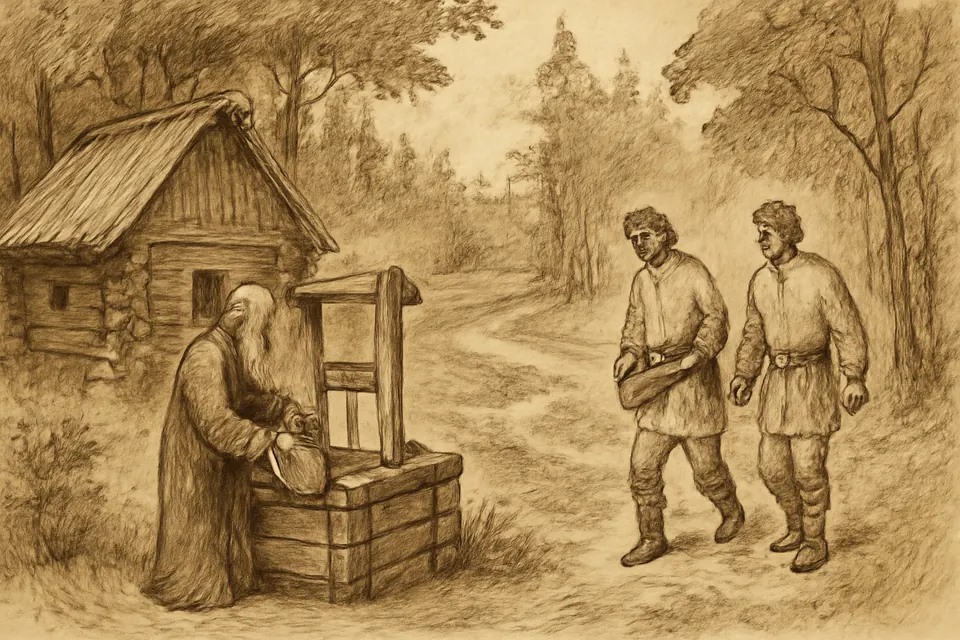
The brothers needed a rule. Paul went to Moscow to ask Metropolitan Photius for a blessing to found a monastery. According to the Life, the blessing did not come at once, but only after Photius was moved by a vision. The community dates its founding to 1414, when the Trinity church was built. Paul wrote a strict rule, handed the leadership to his disciple Alexis and went back to his solitary cell on a hill, coming down to the monastery only now and then.
He died on January 10, 1429. His last words to the brothers, as the OCA gives them, were: "Brethren, have love one for another and keep to the rule of the monastic community."
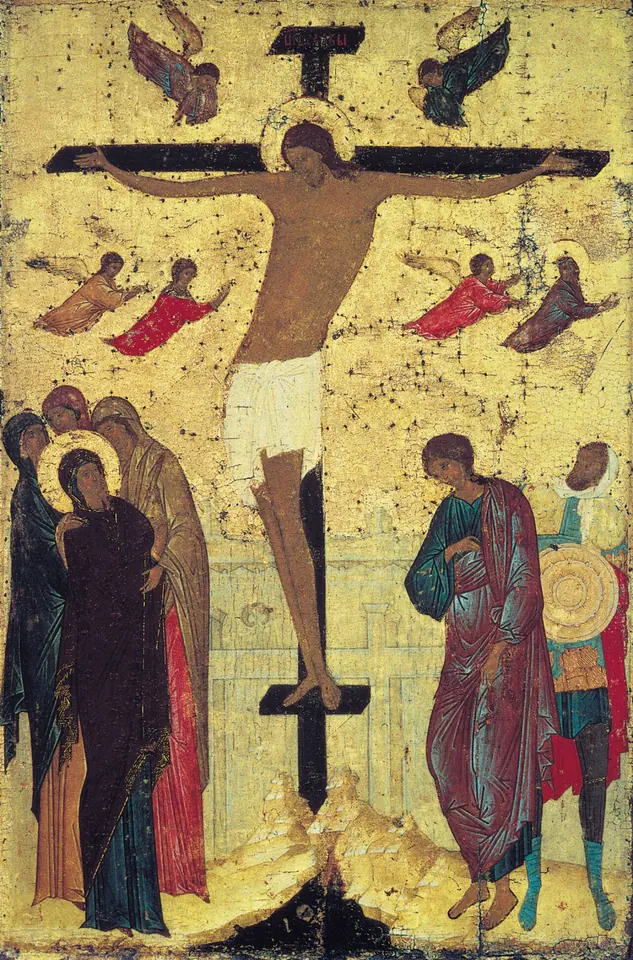
About seventy years after his death, Dionisius, the finest Russian icon painter of his day, and his workshop painted icons for the monastery's Trinity church. Several of them, including this Crucifixion, are now in Moscow.
Miracles and glorification
The Life tells of many traditional miracles at his tomb, and a later version adds a whole cycle of them; we have no independent record of these. What we do know is how his feast came to be kept across Russia. When the monks dug trenches for a new stone church over his grave in the 1540s, they found his body incorrupt, a reported finding recorded in the dictionary's summary of the Life. In 1547 the council of Moscow under Metropolitan Macarius added him to the saints honored throughout the Russian land. Macarius's circular letter to Vologda ordered that the feast be sung "on the 10th day of January" for "the venerable Paul of Obnora, the new wonderworker."
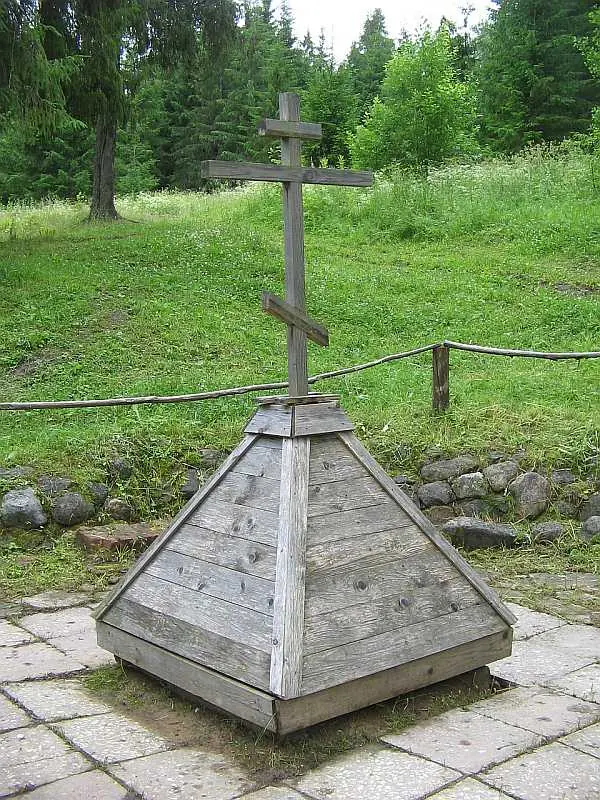
His relics were not placed on view. The dictionary says they lie "under a bushel," hidden beneath the church floor. The Tatars sacked the monastery in 1538, the Soviet state closed it in 1924, and monks returned in 1994. Pilgrims now pray at a wooden shrine over his resting place.

Symbols of St. Paul of Obnora in art
Russian icons show him as a very old monk with a long white or gray beard, in the dark mantle and schema of a hermit. Look for:
- The hollow linden tree: his three years of silence. Some icons place him standing inside the trunk.
- An unrolled scroll: usually lettered with words of counsel to his monks.
- The forest, a hut or a well: his hermitages on the Gryazovitsa and Nurma Rivers.
- A copper cross: the blessing of St. Sergius.
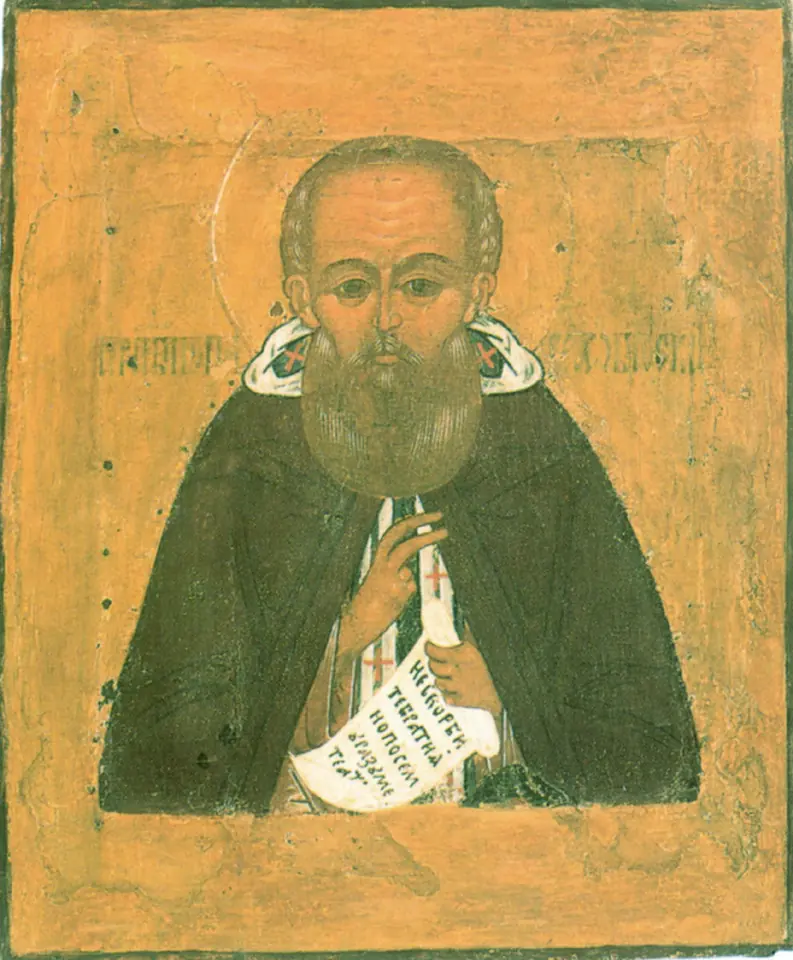
He often appears beside other disciples of St. Sergius and the hermits of the Vologda forests on icons of the northern saints.
Prayer to St. Paul of Obnora
The Orthodox service for his feast includes this troparion, in the translation of the Orthodox Church in America:
Inflamed with divine love from your youth, O venerable Paul, and despising all earthly attractions, you came to love Christ alone, / and for His sake, you settled in the inner wilderness / and lived with the wild animals, entirely for Christ. / Thus, the All-Seeing Eye, having beheld your labors, / enriched you with the gift of miracles, even after your repose. / Therefore, we cry out to you: / Pray unceasingly for us who always revere your honorable memory with hymns of praise.
Let us ask St. Paul to pray for all who seek silence with God, and for every community that tries to keep his last counsel: love one another and keep the rule.
Frequently asked questions
Who was St. Paul of Obnora?
A monk born in Moscow in 1317 who fled an arranged marriage at twenty-two, became a disciple of St. Sergius of Radonezh, and later lived as a hermit in the Komel forests north of the Volga. The disciples who gathered around him became the Pavlo-Obnorsky Monastery, founded in 1414. He died on January 10, 1429.
When is the feast day of St. Paul of Obnora?
January 10. Churches on the Julian calendar, such as the Russian Orthodox Church, celebrate that date on January 23 of the civil calendar.
Why is St. Paul of Obnora shown in a tree?
His Life says that he lived for three years in the hollow of an old linden tree beside the Gryazovitsa River, in silence, before moving to the Nurma River. Icons show him standing inside the trunk.
Where are the relics of St. Paul of Obnora?
At the Pavlo-Obnorsky Monastery in the Vologda region of Russia. His body was found incorrupt in the 1540s and has been kept beneath the floor of the church rather than displayed. Pilgrims pray at a wooden shrine over the place.
Keep exploring
Sources
- Orthodox Church in America: Venerable Paul, Abbot of Obnora, Vologda. His years with St. Sergius, the linden tree, his fasting, his age at death and his last words
- Orthodox Church in America: Troparion and Kontakion for January 10. The troparion quoted here
- Russkiy biograficheskiy slovar (Russian Biographical Dictionary), vol. 13: Pavel, prepodobny Komelsky (Obnorsky), at Azbyka.ru. The copper cross, Metropolitan Photius, the 1547 council and Macarius's letter, the finding of the relics, the age of the Life