St. Stephen of Muret, Founder of the Order of Grandmont

St. Stephen of Muret (1045–1124) was a French hermit who lived for decades in the woods of Muret, near Limoges, and whose disciples became the Order of Grandmont, one of the strictest religious orders of the Middle Ages. He taught that there is no rule but the Gospel of Christ. He was canonized in 1189, and his feast is February 8.
Who was St. Stephen of Muret?
St. Stephen of Muret was a French hermit who lived for many years in the woods of Muret, in the hill country near Limoges, and died there on February 8, 1124. A handful of men came to live and pray with him. After his death they moved to the rocky height of Grandmont nearby, and the Order of Grandmont grew from that small company. Within a few generations it had well over a hundred houses across France, and its poor, silent monks were called les bons hommes, "the good men."
Stephen himself wrote no rule and founded no great abbey. What he left was the example of a life given entirely to God, and one saying that his disciples never forgot: there is no rule save the Gospel of Christ.
The life of St. Stephen of Muret
A story that cannot be trusted
The old life of Stephen tells a full and tidy story. At twelve he went to Italy with his father, the Viscount of Thiers, and stayed in the household of Milo, Archbishop of Benevento. He then lived among hermits in Calabria, went to Rome, and received a bull from Pope Gregory VII allowing him to found a community like theirs. He is said to have settled at Muret in 1076.
The Catholic Encyclopedia of 1912 says plainly that this story is impossible. His father is said to have made a pilgrimage to the relics of St. Nicholas at Bari years before they were brought there, and Milo was never archbishop for twelve years. The bull of Gregory VII turned out to be a forgery, made when other orders were arguing over whether Grandmont belonged to them. Dom Martène, the great Maurist scholar, thought the community could not be older than about 1100.
So we hold what is sure and let the rest go. Stephen came from a noble family of Auvergne. He traveled to Italy and met religious men there whose holy life moved him to imitate them. He came home and became a hermit at Muret. That is enough.
The hermit of Muret
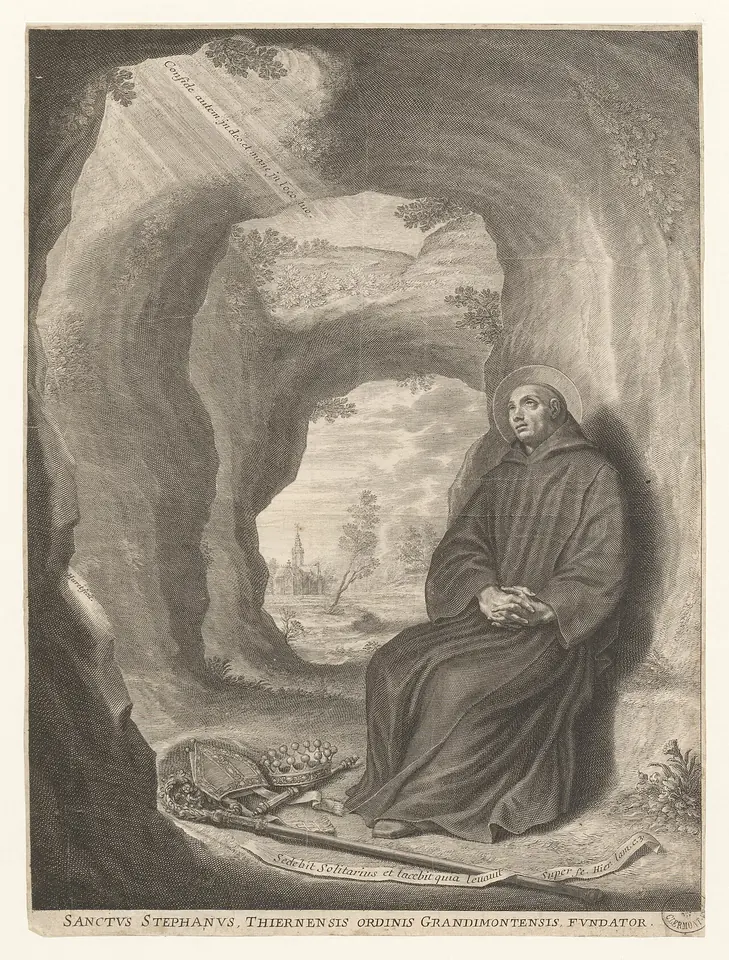
At Muret, Stephen lived in great poverty and prayer. Men came to share his life, and he received them, but the Catholic Encyclopedia notes that he did little to organize them. He offered them the example of his holiness, and that was his whole method. The order took firm shape only after his death.
His teaching comes down to us in one line, kept by his disciples: there is no rule save the Gospel of Christ. Every rule of religious life rests on the Gospel, he said, and so a monk who lives the Gospel's teaching keeps every duty of his state.
Death and the move to Grandmont
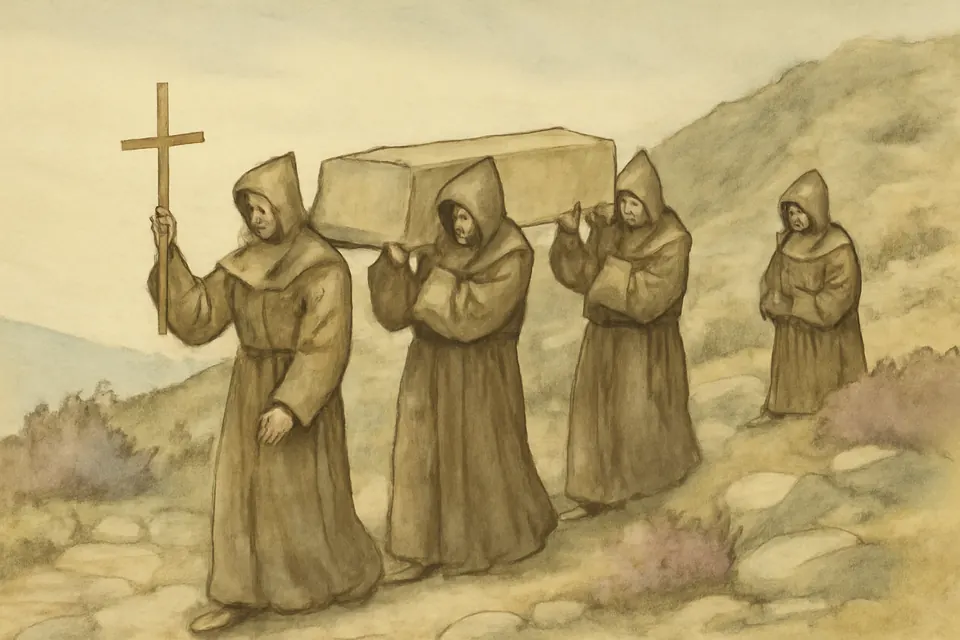
Stephen died at Muret on February 8, 1124. His disciples soon found themselves in a dispute over who owned the land at Muret, and they moved to the stony, deserted height of Grandmont close by. The house there became the head of the order.
The Order of Grandmont
The early Grandmontines were known all over France for their austerity. The rule written down by Hugh Lacerta some decades after Stephen's death forbade them to own lands, cattle, revenues or parish churches. They could beg only when there was no food in the house, and even then the bishop had to be told first. Silence and fasting were strict.
By 1170 there were sixty houses, and under the next prior eighty more were founded. King Henry II of England had the monastery at Grandmont rebuilt, and St. Louis IX built a house for the order at Vincennes. Three small houses stood in England, at Alberbury, Craswall and Grosmont.
The golden age lasted only about sixty years. Quarrels between the choir monks and the lay brothers, who ran the order's property, troubled Grandmont for generations, and in 1317 Pope John XXII reorganized the order. It declined slowly after that, and the last two monks left the mother house in 1787. Today only fragments of wall remain.
Miracles and holiness
The Catholic Encyclopedia notes that the writings once credited to Stephen are not his own. No particular miracle from his life is recorded in the sources we have consulted, and the lives written at Grandmont mix history and legend. What the Church honored when Pope Clement III canonized him in 1189 was a life of prayer, poverty and simplicity that drew others to Christ. We can call the devotion of pilgrims at his relics a traditional honor, kept in the Limousin for nine centuries.
Symbols of St. Stephen of Muret in art
Stephen is rarely painted, and he is easiest to recognize by where he appears: in the churches of the Limousin and in art made for Grandmont.
- Hermit's habit and hood: the coarse tunic, scapular and hood of the early Grandmontines, brown at first and later black.
- Book of the Gospels: his saying that the Gospel is the only rule.
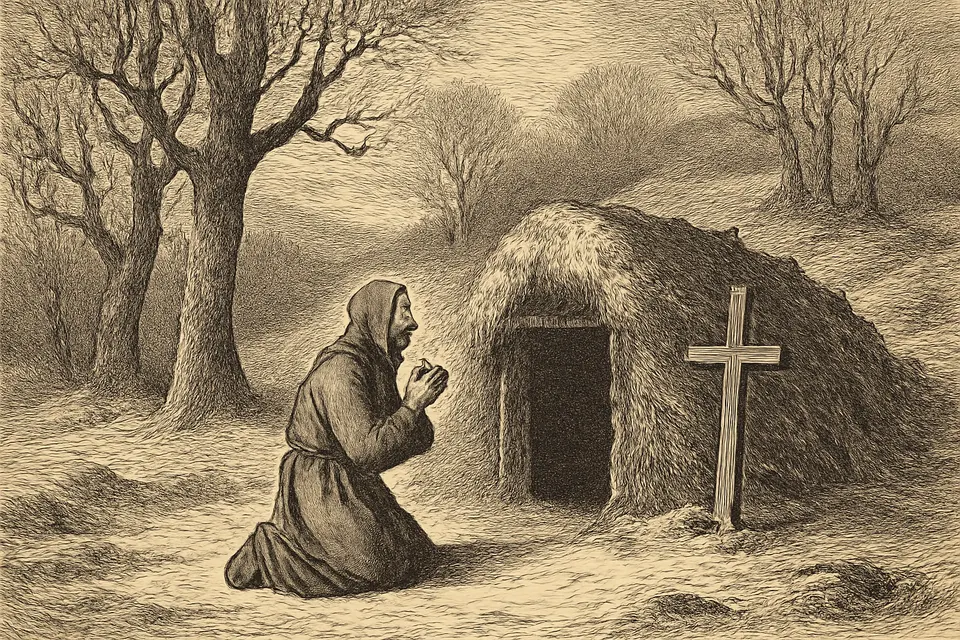
- Cave or forest hut: the solitary life at Muret.
- Staff: the founder and father of a community.
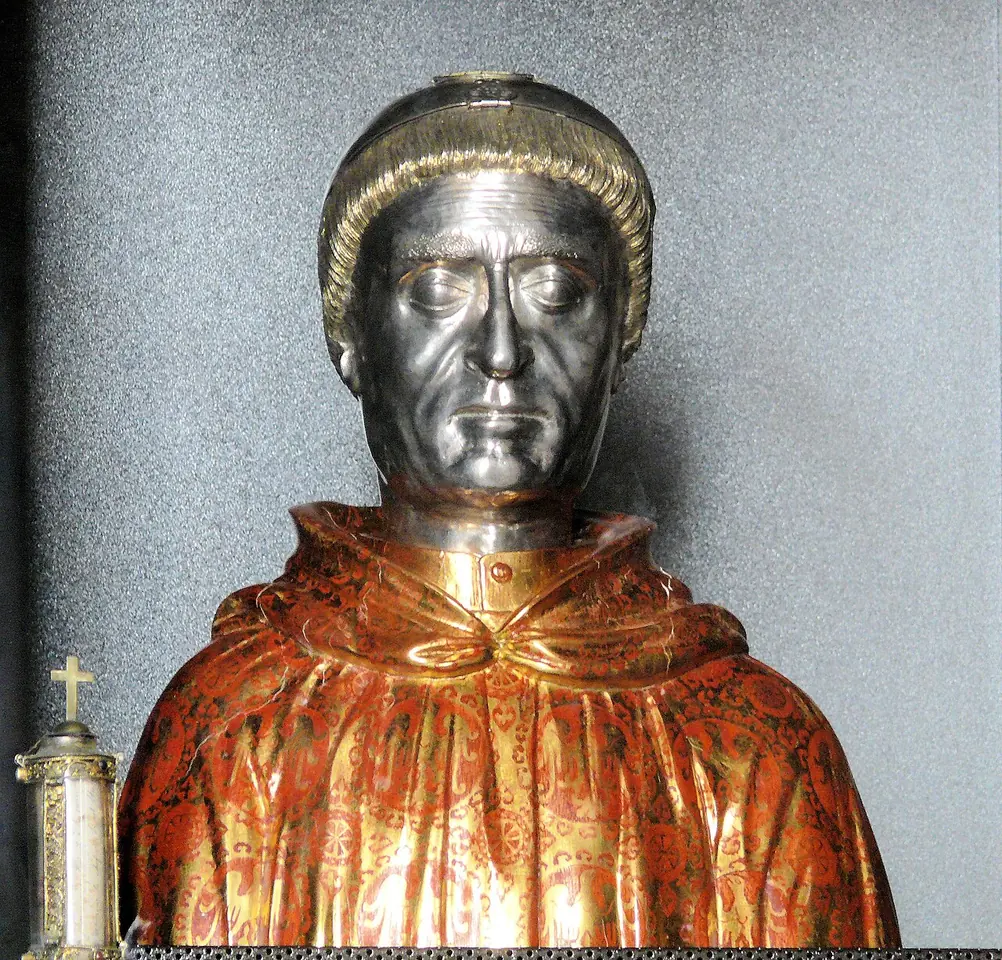
- Reliquary bust: the silver and gilded bust at Saint-Sylvestre that holds his head.
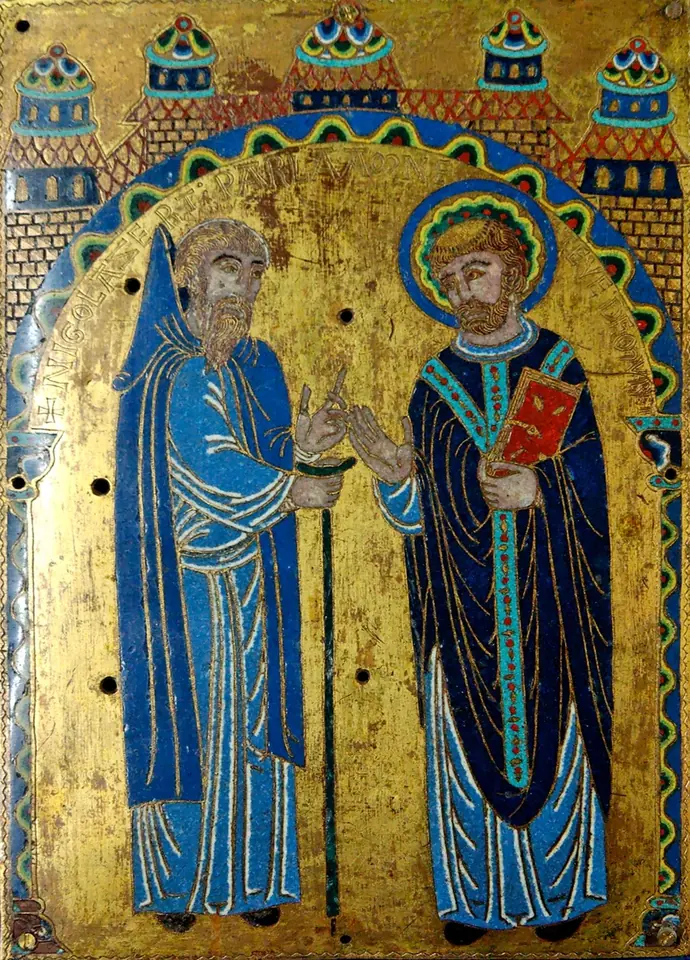
The enamel plaque near the top of this page, made in Limoges for the high altar of Grandmont about 1189–1190, is the oldest image of him. It shows Stephen with a halo and a red book, speaking with Hugh Lacerta, the disciple who wrote down the customs of Grandmont.
Feast day and where he is honored
We keep the memory of St. Stephen of Muret on February 8, the day of his death and his date in the Roman Martyrology. His head rests in a reliquary bust in the parish church of Saint-Sylvestre, near the site of Grandmont, where his feast is still kept. Find other saints of the season on our feast days page.
Prayer to St. Stephen of Muret
We know of no traditional prayer to St. Stephen of Muret in common use outside the Limousin. We can take his own saying as a prayer: let the Gospel of Christ be our rule. Let us ask St. Stephen to pray for hermits and for all religious, for those who feel drawn to a simpler life, and for everyone who wants to live the Gospel without excuses.
Frequently asked questions
Who was St. Stephen of Muret?
A French nobleman's son who became a hermit near Limoges around the year 1100 and gathered a few disciples around him. After his death in 1124 they moved to nearby Grandmont and became the Order of Grandmont, known in France as the bons hommes, the good men.
When is the feast of St. Stephen of Muret?
February 8, the day he died in 1124. It is his date in the Roman Martyrology; his feast is kept locally in the Limousin.
What was the Rule of Grandmont?
St. Stephen left no written rule. His saying was that there is no rule save the Gospel of Christ. The written 'Rule of St. Stephen' was put together after his death by Hugh Lacerta, one of his disciples, at the request of the fourth prior, Étienne de Liciac.
Where are the relics of St. Stephen of Muret?
His head is kept in a reliquary bust in the parish church of Saint-Sylvestre (Haute-Vienne), near the ruins of Grandmont.
Keep exploring
Sources
- Catholic Encyclopedia (1912): St. Stephen of Muret. The problems with the traditional story of his youth, his death on February 8, 1124, canonization in 1189 and the head relic at Saint-Sylvestre
- Catholic Encyclopedia (1912): Abbey and Order of Grandmont. His saying on the Gospel, the forged bull of Gregory VII, Hugh Lacerta's rule, the move to Grandmont, the order's growth, decline and end in 1787