St. Athenagoras of Athens
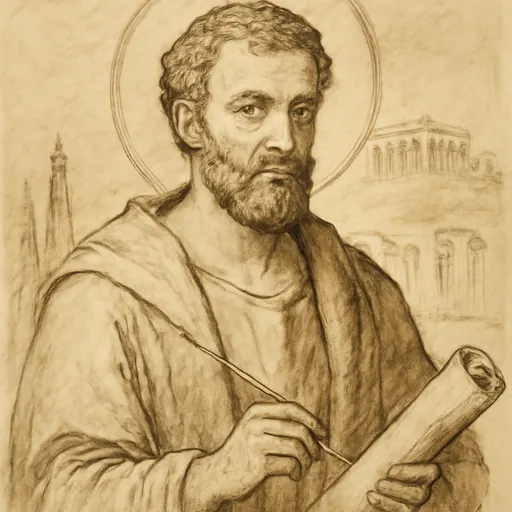
St. Athenagoras of Athens was a Christian philosopher of the 2nd century, a convert who wrote one of the finest early defenses of the faith, the Plea for the Christians (about 177), addressed to the emperors Marcus Aurelius and Commodus. He also wrote the first full Christian treatise On the Resurrection of the Dead. We keep his memory on July 24.
Who was St. Athenagoras of Athens?
St. Athenagoras of Athens was a Christian philosopher of the 2nd century, one of the apologists who defended the young Church before the educated pagan world. Around the year 177 he addressed a carefully reasoned Plea for the Christians to the emperors Marcus Aurelius and his son Commodus. He also wrote On the Resurrection of the Dead, the first complete Christian treatise on the subject. Those two works are almost all we have of him.
The Catholic Encyclopedia puts it plainly: he is a man "of whom no more is known than that he was an Athenian philosopher and a convert to Christianity." He was not a martyr, as far as we know, and no early miracles are told of him. He is honored for his mind, which he gave to Christ.
His life
What we know comes from his own writings. He calls himself an Athenian and writes as a trained philosopher who knew Plato, the poets and the Stoics thoroughly. Early Christian writers barely mention him. St. Methodius of Olympus, who died about 311, quotes the Plea, and a 5th-century church historian, Philip of Side, gives biographical details that the Catholic Encyclopedia calls untrustworthy. The encyclopedia suggests his works may for a time have circulated without his name.
His writing does tell us something about the man: he was patient, courteous, learned and very clear. He wrote to two emperors who were persecuting Christians, and he wrote to them as one philosopher to others.
The Plea for the Christians
The Plea is addressed "To the Emperors Marcus Aurelius Antoninus and Lucius Aurelius Commodus, conquerors of Armenia and Sarmatia, and more than all, philosophers." Internal evidence dates it late in 176 or in 177, the same year Christians were martyred at Lyon, among them St. Blandina.
It opens by pointing out an injustice. Every nation in the empire may worship whatever it likes, Athenagoras says, even cats and crocodiles in Egypt, yet Christians are punished for the name alone:
Names are not deserving of hatred: it is the unjust act that calls for penalty and punishment.
He then answers the three charges commonly made against Christians: atheism, cannibalism and incest.
Not atheists
Christians are called atheists because they reject the gods of the city. Athenagoras replies that they worship the one uncreated, eternal God, and he gives one of the earliest clear statements of the Trinity in Christian literature (chapter 10):
Who, then, would not be astonished to hear men who speak of God the Father, and of God the Son, and of the Holy Spirit, and who declare both their power in union and their distinction in order, called atheists?
A people who love their enemies
Against the charge of immorality he quotes the Sermon on the Mount: "Love your enemies; bless them that curse you; pray for them that persecute you." Which philosopher, he asks, has so purified his soul that he loves those who hate him?
Reverence for every human life
Against the charge of murder and cannibalism he gives a striking answer. Christians will not even watch the gladiator shows, "deeming that to see a man put to death is much the same as killing him." And they hold that women who use drugs to bring on abortion commit murder, for Christians regard "the very fœtus in the womb as a created being, and therefore an object of God's care." The same reverence forbids exposing infants. This chapter is among the earliest Christian witnesses to the dignity of unborn life.
He closes by asking the emperors to "bend your royal head in approval," reminding them that Christians pray for their rule.
On the Resurrection of the Dead
His second work, written after the Plea, defends the Christian hope that the body will rise. The Catholic Encyclopedia calls it "the first complete exposition of the doctrine in Christian literature." Athenagoras argues that God has the power to raise the dead, that doing so is neither unworthy of God nor unjust, and that human nature itself demands it, because a human being is soul and body together. As he puts it, the end of a man's being must appear "in some reconstitution of the two together."
How his words came down to us
The early apologies reached us because Byzantine scholars kept copying them. One of the treasured manuscripts of this kind is the Arethas Codex in Paris, made in the 10th century for Archbishop Arethas of Caesarea. The page shown below opens the Exhortation to the Greeks, another early defense of the faith once credited to St. Justin.
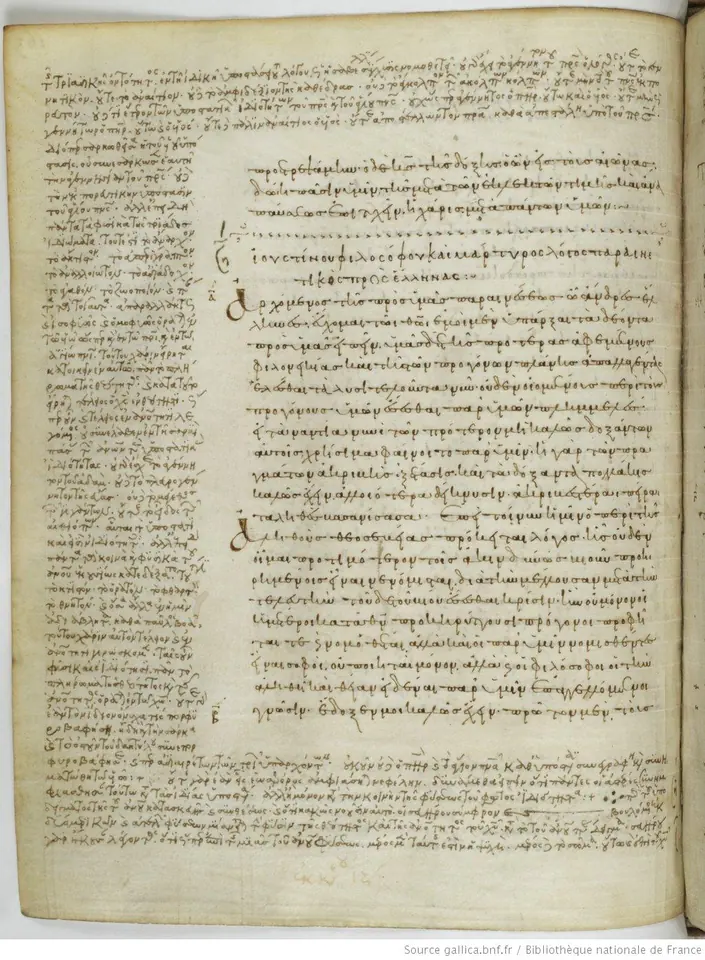
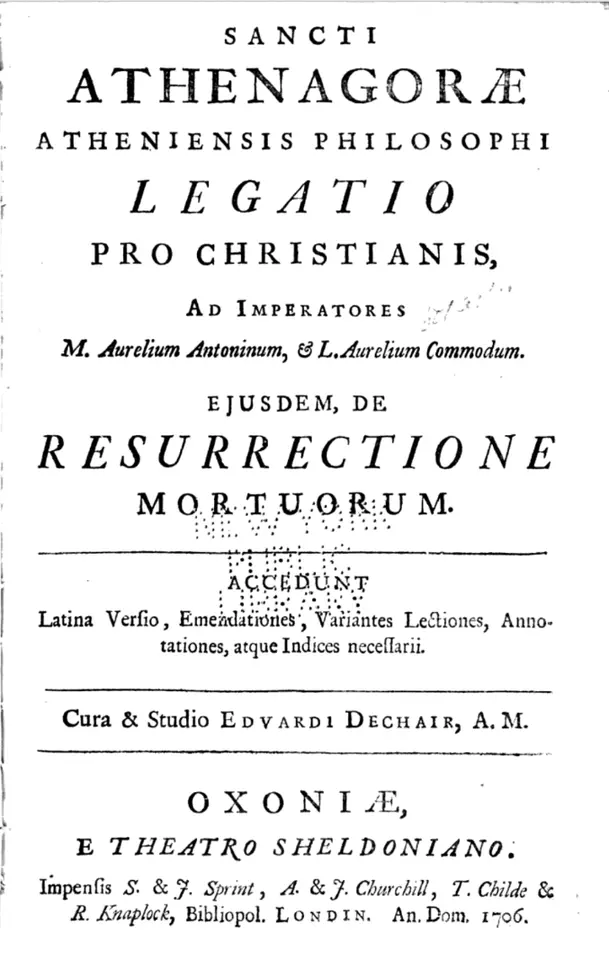
When scholars printed his works, they gave him the title of saint. The Oxford edition of 1706, prepared by Edward Dechair, is headed Sancti Athenagorae Atheniensis Philosophi Legatio pro Christianis, "The Embassy for the Christians of St. Athenagoras, Athenian Philosopher."
Miracles
No miracles are recorded for St. Athenagoras. He is honored as a teacher of the faith, not a wonderworker.
Symbols of St. Athenagoras in art
Images of him are rare, and none is ancient. When he is shown, look for:
- The philosopher's cloak, the plain pallium Greek philosophers wore, which early Christian teachers kept.
- A scroll or book, for his Plea and his treatise.
- A pen, for the writer and apologist.
His fellow apologist St. Justin Martyr is often shown with the same philosopher's cloak.
Feast day
We keep his memory on July 24, the date modern saint lists give him. See our feast days page for other saints of July.
Prayer to St. Athenagoras
No traditional prayer to St. Athenagoras has come down to us. Let us pray in the spirit of his Plea, asking God for the courage to give a reasoned answer for our hope, to love those who misunderstand us, and to defend every human life, born and unborn, as "an object of God's care." St. Athenagoras, pray for Christian thinkers and teachers.
Frequently asked questions
Who was St. Athenagoras of Athens?
An Athenian philosopher who became a Christian and, about 177, wrote a reasoned defense of the faith to the emperors Marcus Aurelius and Commodus. The Catholic Encyclopedia notes that almost nothing else is known about him.
What did St. Athenagoras write?
Two works survive. The Plea (or Embassy) for the Christians answers the charges of atheism, cannibalism and immorality made against Christians. On the Resurrection of the Dead argues that the resurrection of the body is possible and fitting.
What did St. Athenagoras teach about abortion?
In chapter 35 of the Plea he wrote that Christians regard women who use drugs to cause abortion as committing murder, because they regard "the very fœtus in the womb as a created being, and therefore an object of God's care."
When is the feast day of St. Athenagoras?
July 24 in modern lists of saints. He has no feast in the General Roman Calendar.
Keep exploring
Sources
- Catholic Encyclopedia (1907): Athenagoras. What is known and not known of him; the date of the Plea (176 or 177); Methodius's quotations and Philip of Side's unreliable details; the treatise on the resurrection
- Athenagoras, A Plea for the Christians (Ante-Nicene Fathers, vol. 2), at New Advent. Quotations from chapters 1, 10, 11, 35 and 37
- Athenagoras, On the Resurrection of the Dead (Ante-Nicene Fathers, vol. 2), at New Advent