St. John Boste, Priest and Martyr of Durham

St. John Boste (about 1544-1594) was an Oxford fellow from Westmorland who became a Catholic, was ordained at Reims, and for twelve years served the hidden Catholics of the North of England. Betrayed in 1593, racked in the Tower of London, he was hanged, drawn and quartered at Durham on July 24, 1594, his feast day. He is one of the Forty Martyrs of England and Wales, canonized in 1970.
Who was St. John Boste?
St. John Boste was an English priest who spent twelve years serving the persecuted Catholics of the North of England under Queen Elizabeth I, and who died for the faith at Durham on July 24, 1594. He was a scholar who gave up an Oxford career, a hunted man who stayed cheerful under torture, and, at the very end, a priest who used his own trial to bring a frightened fellow prisoner back to God.
Pope Paul VI canonized him in 1970 as one of the Forty Martyrs of England and Wales. We keep his feast on July 24.
From Oxford to Reims
John was born about 1544 at Dufton, a village in the hills of Westmorland, into a good Catholic family. The Catholic Encyclopedia tells us that he studied at Queen's College, Oxford, from 1569 to 1572 and became a fellow of the college. In 1576 he was received into the Catholic Church at Brome in Suffolk.

In 1580 he resigned his fellowship and crossed to the English College at Reims, where young Englishmen were trained for the priesthood. He was ordained priest on March 4, 1581, and in April of that year he was sent back to England. To be a Catholic priest in England was by then high treason.
A hunted priest in the North
He landed at Hartlepool and worked in the North of England. He went from one Catholic house to another, often by night, saying Mass, hearing confessions, baptizing and bringing the sacraments to the dying. The Catholic Encyclopedia calls him "a most zealous missioner" and says that the authorities made "extraordinary efforts" to catch him. For twelve years he slipped through their hands.

Betrayed at Waterhouses
At last he was betrayed by a man named Eglesfield, and on July 5, 1593, he was taken at Waterhouses, the house of William Claxton near Durham. Catholics, the Encyclopedia notes, still went to visit the place in the early twentieth century. He was sent to London and put to the rack in the Tower more than once. Through all of it, witnesses said, he was "resolute, bold, joyful, and pleasant."
The trial at Durham
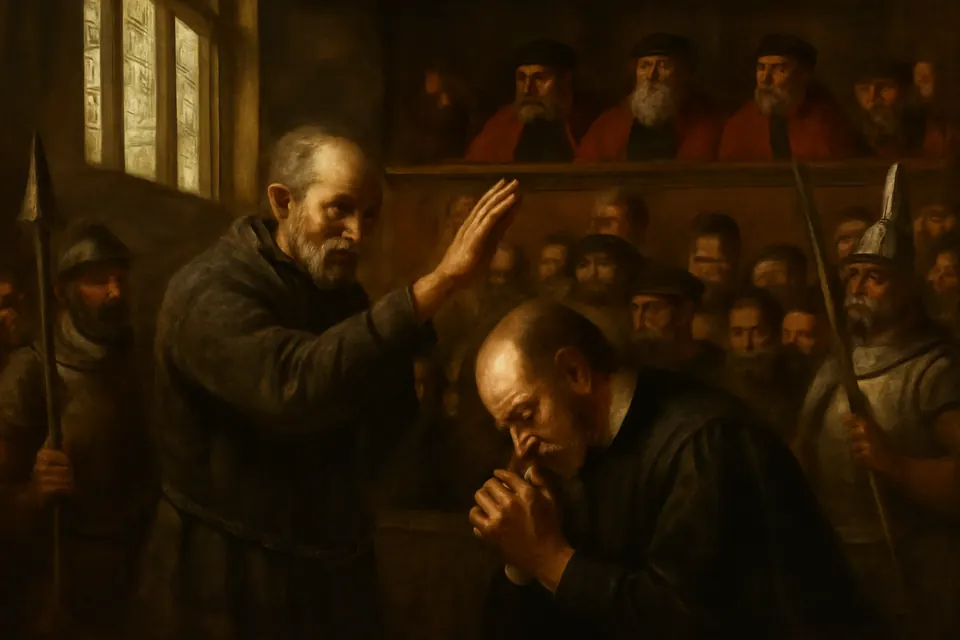
In July 1594 he was sent back to Durham for trial at the summer assizes. Standing in the dock with him was George Swalwell, a former Protestant minister who had become a Catholic and then, out of fear, recanted. John Boste spoke to him there in court, and Swalwell repented of his denial. The priest absolved him publicly, before the judges. Blessed George Swalwell, the Encyclopedia's "fellow-martyr," then died for the faith he had found again.
Martyrdom at Dryburn
On July 24, 1594, John Boste was taken to Dryburn, just outside Durham, to be hanged, drawn and quartered. He recited the Angelus as he climbed the ladder, the old prayer of the Incarnation that Catholic England had once rung from every church tower at morning, noon and night, now said aloud by a condemned man before a hostile crowd. The executioners treated him with special cruelty: he was cut down from the rope almost at once, so that he was still alive and conscious for what followed. We know these details because a younger priest, Christopher Robinson, stood in the crowd and wrote an account of the trial and death. Robinson himself was martyred at Carlisle not long afterward.
The Forty Martyrs
The Church remembered him for nearly four centuries. In 1970, Pope Paul VI canonized forty martyrs of England and Wales, priests and lay people, men and women, who died between 1535 and 1679. John Boste was among them, with St. Edmund Campion, St. Margaret Clitherow, St. Cuthbert Mayne and St. Henry Walpole. No miracles, approved or reported, are told of him in the old sources; as a martyr, none was needed for his canonization. What we have instead is the record of his courage, written down by a man who saw it.
Symbols of St. John Boste in art
There are few old images of St. John Boste. Modern paintings, banners and church windows of the English martyrs show him with the signs they share:
- The martyr's palm: victory through death.
- The priest's stole: the priesthood for which he died.
- The rope or halter: for the hanging at Dryburn, the usual sign of the martyrs executed at Tyburn, York and Durham.
- The rosary: for the Catholic devotion that was itself forbidden.
- A book: for the Oxford scholar and the Gospel he carried.
Because the Forty were canonized together, they are often painted together: rows of priests in vestments or plain clothes, lay men and women in Tudor and Stuart dress, a Carthusian monk or two, each with a palm. St. John Boste is rarely named in such groups by anything but a label, so look for a priest with a northern setting: the cathedral of Durham on its hill, or the moors of his native Westmorland.
Feast day and prayer
We keep his feast on July 24. The Catholics of the Diocese of Hexham and Newcastle hold him in particular affection, and several parishes and schools in the North East bear his name. See the feast day calendar.
We know of no traditional prayer to St. John Boste alone. The Church in England prays for the intercession of all its martyrs together in the Mass of the English Martyrs on May 4. In the words of the Angelus, which he prayed on the ladder, let us ask him to pray for us: for priests who serve in hard places, for those who have denied their faith out of fear and long to come back, and for the Church in the North of England.
Frequently asked questions
Who was St. John Boste?
An English priest born at Dufton in Westmorland about 1544. A fellow of Queen's College, Oxford, he became a Catholic in 1576, was ordained at Reims in 1581, and worked secretly in the North of England until he was captured in 1593 and martyred at Durham the next year.
When is the feast of St. John Boste?
July 24, the day of his martyrdom in 1594. He is also honored with the Martyrs of England and Wales.
Where was St. John Boste martyred?
At Dryburn, just outside the city of Durham, on July 24, 1594.
When was John Boste canonized?
Pope Paul VI canonized him on October 25, 1970, as one of the Forty Martyrs of England and Wales.
Keep exploring
Sources
- Catholic Encyclopedia (1907): St. John Boste. Dufton, Queen's College, his reception at Brome in 1576, ordination at Reims on March 4, 1581, the landing at Hartlepool, the betrayal at Waterhouses on July 5, 1593, the Tower, George Swalwell, the Angelus on the ladder, and Christopher Robinson's eyewitness account
- Pope Paul VI, Homily for the canonization of forty martyrs from England and Wales, October 25, 1970 (vatican.va)